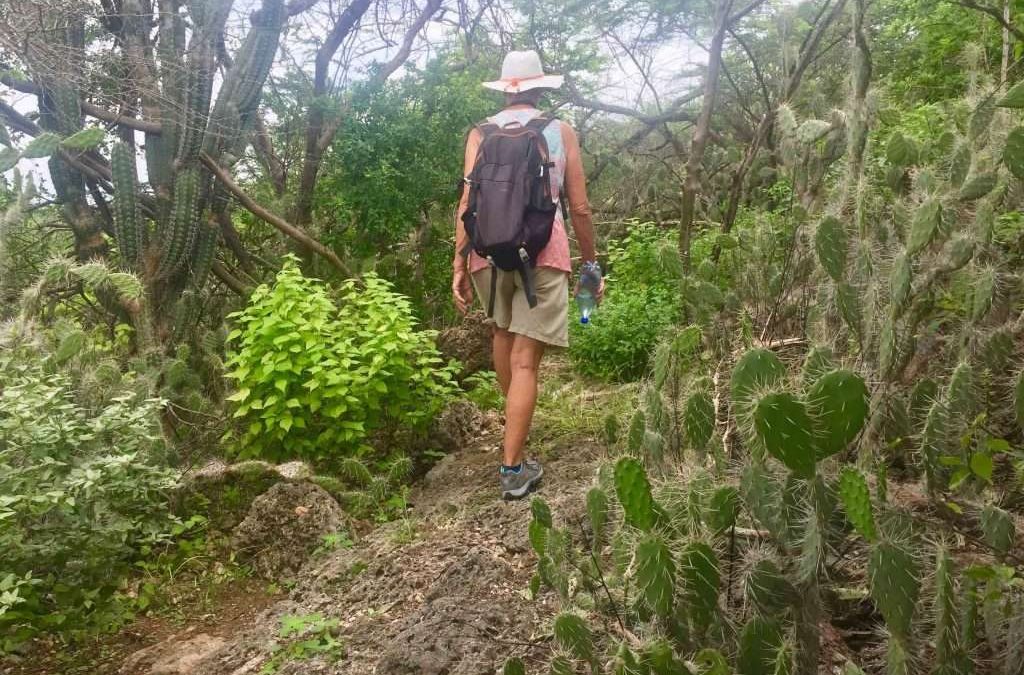
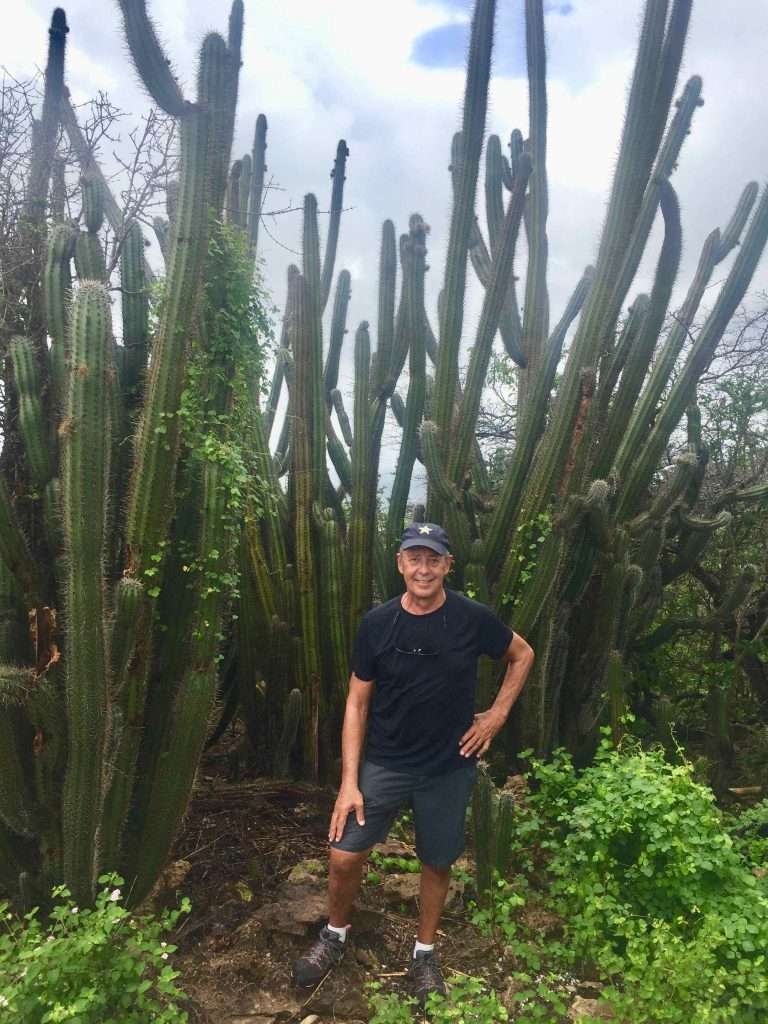
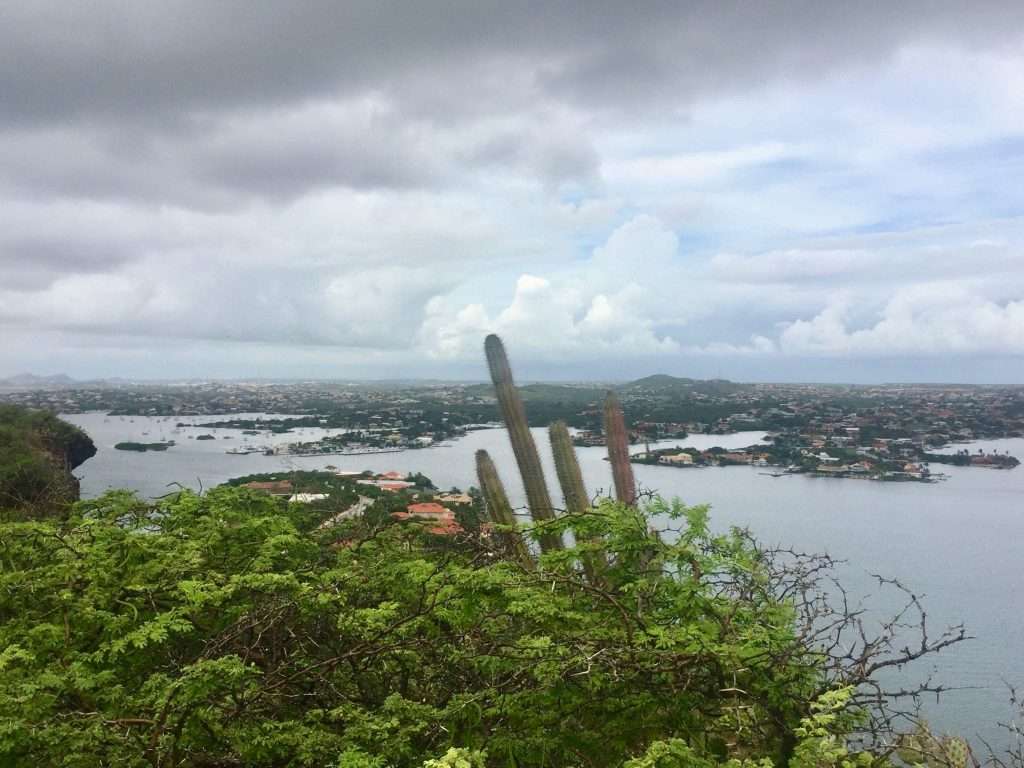
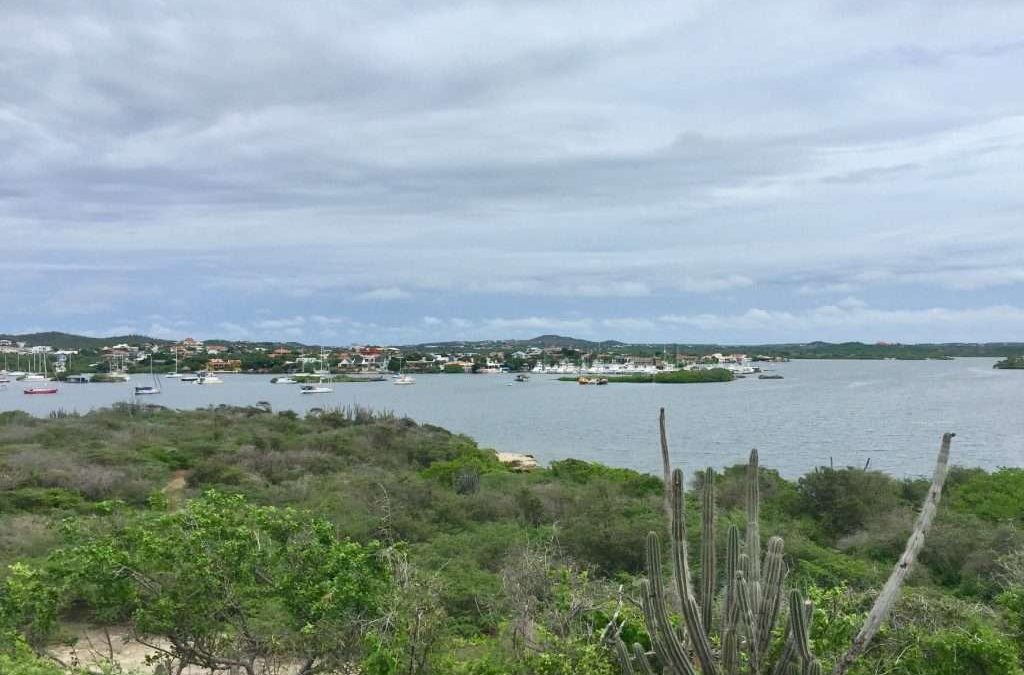
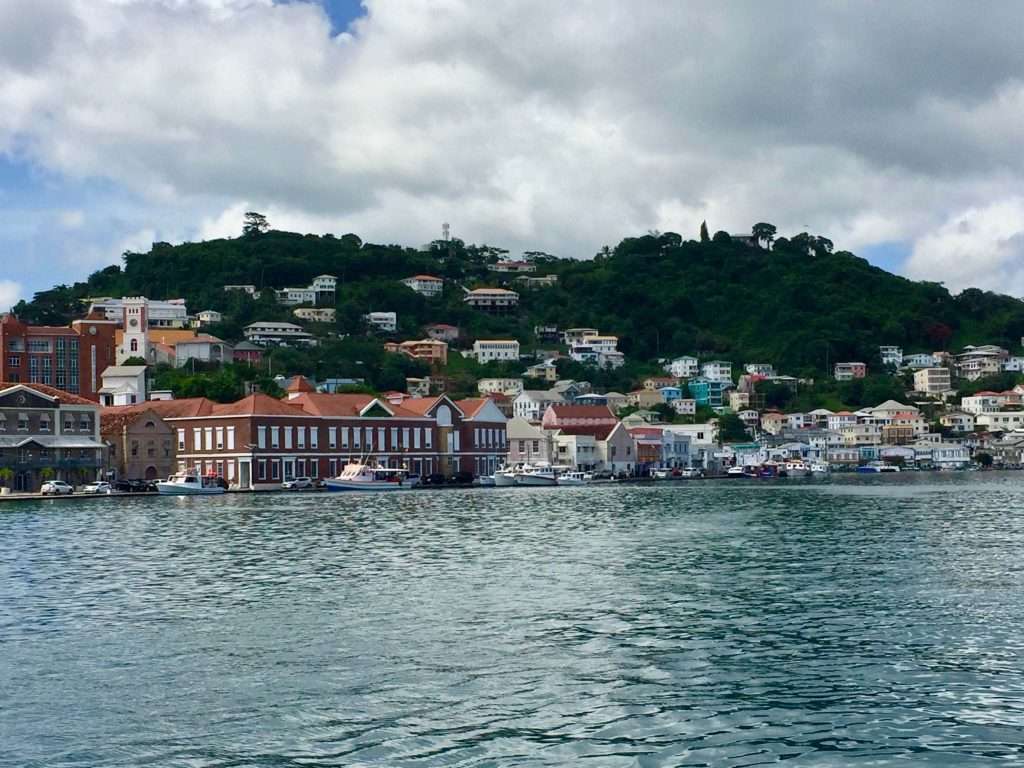
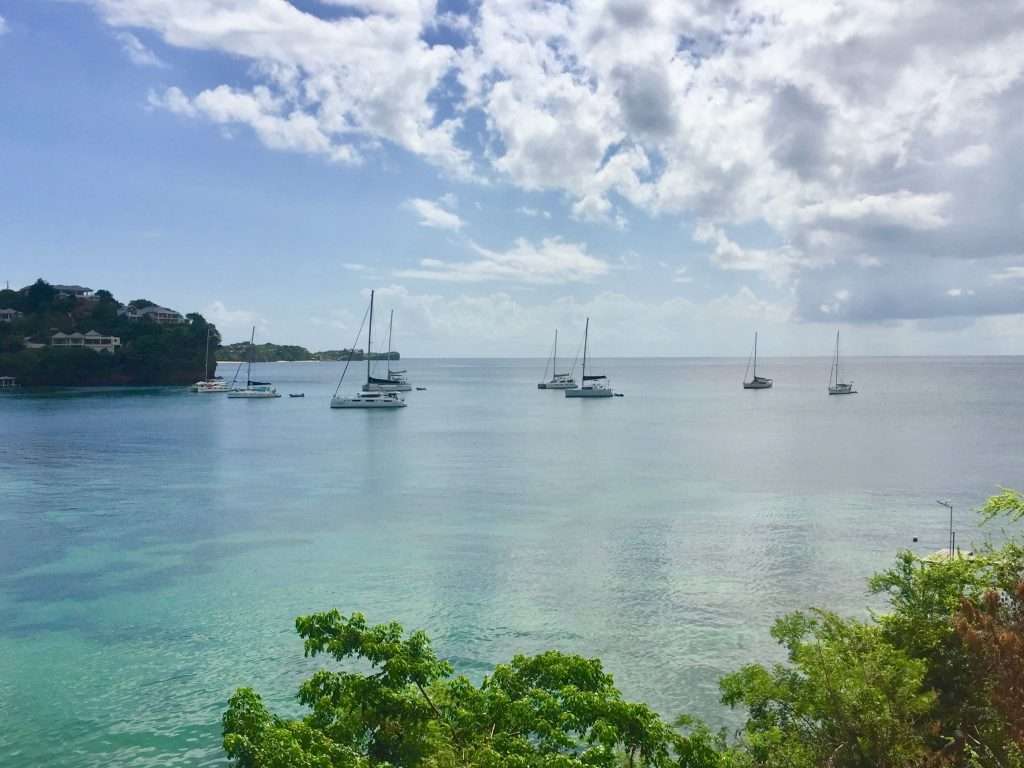
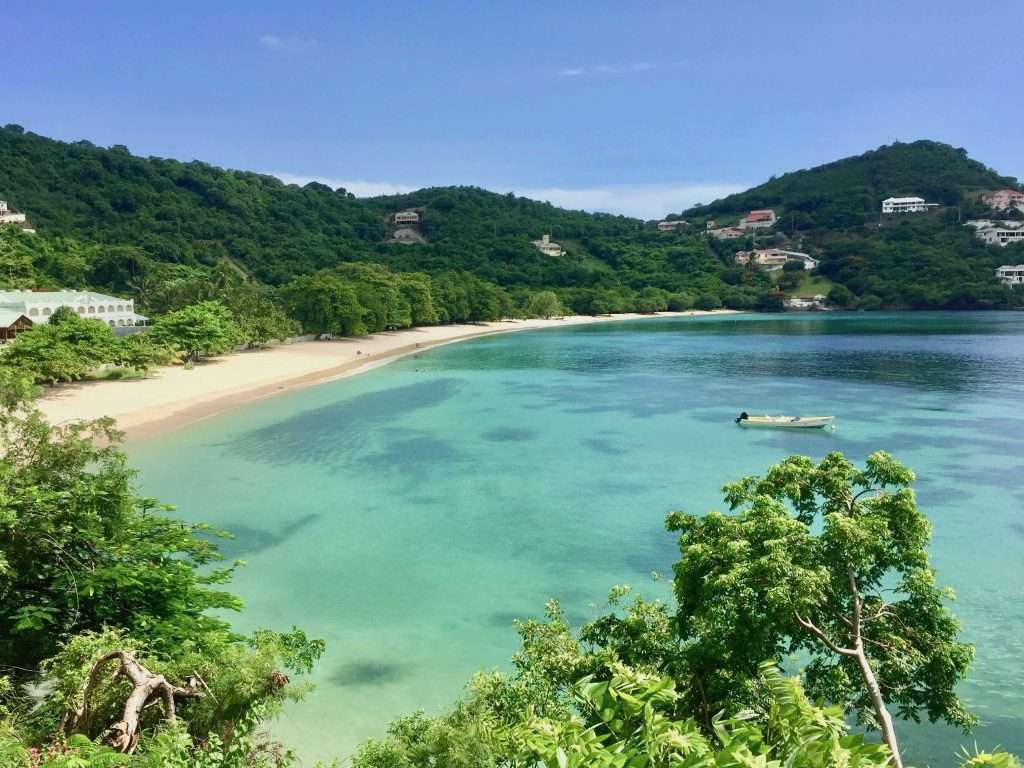
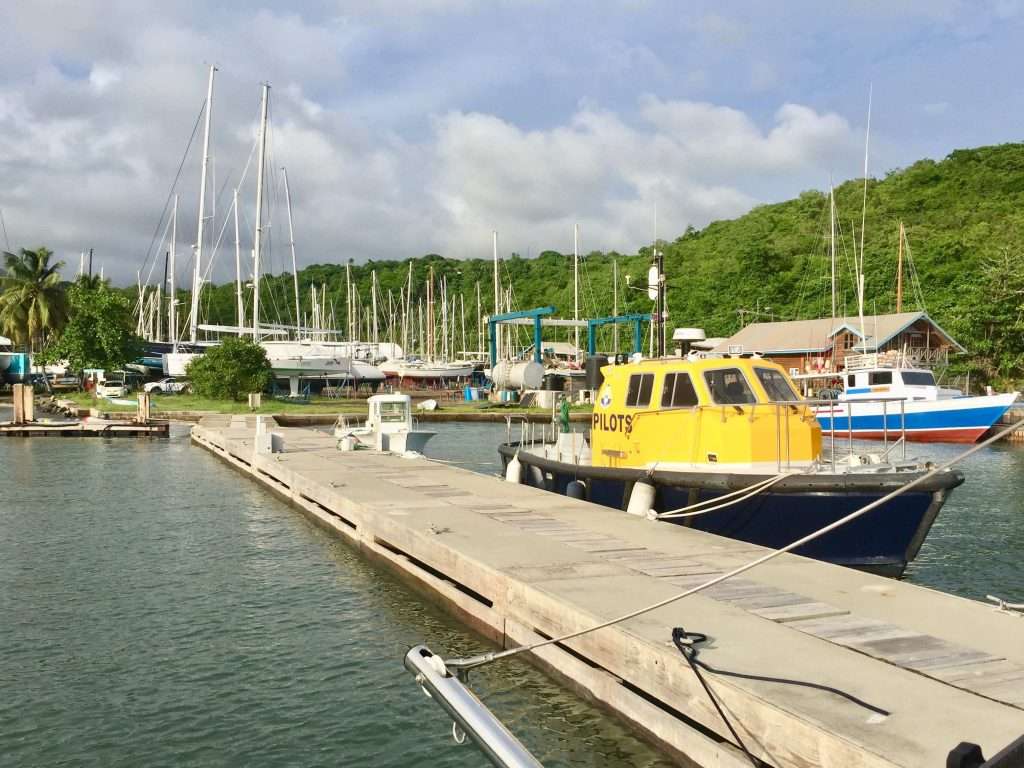
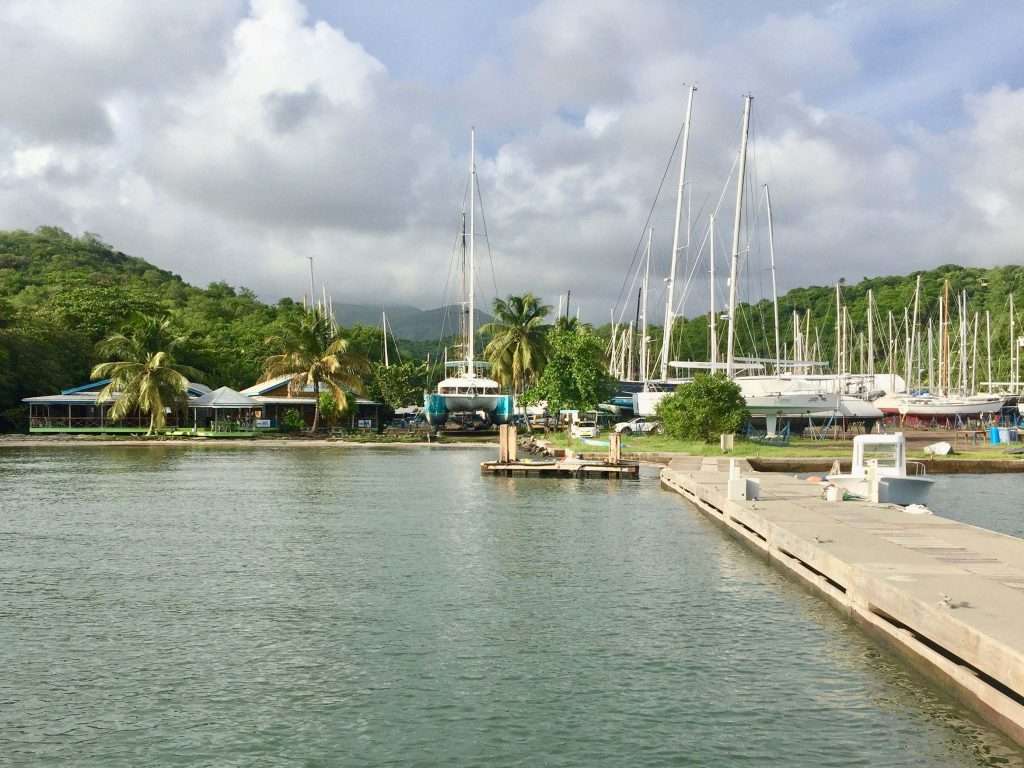
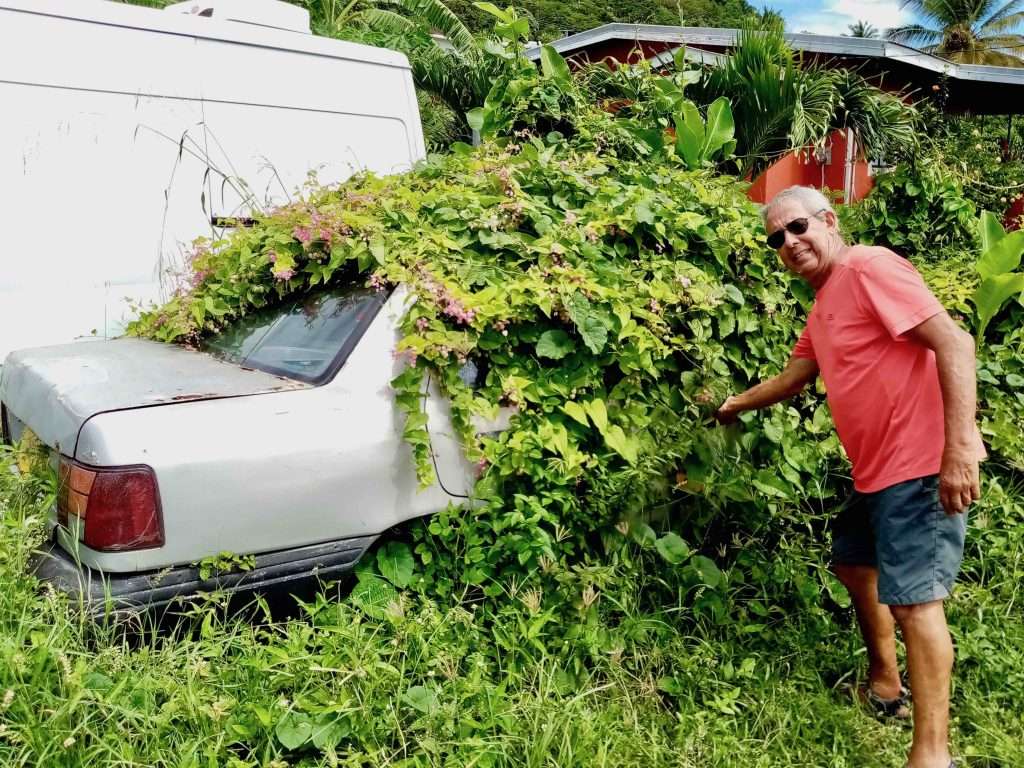
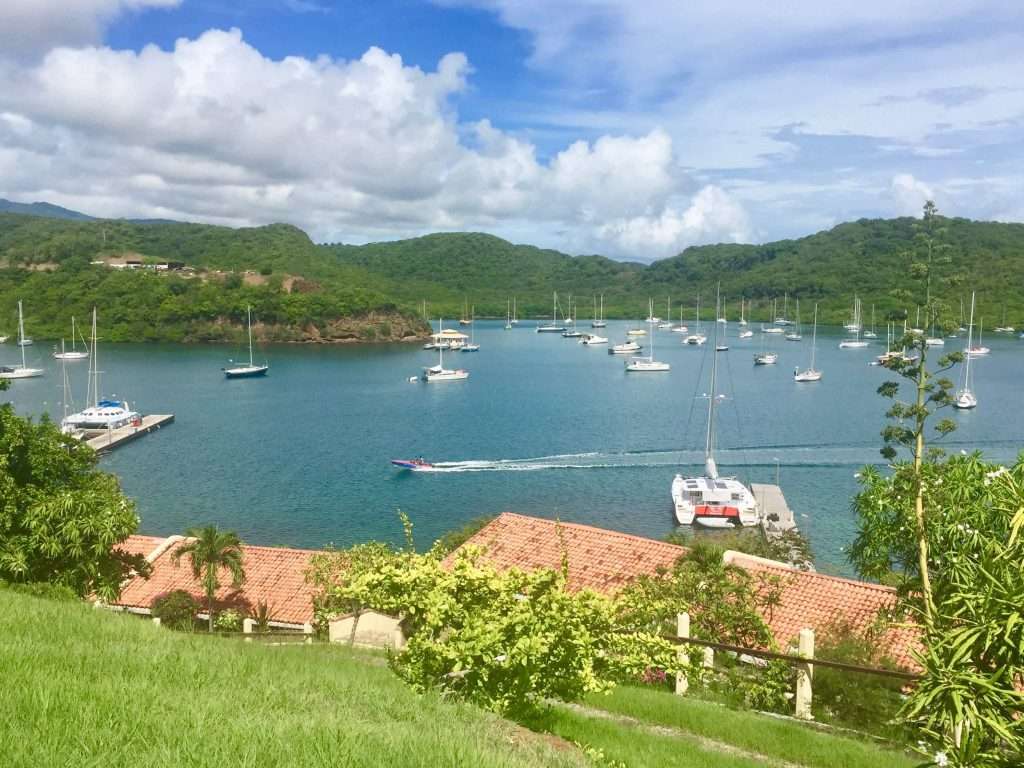
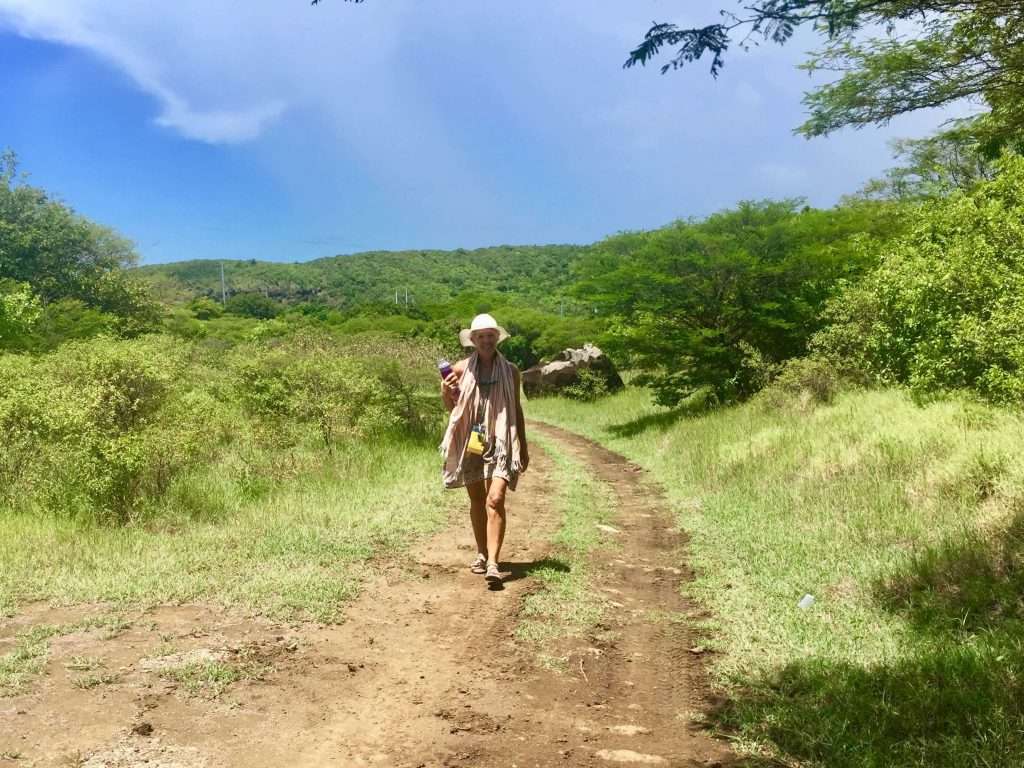
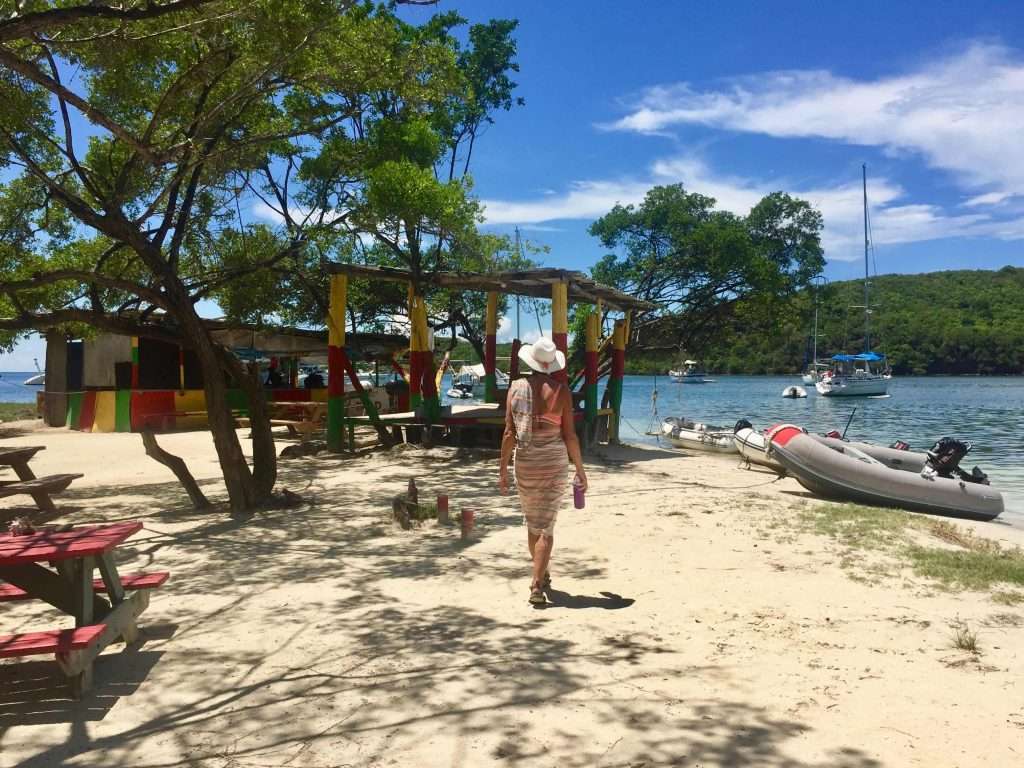
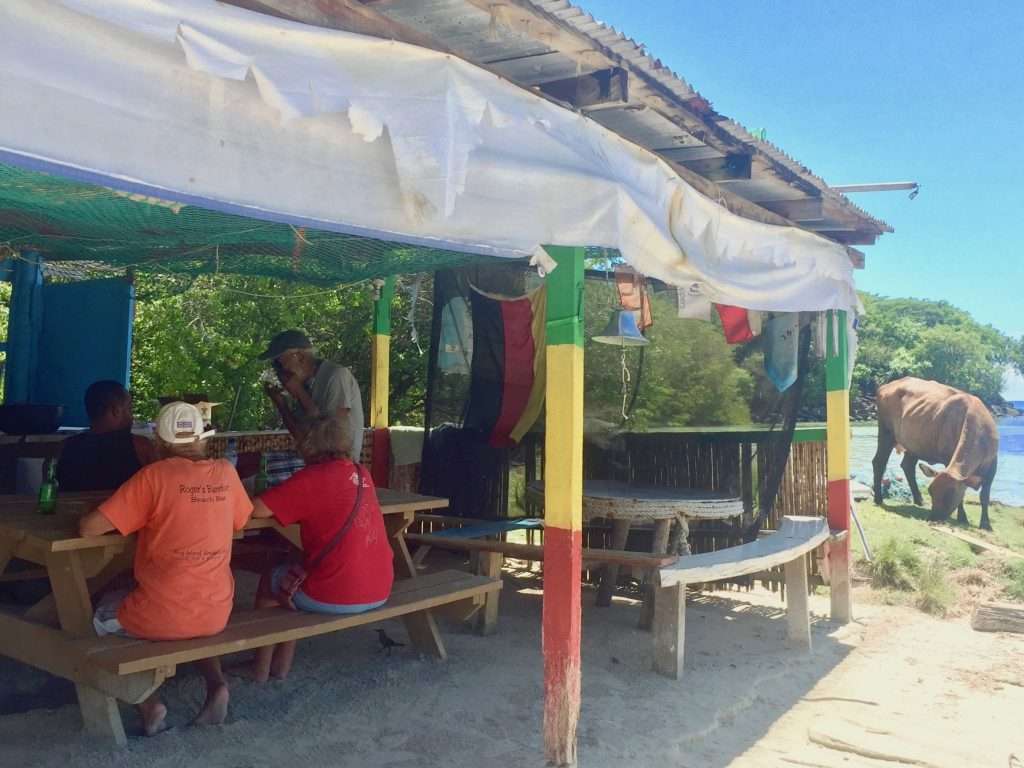
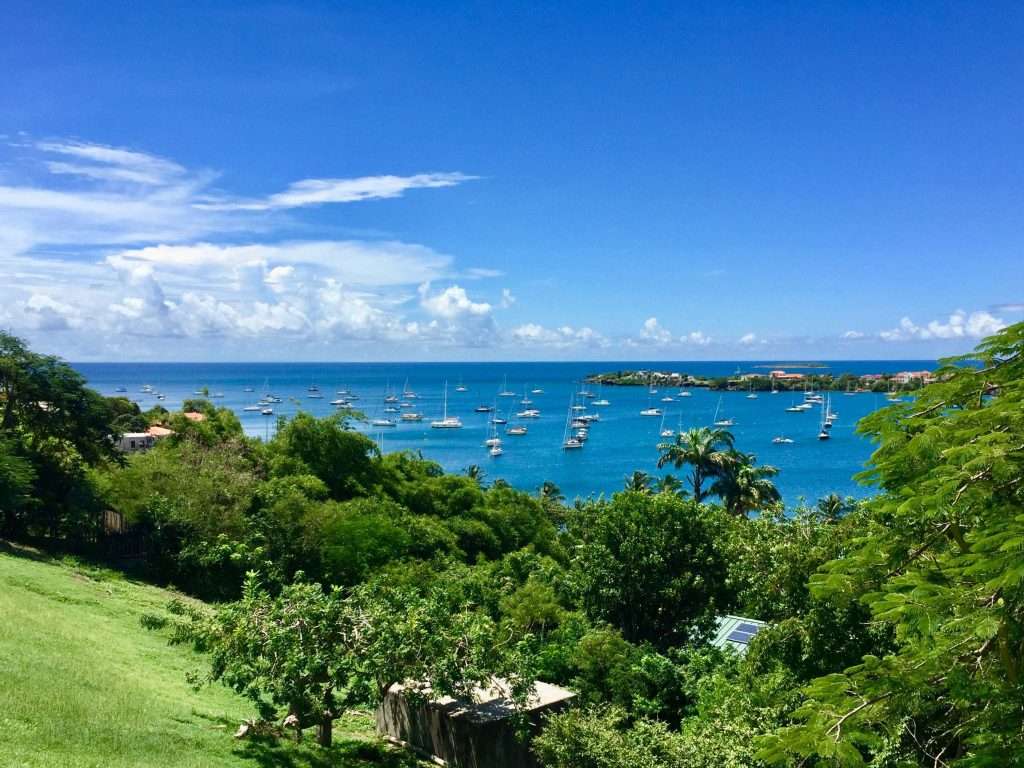
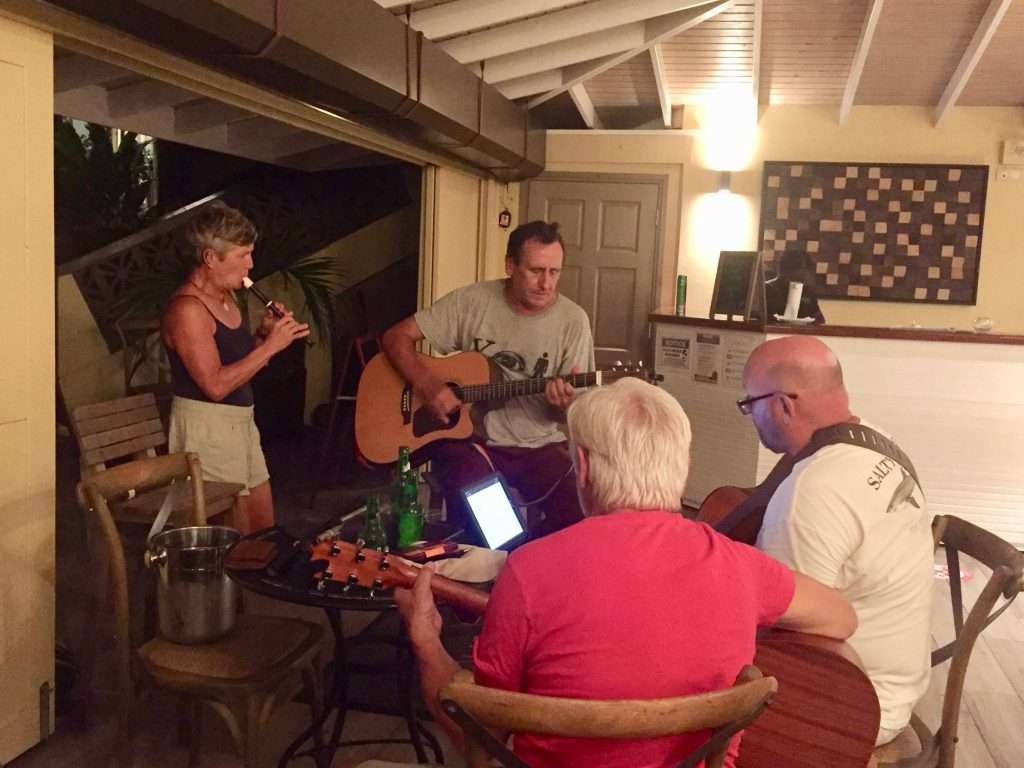
Whilst waiting for confirmation of the 1st December border opening of Colombia, we did our laundry and did two long hikes: The “Meditation” hike above Santa Barbara resort, which clearly hadn’t been walked by anyone for years. I should have taken a machete to fight through the prolific cacti and “Hook and spear” thorn trees. (Haak en steek dorings)
Annie forging ahead on the Meditation hike
Cacti flourish here.
As if the scratches on our legs were not enough, a solid rain downpour hit us just before we reached the lookout, drenching us completely. During my meditation afterwards, I tried to answer the questions “Why did we tackle this hike?” and “Where did you put the Betadine antiseptic and Voltaren meds?”
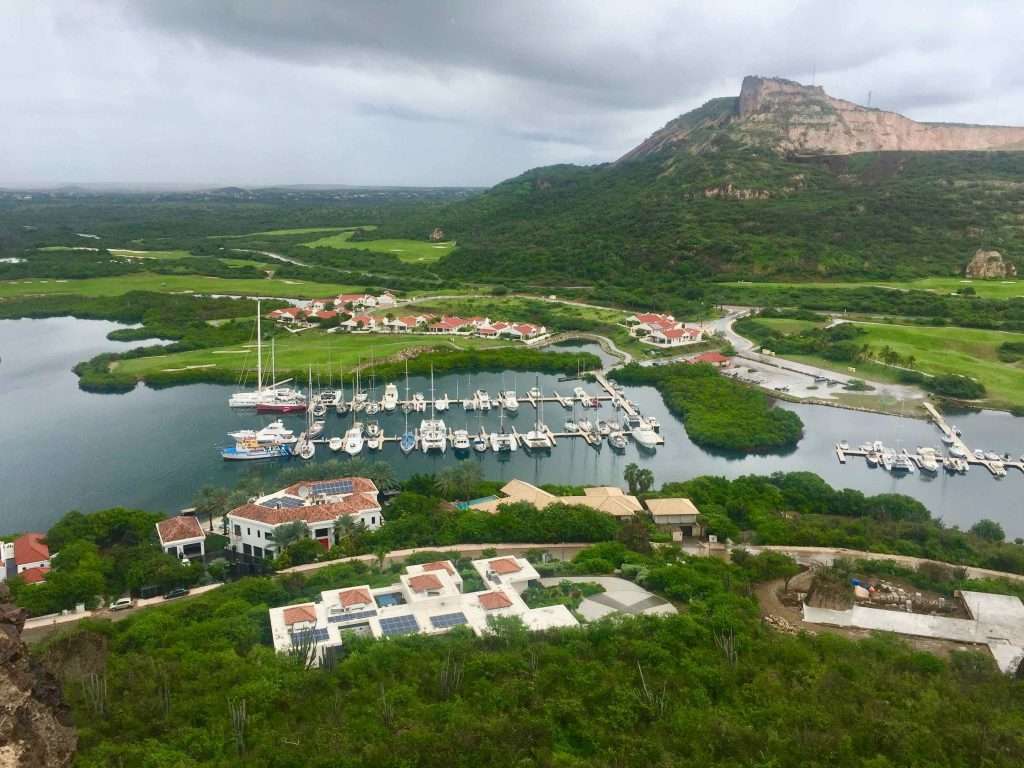
Looking down to Seru Boca marina.
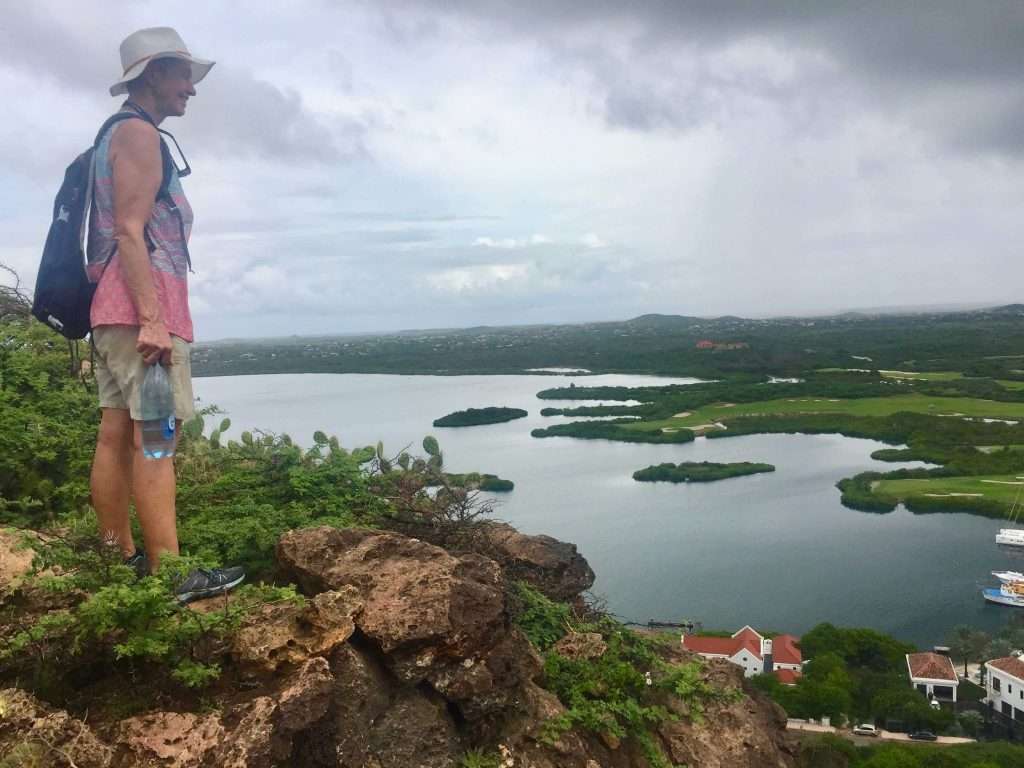
Annie at the lookout.
View across Spanish Water.
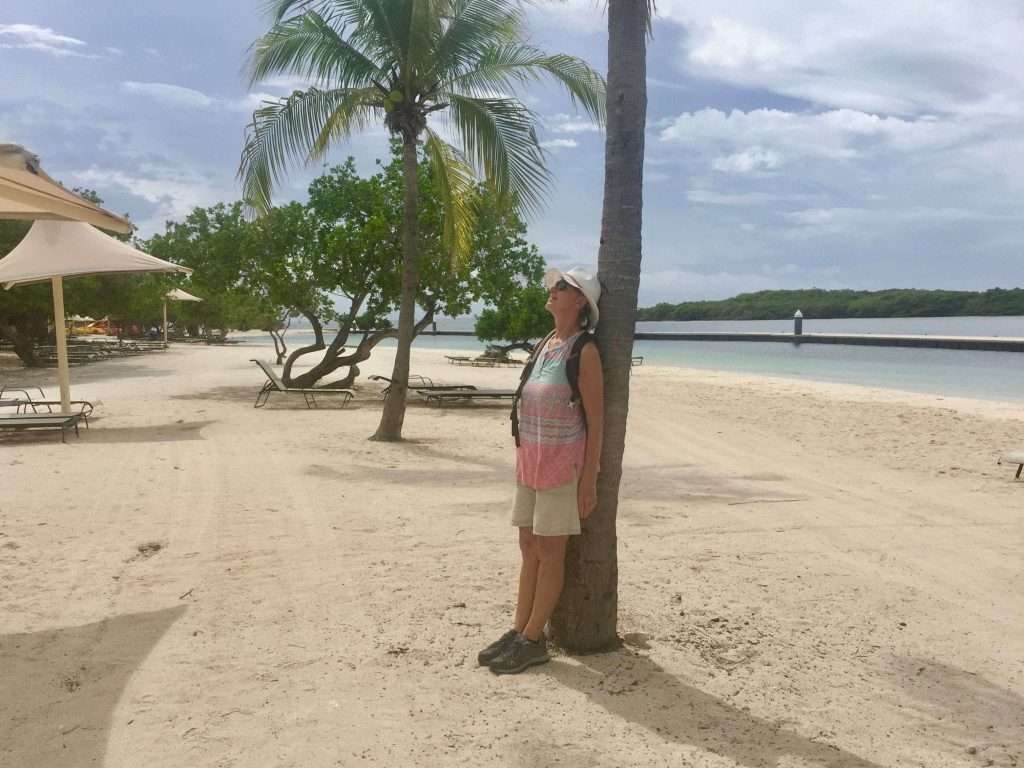
Annie catching her breath back at Santa Barbara beach.
The next hike was the Jan Thiel lagoon walk (aka “The roller coaster hike”) on Sunday the 29th Nov. After the previous day’s rain, this was a slippery mud-bath and begged the same question as above. After a swim, some Voltaren anti-inflammatories and a stiff whisky, we went to bed early.
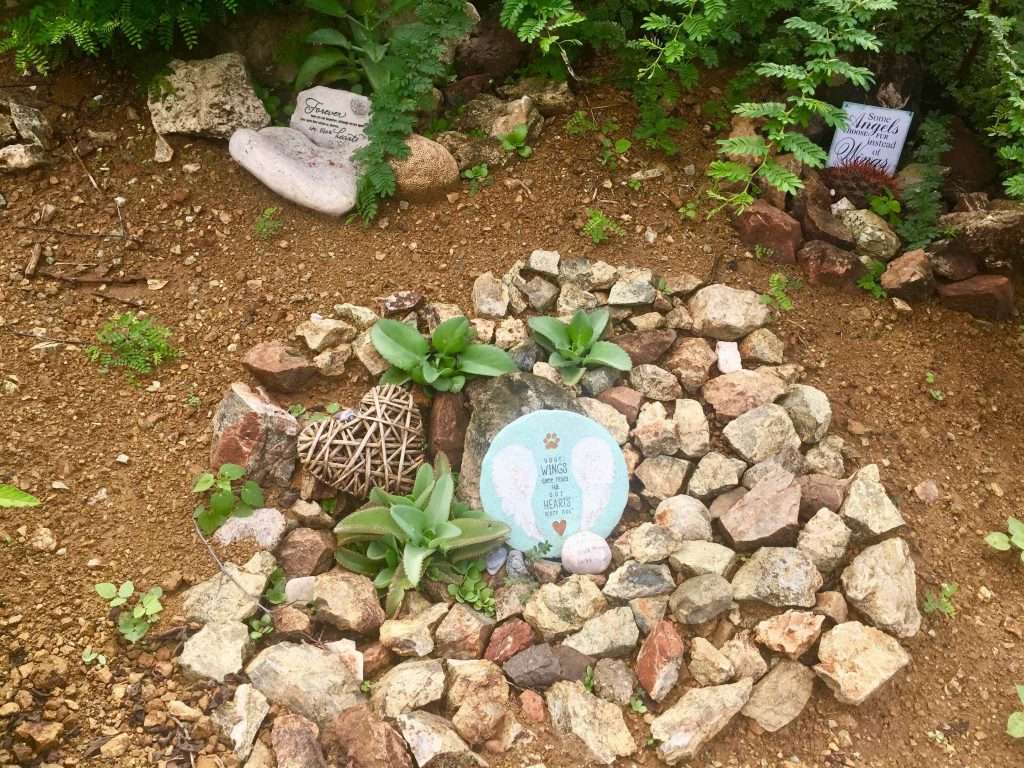
The only worthwhile photo on this walk – an animal cemetery in the bush.
There was the good news by email just before bedtime that Colombia will open it’s harbours on the 1st December – details about Covid-19 protocols to follow. Confirmation came through on the 1st: No prior testing or testing on arrival required after a doctor has checked us out. We took the bus into town and did the 6.4 km circuit checking out with Customs and Immigration on the 2nd December. In the evening we had farewell drinks on Wild Thing.
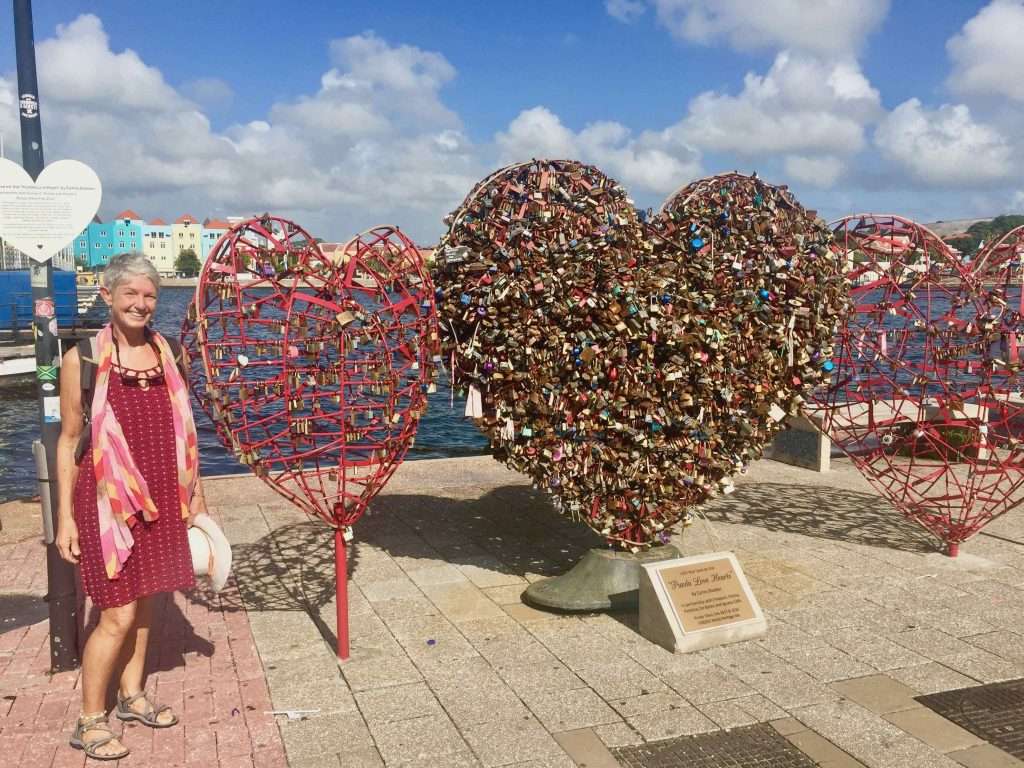
Last look at Punda in Willemstad – new hearts for more locks.
Christmas tree decorations complete.
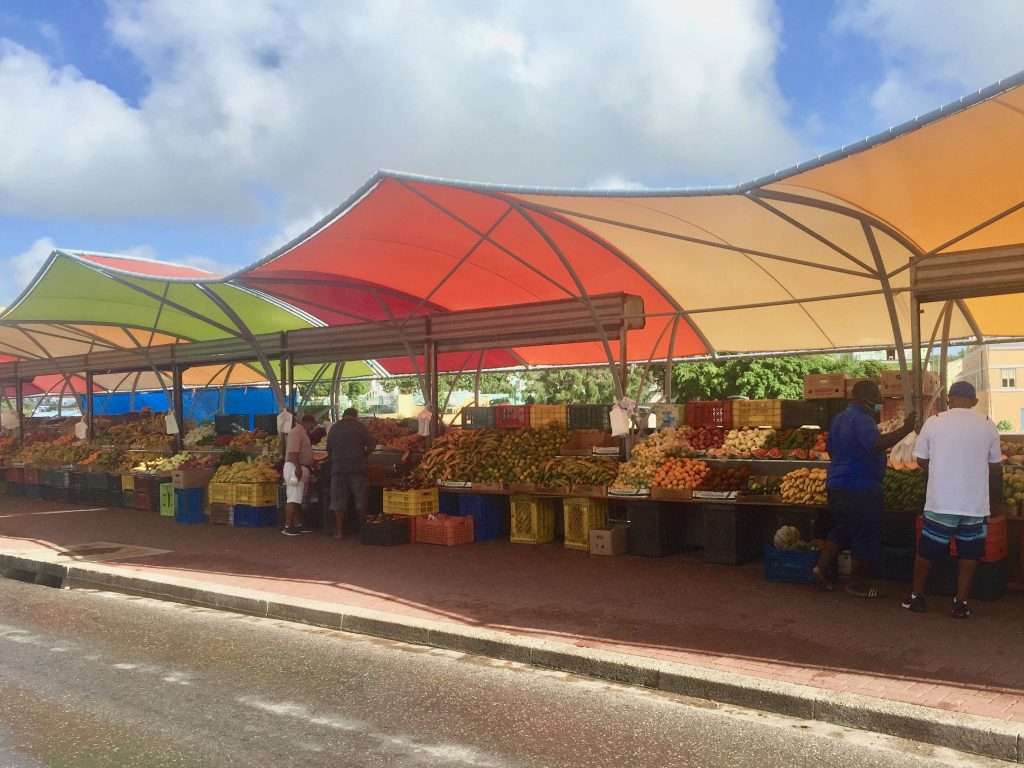
The fresh fruit and veg market.
The following day, we had a relaxed broad reach up the West coast of Curacao and anchored off beautiful Santa Cruz bay, the most northerly anchorage on the island. The reason for setting of from here, is to pass Aruba to the North and avoid the 15 km wide passage to Venezuela to the South – the danger of piracy from Venezuela is a reality.
Passing Willemstad on our way up the west coast.
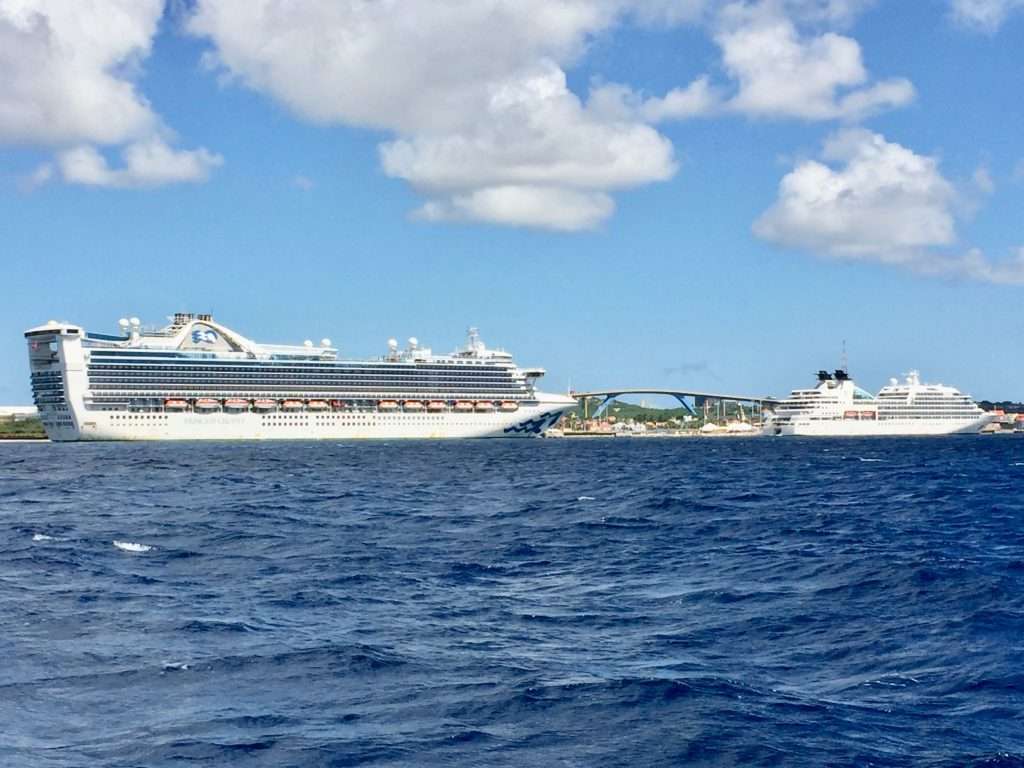
More cruise liners in mothballs – the Kiwi’s say “Beached as”
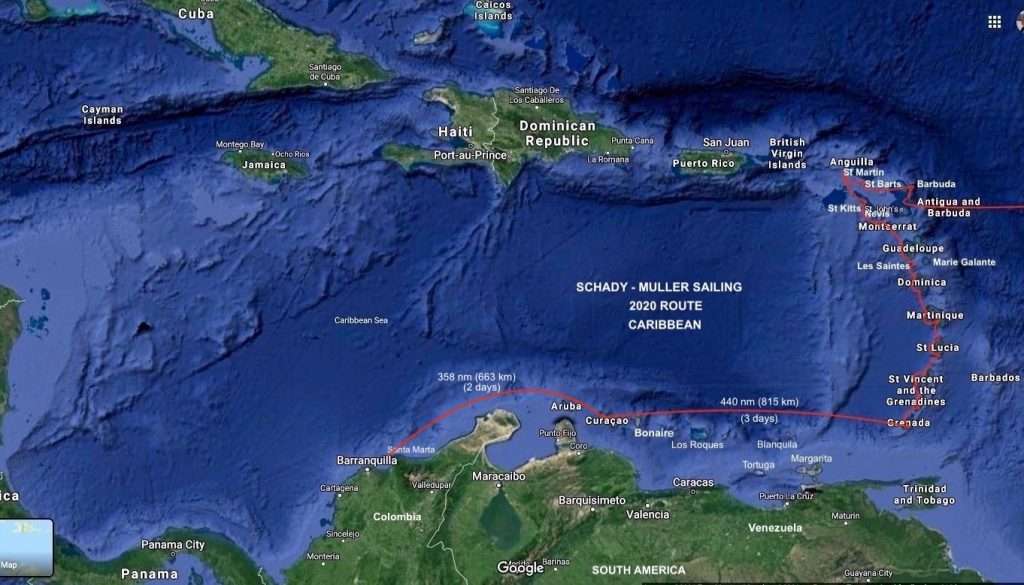
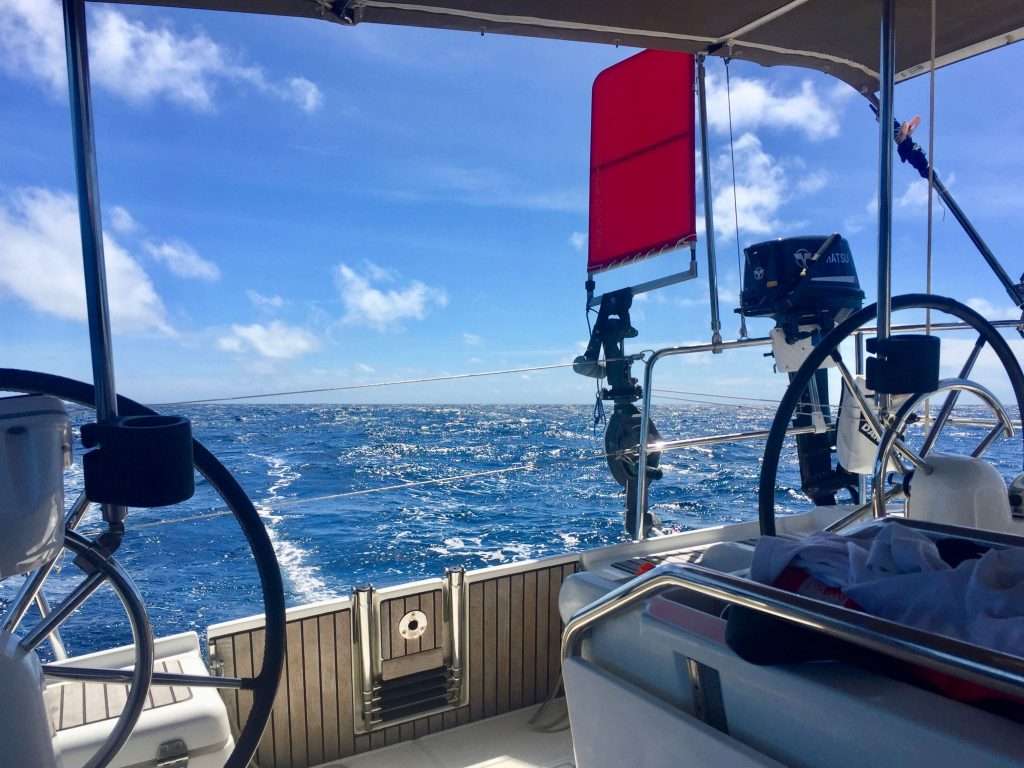
On the 4th December, we set off at 6:30 am for the 358 nm crossing to Santa Marta in Colombia. After 2 hours of motor sailing to get out of the lee of the island, we set the jib out on the pole, with one reef in the main to goose wing downwind. We fine tuned Harry the Hydrovane in 28 knots of north-easterly wind and Harry steered us all the way to Santa Marta over the next 46 hours.
Route Caribbean. (Click on map to enlarge)
At 2pm we passed Northwest Point in Aruba, 8 nm offshore. At 4:30 pm we gybed the sails at 13.15 deg north on the 1,000 metre depth contour, to start our course south. During the night, the notorious easterly and confused swells started to rise, but we were bowling along nicely to cover 176 nm at 6:30am to average 7.3 knots over 24 hours. At 10:00 am we passed Cabo de Vela in Colombia, 20 nm offshore.
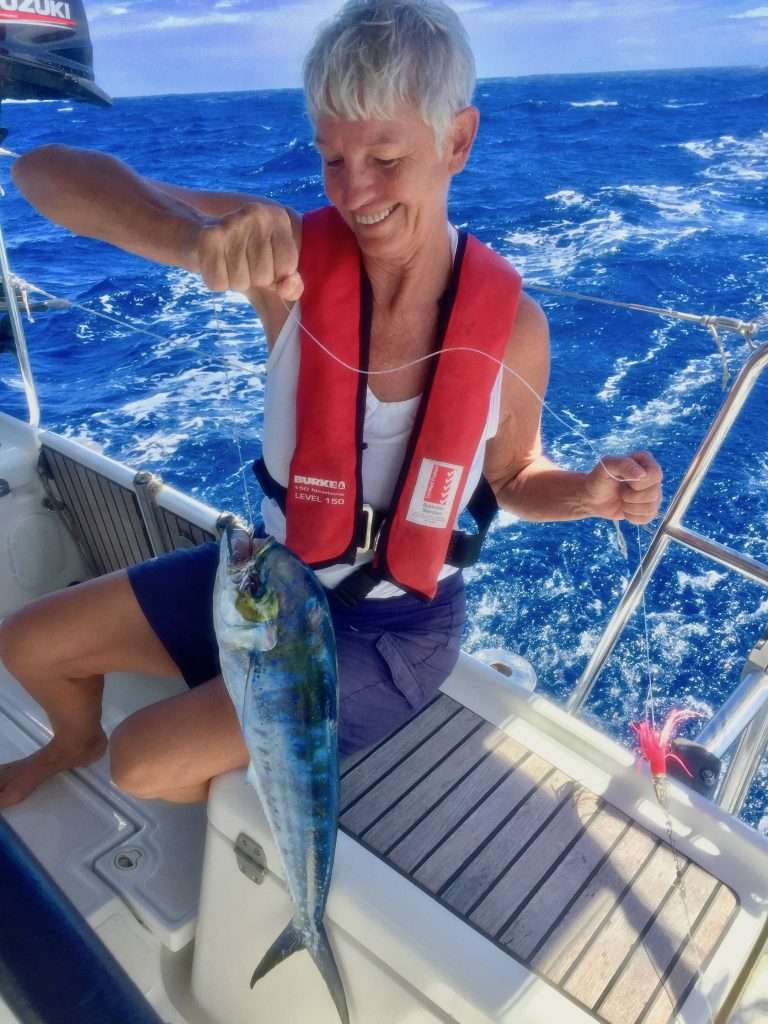
Annie catches another Mahi-Mahi.
Sunday the 5th December was a real relaxed Sunday sail as the waves got smaller, once we were in the lee of Cabo de Vela. As we were approaching Santa Marta, we furled the jib and tucked a second reef in the main in an effort to slow down in the strong 35 knot easterly. We had planned to reach Santa Marta by midday, but now it was still dark and we were not ready to make our landfall.
We managed to drop the sail outside Marina Santa Marta at 6:30 am, as the sun was rising. Esprit had sailed 182 nm over 24 hours to average 7.6 knots. The 358 nm passage she covered in 48 hours at 7.46 knots. Esprit was performing as well as we could wish for.
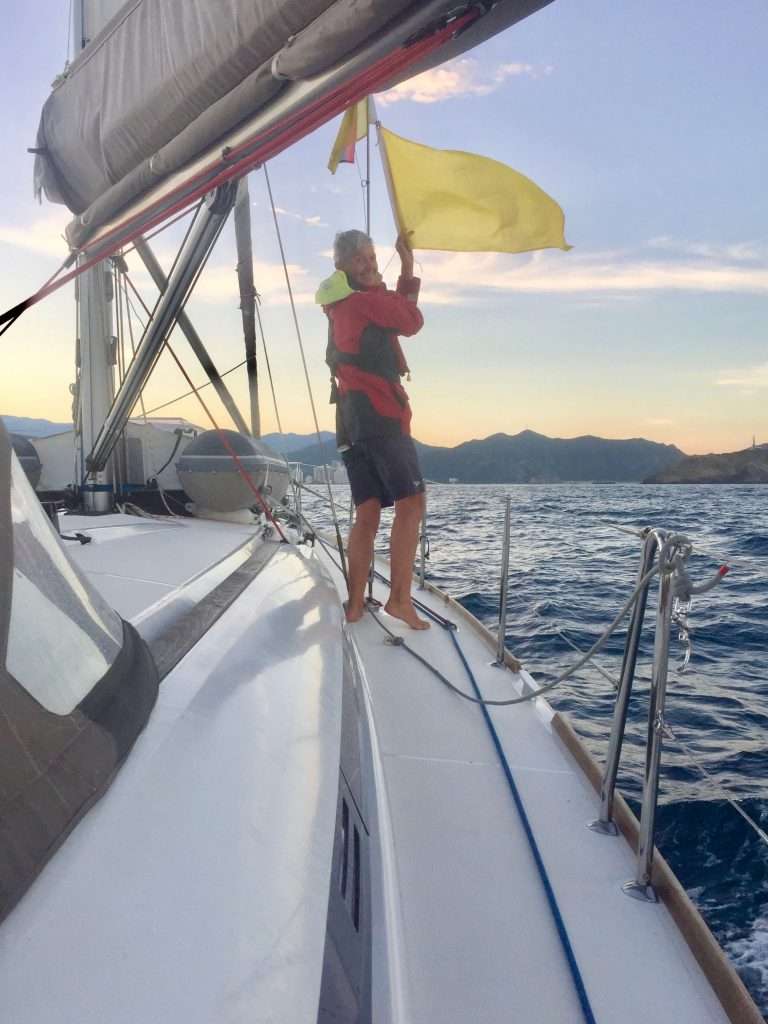
Hoisting the Colombian and quarantine flags.
The marina staff did not come on duty until 8:00 am, so we drifted in the harbour, brewing coffee and having breakfast. The staff were very welcoming and efficient, tying us up at our berth. Being Sunday, the government agencies weren’t working, so we went for showers and slept most of the afternoon. By 5:00 pm we were woken by the many pleasure craft returning to the marina, their sound systems blasting fantastic Spanish music. This was a welcome change from the Afro beat prevalent in the Caribbean.
Washing off the salt.
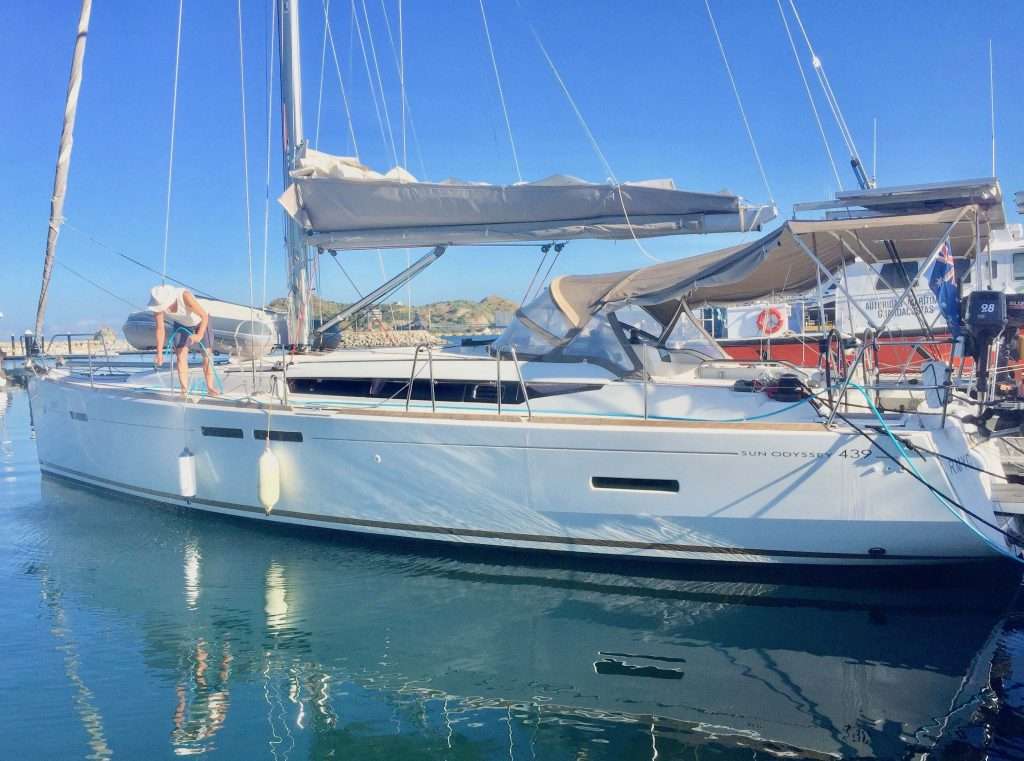
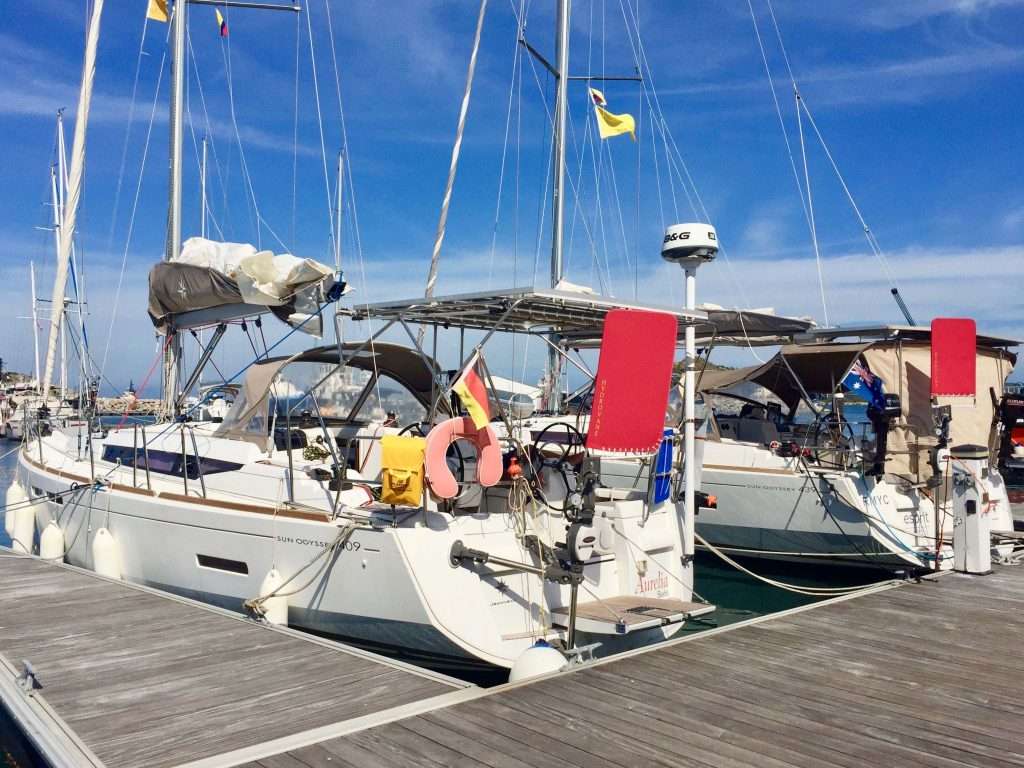
Jeanneau’s at Santa Marta marina
It is now Monday morning and Jorg Domann from Berlin has just berthed next to us in a Jeanneau 409 sister yacht. Sailing single handed and restricted from poling out, he covered the distance in 3 days, which is good for single handing. He has gone to sleep now, whilst we are waiting on a doctor to come and check us up around midday for Covid clearance. It has also given me the opportunity to write this post while waiting. We will report in due course on Santa Marta and Cartagena in Colombia. Until then, cheers and stay safe.
We arrived in Curacao during the rainy season, with the result that the rain came bucketing down for days on end, which was good for filling our water tanks, but not so good for exercise. Whenever there was a break in the rain, we bolted out on walks into the country, or to the supermarket.
Going bush – Spanish Water, on our way to the ocean beaches.
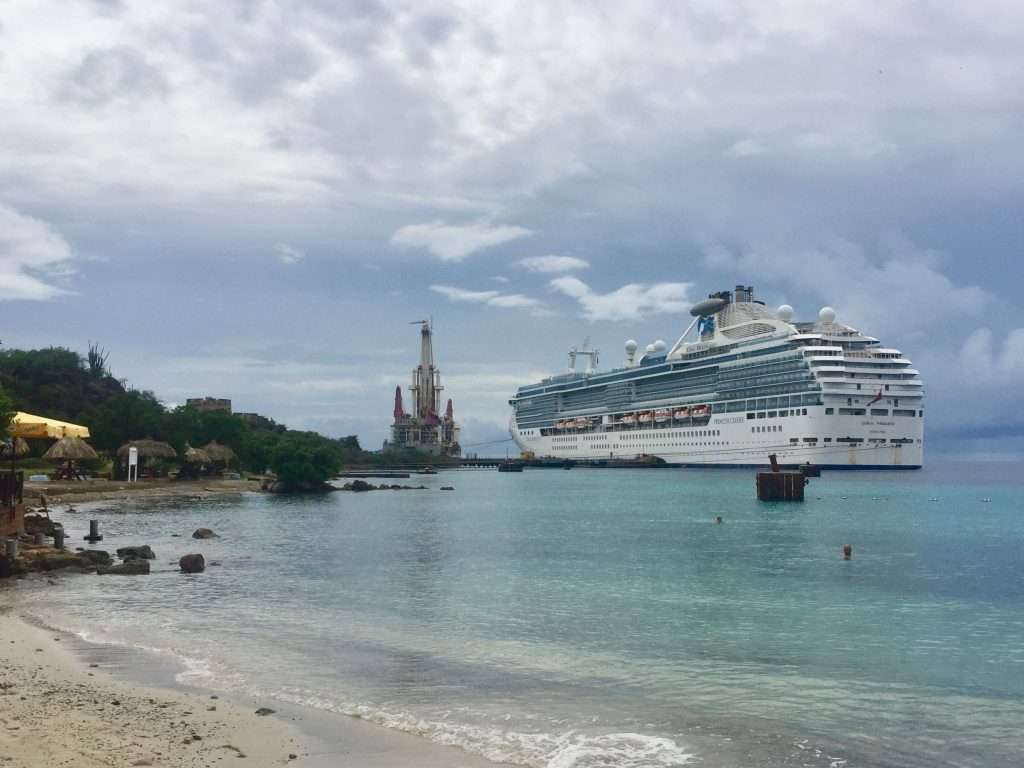
Caracas Bay on the ocean side – a cruise liner and an oil rig laid up due to Covid.
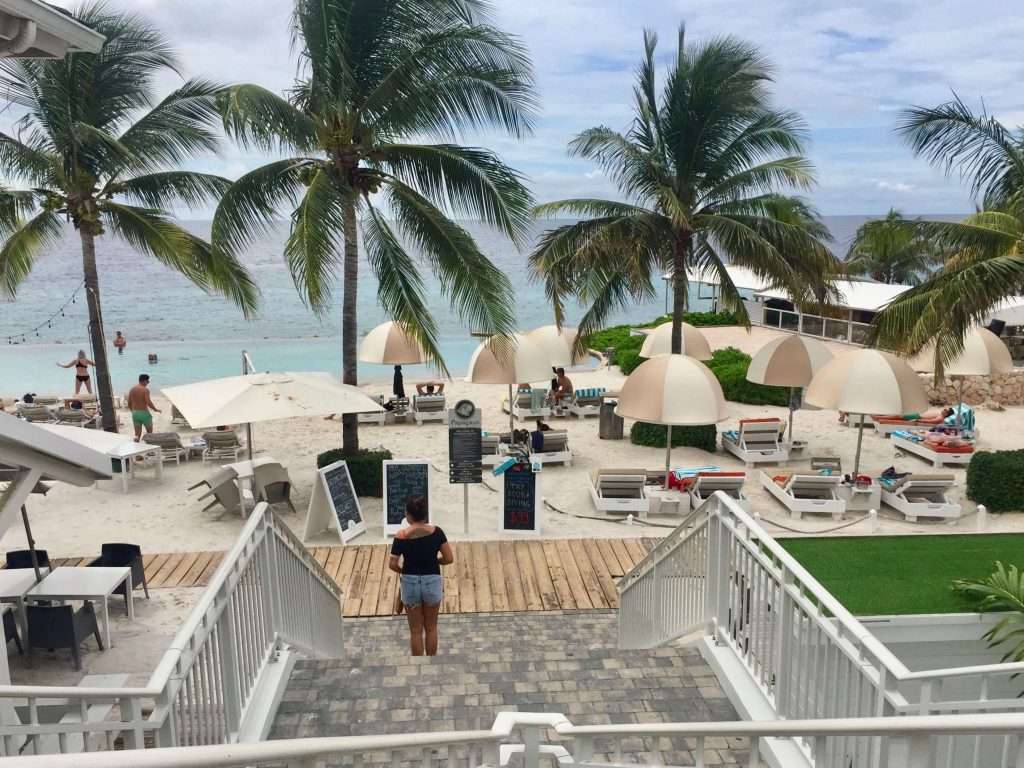
Papagayo Beach with mostly Dutch tourists.
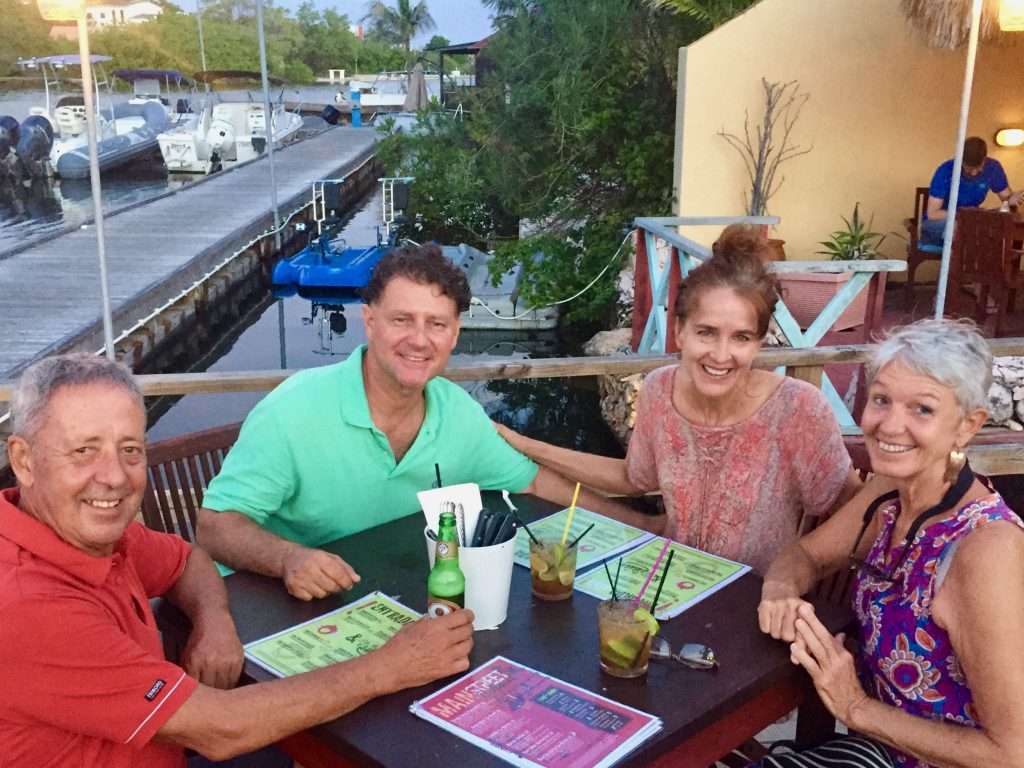
In between, we did work on the boat or had other cruisers over for drinks. Ed and Natalie from Montreal in Canada took us along in their car to do shopping, so we reciprocated with a dinner at Taboosh, a restaurant on the Spanish Water with local cuisine.
Dirk, Ed, Natalie & Annie at Taboosh.
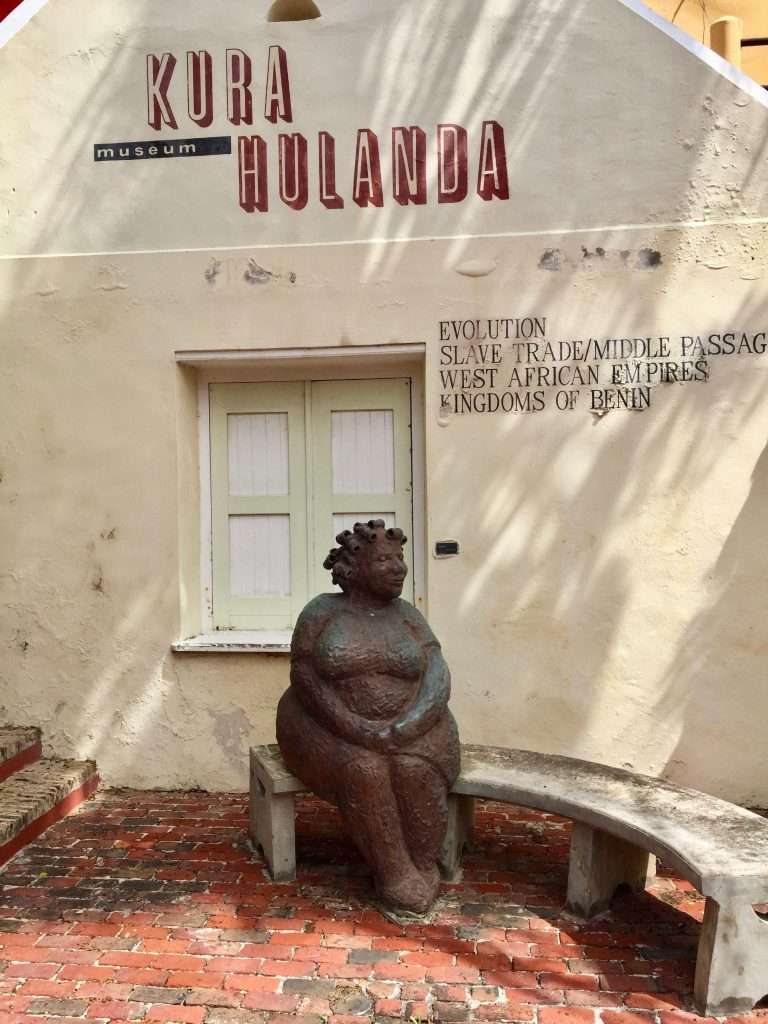
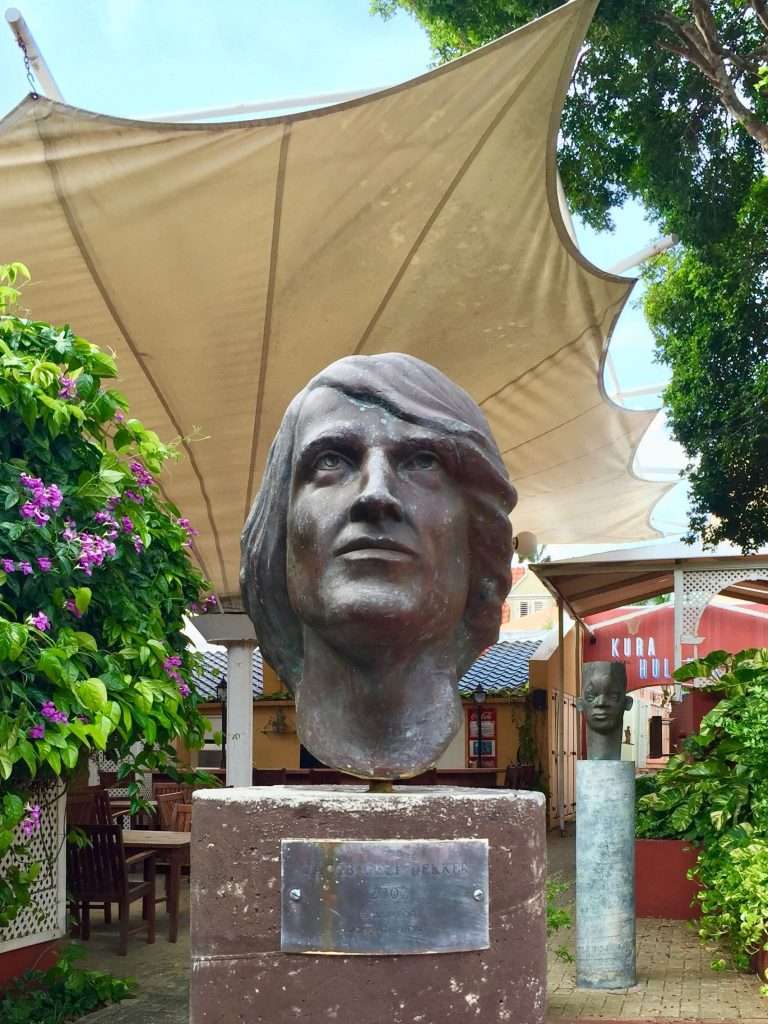
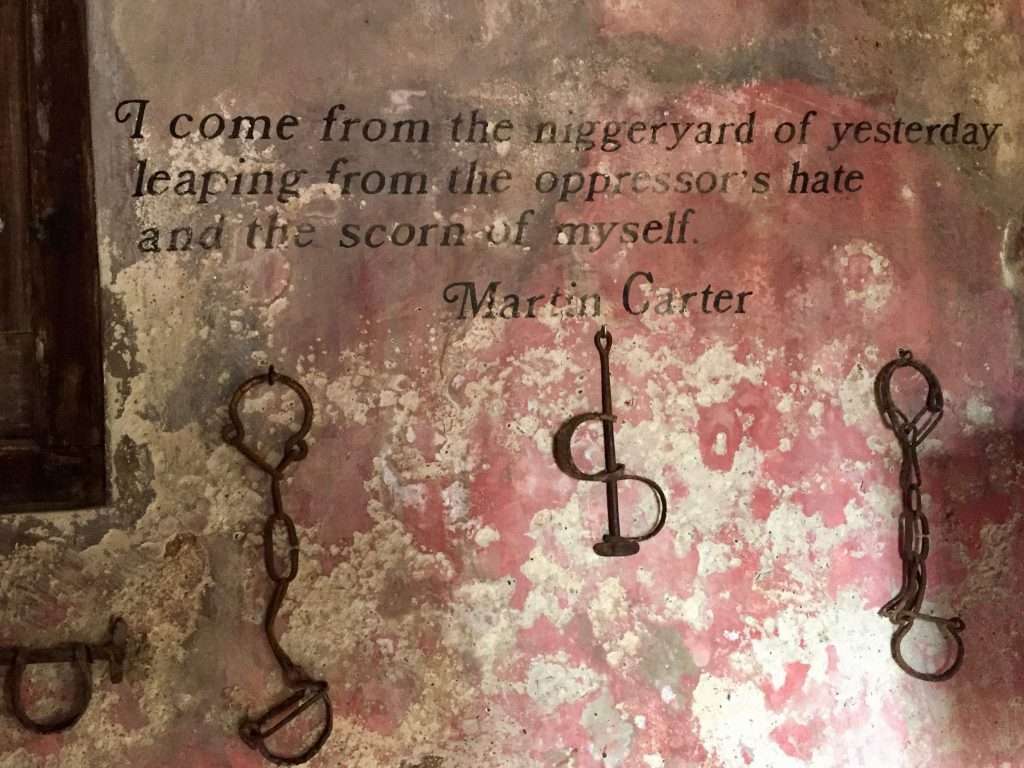
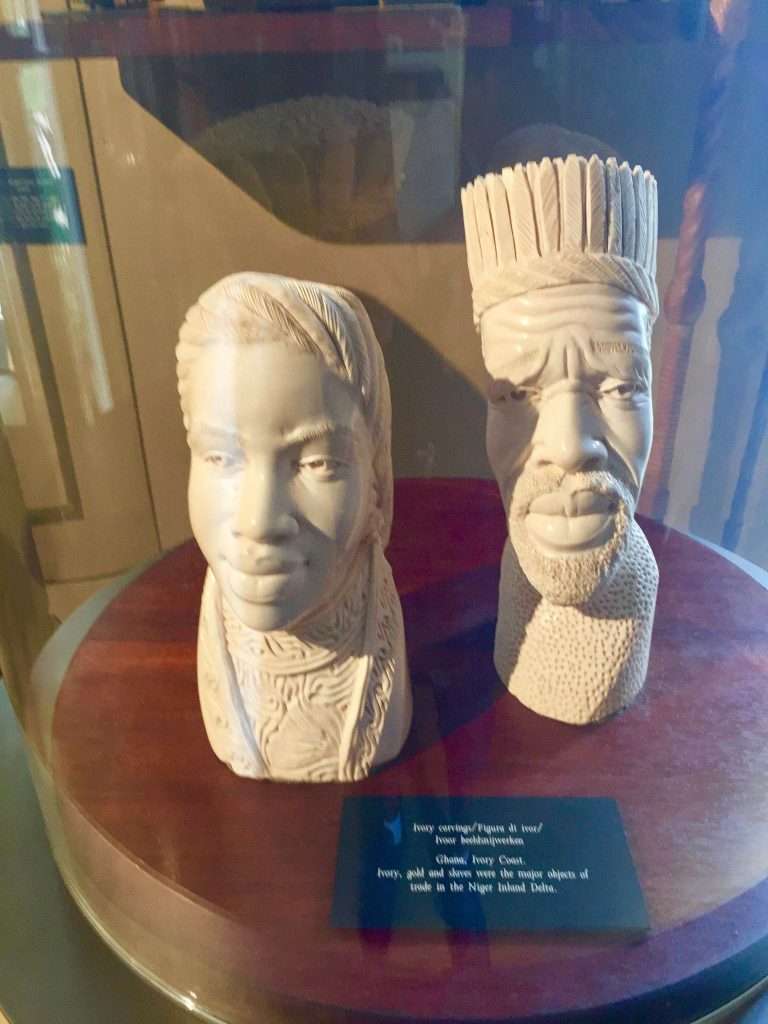
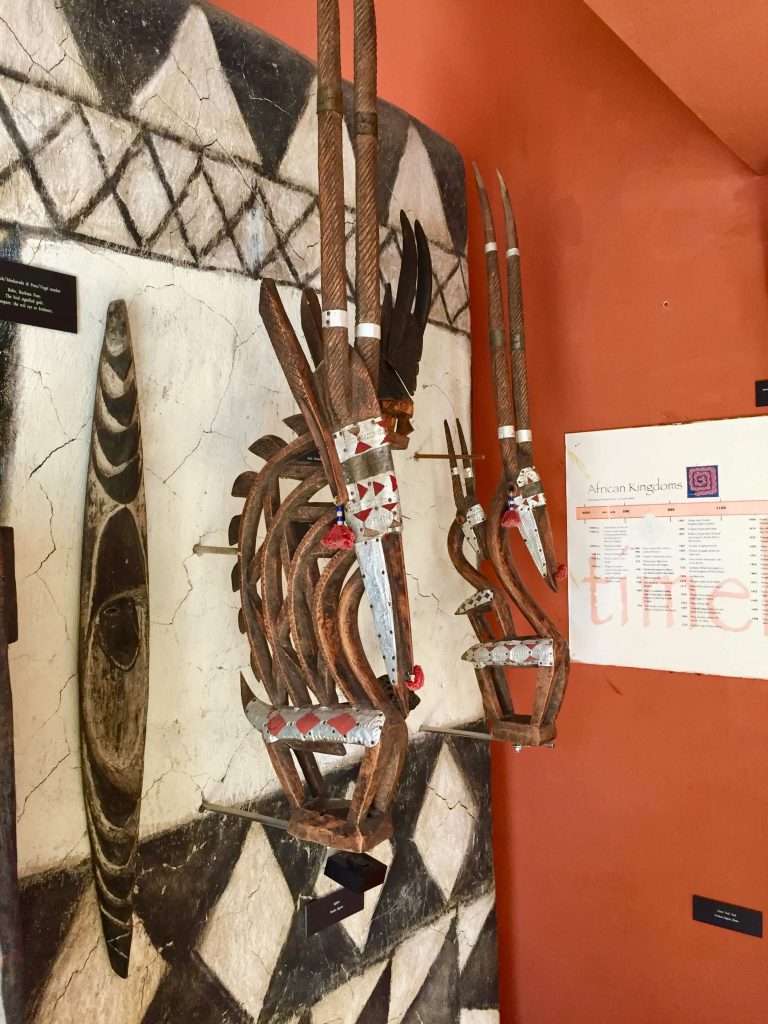
The bus service into town gave us the opportunity to explore the towns of Punda and Otrabanda on opposite sides of the canal into Willemstad. On the Otrabanda side is the fantastic Kura Hulanda Museum, which is part of the urban renewal project which the Dutch entrepreneur and philanthropist, Jacob Dekker funded to the tune of many millions of dollars. Curacao was the centre of the slave trade in years past and the museum is a stark reminder of the terrible fate that befell these people from Africa. The museum has a valuable collection of African art which Dekker assembled over many years. Born in 1948, he sadly passed away a year ago from cancer at the age of 71.
Entrance to the museum.
A bust of Jacob Dekker.
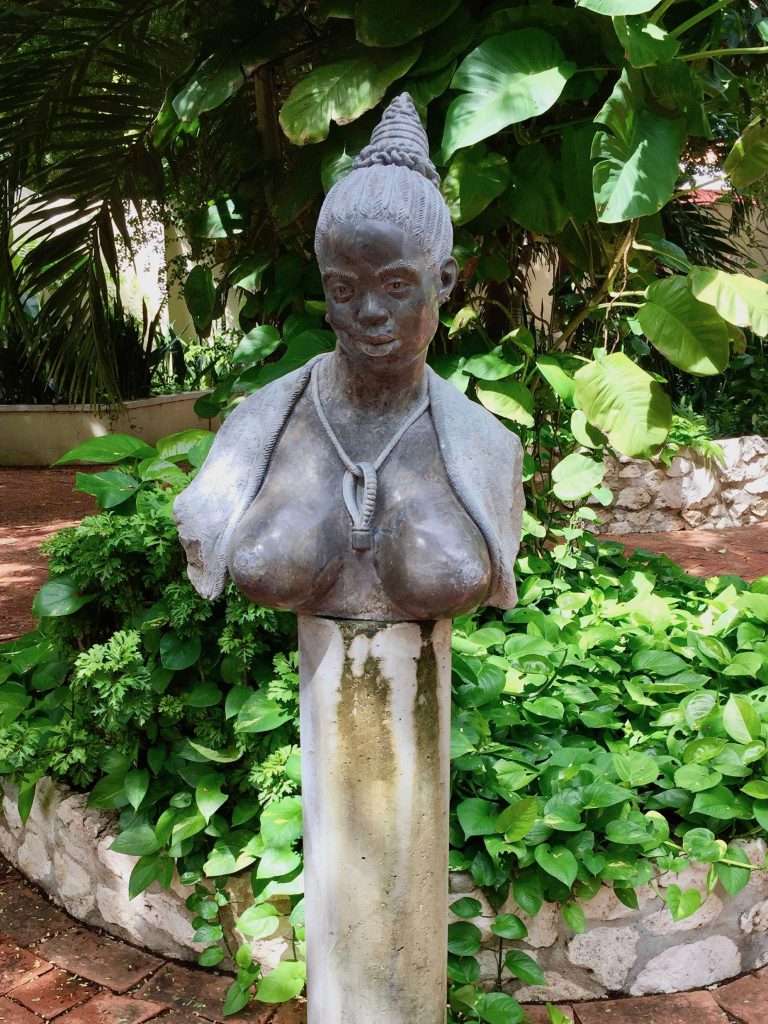
“Mama Africa” sculpture in the museum courtyard, highlighting the origins of the slaves.
Started by the Portuguese in 1526, the current estimates are that about 12 million to 12.8 million Africans were shipped across the Atlantic Ocean over a span of 400 years. The number purchased by the traders was considerably higher, as the passage had a high death rate with approximately 1.2–2.4 million dying during the voyage and millions more died in seasoning camps in the Caribbean after arrival to the New World.
Millions of slaves also died as a result of slave raids and during transport to the African coast for sale to European slave traders. Near the beginning of the 19th century, various governments acted to ban the trade, although illegal smuggling still occurred. In the early 21st century, several governments issued apologies for the transatlantic slave trade. (Source: Wikipedia)
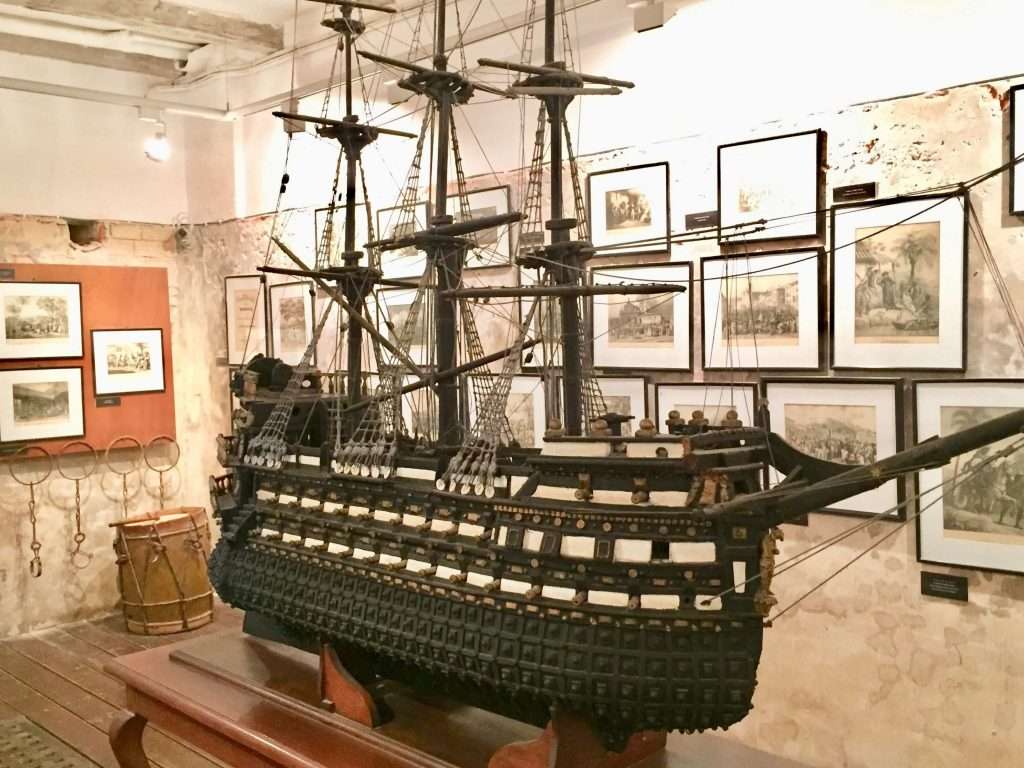
Model of a slave trading ship. In the holds of these ships, the slaves in chains, were crammed like sardines .
Sad!
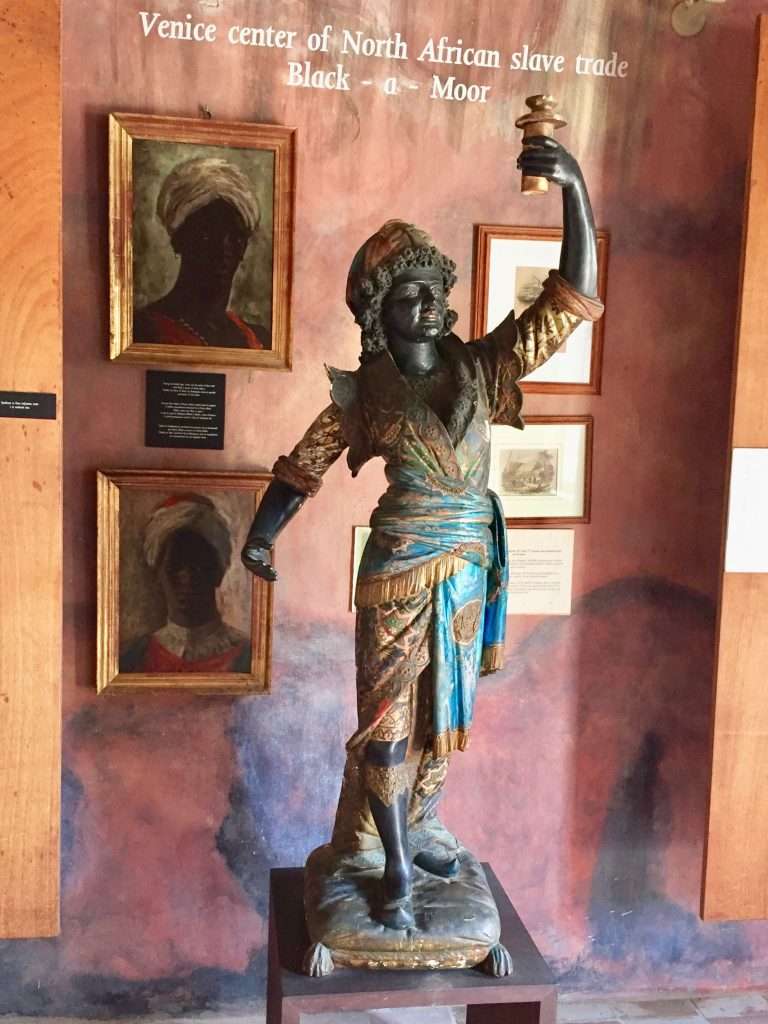
Venice also has something to answer for it’s North African slave trading history.
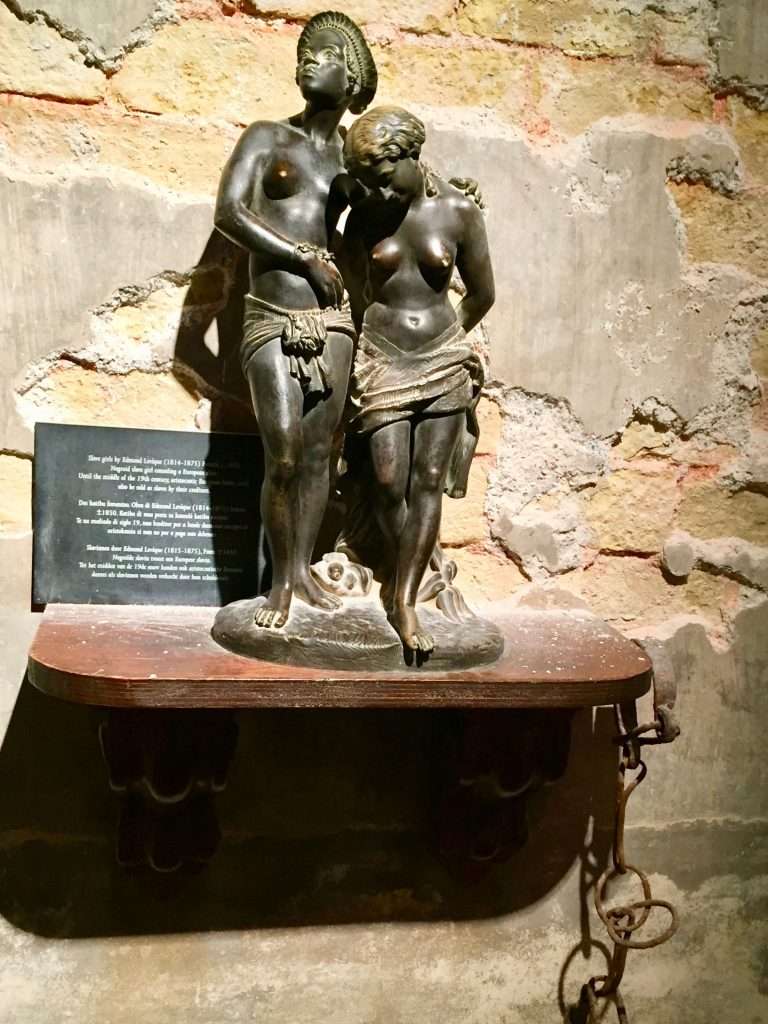
Slave girls – I have only included photos of the less shocking exhibits in the museum.
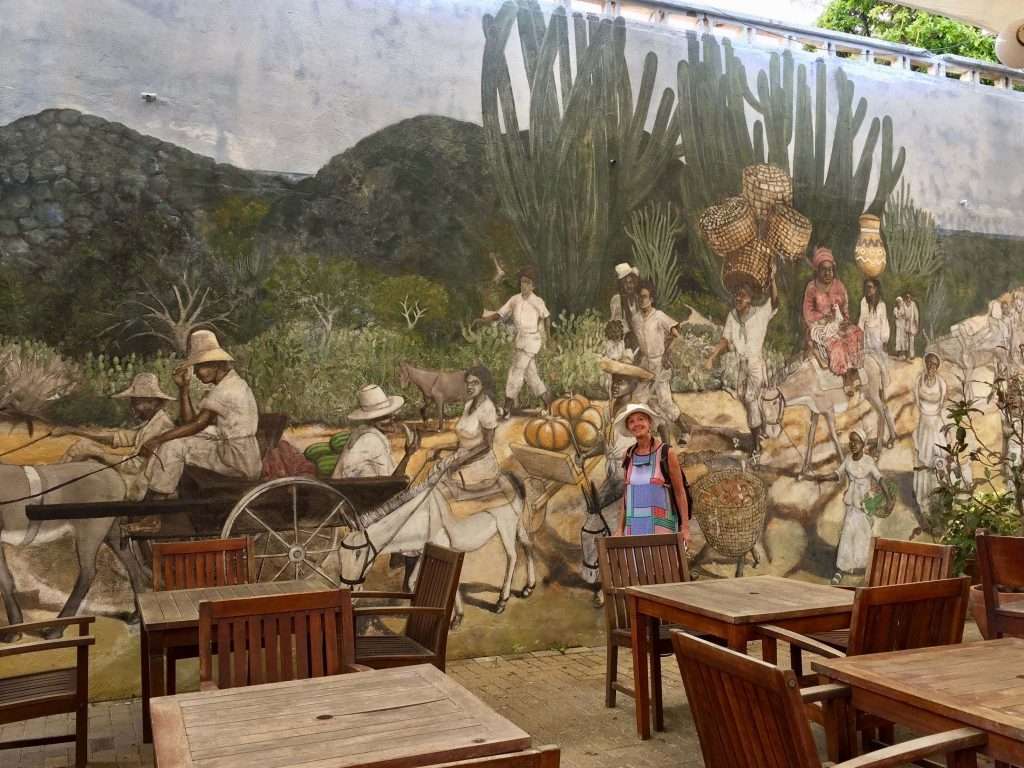
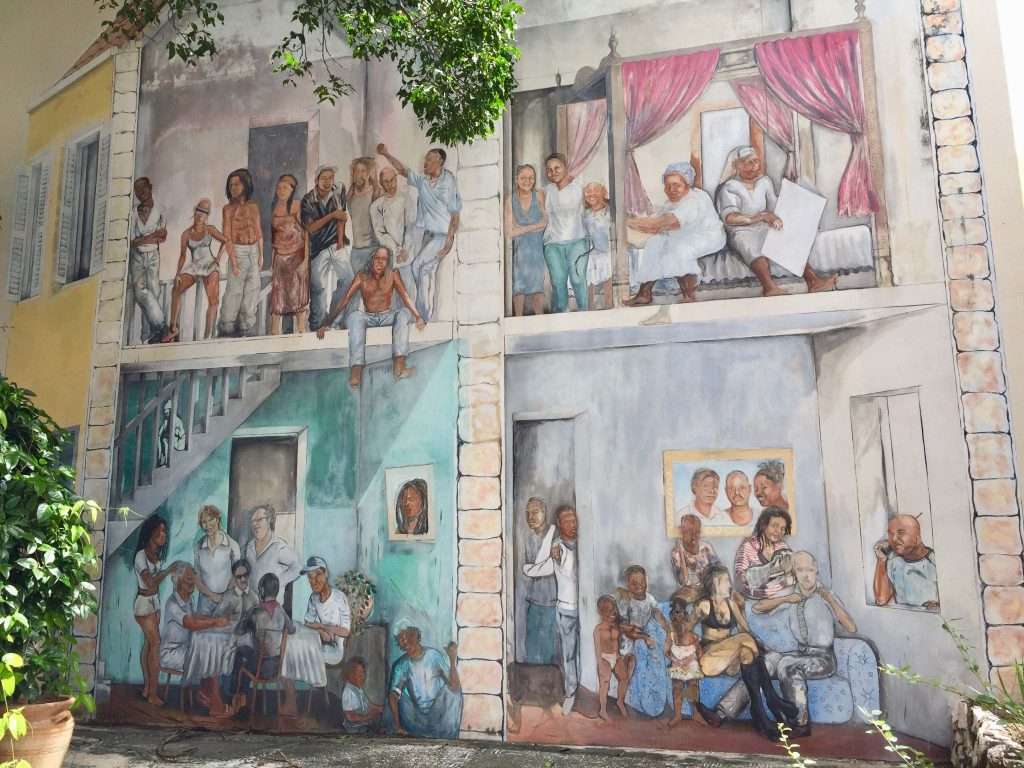
Mural depicting slaves at work in the Caribbean.
Exit of the slave museum – Annie looking back, gobsmacked.
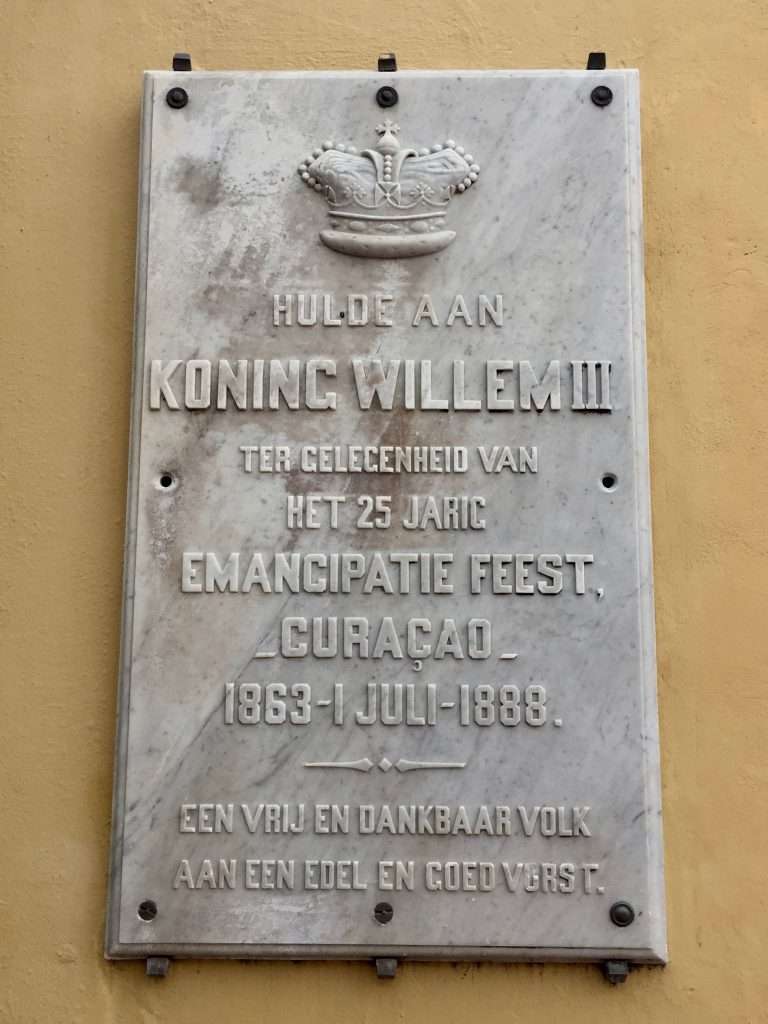
End of a sad chapter – celebrating the emancipation of the slaves in Curacao by King Willem III of the Netherlands.
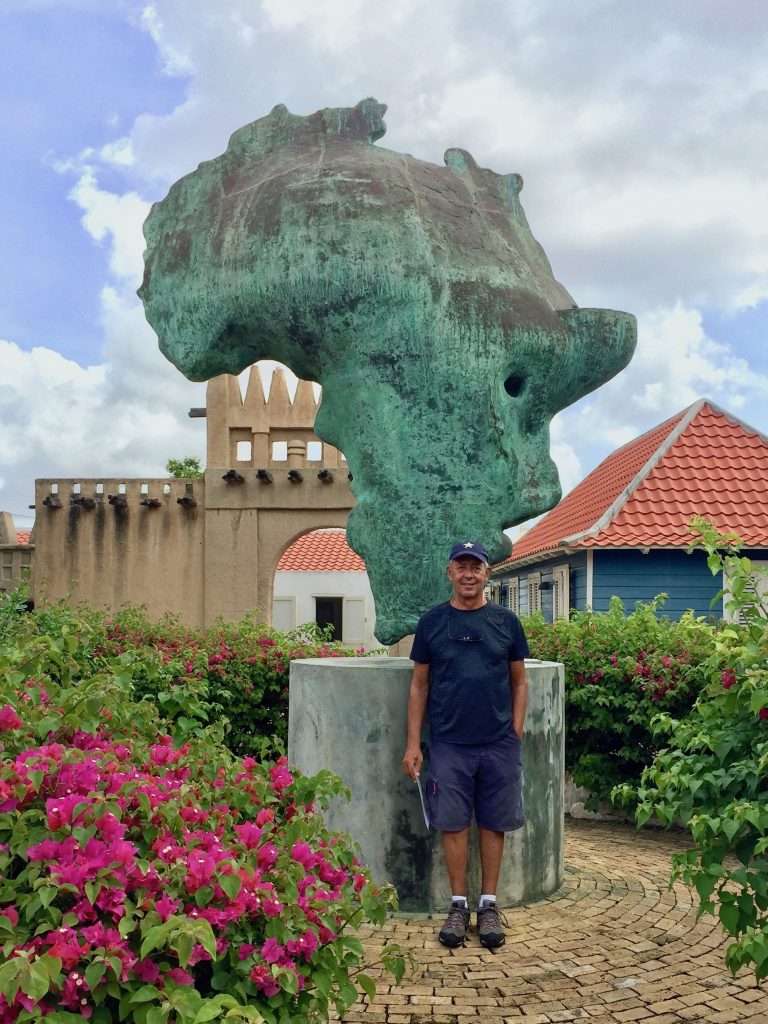
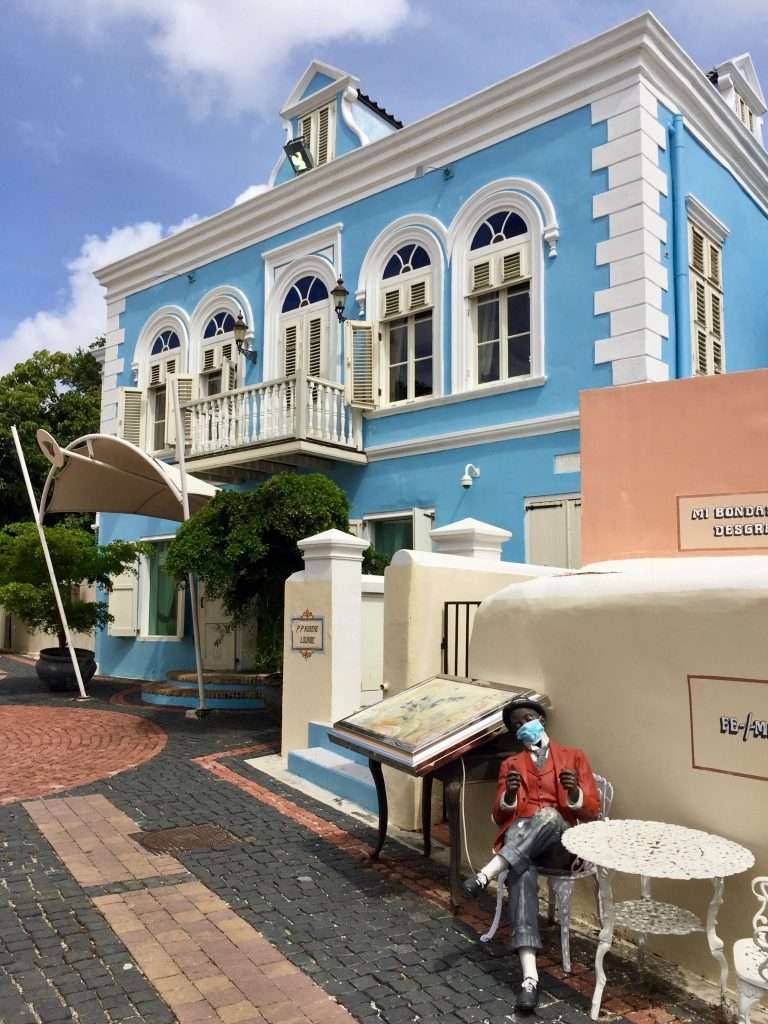
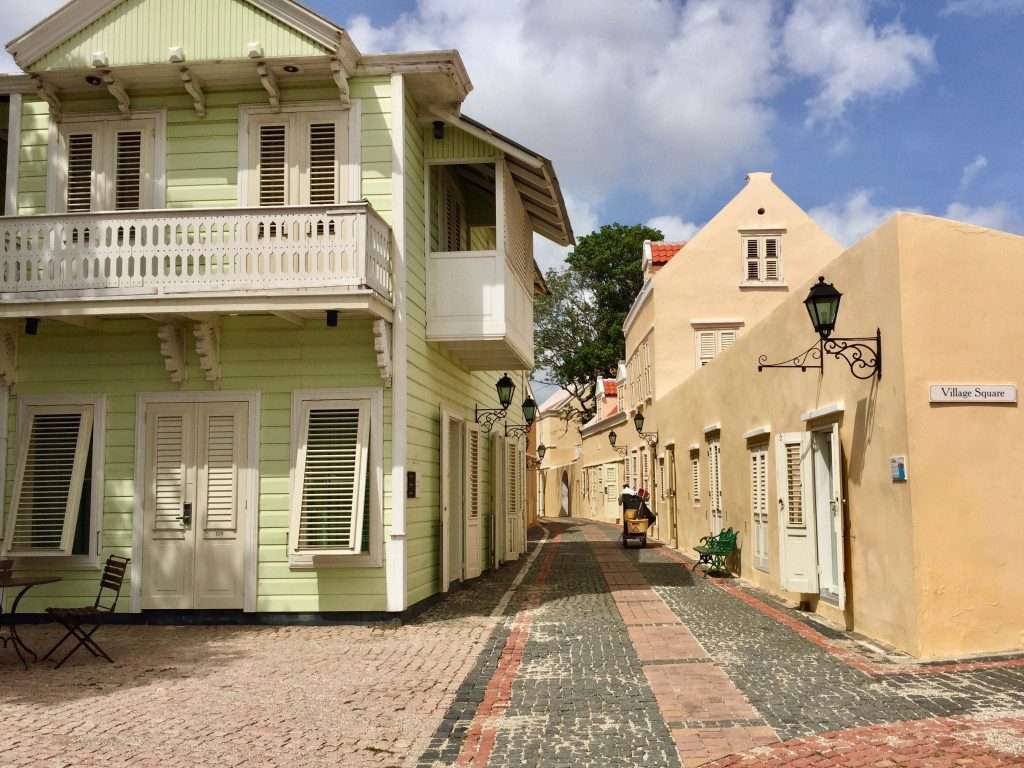
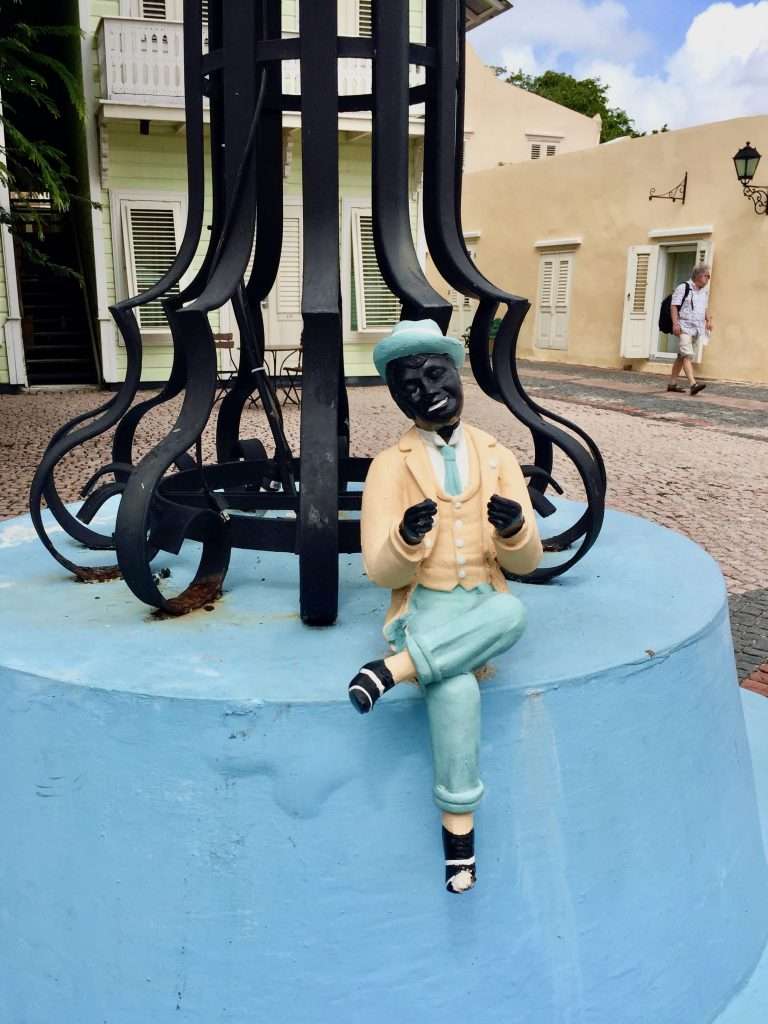
The photos following, are of the redeveloped urban area in Kura Hulanda – with lots of public art around.
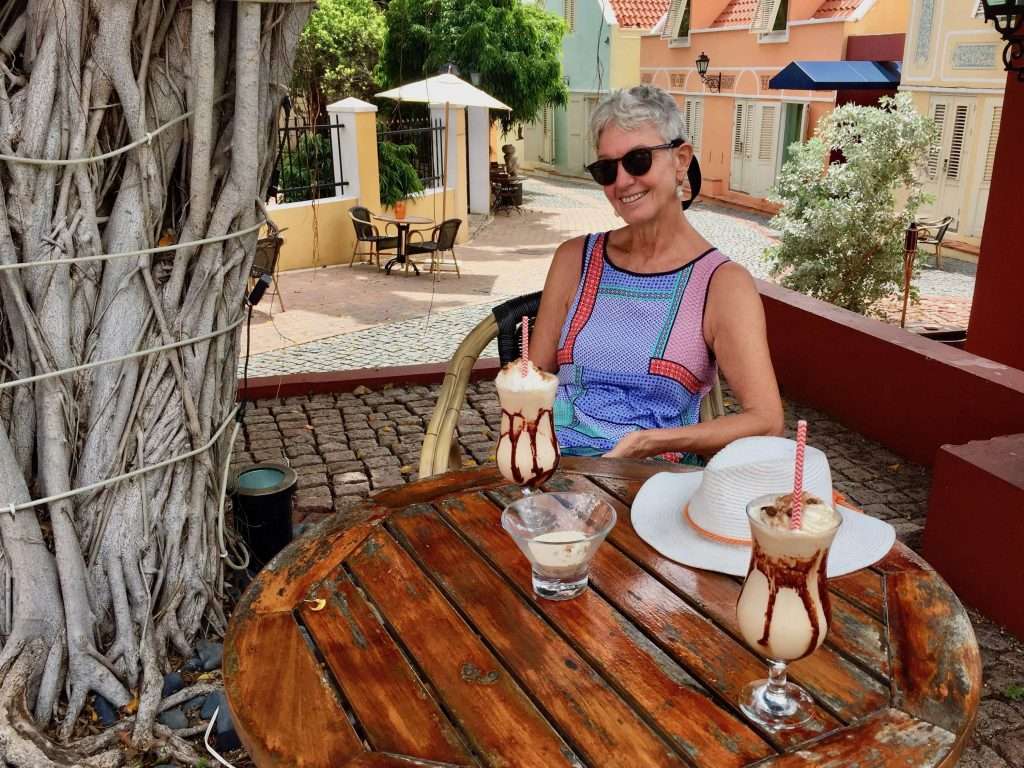
Cooling off with iced cappuccinos.
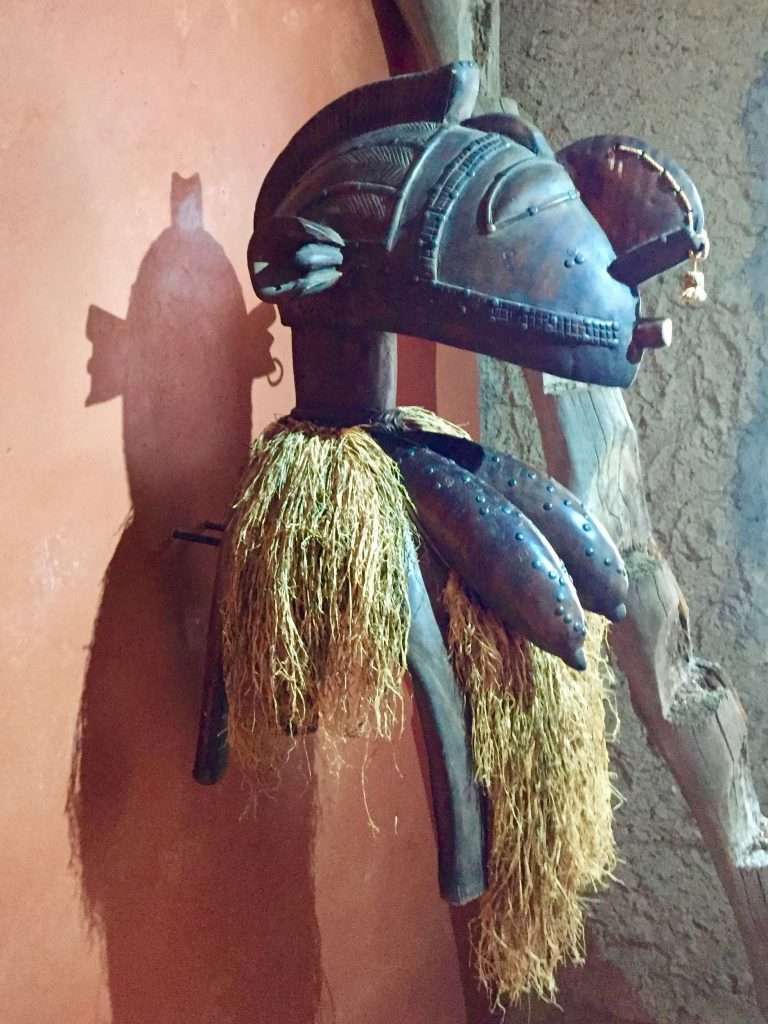
Dekker’s extensive African art collection.
Walking back to Punda.
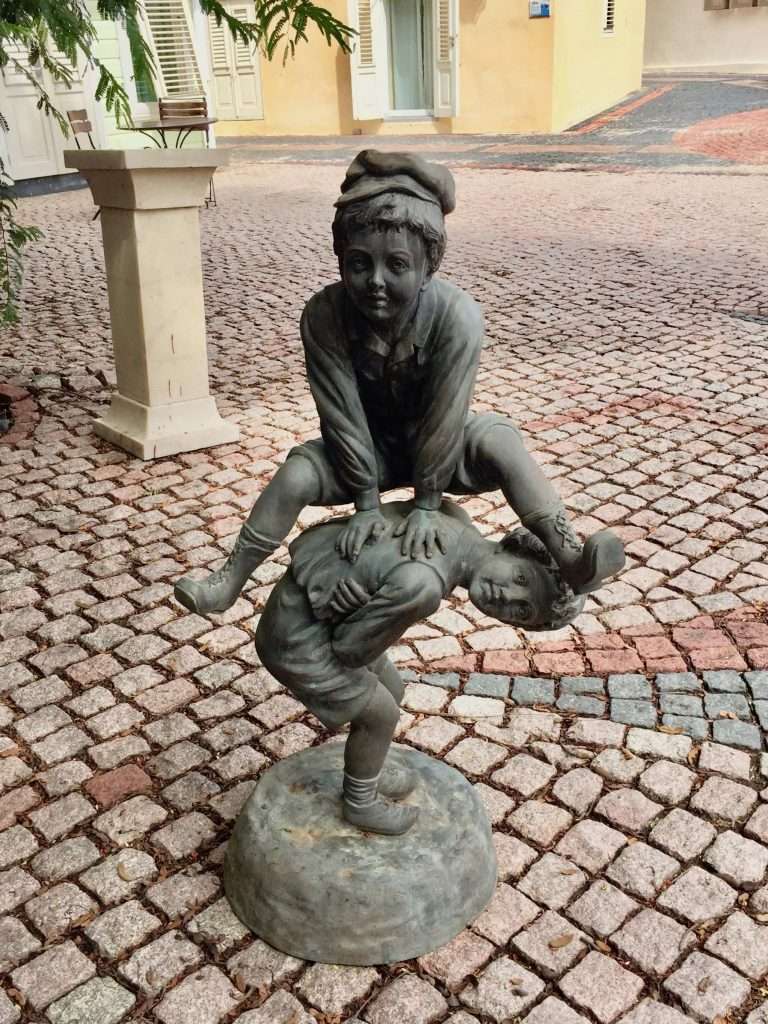
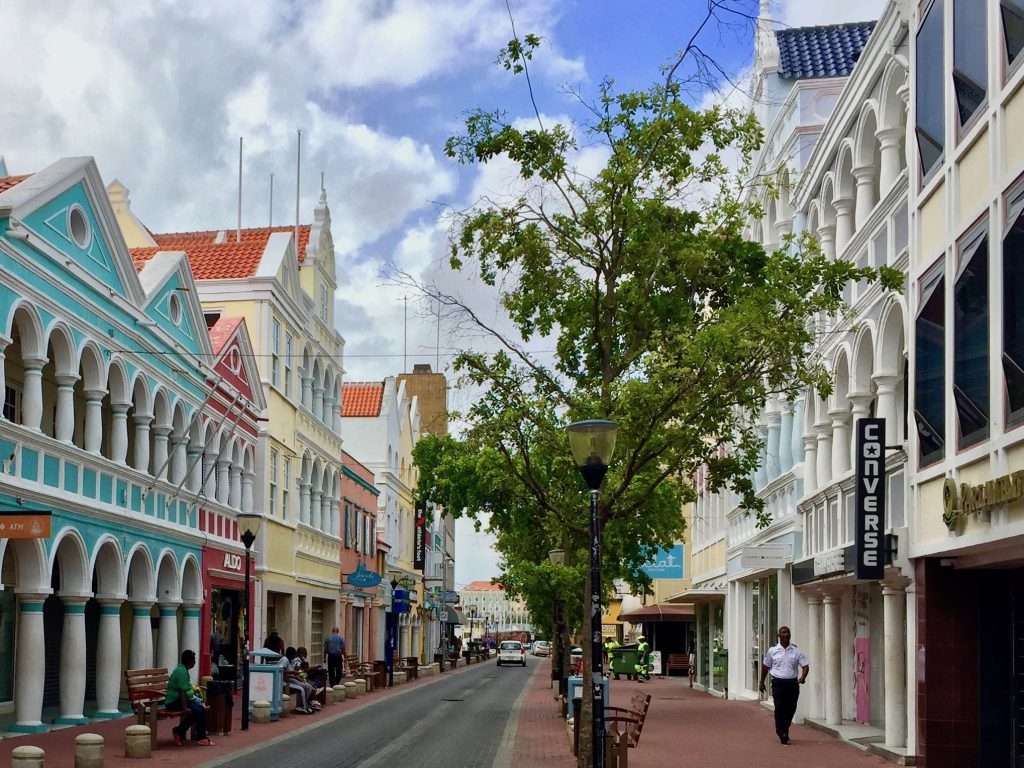
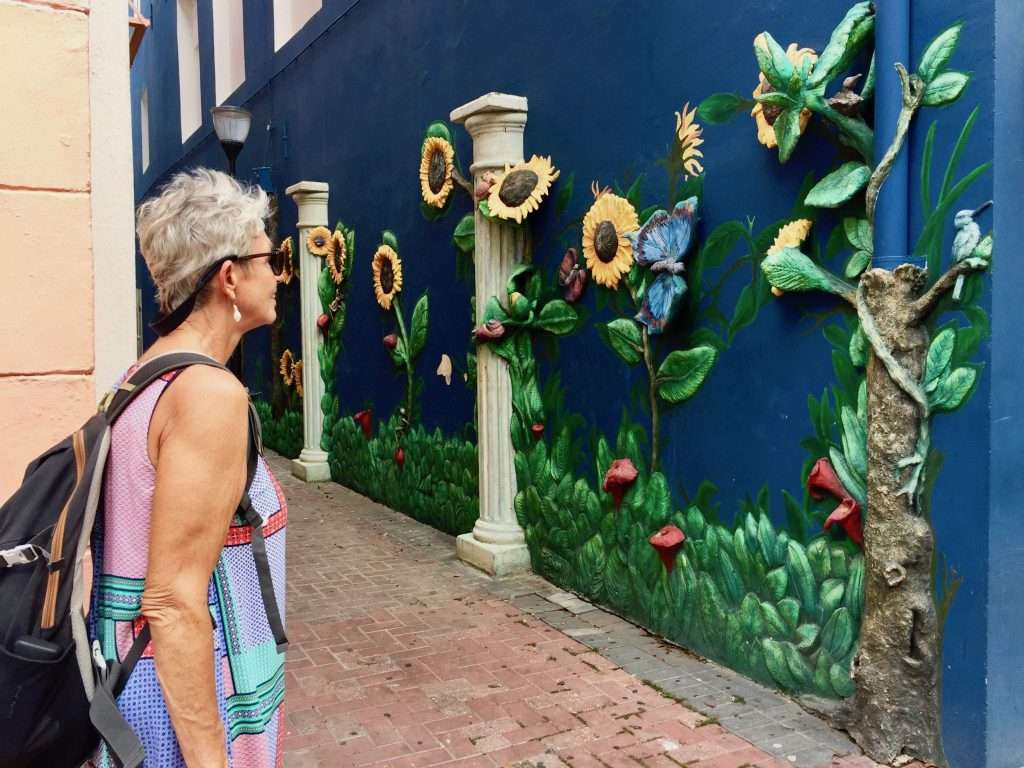
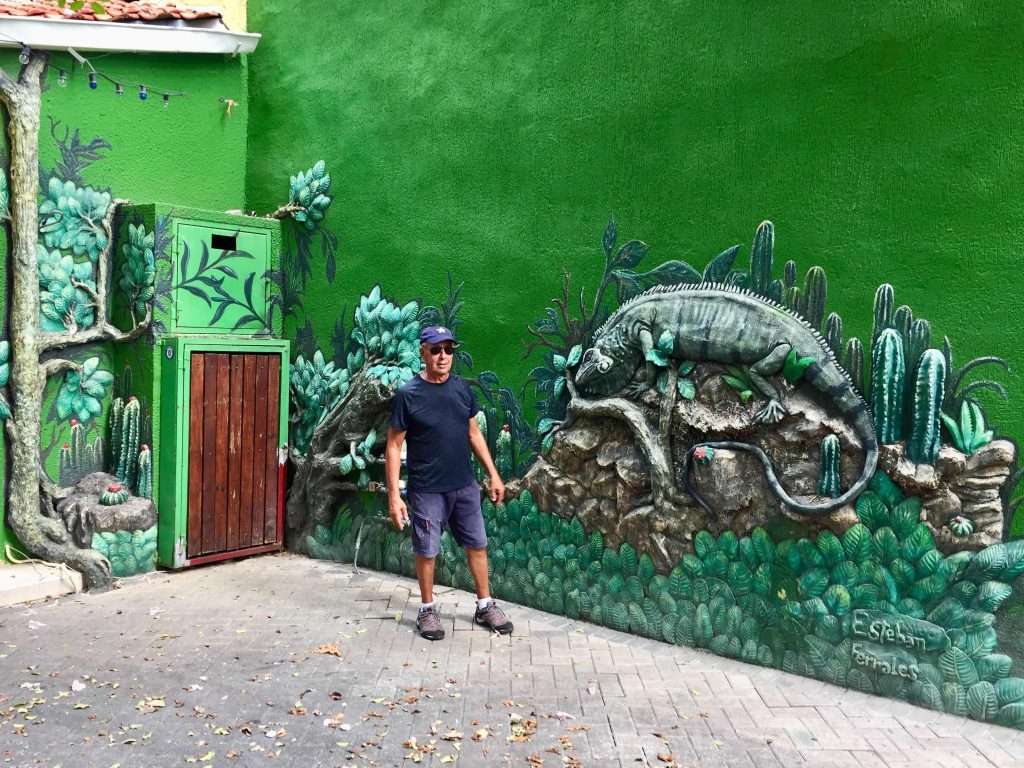
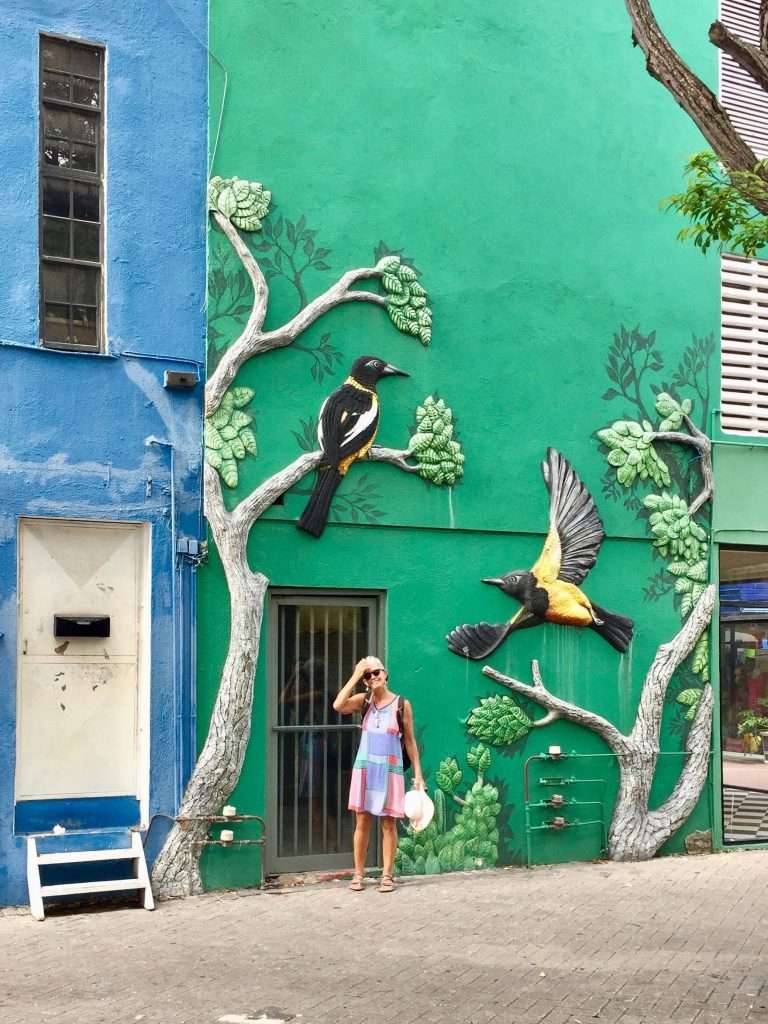
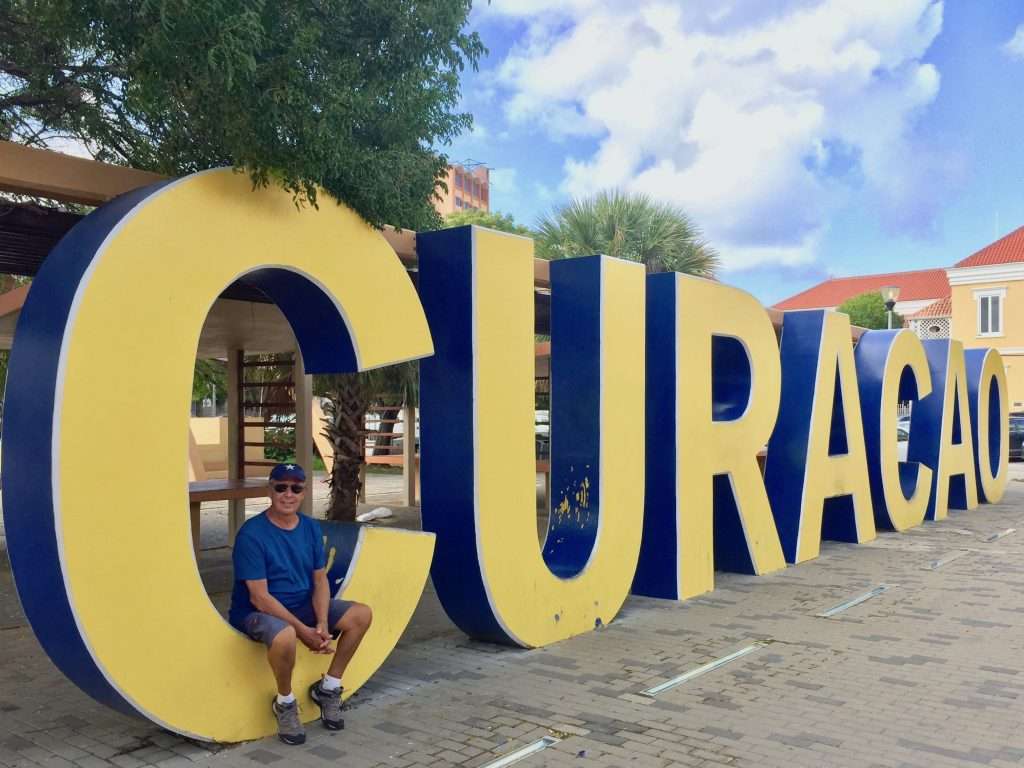
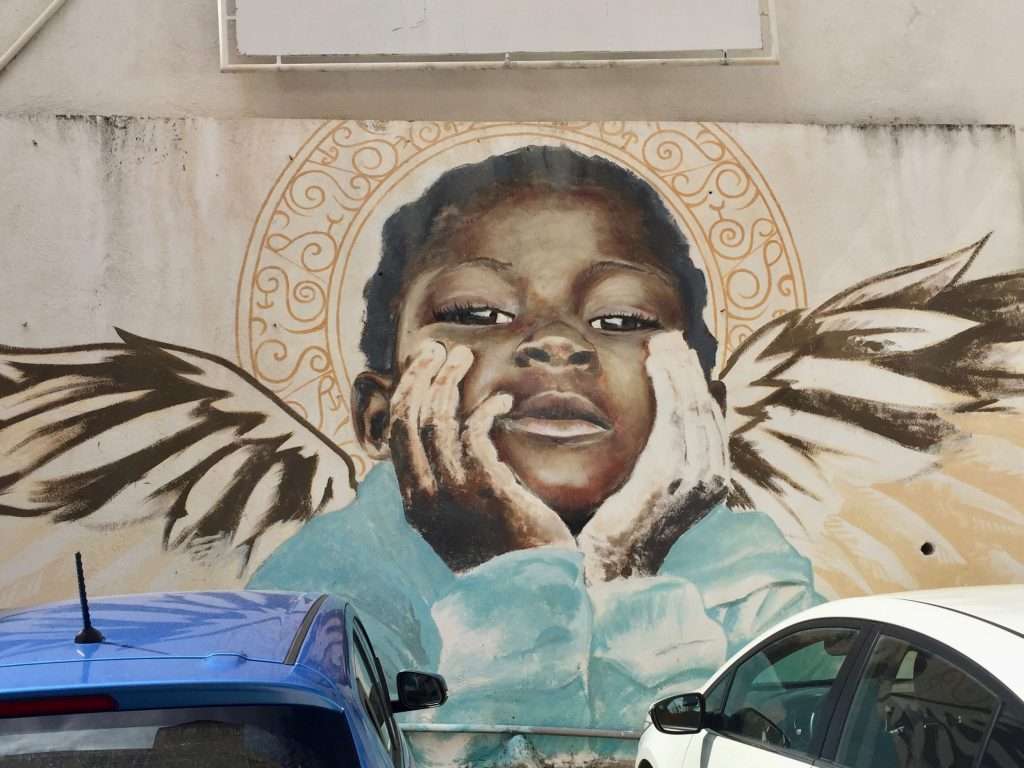
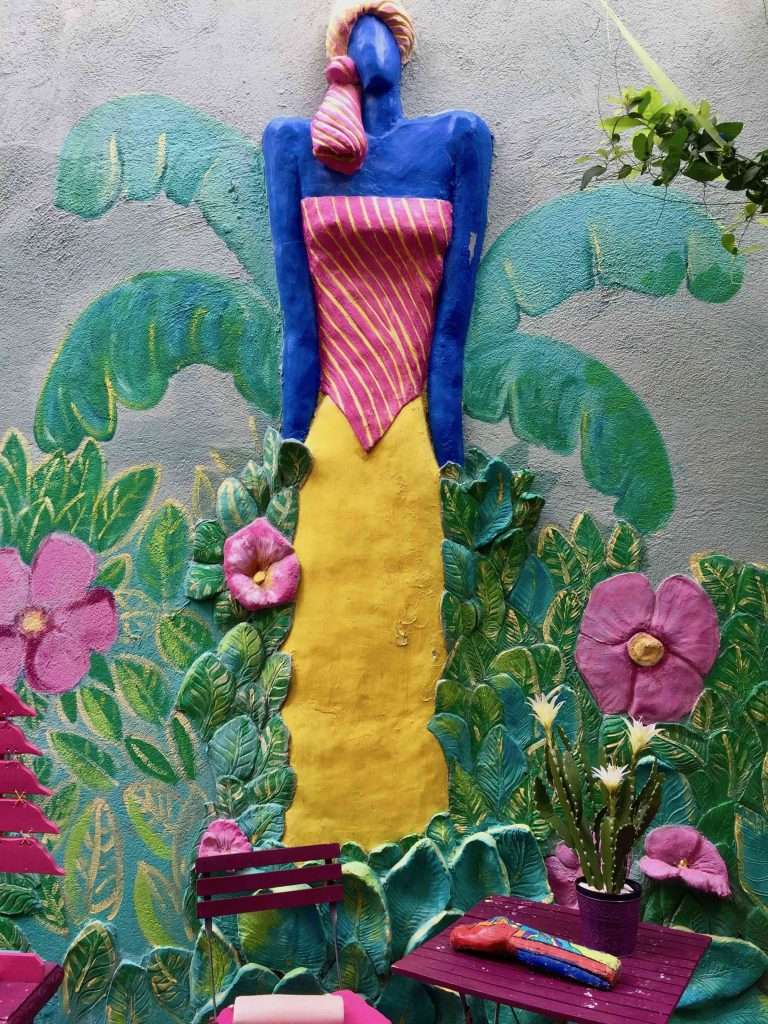
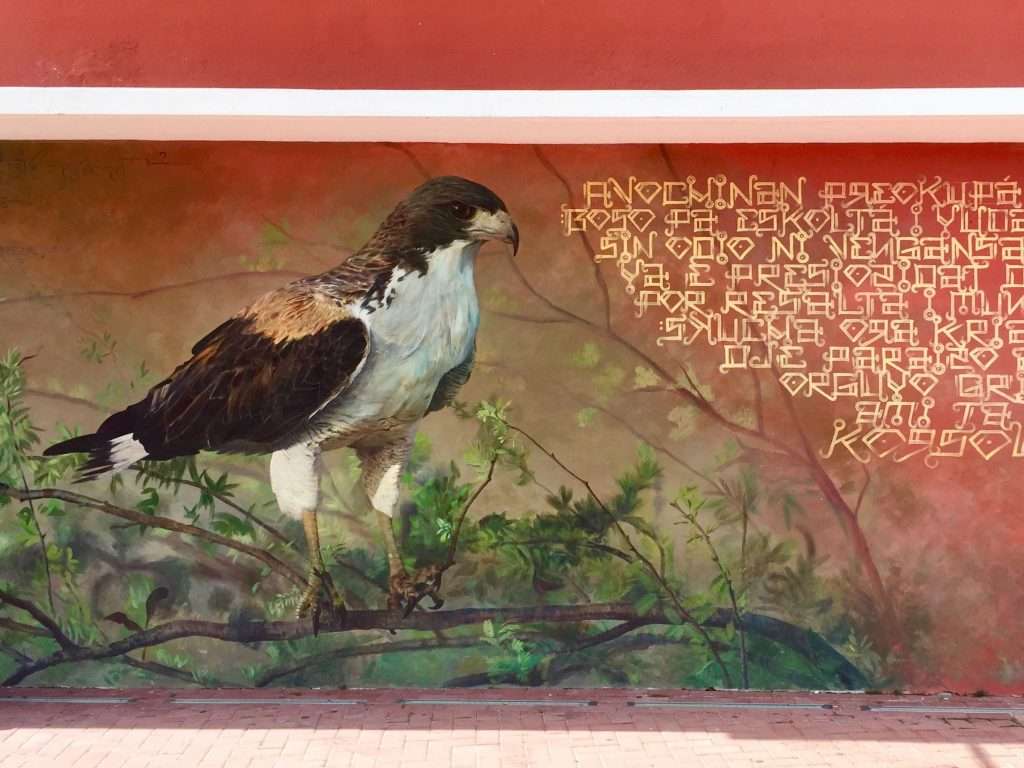
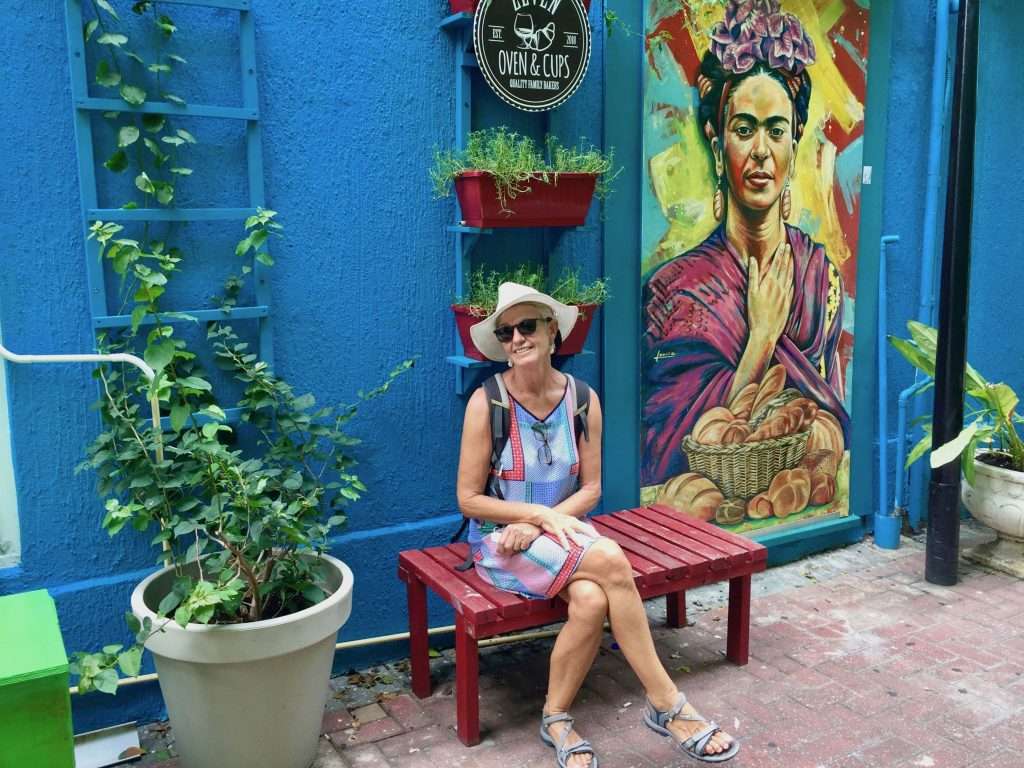
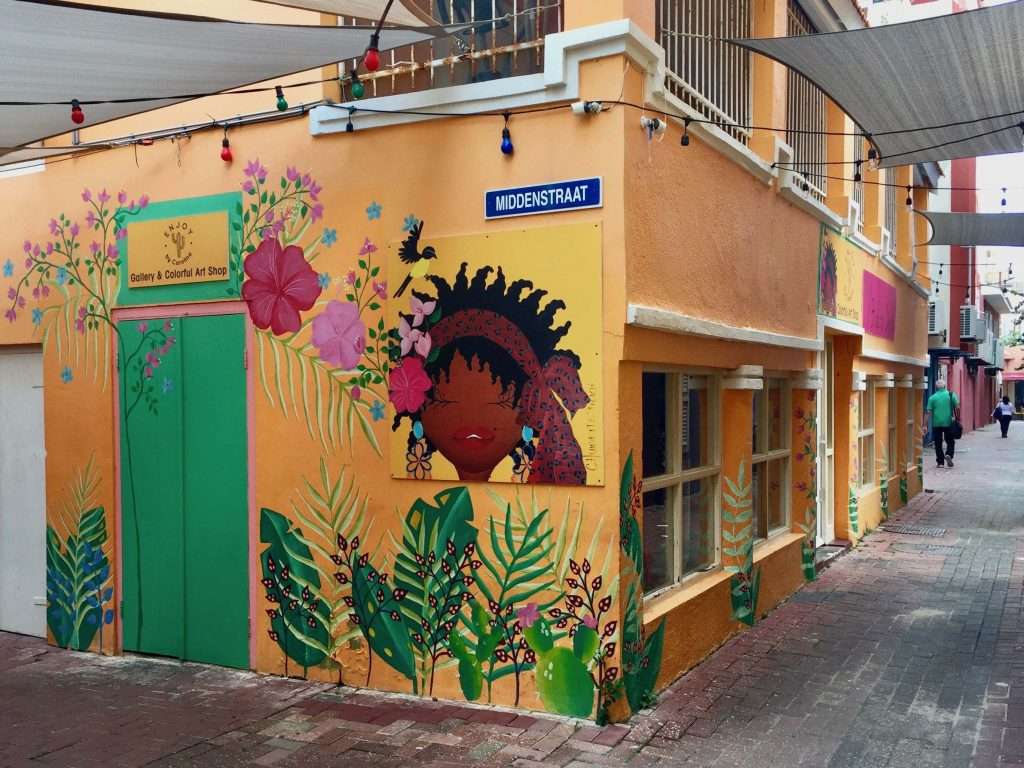
Punda, which we explored on the other side of the canal, is a living and very colourful street art gallery, with artistic surprises around every corner. We enjoyed this so much, we went back two days later to explore the area further. Below, follows some photos of the street art, which don’t need further explanation.
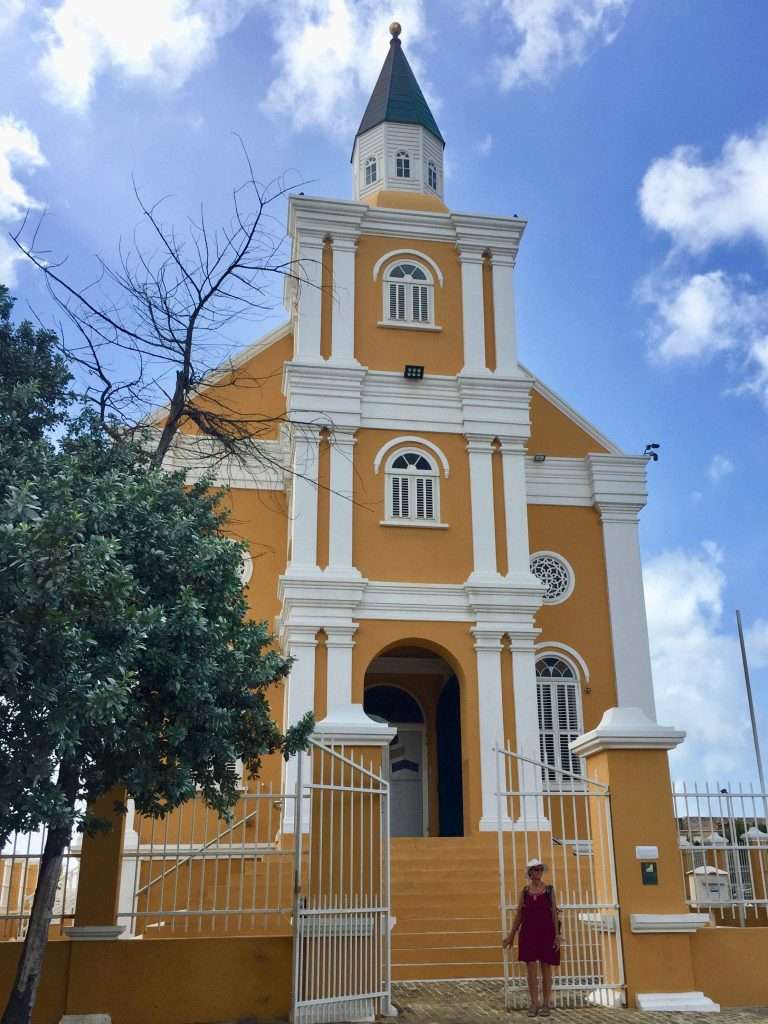
We thought this building was a church – it is the Public Prosecutor’s office!
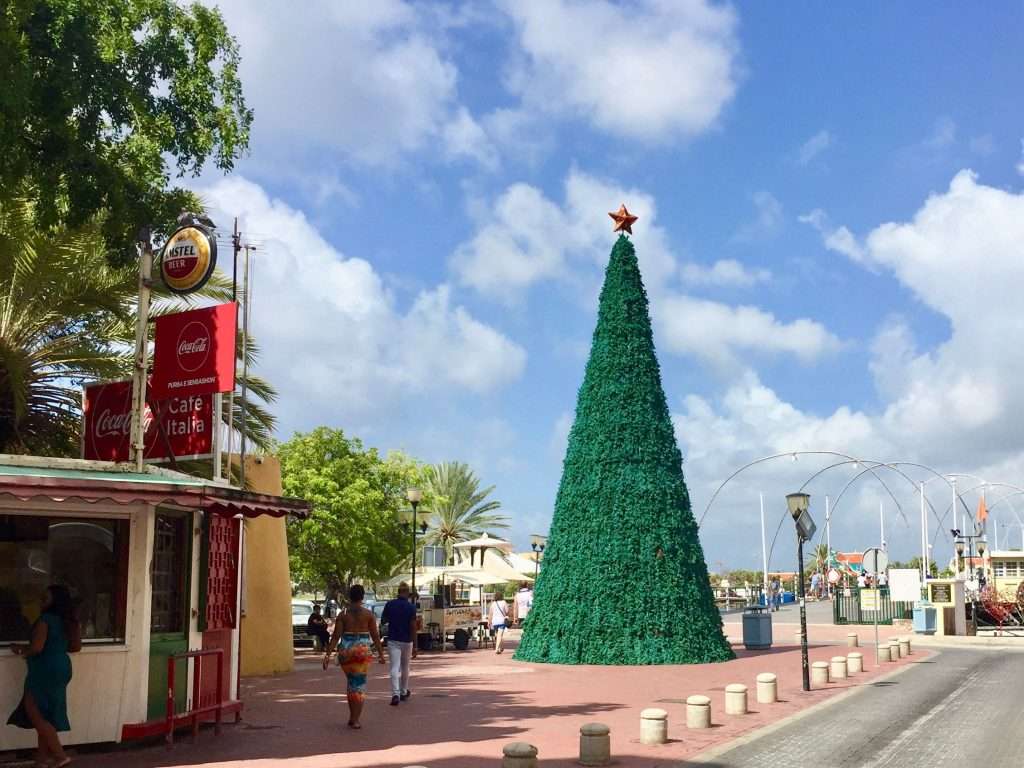
The Christmas decorations are coming out.
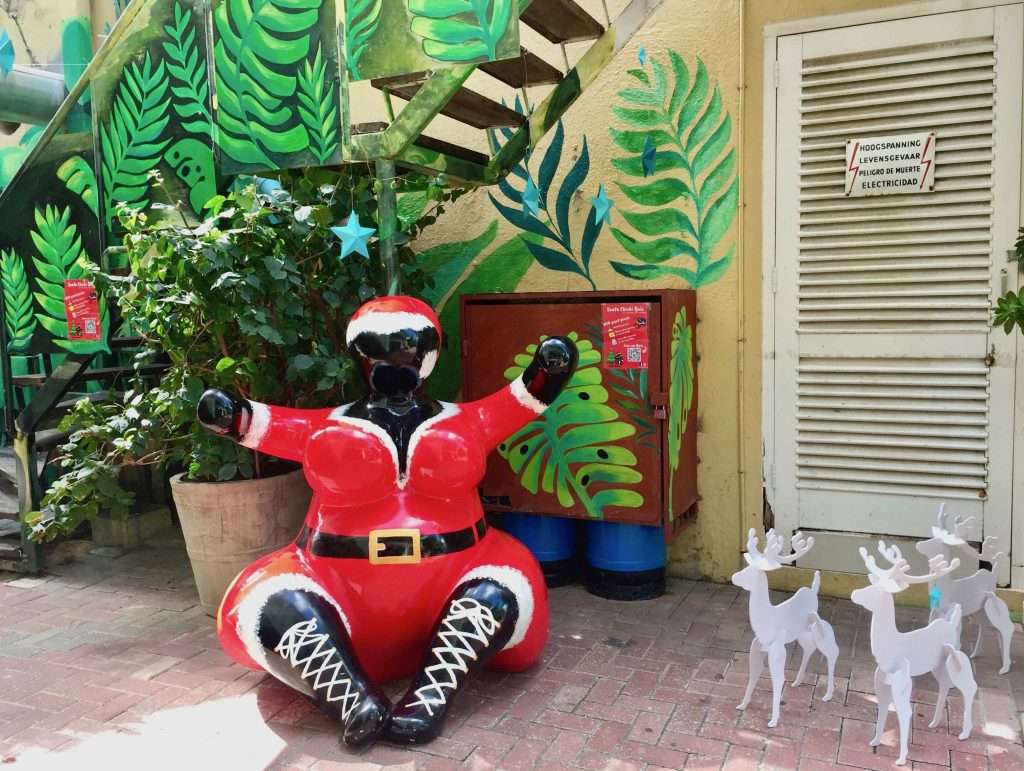
A Chichi Santa with reindeer.
Last night, we had cruisers from Australia and New Zealand around for drinks, all of us waiting for the Colombian border to open on the 1st December (hopefully). Like us, these boats, Merewether and Wild Thing are also planning to transit the Panama canal early in the new year, to start their Pacific crossing. We are all waiting with bated breath. We will report back early in December on our next move, so until then, keep safe and wear your masks.
Note: If the map on the email version you have received is not clear, click on the map to enlarge it.
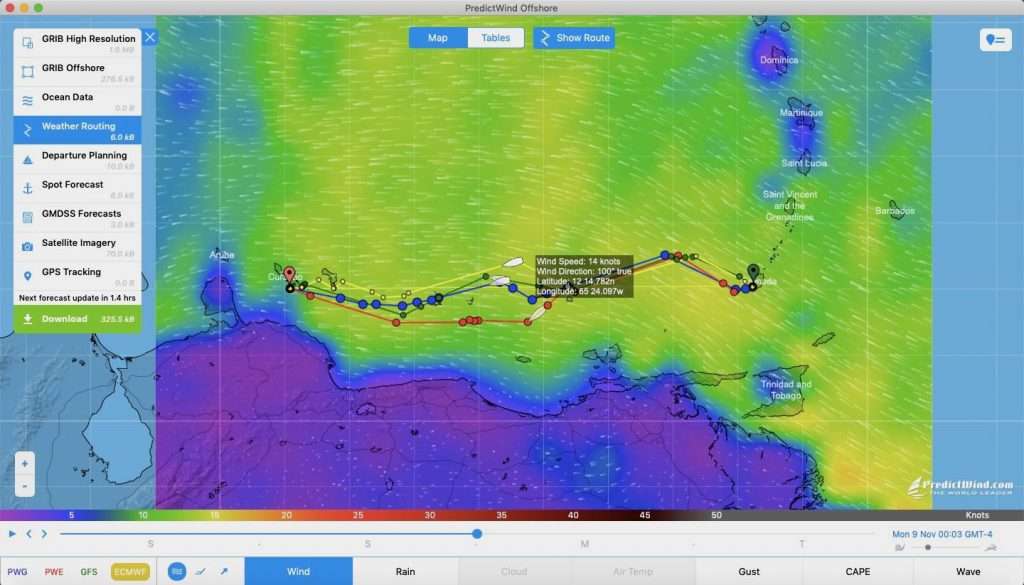
The route from Grenada to Curacao has two potential dangers: 1. Piracy off the North coast of Venezuela, which evidently, is worse than the piracy which we had expected off the Somali coast in the Gulf of Aden – so, we sail well offshore from the Venezuelan Islands of Blanquila and Los Rogues! 2. Strong easterly winds, which build up towards the Gulf of Mexico, after their long journey across the Atlantic.
The Predictwind Offshore service which we are subscribed to, indicated a favourable four day weather window starting on the 7 th November 2020. The expected wind strength for the 440 nm (815 km) distance was around a 15 knot Easterly with swells of 1 – 2 metres. Ideal for Esprit with a poled out jib and full main, going dead downwind. We set sail from St George’s in Grenada on the 7th at 15:00.
To remind us of the high rainfall in Grenada and as a farewell present, we were hit by a severe squall with torrential rain, two miles offshore. After this, Harry the Hydrovane took control and we were sailing downwind at 9 – 11 knots SOG (Speed Over Ground). With no further rain anda consistent wind, we had a wonderful trip downwind for the next two days.
Harry the Hydrovane.
The prediction for day 3.
Weather, according to MetBob in New Zealand (Bob McDavitt), is a mix of pattern and chaos. It therefore comes as no surprise, when the wind suddenly dies down on day three, despite the predictions. We had to start the Yanmar engine and motor for the last 30 hours, before anchoring in Curacao – averaging 6.1 knots over the total distance. As passages go, this one was both good and frustrating.
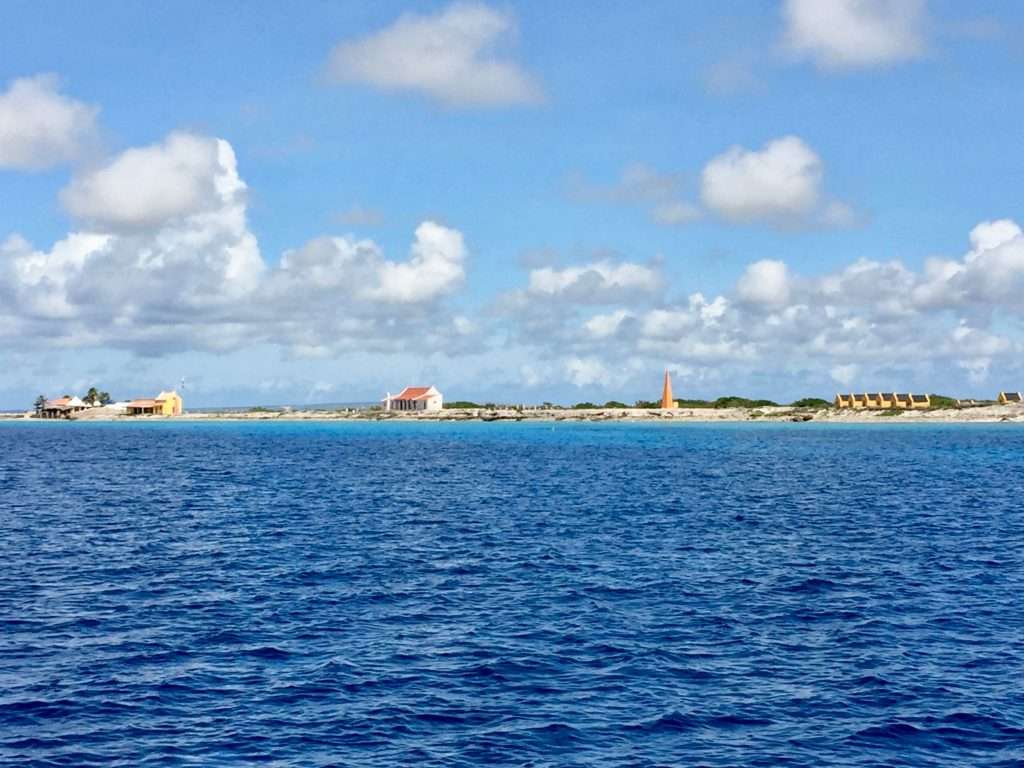
Although Bonaire is the first island in the Netherlands Antilles to be reached, sailing from Grenada, we passed it by as Bonaire required 14 days quarantine on arrival. It is a small island, but has good diving.
Approaching Bonaire.
The southern tip of Bonaire.
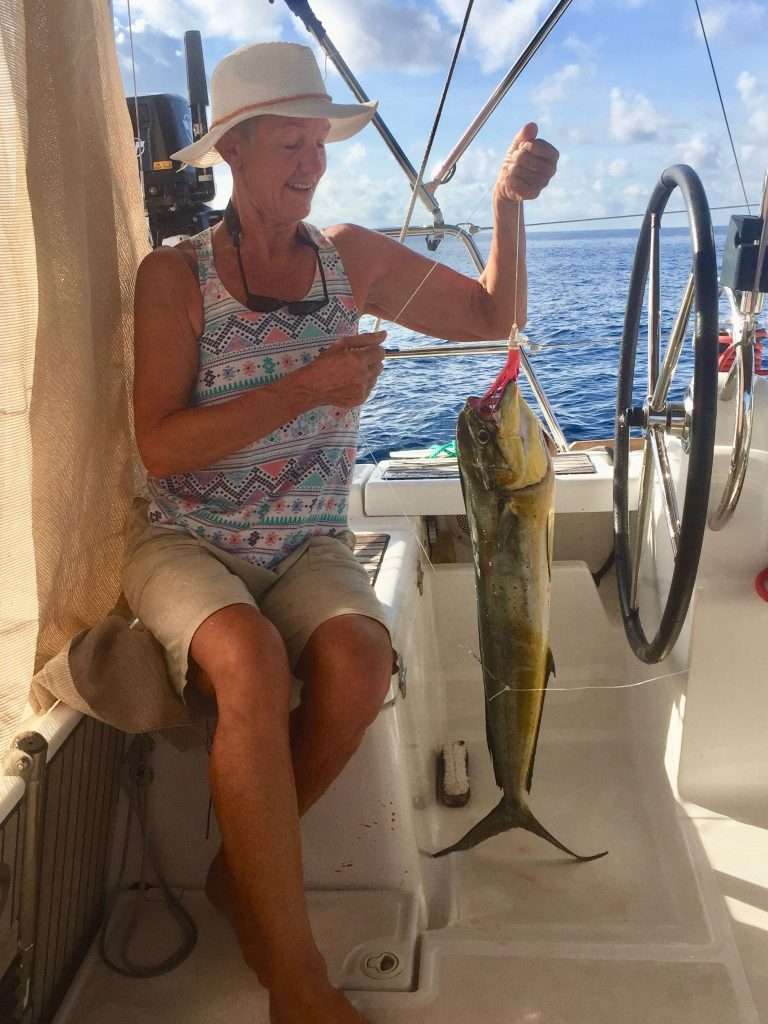
Day 3: Annie catches a good sized Dorado (Mahi Mahi) with her new pink lure.
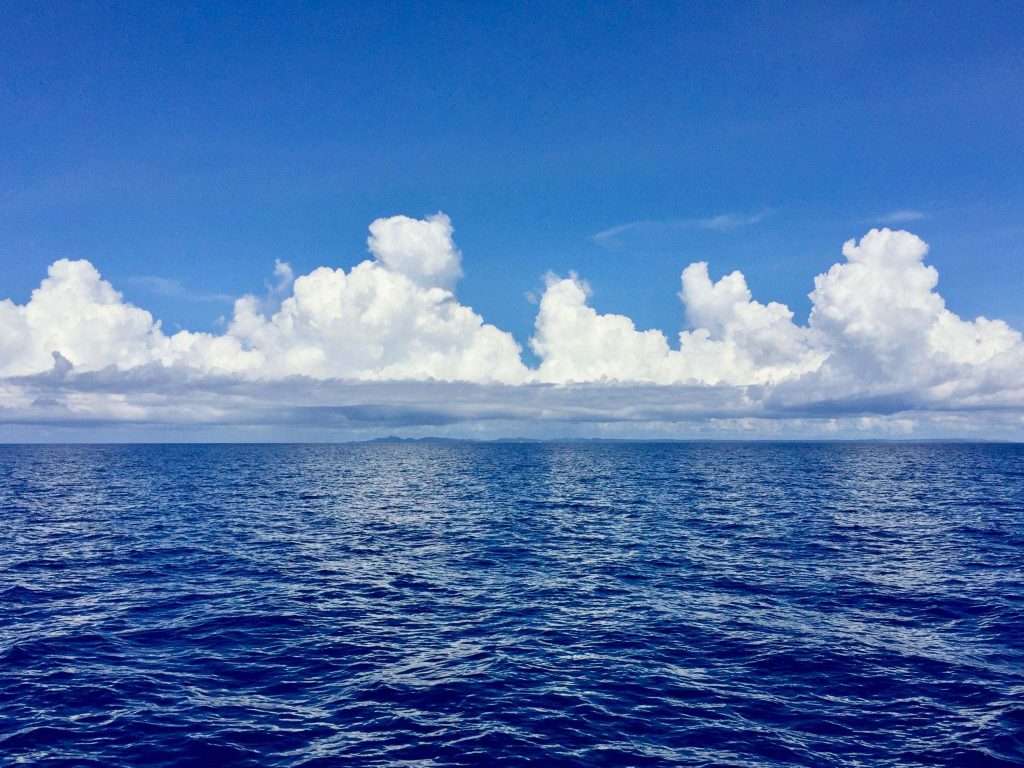
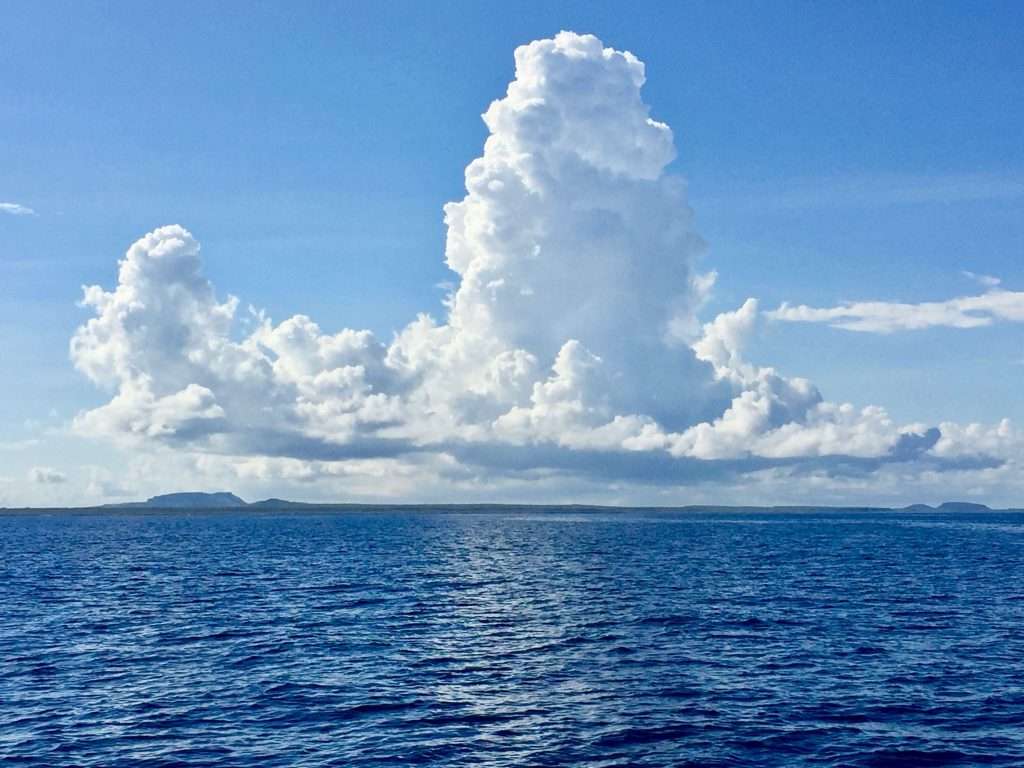
Approaching Curacao – huge Cumulus clouds.
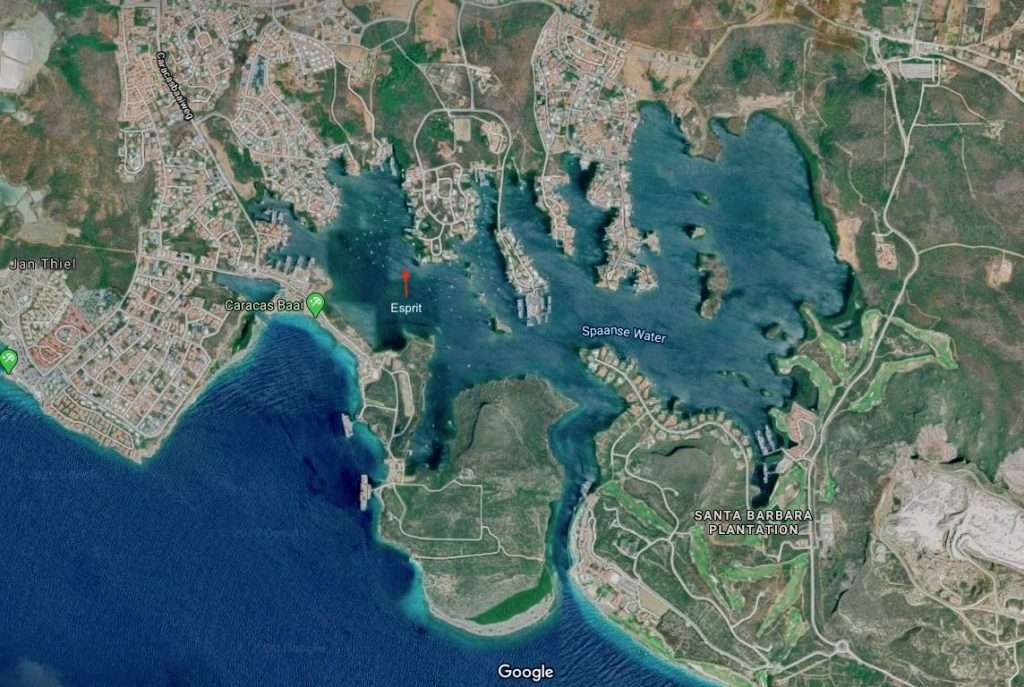
South of Willemstad the capital of Curaçao, is a substantial body of sheltered inland water called Spaanse Water (Spanish Water), accessed by a narrow channel. Yachts anchor here in five designated bays during the hurricane season. Although we have now reached the end of this season, there are still many permanent boats anchored here, mostly from the USA, Canada and SA, who uses the bays as a base to cruise the region.
Spanish Water.
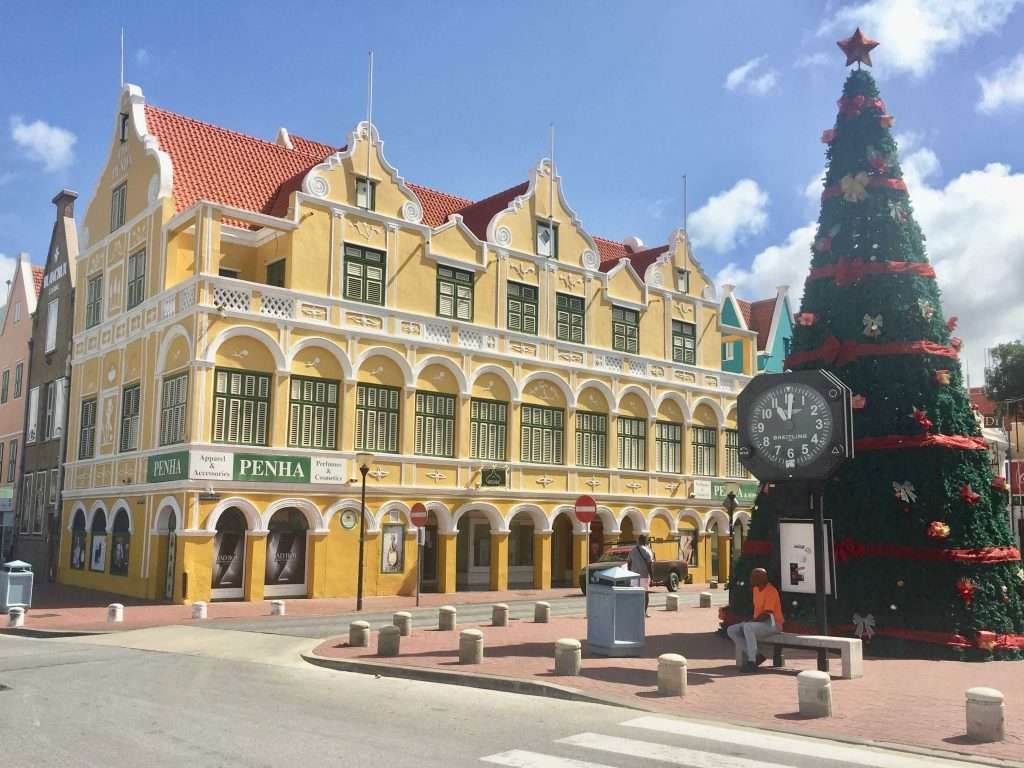
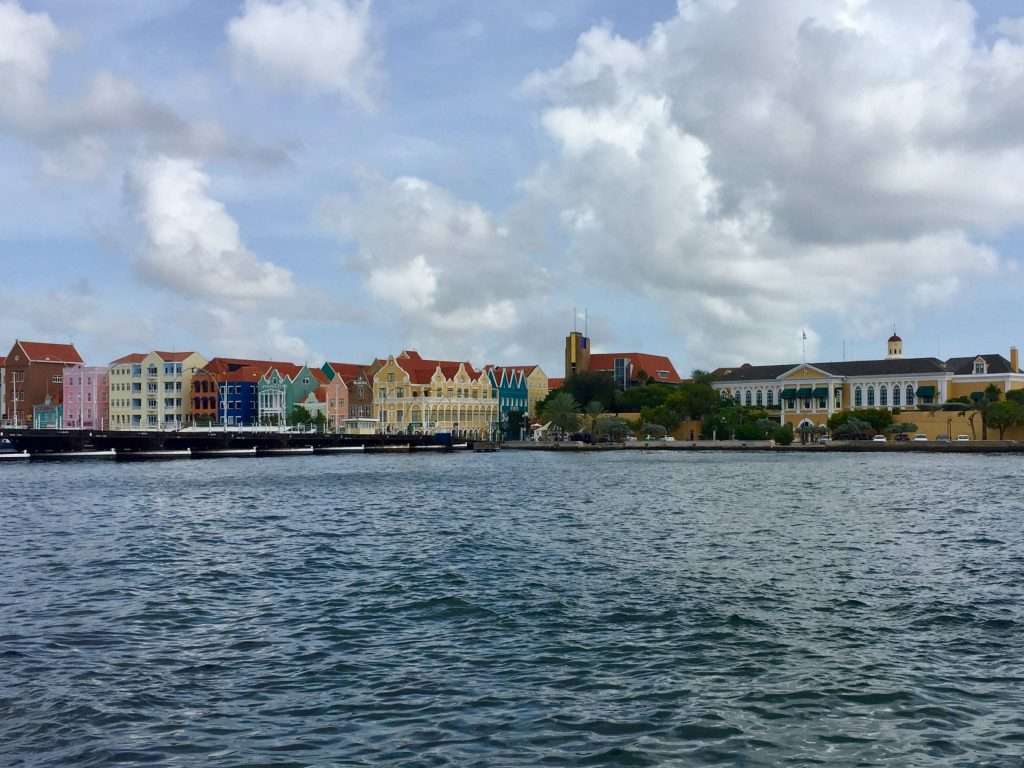
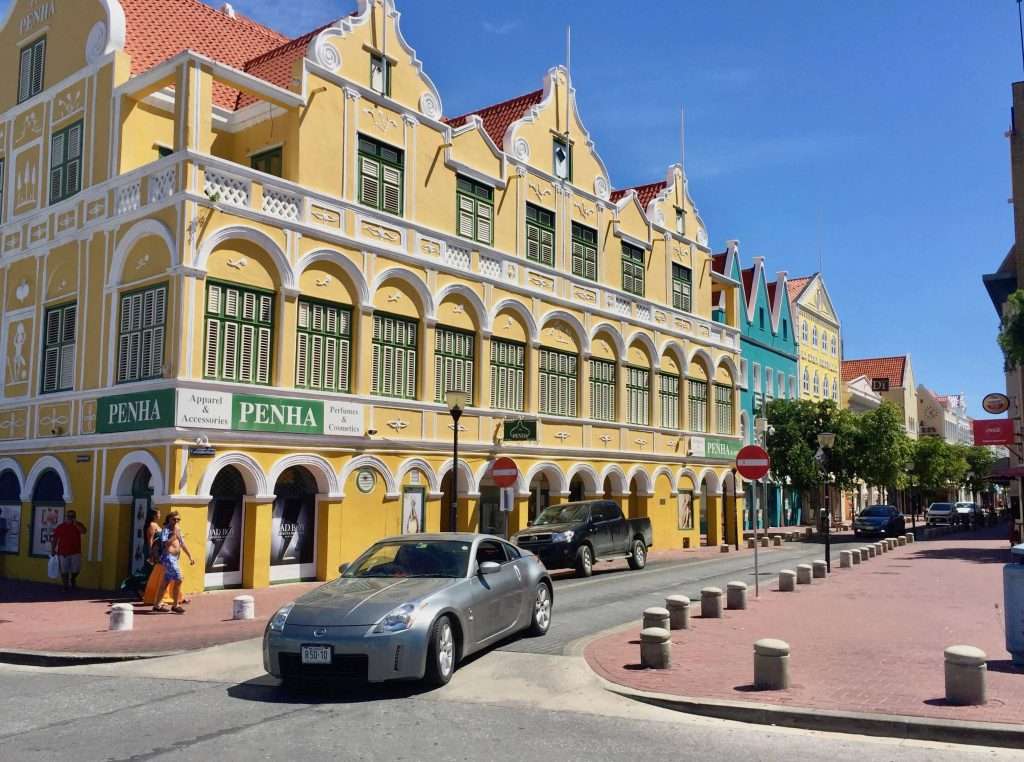
You can’t blame these cruisers, as the island (a self governing province of the Netherlands), is well developed with modern infrastructure and services, but more European than the islands of the Windward and Leeward Islands. The Island was settled by the Dutch around the same time in the 1600’s as Cape Town in SA, so architecturally the Dutch Colonial style buildings with the Amsterdam gables are similar, but more colourful in Curacao. Because it is a world heritage site, modern buildings have to conform in a stylised fashion.
Dutch gables.
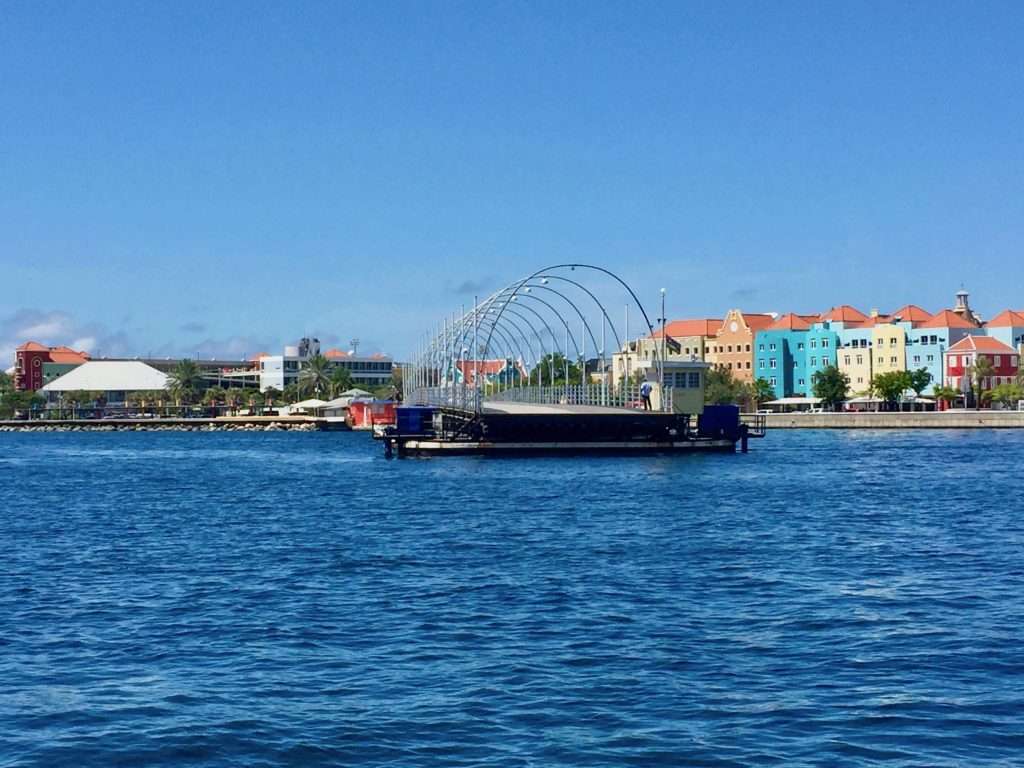
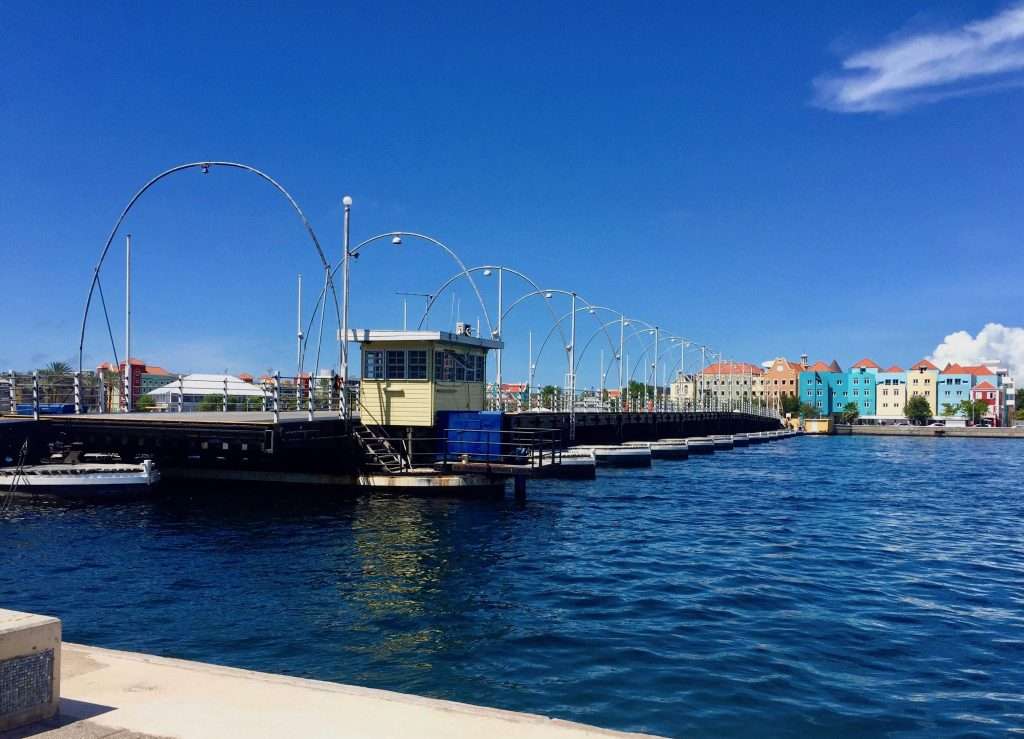
The 1888 Queen Emma floating bridge busy closing.
Almost closed.
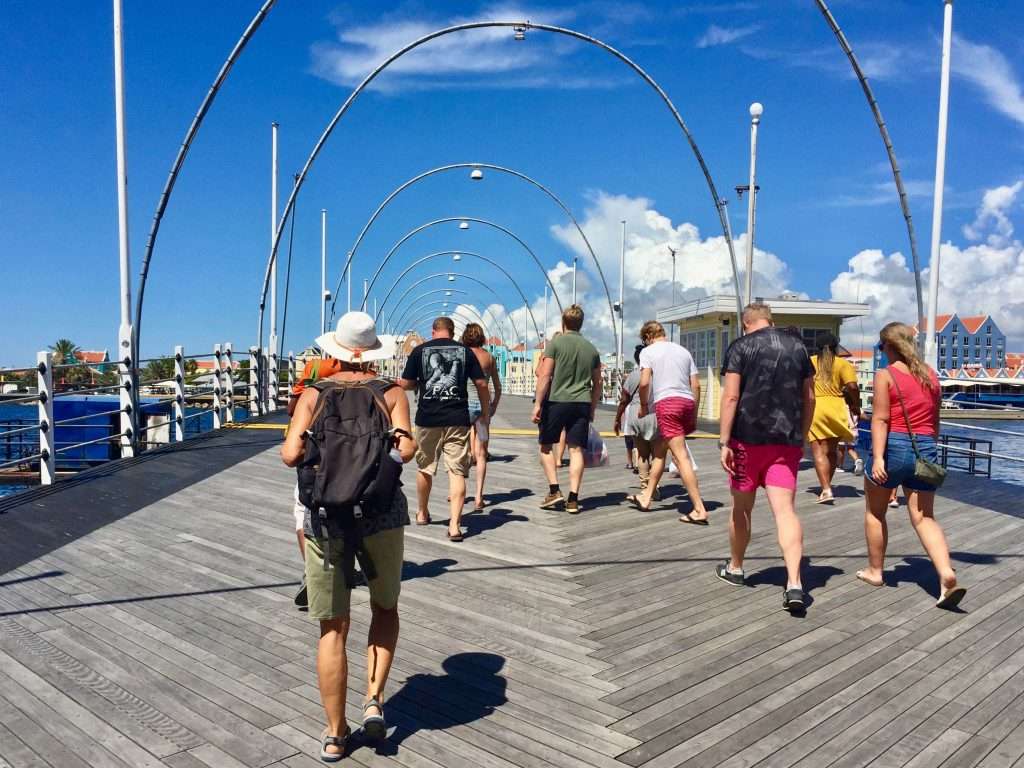
The pedestrians walk over.
The official language is Dutch, but culturally, the island has many influences such as Spanish, Portuguese, French, Afro-Caribbean, Latin American, Asian and Jewish. English is widely spoken, but the native tongue is Creole of Portuguese descent.
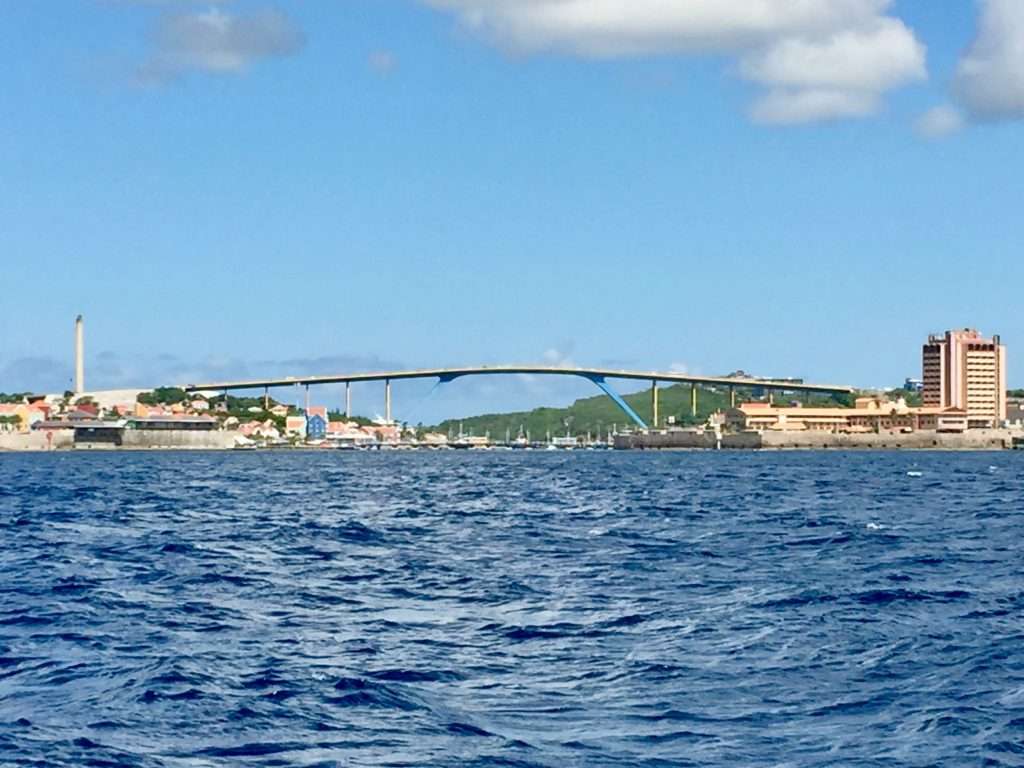
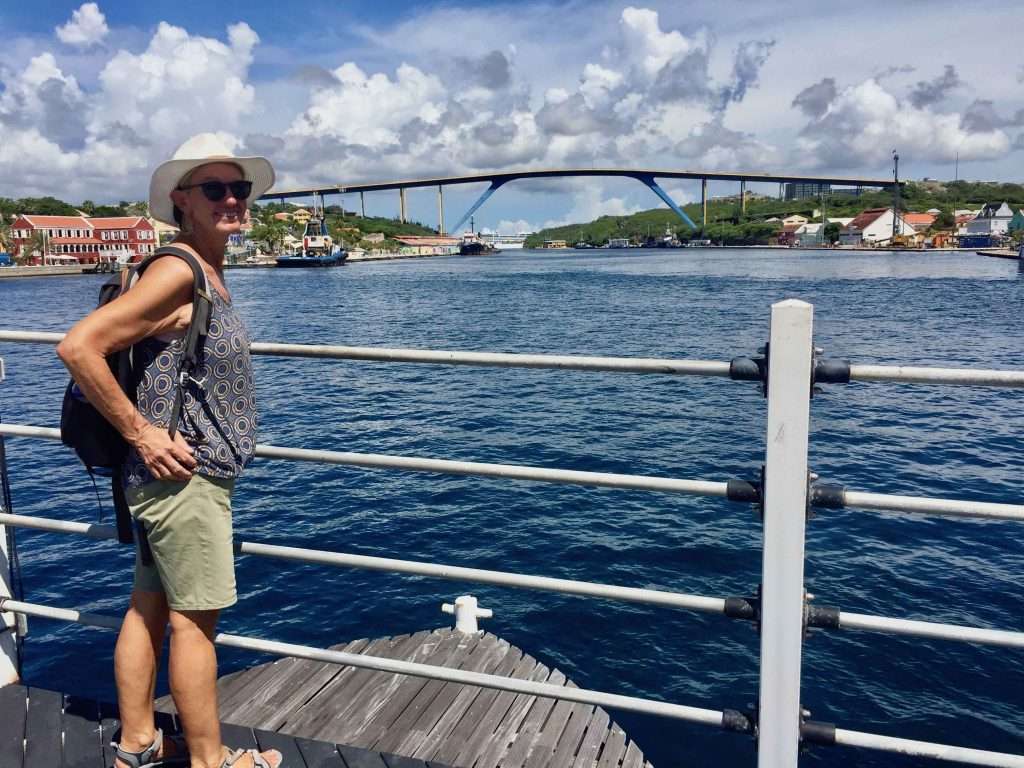
The high Queen Juliana bridge.
Colourful buildings on the dockside.
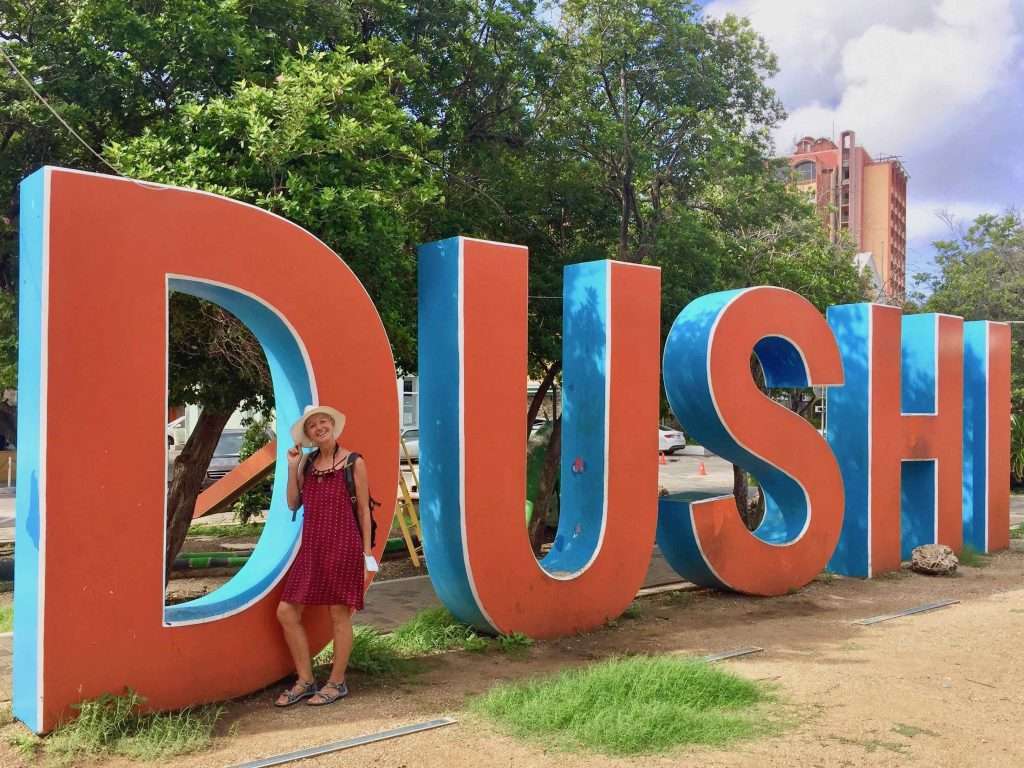
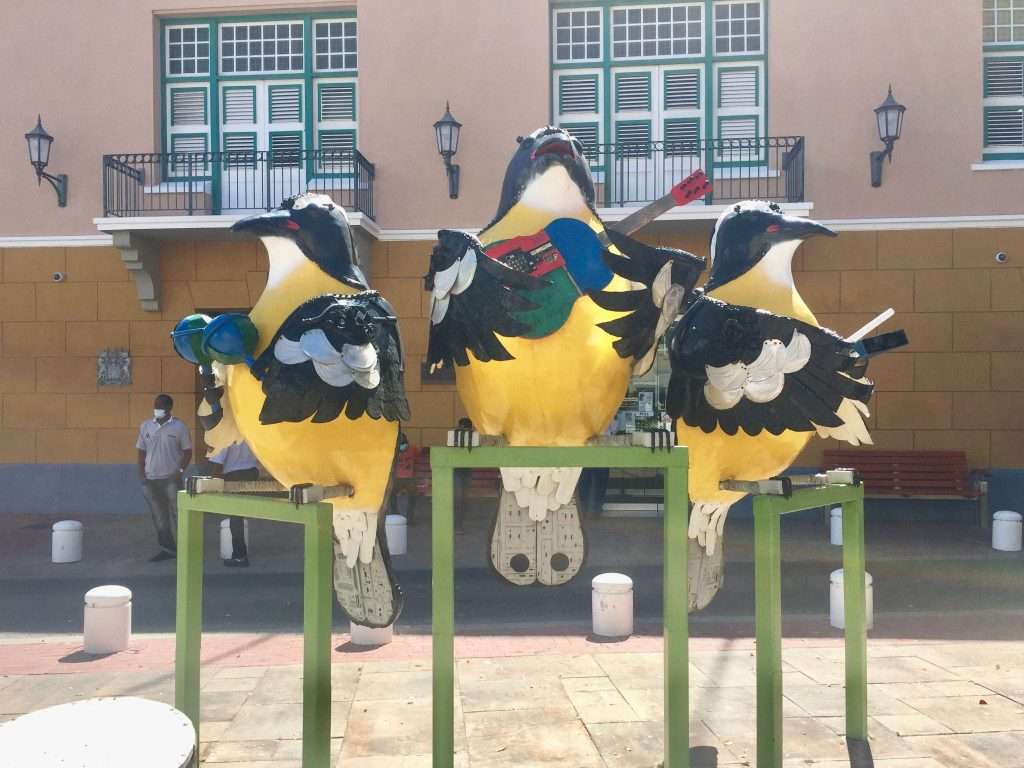
Lots of public art.
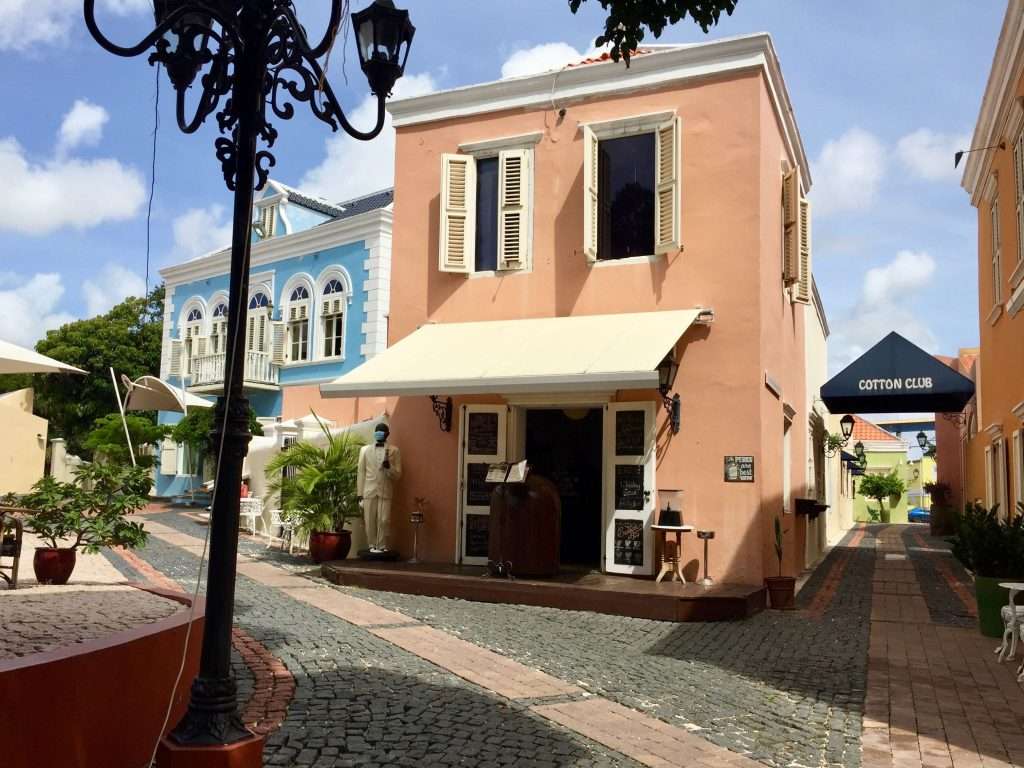
On a street corner.
The morning after our arrival, we took a bus into Willemstad and walked for miles to check in with Customs, Immigration and the Port Authority, staffed by friendly and efficient people, all apologising for the fact that the offices are situated so far apart. In the evening we had Ed and Natalie on “SV Safari” from Canada over for drinks – they had helped us in the morning with information on how to get around. They have a beautifully restored Morgan monohull and two dogs.
Ed and Natalie have a car and they invited us along on their weekly shopping trip to the supermarkets two days later. The supermarkets are well stocked with fantastic cheeses and cheap Amstel beer. The selection of fresh fruit and veg is of good quality and reasonably priced. We look forward to exploring Curacao further, until the end of November, but in the meantime, we conclude with a few photos around the Spanish Water.
Fisherman’s harbour housing, next to which we tie our dinghy up at the dock.
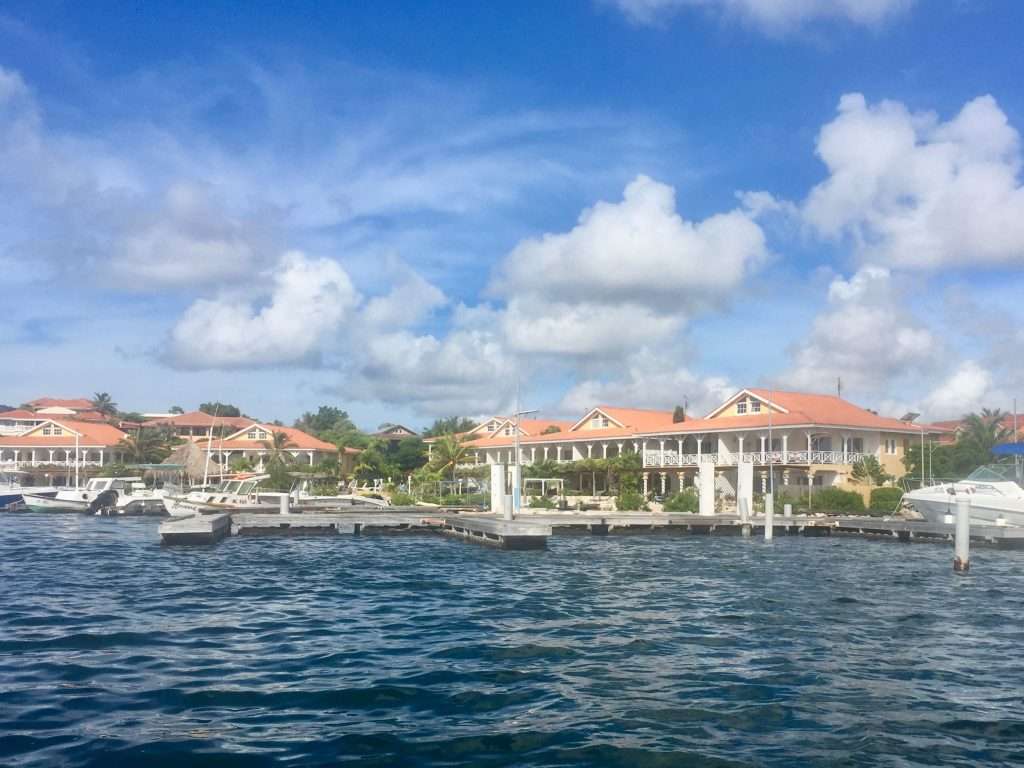
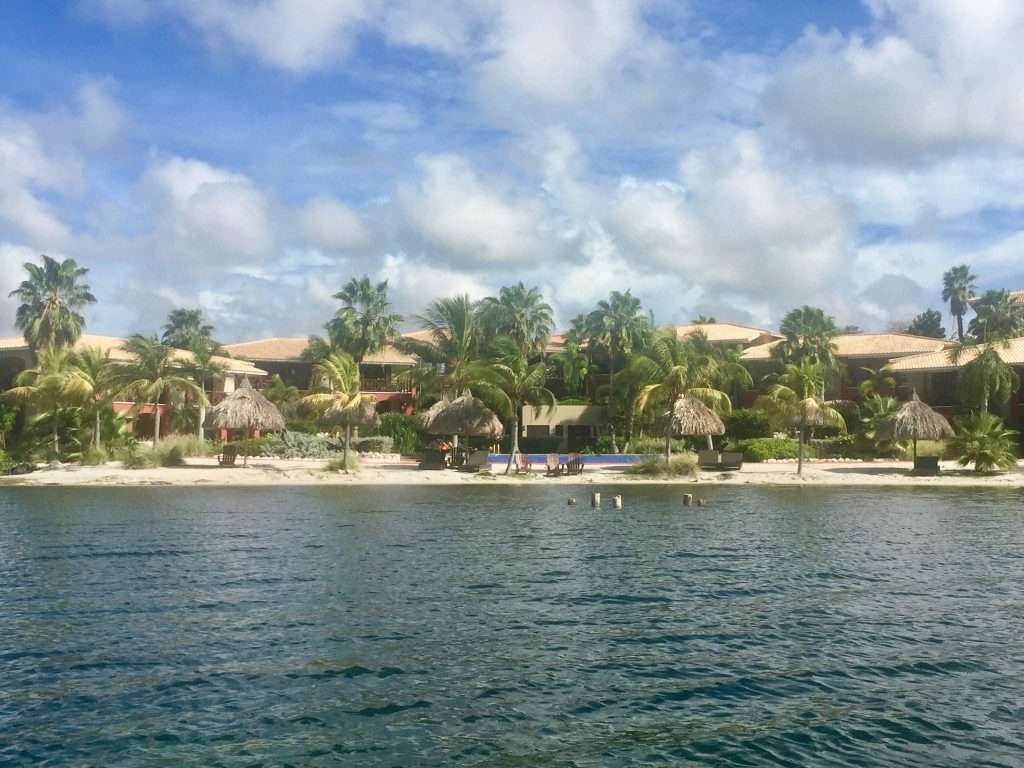
A holiday resort opposite Fisherman’s harbour.
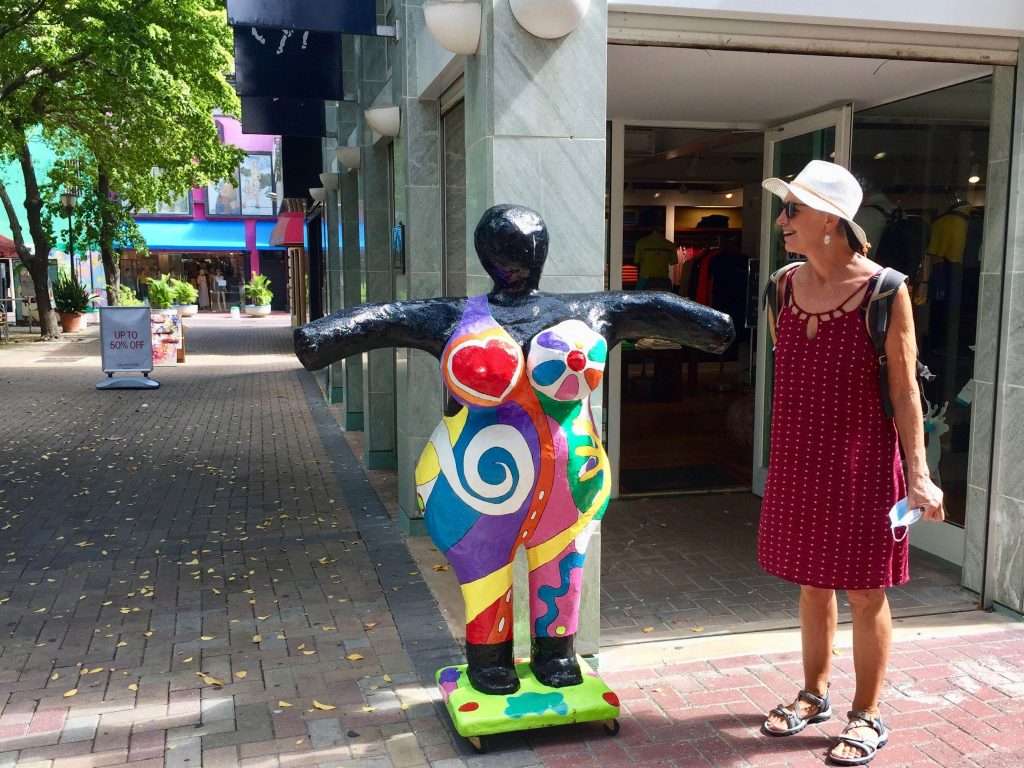
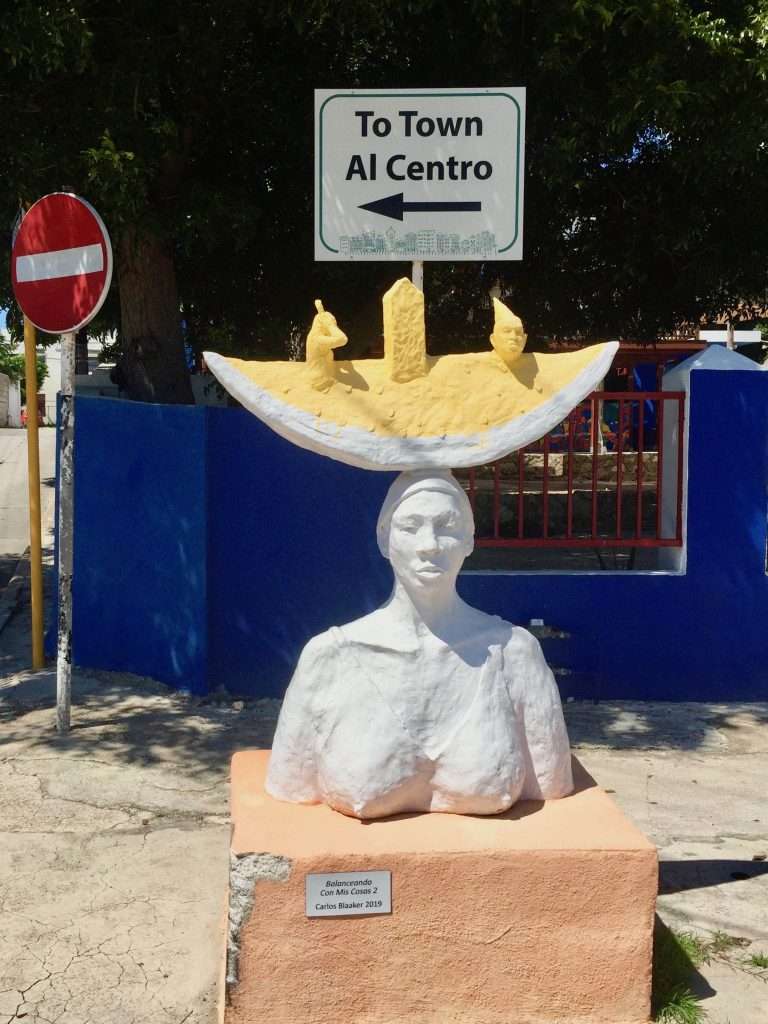
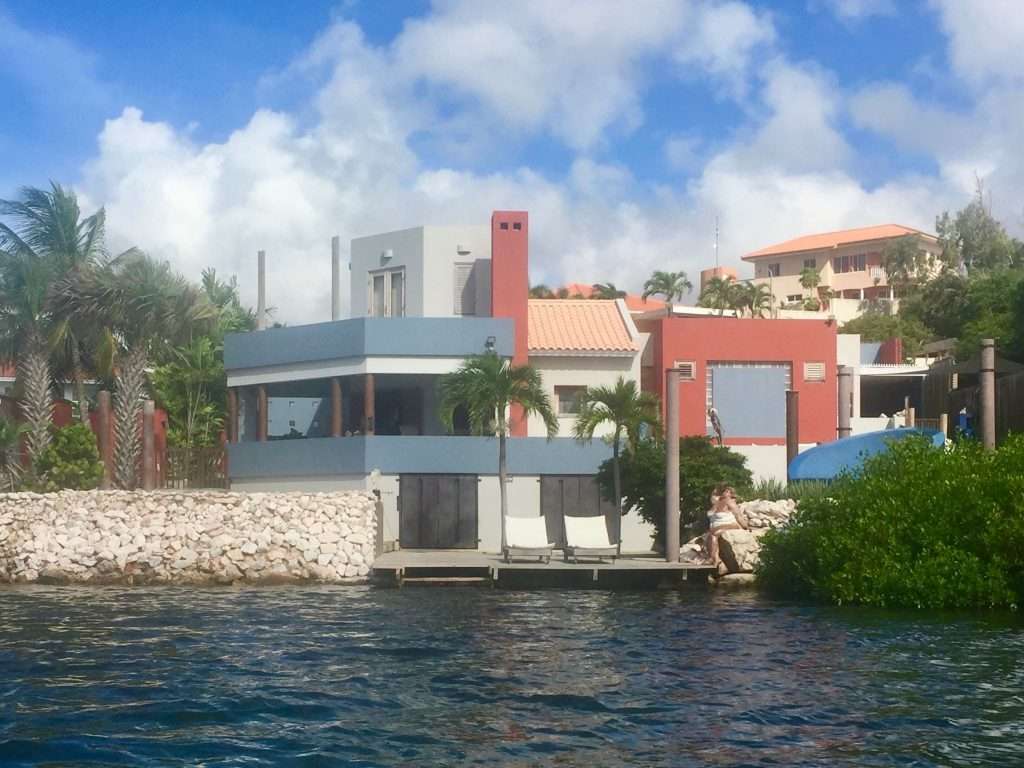
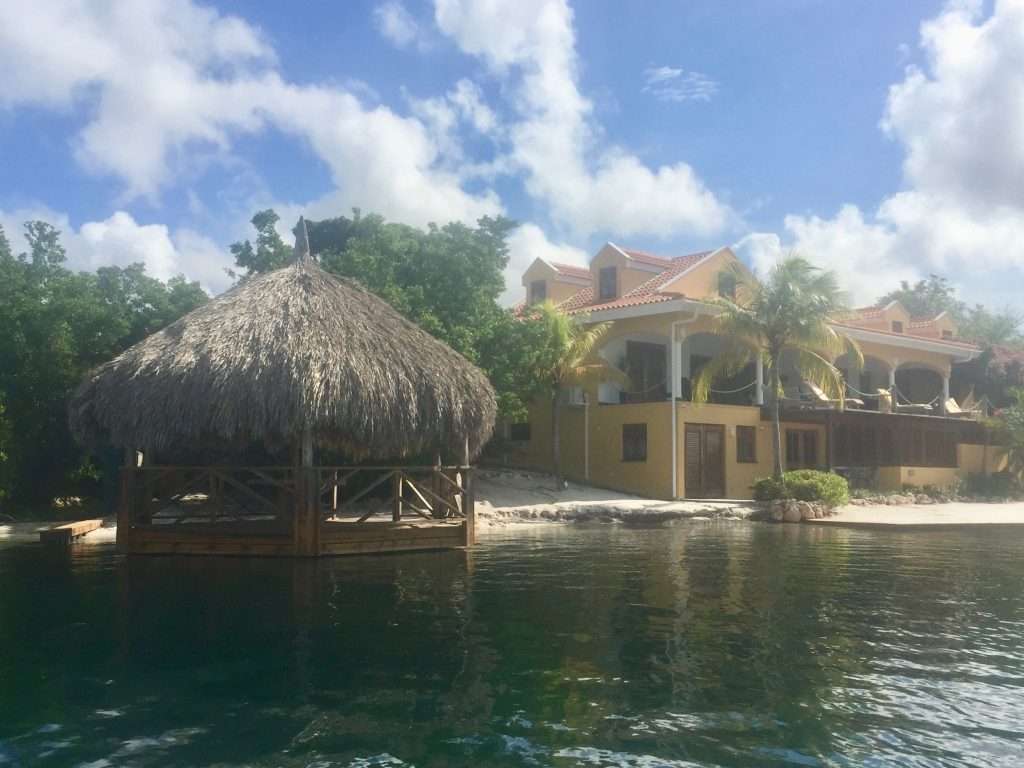
A colourful house next to our anchorage – the voluptuous lady is a statue!
As we approach the end of October, we are still in Grenada, trying to get permission to sail to the ABC Islands (the former Dutch colonies of Aruba, Bonaire and Curacao) north of Venezuela. To our south, Trinidad is still closed. The Covid-19 pandemic has certainly messed up our plans, which at this point, should have seen us returning to Trinidad to launch Esprit back in the water, after touring Cuba, the Aztec sites of south Mexico and Guatemala.
Still in Grenada.
We will visit those countries from Australia, when the Covid thing settles down – hopefully in about 2-3 years time. The music of the “Buena Vista Social Club” from Cuba has to suffice for the moment, despite Ben from Vermont SA, dismissing them as “old chestnuts” (“old chestnut” actually means, a stale joke, story or saying).
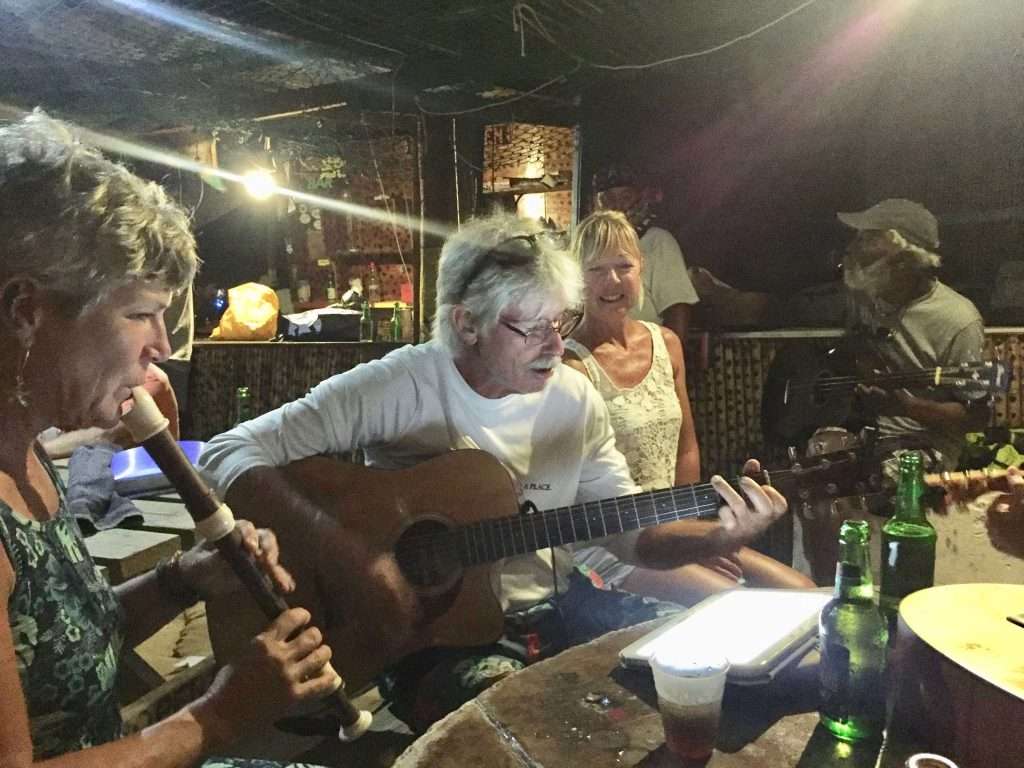
In the meantime our social life here in Grenada carries on unabated, with music evenings, walks, lunches and drinks with friends.
At the music jam: Richard serenading his wife on her birthday.
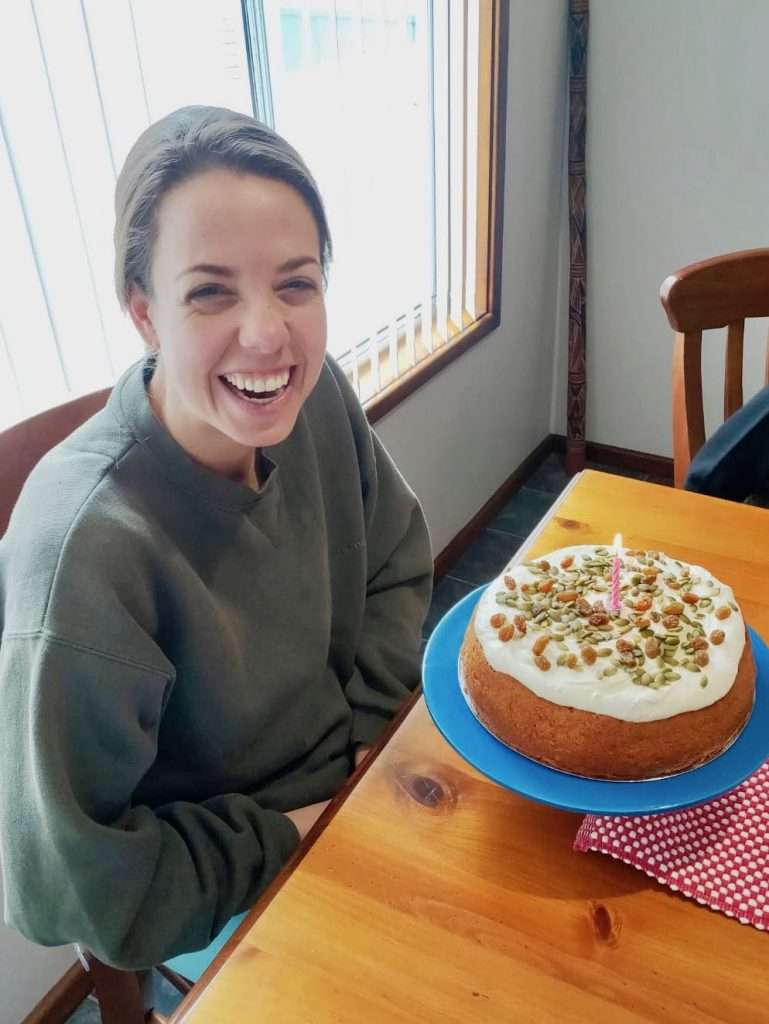
The coup de grace: a flame thrower birthday cake.
Last night, the 26th October, we were on our way to the Cruiser’s Reef Bar in Clarks Court to listen and dance to the “Leaky Seacocks”, but on the way there, we had to turn the dinghy around, when a heavy rain squall hit us. We got drenched on the way back and were just in time to take down all the canvas shade covers, before a massive storm with gusty winds hit Esprit a half an hour later.
Fortunately, the“Leaky Seacocks” (Granada’s “premier” rock and roll band) will be on at Roger’s Barefoot Beach Bar on Sunday arvo, with “Bilge water” as the support act. We will try to get there after brunch at the West Indies Brewery.
The West Indies Brewery is becoming a habit – Jan, Noel, Ceu, Annie and Jane.
News update: Great arvo with the Seacocks but Bilge water was a bit of a disappointment – an ocker Aussie bloke reciting a Banjo Paterson’s poem “Clancy of the Overflow” (1889) to a puzzled crowd, before launching into the worst rendition ever of “Beds are Burning” by Midnight Oil. The Oils Peter Garrett will be in tears.
The Leaky Seacocks.
The dancers.
Bill (80 year old Aussie solo sailor) is a faster beer drinker than me.
Aargh! His bed is burning.
We rented a car for three days to explore the island. Our route took us up the east coast to visit Grenville, the Belmont Estate and the river Antoine Rum Distillery. We stopped in Sauteurs at the north of the island for lunch, before driving down the west coast to Gouyave, and turning inland to see some waterfalls and Grand Etang Lake. We managed to climb up to Fort George in St George’s, visit two museums and do shopping.
Church in Grenville.
Belmont Estate.
Annie and Kelly pointing out the cocoa fruits.
The east coast of Grenada – battered by the easterly winds.
Buying fruit and veg next to the road.
Downtown St George’s.
Walking up to Fort George.
Old gun emplacements at the top.
View down to Port Louis Marina.
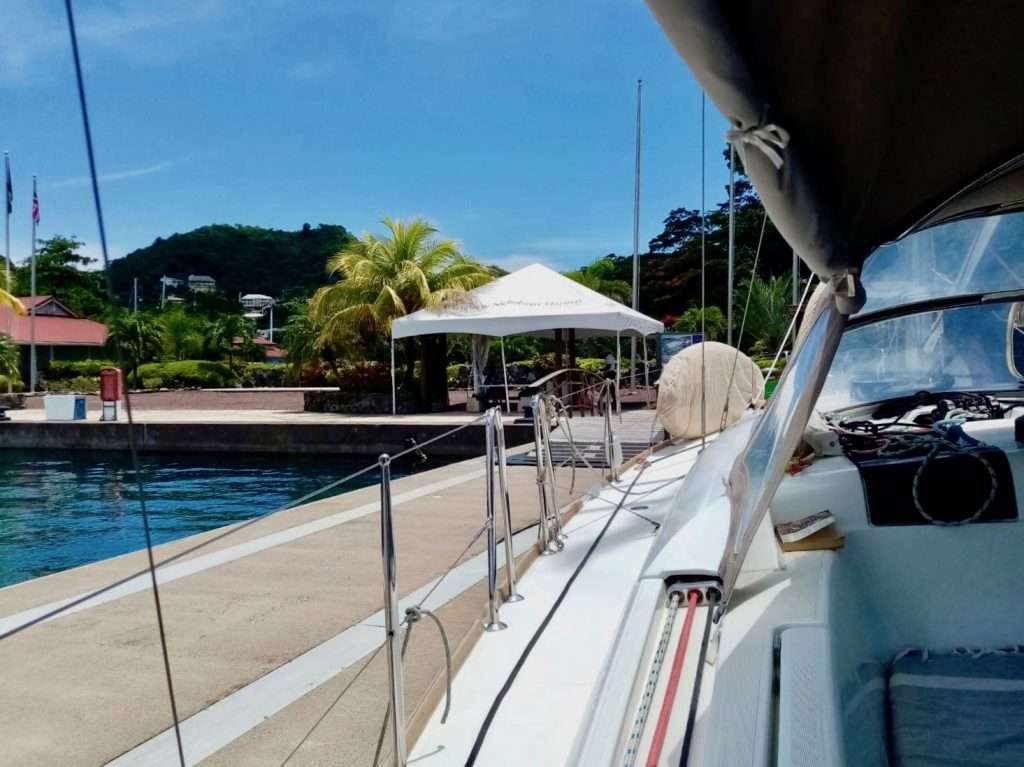
On the 31st October we sailed from Secret Harbour to St George’s to meet up with some friends at the Victory Bar in Port Louis marina. Saturday night is their music night and we enjoyed good music and good food.
A great duo – this young guy on steel drum and the lady called “The Voice”
During our Sunday morning walk along Grande Anse beach, it started raining and continued bucketing down through the afternoon and night. The next morning we set sail for Carriacou Island, (Part of Grenada, about 30 nm to the North) and anchored halfway there at Corn Store Bay on Ronde Island. The next day we had a wet sail in a howling wind and anchored in Tyrell Bay in the south of Carriacou.
Grande Anse beach before the rain deluge.
Tyrrel Bay offered us the opportunity to explore the town and get rid of our trash, before we sailed to Anse La Roche for lunch the next day. We anchored overnight in Hillsborough, the main town and had our hair cut the next day. On the way back to Tyrrel Bay, we stopped for lunch at Paradise Beach, opposite Sandy Island.
Beautiful Anse La Roche bay with Tim’s beach bar.
Hillsborough jetty.
Hillsborough town.
Paradise Beach.
Sandy Island.
Armin Stauch, a fellow sailor who kindly included a part for us in his order from the US, sent us a text to say our new Suzuki outboard propellor had arrived in St George’s. So, on Friday the 6th November we sailed back to Grenada to collect the prop and checked out with Customs on Saturday morning. We will set sail for Curacao at 4pm this arvo for the two day and 14 hour crossing – looking forward to do some distance again. We will update you on the ABC islands in our next post. Stay safe and be happy!
Tyrrel Bay: Machineel tree warning – seen all over the Caribbean.
Tyrrel Bay: A design from Popular Mechanics.
Finally, some news from our girls: Karen, with her punishing hours as an orthopaedic surgery registrar, still finds time to do a masters degree in surgical education. With her colleague Sav, they have become published authors. Michelle, seems to have found a work/play balance, and have climbed Rabual volcano in PNG with some friends.
Work: A food security advisor and a gender advisor walk miles in the rain and mud through remote Western Province PNG wondering where this job will take them next.
Play: Michelle at Kokopo island, with Rabual volcano in the background.
We tied up to the quarantine jetty at St George’s harbour in Grenada at midday on the 9th September 2020, where a nurse and an official were waiting for us. We were informed that because we have arrived from St Vincent and the Grenadines and had been there for more than two months after negative PCR testing for Covid-19, we didn’t require further testing. An hour later, the necessary health clearance, customs and immigration formalities had been done and we were free to go.
The quarantine station at St George’s harbour
The Carenage on “The Lagoon” (St George’s Harbour)
We motored past the more than five dozen boats from other countries tied up in quarantine in the anchorage and dropped our anchor at lovely Morne Rouge beach, a mile to the South west. We were anchored next to Craig and Zena from Melbourne, on their Hunter 49 “Adriana”. They gave us all the pointers for Grenada over sundowners, as they have been here a while.
Morne Rouge anchorage.
Morne Rouge beach.
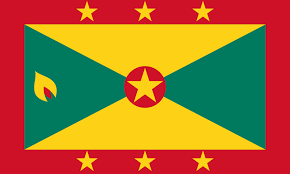
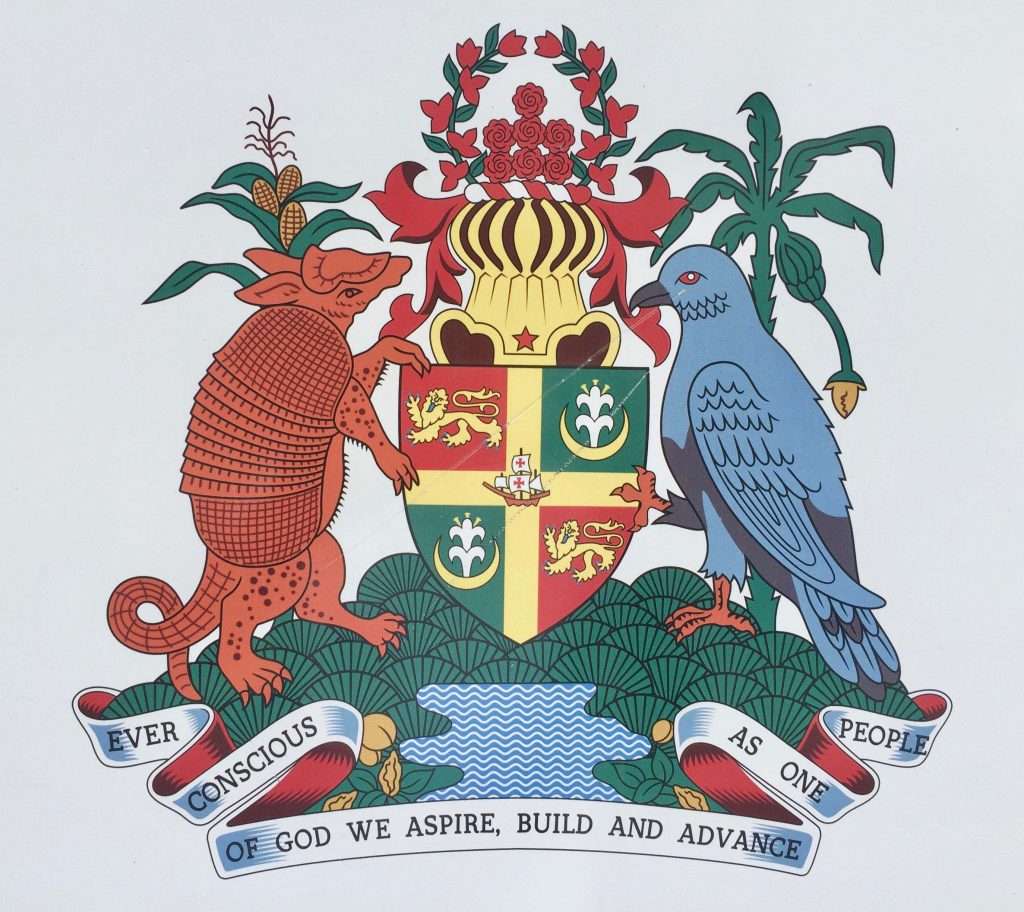
Grenada is known as the spice island, due to the many spices that grow in this lush green island, foremost nutmeg which was first planted here in 1843. Today, Grenada produces one-third of the world’s nutmeg supply and is the largest single supplier. The nutmeg fruits, resembling apricots, encases the nutmeg seed and is in fact, the only object represented on the Grenada flag, besides seven stars, one for each of the country’s parishes.
Grenada flag.
The Spiceland Shopping Centre with a huge IGA supermarket was about 2 kms across the hill. We walked there and found some reasonably priced Californian Chardonnay and other essentials to take back to the boat. The following day, we took a minibus taxi into St George’s to shop for boating equipment at the Island Water World chandlery in St George’s. We bussed back and joined four other Aussies for sundowners at the Plywood Bar.
Grenada coat of arms – a bit more artistic.
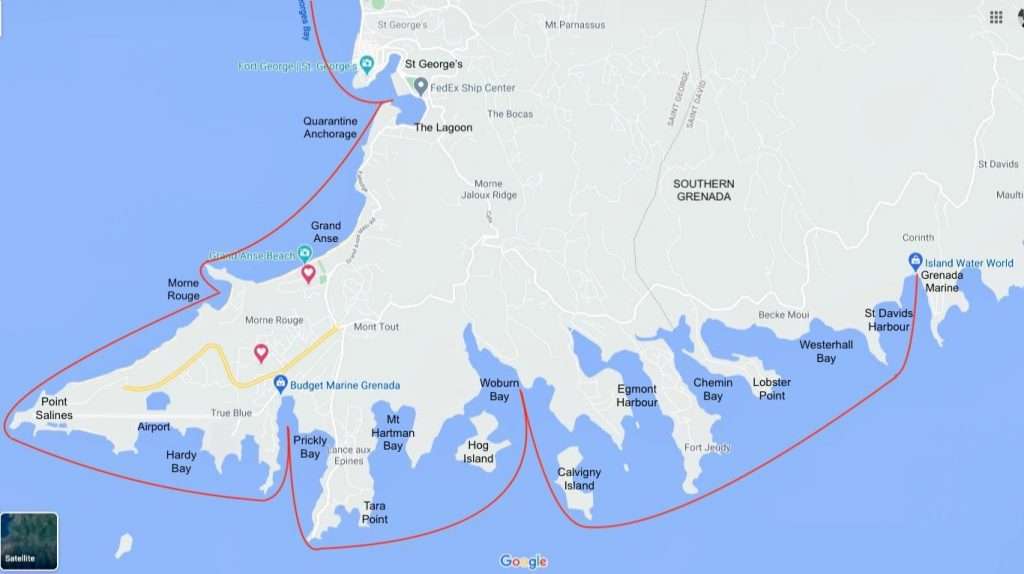
On Monday the 14th we motored south and then east along the south coast of Grenada to Prickly Bay to visit the Budget Marine chandlery and the Ace hardware store for some more parts we couldn’t find in town. On Tuesday it was a 4nm bouncy ride into the wind and swell to Woburn Bay where we anchored. We were joined for coffee by our young Aussie friends Matt and Kristina on “Yotty”, who we last saw in Martinique.
Dirk, Matt, Kristina and Annie.
We agreed that a serious catch up over beers was required the same evening, so we headed to Whisper Cove Marina where the happy hour beers were cheap and the pizzas tasty.Recovery took a day and the next day we took a minibus taxi into St George’s. The minibus taxis run on predetermined routes and will hoot at all pedestrians to offer them a lift – they will stop anywhere and charge EC$2.50/person (AUD 1.30), regardless of distance. Despite the narrow winding roads, the drivers all aspire to a Formula 1 racing career – with white knuckled passengers (except for the driver’s offsider, who opens and closes the door and collects the fares).
View from the taxi stop above Woburn Bay – Hog island in the centre.
The social life in Woburn Bay was quite busy, so the week that we waited to haul out our boat at Grenada Marine, slipped by quickly. There were things to do while we waited, so we had all our gas bottles filled with propane, took a minibus into St George’s twice to get boat parts and buy wine. We were delighted to find Hardy’s Chardonnay and Cab Sav from Australia, in 3l casks at AUD 30/cask – not cheap, but hey! Infinitely better than some of the rotgut on sale here.
Karen our daughter celebrated her 32nd birthday on the 21st September in Newcastle, NSW.
Happy 32nd Karen!
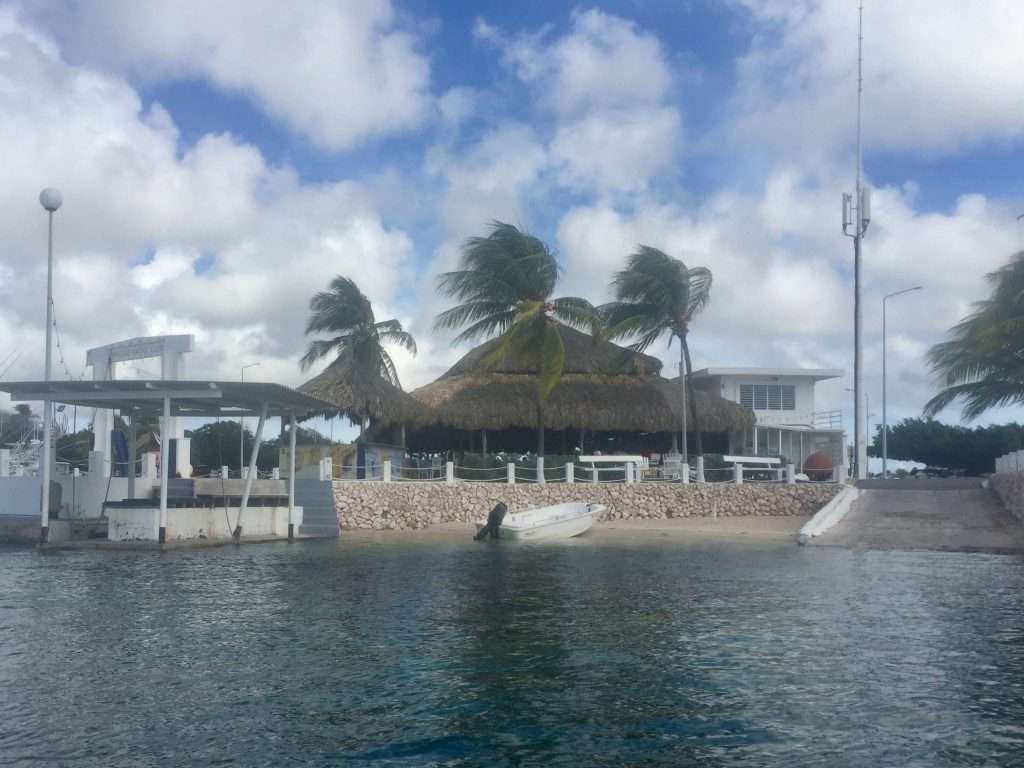
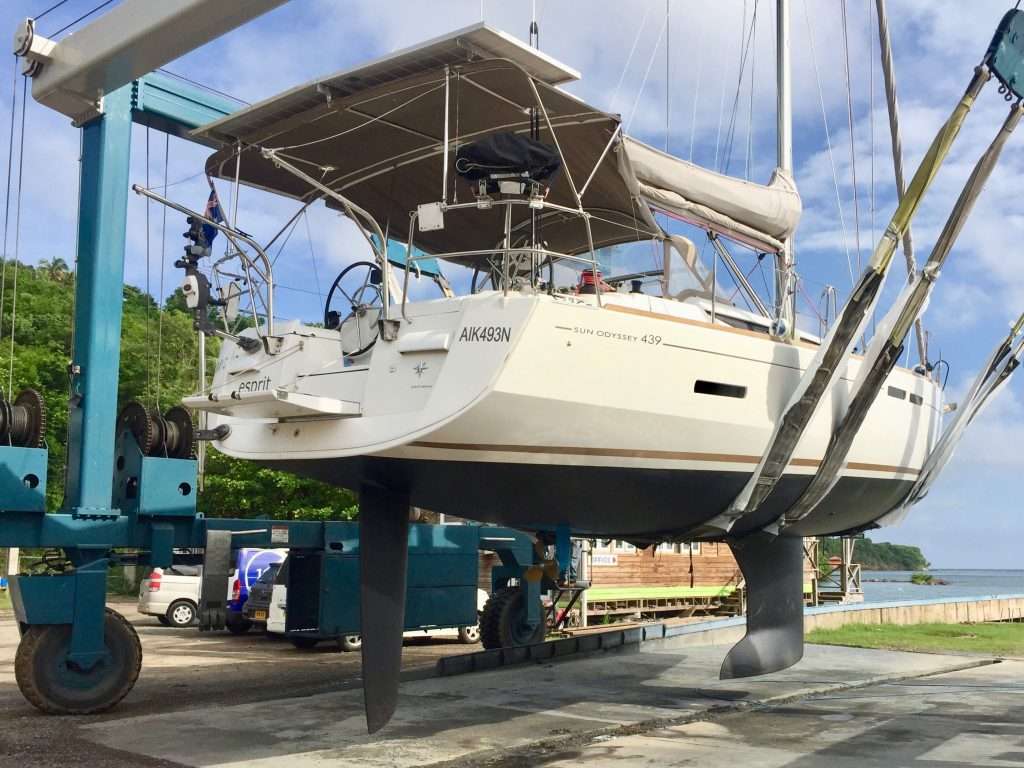
Grenada Marine boatyard and travel lift.
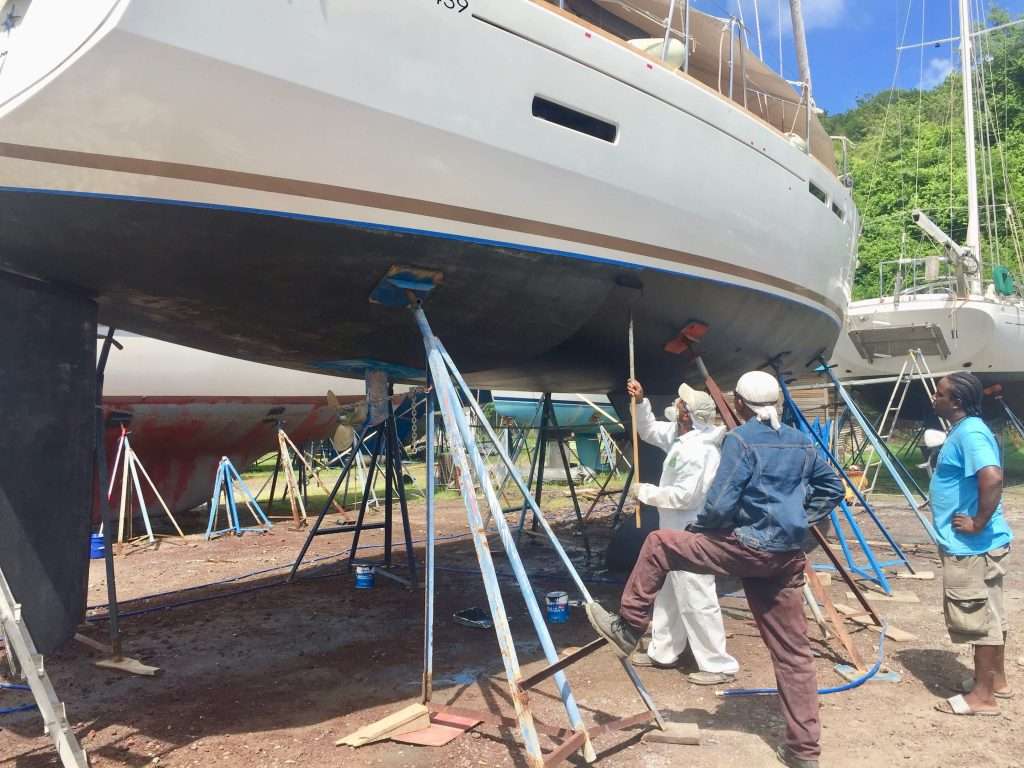
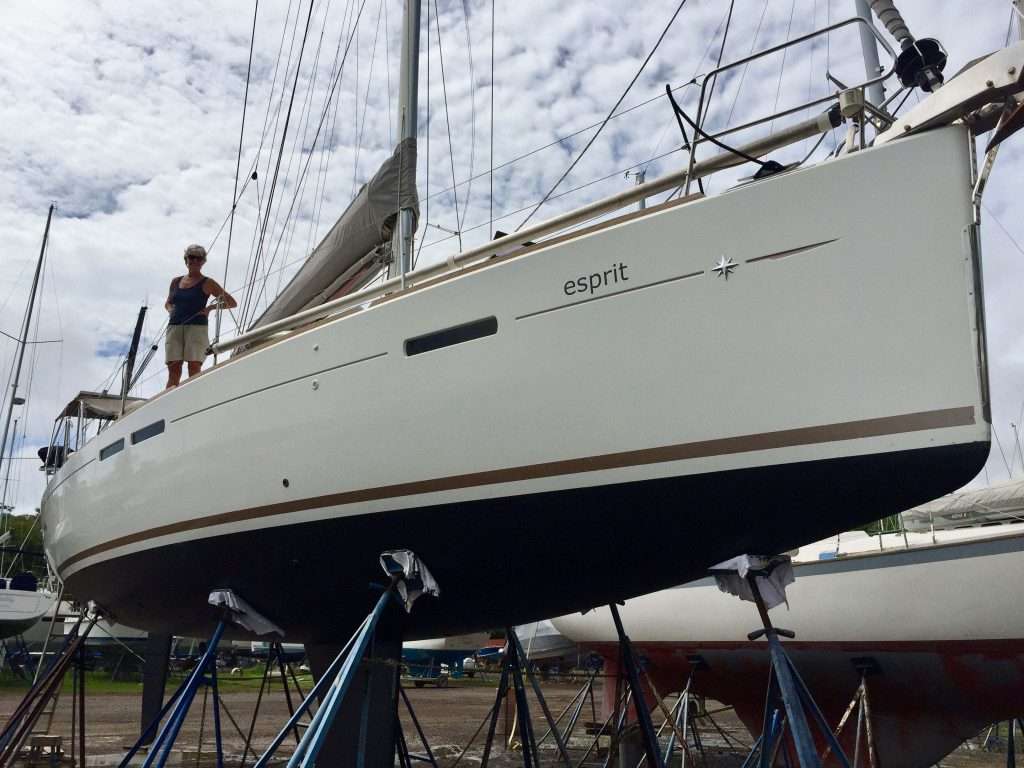
On the 22nd September, Esprit was hauled out and pressure cleaned at Grenada Marine. The hull was scraped and then sanded before application of three coats of anti fouling. Gelcoat repairs were done to the many scratches above the waterline, picked up over the last two years in the crowded Mediterranean harbours.
Grenada Marine – Laura’s Bar on the left.
The topsides were then polished and while this was done the workshop extended our davits by 300 mm and fabricated a new s/s protective strip for the bow. The work progressed slowly because of intermittent heavy rain and “liming”. The southern windward islands lifestyle of “liming” means chilling, relaxing and chewing the fat. This cuts productivity by 30%, so that the expected 7 days on the hard, dragged to 10 days.
Painting the first coat of anti fouling, – the two “supervisor’s” are busy liming.
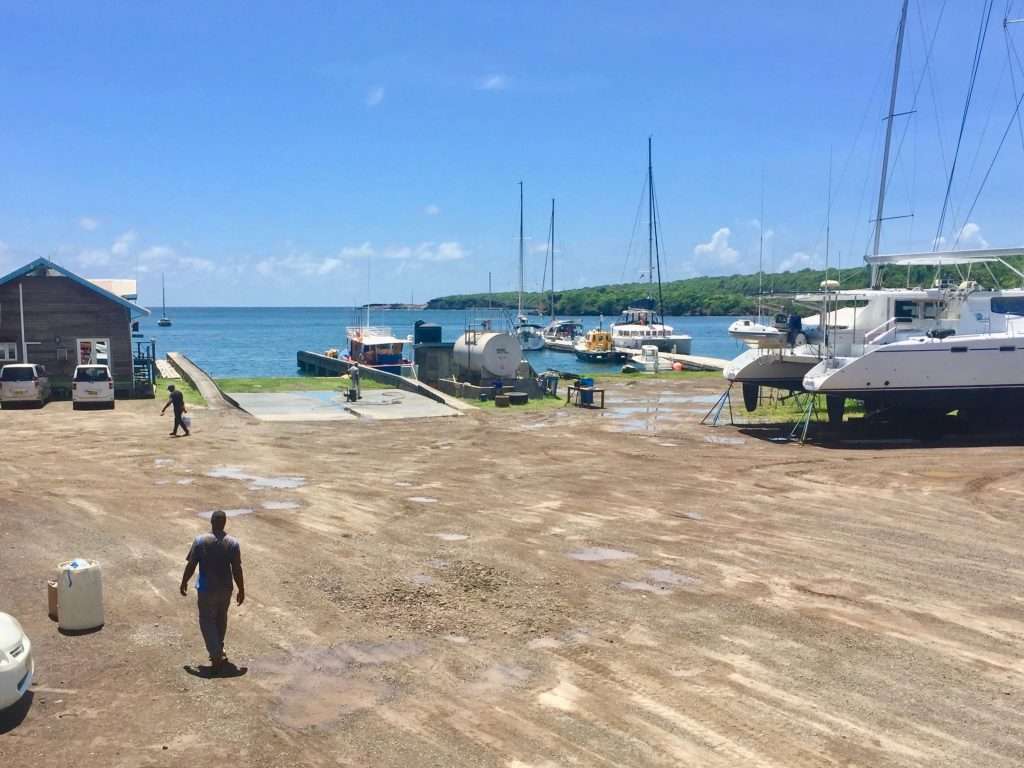
We have not seen an attractive boatyard in our more than four and a half years of travelling and Granada Marine wasn’t an exception. The up and down the ladder to go to the toilets and showers, the mud, the mozzies and the sandflies, (no-see-ums) and general chaos can be challenging and we were therefore relieved to launch Esprit back into the water on the 1st October 2020.
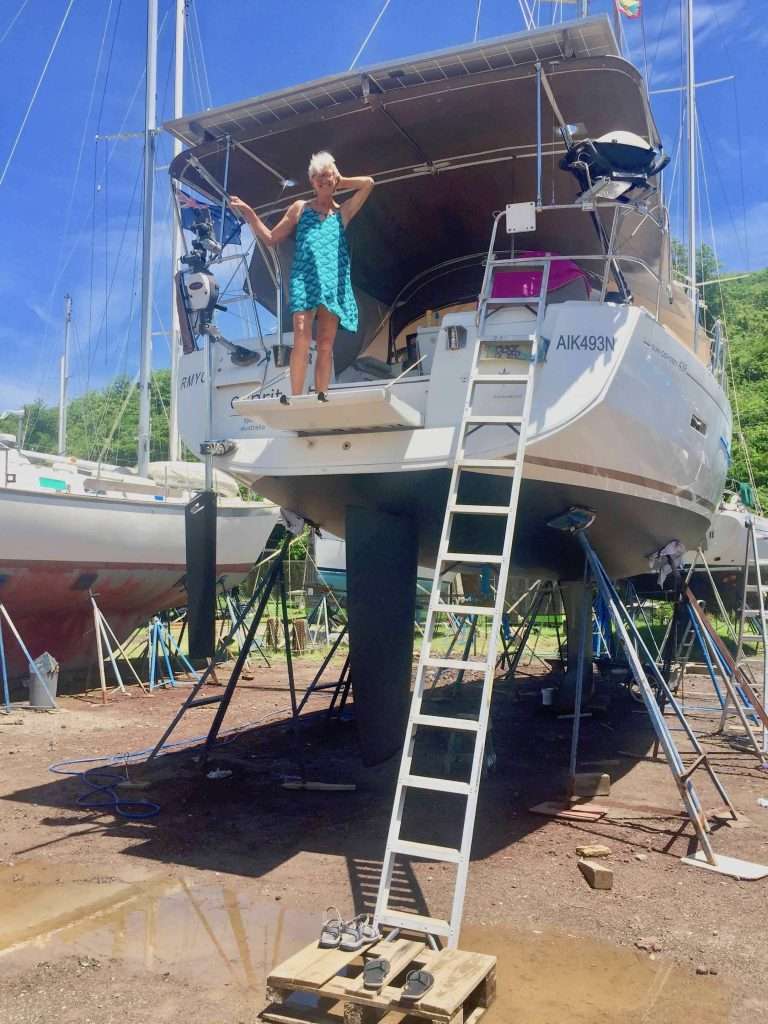
Annie’s home on the hard.
View from our cockpit over the muddy yard.
Annie making friends on her morning walks.
Evening respite at Laura’s bar and restaurant.
After re-launching, it was late afternoon, so we tied up to the dock for the night to leave the next morning in a freshening wind from the south. We motored 2 nm to Westerhall Bay, which is very sheltered from the southerlies, which by the evening, had increased to 25 knots and torrential rain. We decided to stay put until the two systems to the northwest of us, moved on to Mexico.
Gleaming hull with new s/s bow protector, before launching.
Heading back to her natural environment.
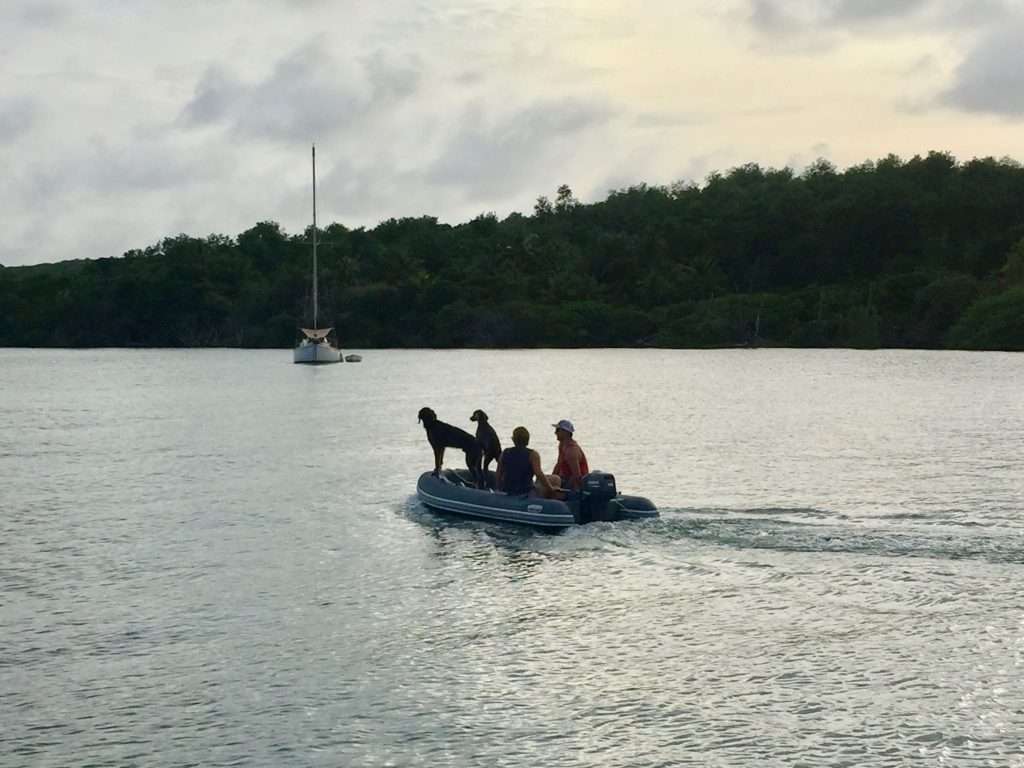
Matt and Bonnie, our yard neighbours for a week, taking their dogs back to their boat.
The stay in Westerhall also gave me the opportunity to unpack the main food cupboard to dismantle the shelving and linings, to remove the lentils from a torn packet, below the floor, before they started sprouting. I also fixed two shopping trolleys with broken wheels and serviced the anchor winch.
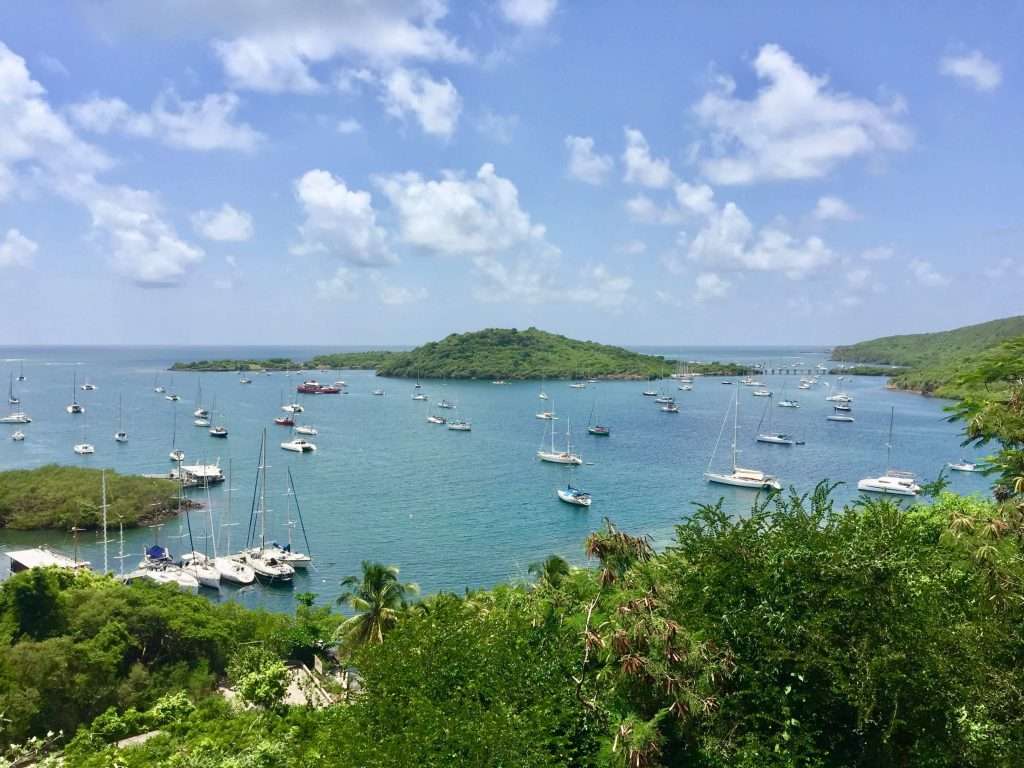
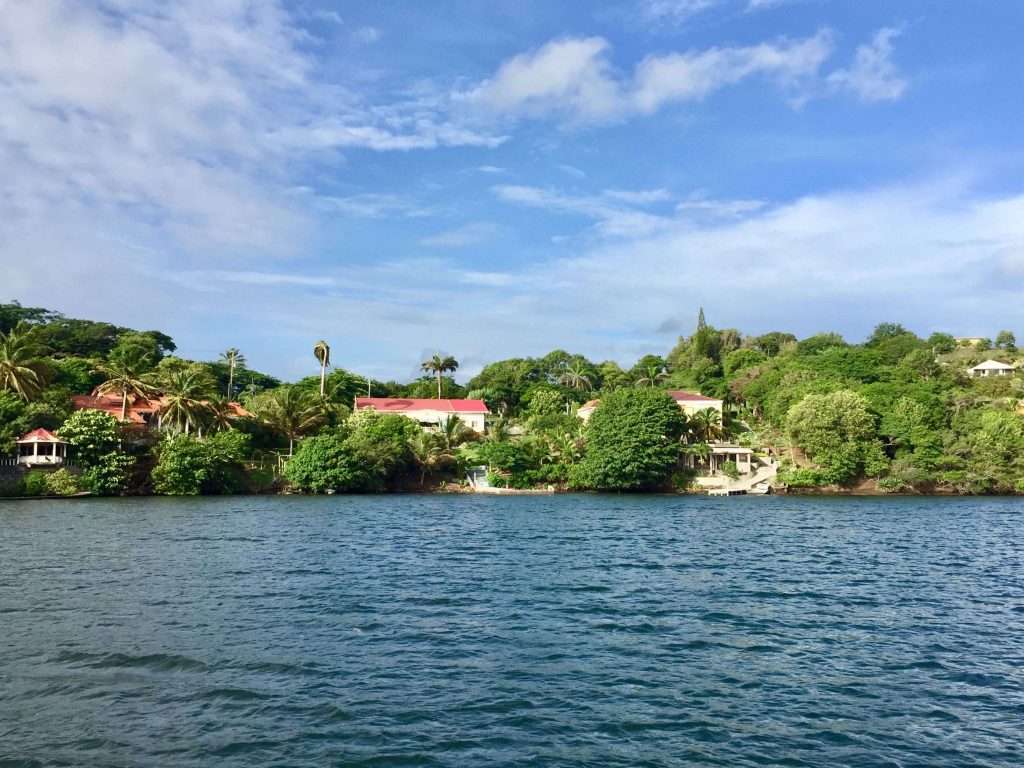
Westerhall Bay.
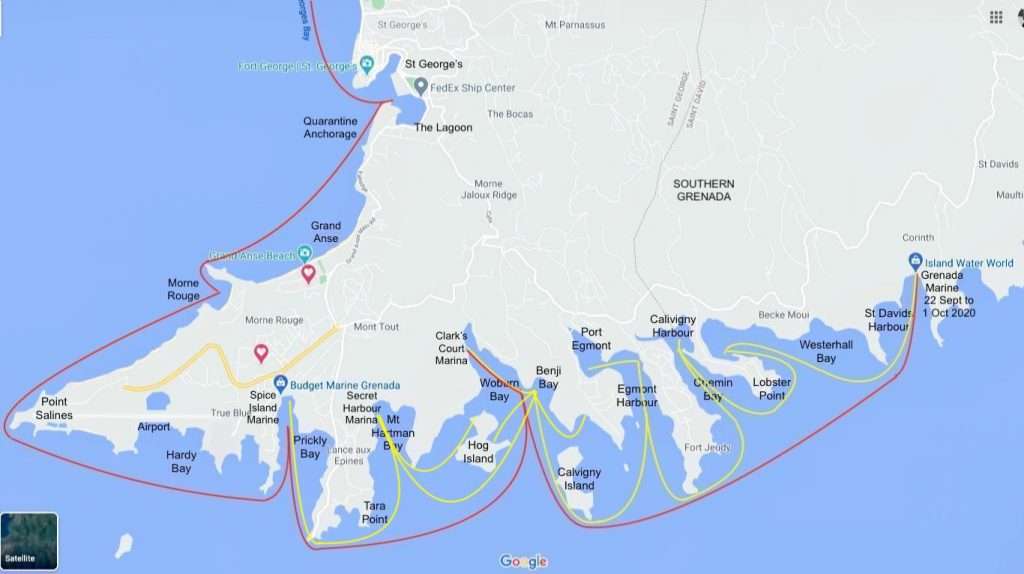
There was no rush to get back to Woburn Bay to the west, so we visited a few more bays on our way back. After Westerhall Bay for two days, we anchored in Calivigny Harbour, at the top of Chemin Bay, where we did a walk to the nearby SOG supermarket for provisions. The next anchorage was at Port Egmont (a very good bolt hole in case of a hurricane), before motoring to and anchoring back in Woburn Bay on the 6th October.
Calivigny Harbour.
Port Egmont.
It happened to be Tuesday when we re-anchored at Woburn Bay, so we visited Whisper Cove Marina for happy hour and pizzas and to catch up with the regulars we have met there before.
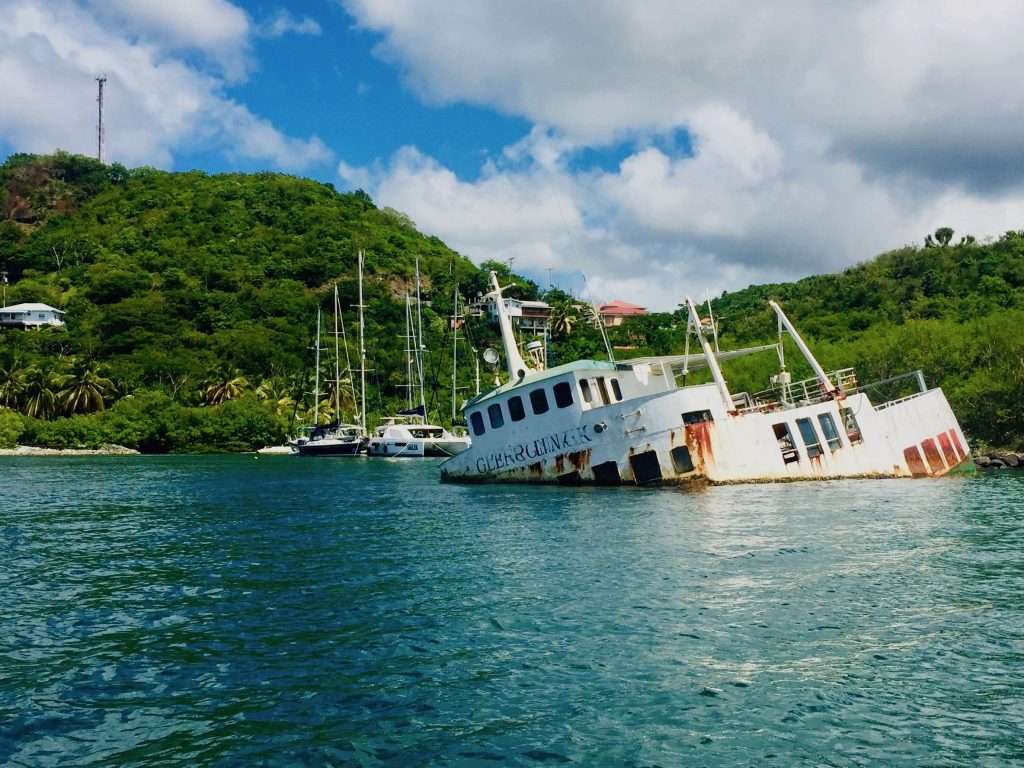
The wreck off Whisper Cove Marina.
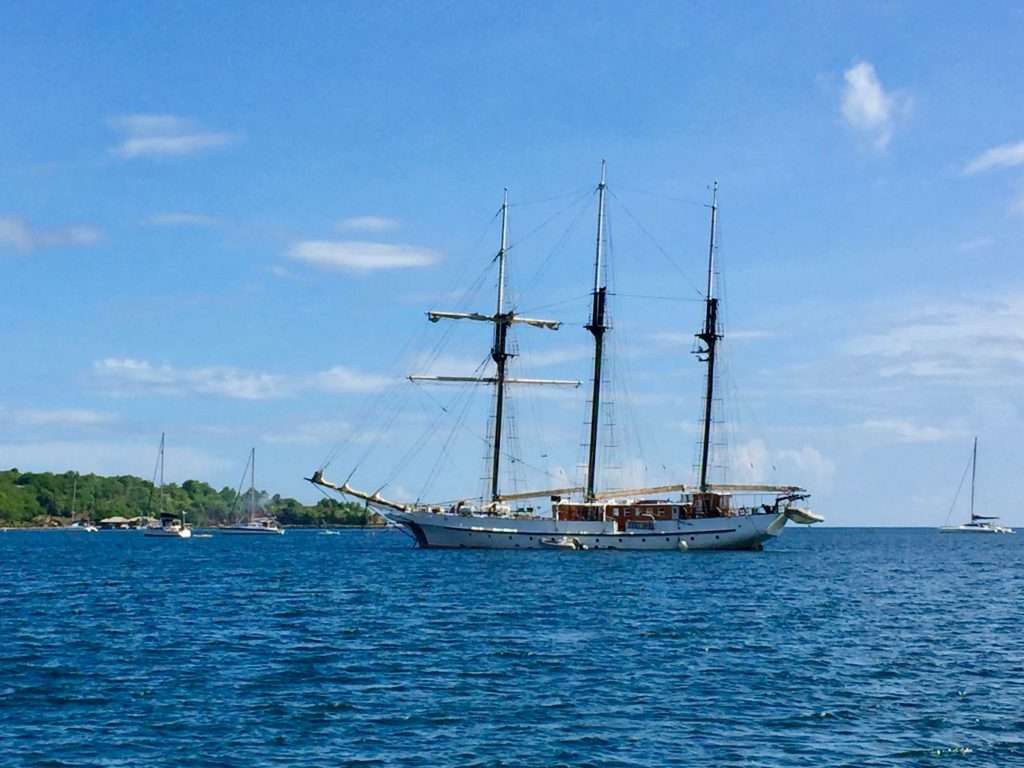
The three master we were anchored next to.
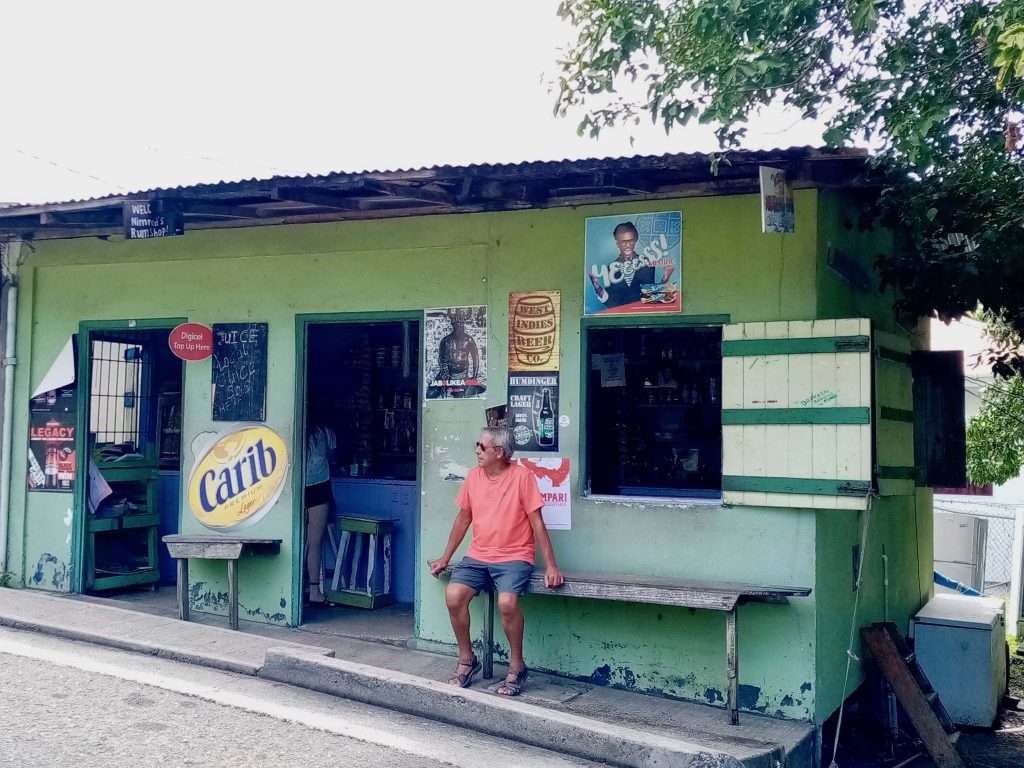
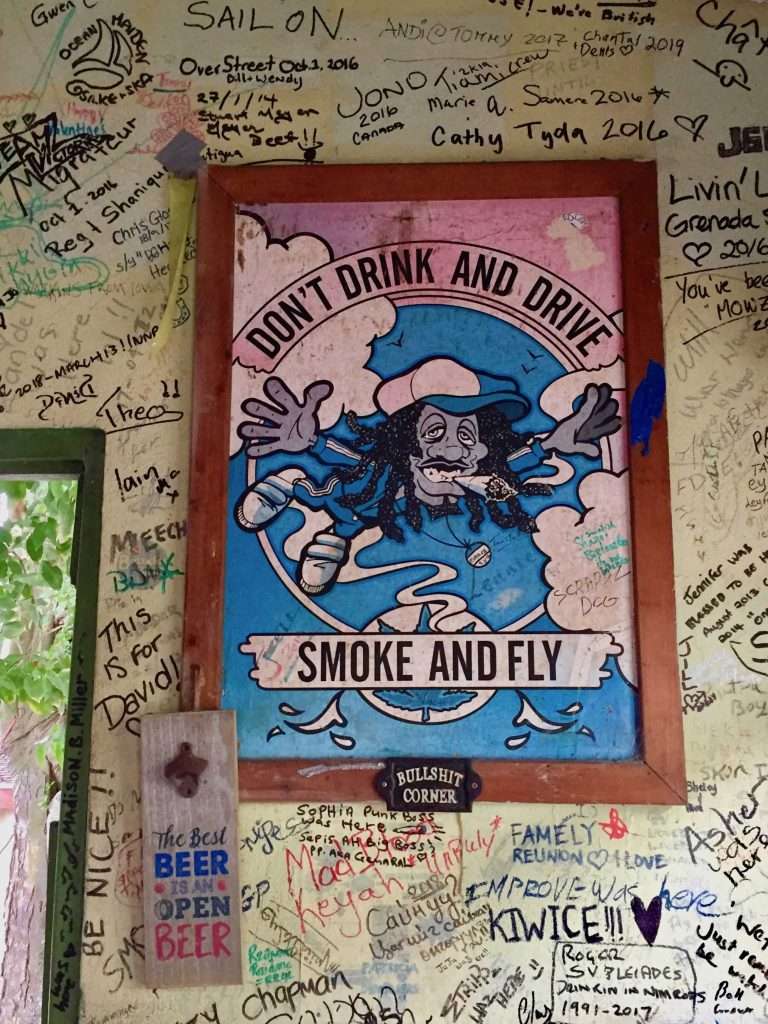
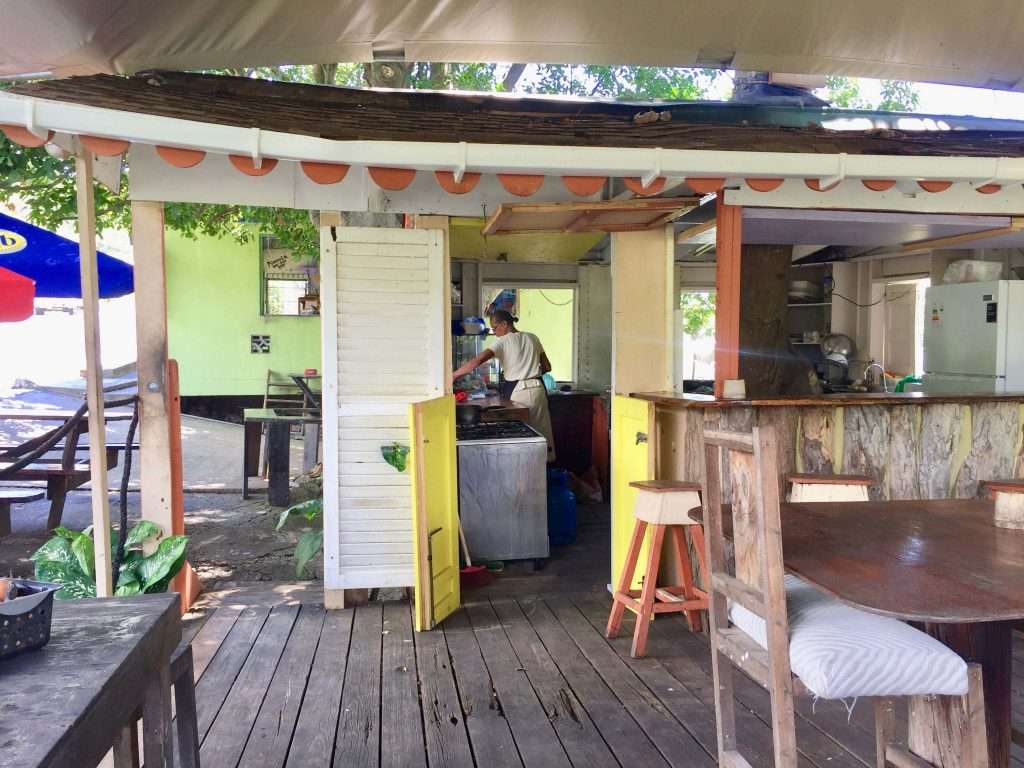
A must do visit in Woburn Bay is Nimrod’s rum shack and adjoining kitchen/restaurant run by his mother. We ordered her tasty roti’s and a few beers.
Nimrod’s rum shack and bus stop.
Inside Nimrod’s.
Mum in the kitchen making the roti’s.
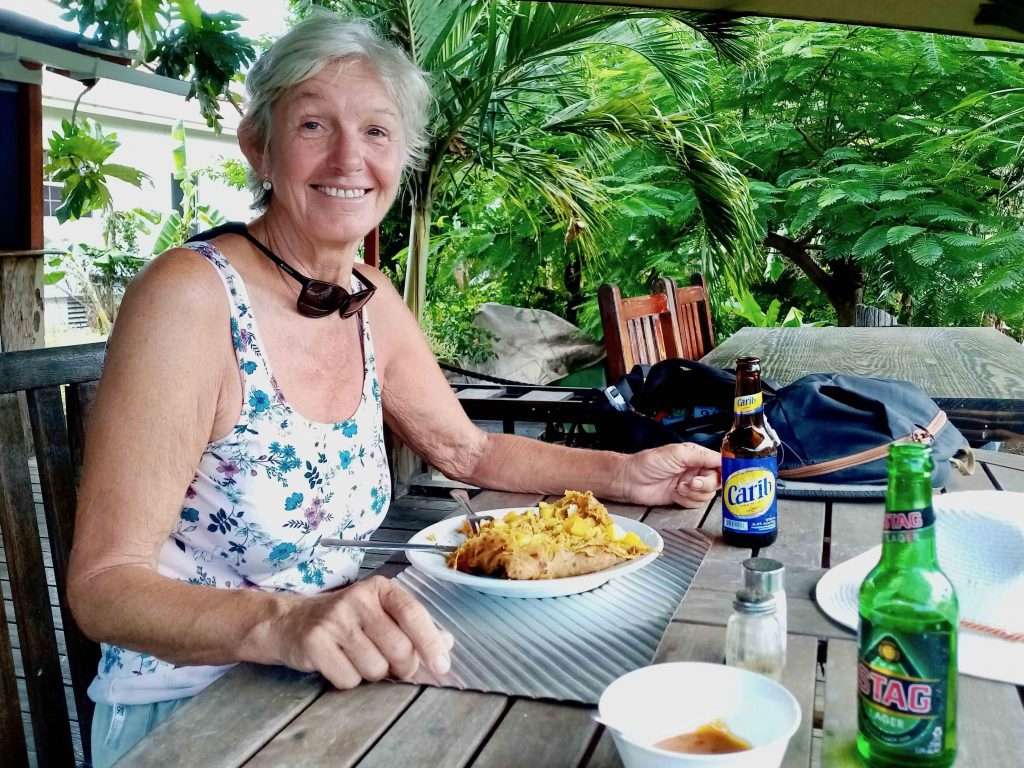
Annie with a tasty and generous roti.
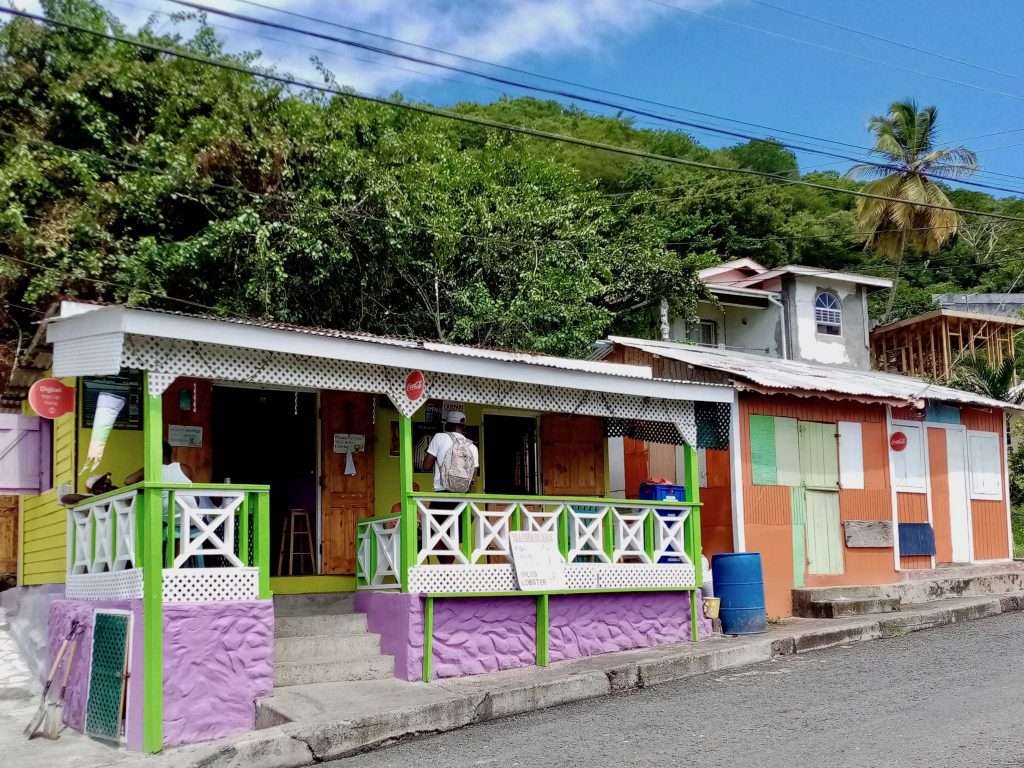
Another colourful bar across the street.
On the ay back to our dinghy – I couldn’t open the door of this car.
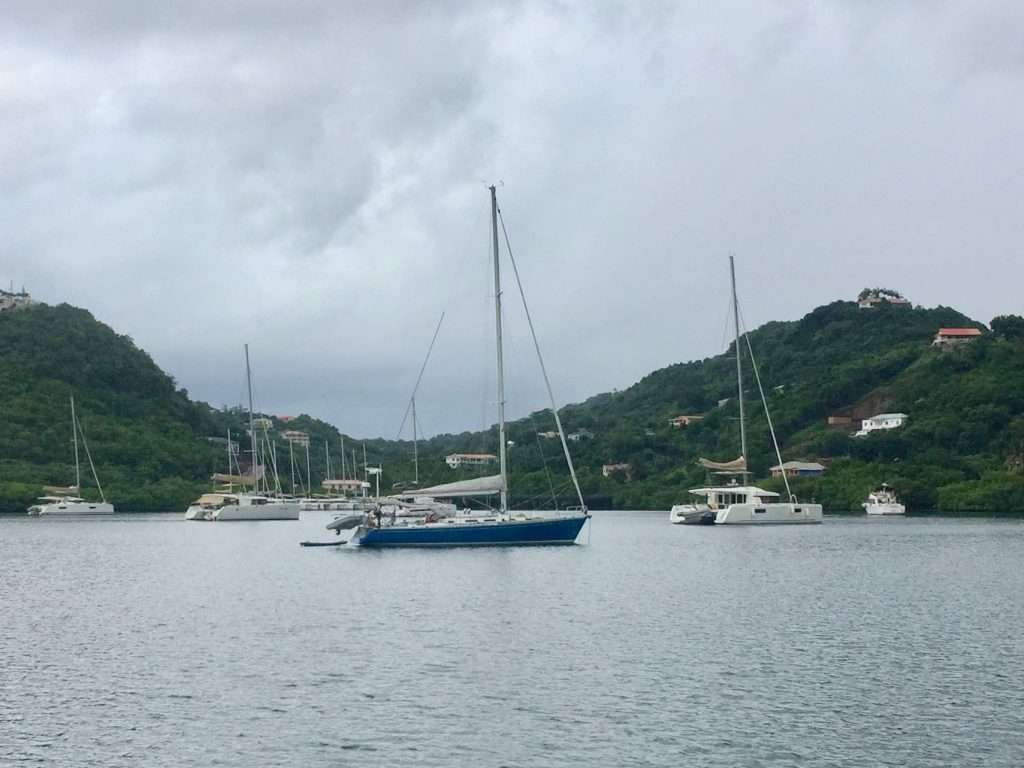
We motored around Hog Island to Secret Harbour, where our Canadian friends, Jan and Jane were anchored. We had last seen these fellow Jeanneau sailors in St Martin in January.
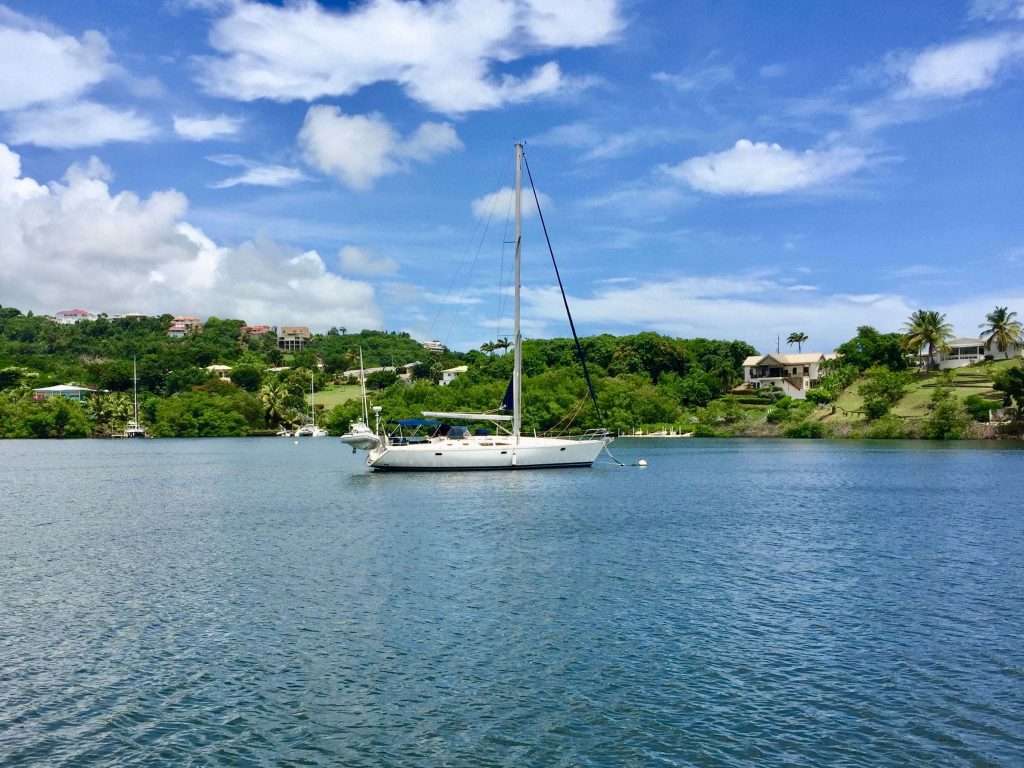
The Secret Harbour anchorage.
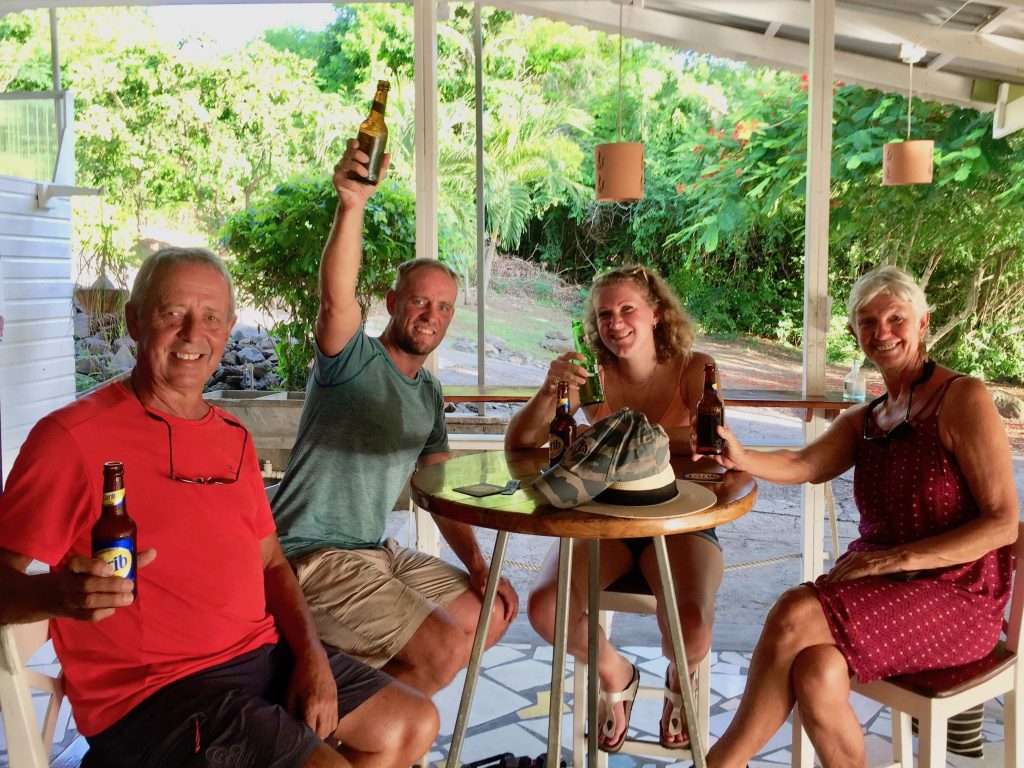
We caught up over drinks with Jan and Jane, with dinner at the Secret Harbour Marina restaurant, followed by a Sunday brunch at the West Indies Beer Brewery.
Jan, Annie and Jane at the Brewery.
The Saturday weather was fine, so we installed a third reef in our mainsail – something that we wished we had during our Atlantic crossing, but probably won’t need on our Pacific crossing, (according to Murphy). In the afternoon we motored to Hog Island for a walk around the island and to have beers at Roger’s Barefoot Beach Bar afterwards.
A brisk walk around Hog Island.
Arriving at Roger’s.
Roger’s regulars chewing the fat.
Monday the 12th October saw two significant events. Simon Clay, the local B&G agent came out to Esprit, to update the software on our electronics system, which I wasn’t able to do through the hotspot on my mobile phone. The VHF radio wouldn’t talk to the portable handset and the autopilot was playing up. Simon downloaded the latest software updates and took the handset to check it out.
The technology today is so different, compared to 1982 when we did our first South Transatlantic Race to South America – back then we had a sextant, compass, charts, shortwave radio and sometimes weather forecasts. Now you need to be an electronics wiz. Not easy for a 73 year old fart.
The other event was the arrival of a young man on an Air Canada flight with Covid-19, bringing the total number of cases, which was stable for 6 months, at 24 persons infected and no deaths, to 25. I must say, Grenada is an excellent example to the world of how to manage the Covid-19 pandemic.
Mask wearing and social distancing is mandatory everywhere, as is contact tracing. On entering a business, you have to wear a mask, sanitise your hands and going into restaurants/bars your temperature is checked and your name and contact number recorded in a logbook. Surely, this is fake news Mr Tweety Trump?
The 14th October was another good day. John of Fast Manicou was back and delivered our beer, wine and bulk supplies in the morning. At midday we picked up the new Tohatsu 9.8hp outboard in Prickly Bay, which we had ordered from Budget Marine. Our trusty Suzuki 6hp outboard has always been a bit light for our 2.9 m Highfield dinghy. We celebrated at the music jam hosted on Wednesday nights at Secret Harbour Marina with a large group of cruisers.
Prickly Bay Harbour.
Some of the muso’s at Secret Harbour.
On Friday evening there was another enjoyable music jam at Hog Island with the cruisers anchored in the bay. The wine was flowing copiously at the boerewors braai aboard Esprit afterwards, with the result that we are having a quiet Saturday today, with me taking the opportunity to post this update.
Hog Island jam.
Our route from east to west in yellow.
The end of October signals the “end” of the hurricane season in this region (who knows?), so we plan to then sail west to the ABC islands to the north of Venezuela – we will update you then with our progress.
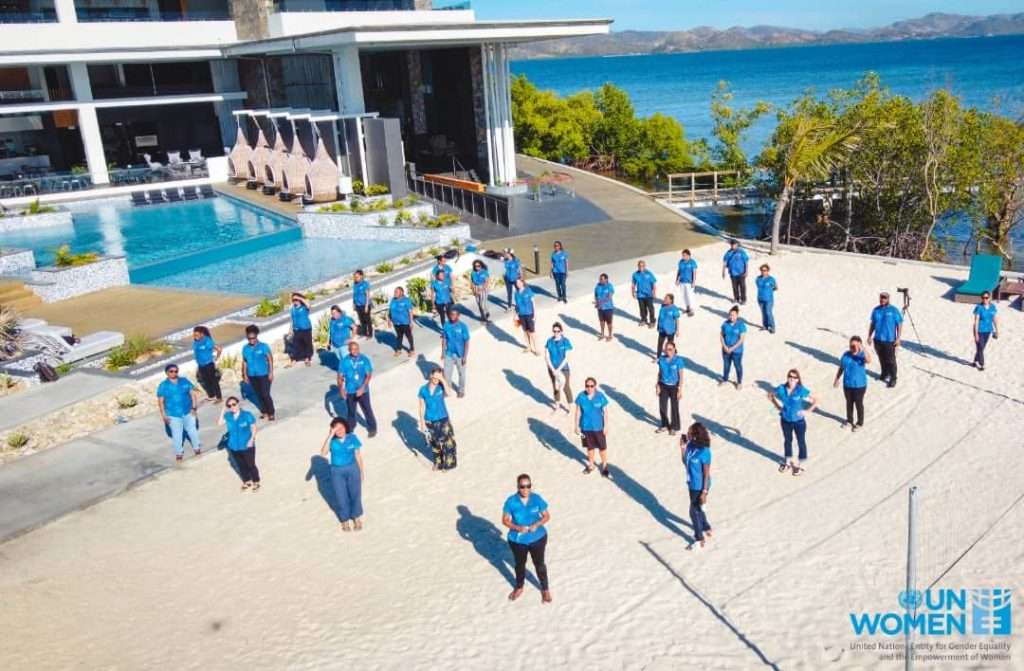
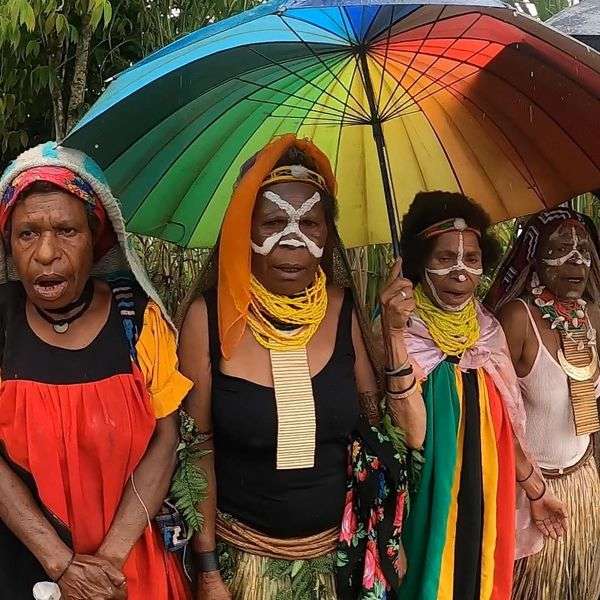
Finally, two updates from our daughter Michelle in Papua New Guinea: A socially distanced photo of the UN Women’s team meeting in Port Moresby and her working visit to the Kumin people in the Southern Highlands of PNG.