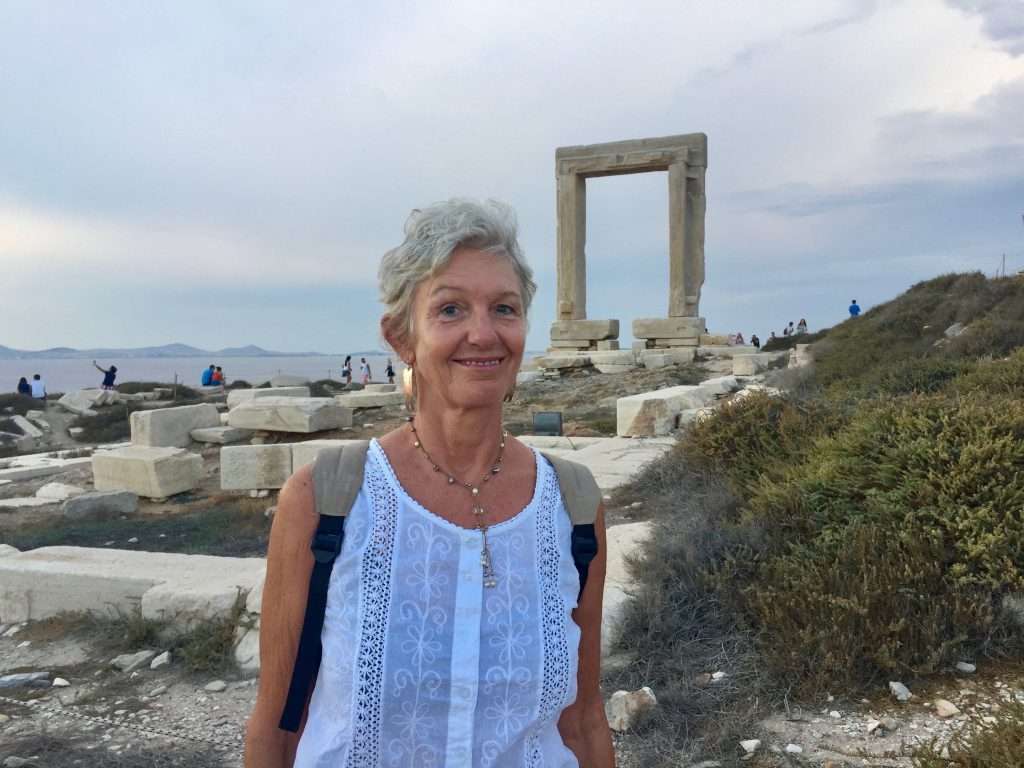
Naxos is the largest and most fertile island of the Cyclades and has an interesting history. It was sacked by the Persians in 490 BC, became a Venetian duchy for more than 300 years in 1207, fell to the Turks in 1566 and became Greek in 1832. On the approach to Naxos harbour, the marble arch which is part of a temple to Apollo is prominent – begun in 530 BC, but never finished. Marble is plentiful on Naxos.
The marble arch with the town in the background.
Naxos town – Venetian castle at top left.
Annie at the arch.
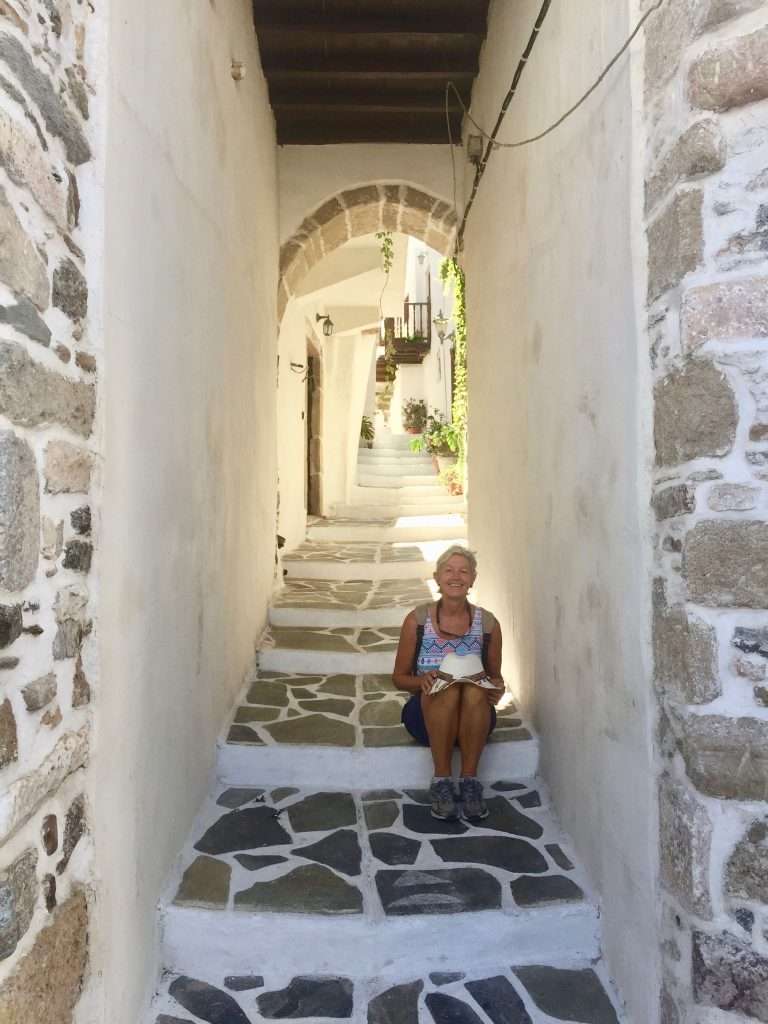
The warren of alleys, arches and tunnels around the Venetian castle on the summit of the hill in town, is the most fascinating part of the town. It was the up-market end of town and many of the entrances sport coats of arms from the time when Naxos ruled over the surrounding islands.
The old market street.
Oh look – this alley is 2m wide, we can put taverna tables out here.
Alleyway with rooms over.
Fascinating spaces.
A small square.
Walking up to the castle.
View from the top. Paros island in the background.
Exiting the castle through another gate.
Evening promenade.
Annie and an ancient marble statue.
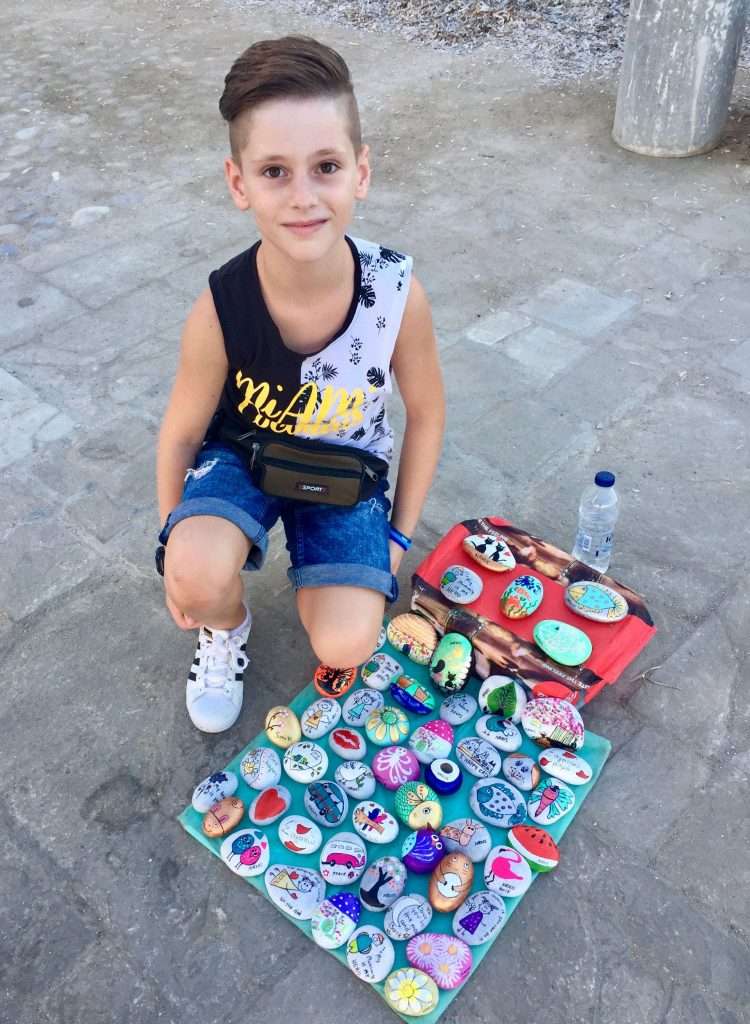
Budding Onassis – I had to buy a stone to take this photo. I bought the one with the lips – EU 2.50.
We spent two days exploring the beautiful old town and the castle before setting sail in a building wind, to Paros, only 5 miles to the west. The north facing bay at Naoussa on the north east corner of Paros was untenable in the strong north wester, so we sailed down the west coast to the main harbour at Paroikia. There is a sheltered bay to the north of the ferry harbour where we anchored with a number of other yachts.
Paros town from our anchorage.
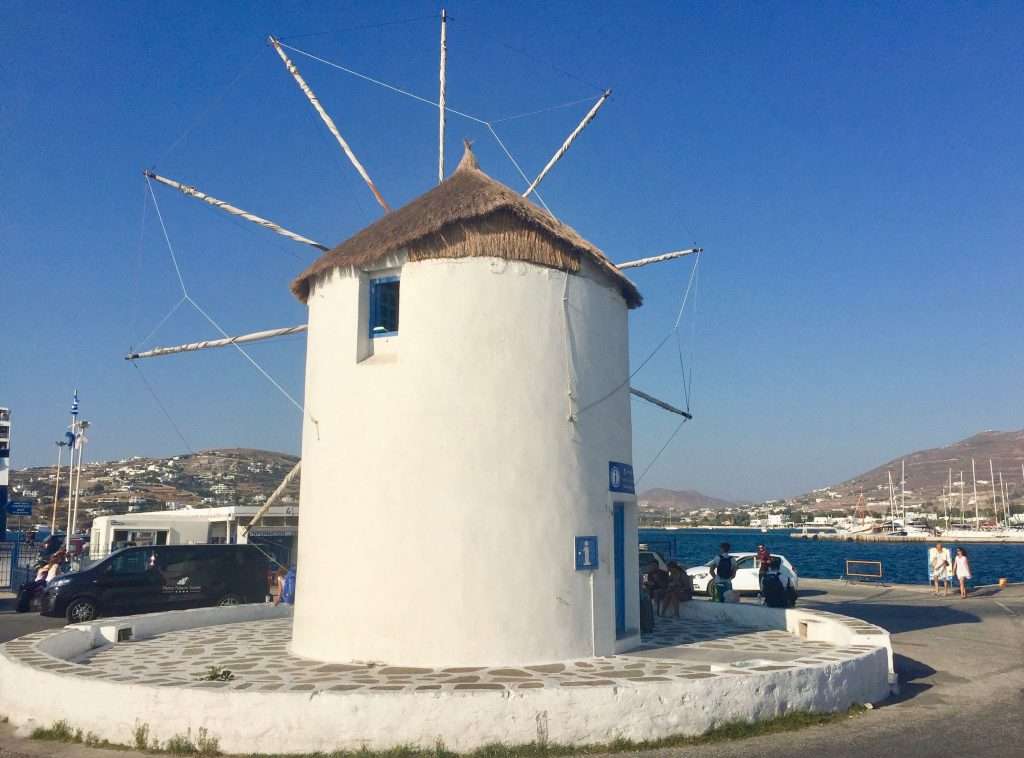
The old windmill.
When you stepped off the ferry in Paros back in the seventies, your first port of call was this old windmill. It was then the police station and information office. Dozens of backpacks would be stacked against the wall outside, while their owners would go off in search of accommodation. With the advent of online booking, the windmill and the moat around it has lost this function – it is still an attractive landmark to welcome you.
The little church.
A hundred metres to the left the little church is still as pretty as ever. The old town has lost none of its charm, but as one would expect, the town has grown around the bay to accommodate the masses of tourists. We did some shopping and Annie had her laptop seen to by a local computer shop – the fellow reloaded her MS software for free . I discovered a very palatable 3 litre cask Retsina at EU 6.70, so bought a couple of casks.
Old town.
More old town.
Beaches around the bay.
Annie bought and shocked me with a ventilated fedora, as she was getting worried about my dark complexion. She knows I hate anything on my head, as it makes my head overheat, but she insists this hat won’t do that. In triumph she posted a photo to our girls on WhatsApp – who cracked up, saying that I look like an Italian pimp. Confusing opinions – what is a man to do? We’ll see if the hat survives.
Aargh!
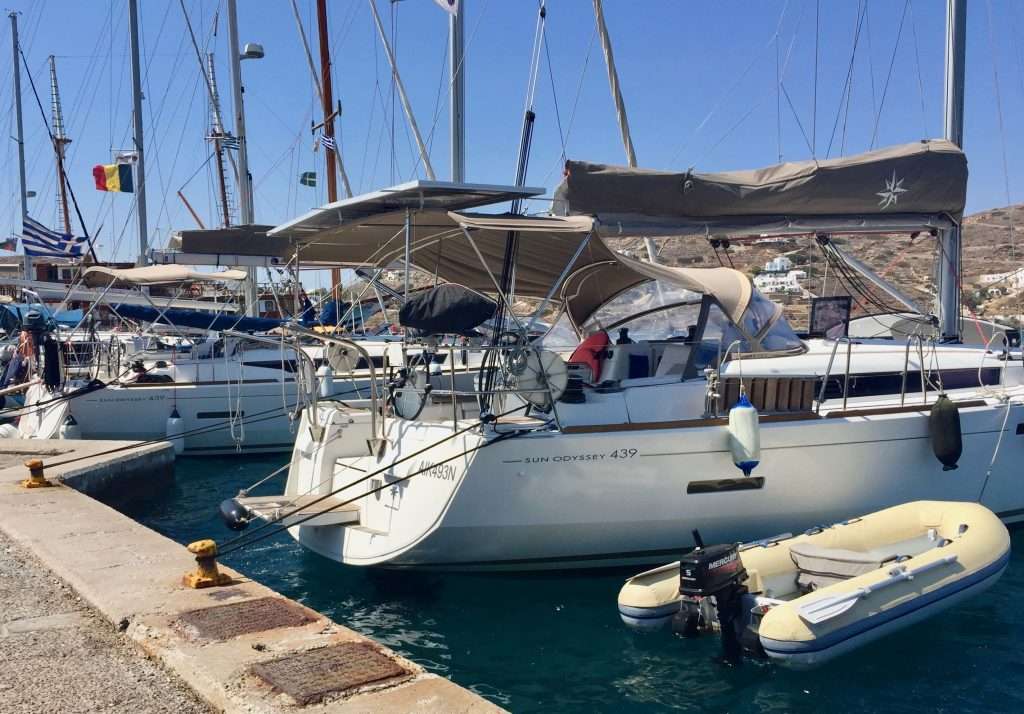
After two days in Paros, we set sail and carefully navigated the narrow and shallow Paros channel, between Paros and Anti-Paros, dodging vehicle ferries between the islands as well as dozens of kite boarders. Once through and out of the lee of the islands, the wind picked up to 18 knots and we had an exhilarating 24-mile run to Ios. We were lucky to get one of the last open stern berths on the public jetty, in the small harbour. It was like a Jeanneau SO 439 convention – three of Esprit’s siblings tied up next to us. Now, I did say we won’t re-visit the fleshpots of our youth – but we did want to visit Thira (Santorini), to take photos of that magnificent setting. Ios happens to be on the way south – so, we are having a little sticky beak.
Last berth in Ios harbour – next to a SO 439.
More SO 439’s.
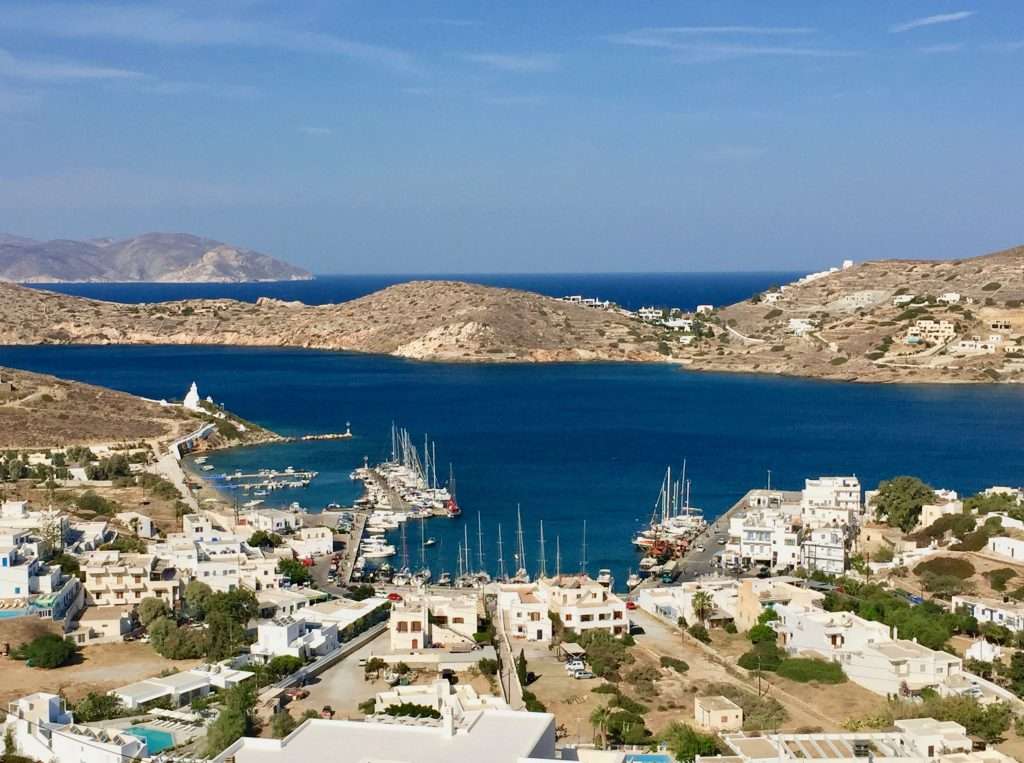
Ios harbour from a church nearby.
The church nearby.
Architecturally, I like these organic forms.
Walking up to the chora – this little church.
Near the top – I can count 6 chapels or churches.
View down to the harbour.
The main church in the chora.
A well deserved frappe in the minute town square.
Ios town is still charming, but geared towards the younger set, with more bars than tavernas. In fact, pub crawl tours are on offer, with most pubs offering five Jaeger bombs for EU10, or buy seven shots and get a free T-shirt. The island’s beaches have also become de facto nudist beaches among the younger set. After a bumpy night in the harbour due to all the ferries and a strong Meltemi, we did our climb up to the chora (main town), walked around the harbour and then sailed down to Manganari beach to be in the lee of the island in the 30 knot northerly. Manganari with one taverna, has grown a lot since we camped on the beach.
Manganari beach -crystal clear water
Now with beach loungers and umbrellas.
Calamaria!
Walking back to the boat after lunch.
During the night the Meltemi gusted up to 30 knots, with Esprit slewing from side to side – not conditions conducive to a good night’s sleep. By midday the next day, the wind abated and we went for a long walk along the bay, before having lunch at a beach taverna. Delicious calamari and salads washed down with the house wine. A good night’s sleep followed. By 8am the next morning, we set sail for a smooth run to Thira (Santorini) and a cruise around this giant volcano.
Santorini map.
The principal island is Thira, shaped like a new moon encircling the rim of the crater, now filled with water. To the northwest Thirasia forms another part of the rim and in the middle, a black mass of cinder and lava (Kammeni and Nea Kammeni) is the volcanic plug. Thira is steep-to, dropping sheer into the sea from 150 – 300m and keep going down for another 300m. Since the great eruption of about 1,400BC (Calculated as three times greater than Krakatoa in 1883), the volcano has remained active. It has erupted eight times since then and in 1956 a massive earthquake destroyed many of the buildings at Finikia and Thira.
Starting with Finikia in the north of Thira.
Finikia from the south.
Annie and Thira.
Thira from a distance.
Tripper boats anchored off Nea Kammeni.
Potamos on Thirasia.
Thira and the Atlantis legend – Plato first recorded the Atlantis legend that has baffled historians to the present day. Thira could be a candidate. It may be that the Thira explosion effectively destroyed the Minoan civilization on Crete and the other surrounding islands. Adding to the puzzle of Thira, is that not a single inhabitant has been found buried in the ash and pumice of the excavations at Akrotiri in the south of Thira.
On a mooring next to these gin palaces below Finikia.
Anchoring is virtually impossible due to the great depth, but we found a spot close inshore at Ormos Riva in the north of Thirasia island. A perfect evening with the lights of the towns on the crater rim glittering like stars, got us in the mood for a bit of dancing on the deck, to ABBA going full blast. A couple of Metaxa nightcaps made us sleep well. The following day we set sail for Folegandros, about 23nm to the northwest.
Karavostasi, the harbour of Folegandros is a sleepy hollow with crystal clear water. A few middle aged tourists – mostly Greek, (which is a good sign) and a few tavernas. We didn’t fancy the one hour walk up to the chora, so we did a walk around the bay and finished off with dinner at a rustic taverna on the beach.
Karavostasi harbour on Folegandros.
Perfect spot for paddle boarding.
Leaving Folegandros at sunrise.
The free Wifi at the taverna alerted us to some heavy weather coming, so we set off early the next day to sail and find shelter in Adhamas harbour on Milos, the southwestern most island of the Cyclades. Milos is an ancient volcano which, like Thira, long ago erupted and scooped out the giant bay. In the first world war the large natural harbour was a British naval base.
Google map of Milos.
It was during the Hellenistic period that the Venus de Milo (the Aphrodite of Milos) was sculpted, and is probably one of the best-known pieces of ancient Greek sculpture. The statue was found in the late 19th century by a farmer collecting old Greek stones for field walls. He negotiated to sell it to the French consul, but before a French ship arrived to collect it, the Sultan’s governor forcibly took the statue and put it aboard a ship bound for Istanbul. After a brief skirmish, the French got the statue back on board a French ship.
Venus de Milo.
It is said it was during this skirmish that the Venus de Milo lost her arms, which were spirited away by a local. The arms haven’t been found since and probably shouldn’t, lest it change our accepted perception of the armless beauty art historians are so familiar with. Photos of the statue adorn every shop on the island.
The Plaka chora above fishermen’s cottages.
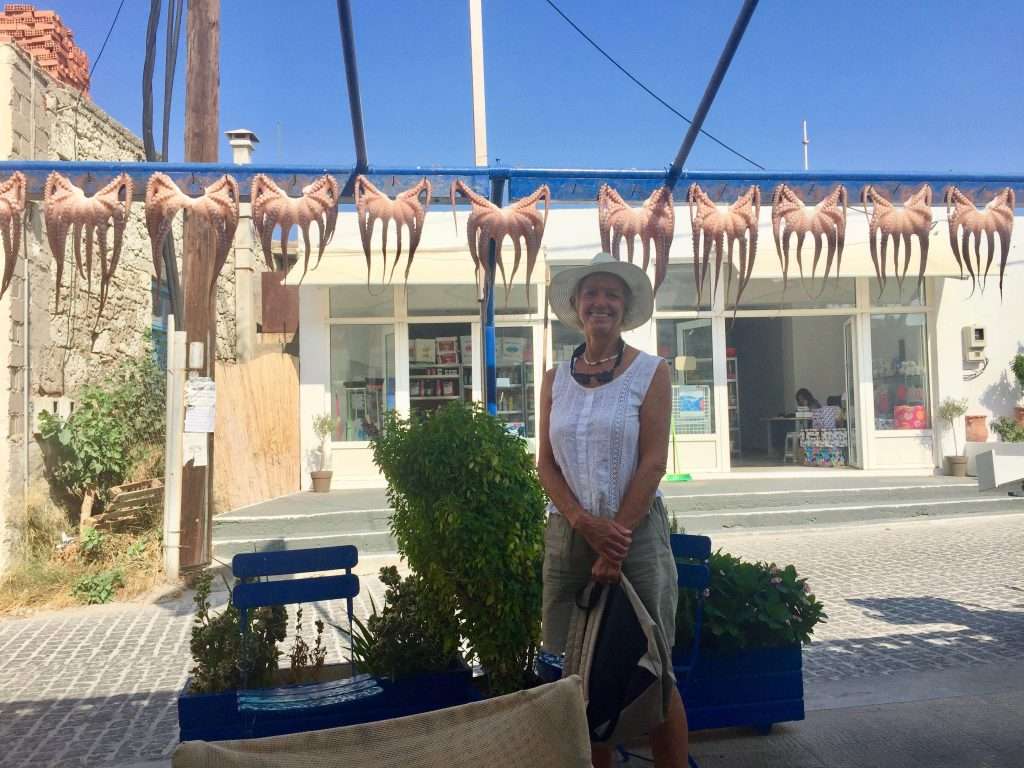
Annie bought an Octopothi for the BBQ from the fishmonger.
Chapel at the cemetery.
Vaulted graves.
Some of the Greek navy ships tied up to have shelter from the Meltemi.
We took a bus up to the chora to buy more data from Vodafone and visit amongst others, the local cemetery where the departed are housed in vaults of various sizes. We spent the next three days waiting out, hopefully, the last of the fierce Meltemis.
View from the chora.
Ancient theatre.
View across the crater/bay.
A decent walk up to the highest chapel.
We didn’t mind, as Milos is a most agreeable island and we could spend the time doing some maintenance on Esprit. We will next report from the Saronic and eastern Peloponnese.
On Wednesday 22nd August, Annie’s brother, Joe Schady and his partner Mary Griffiths arrived in Rhodes.
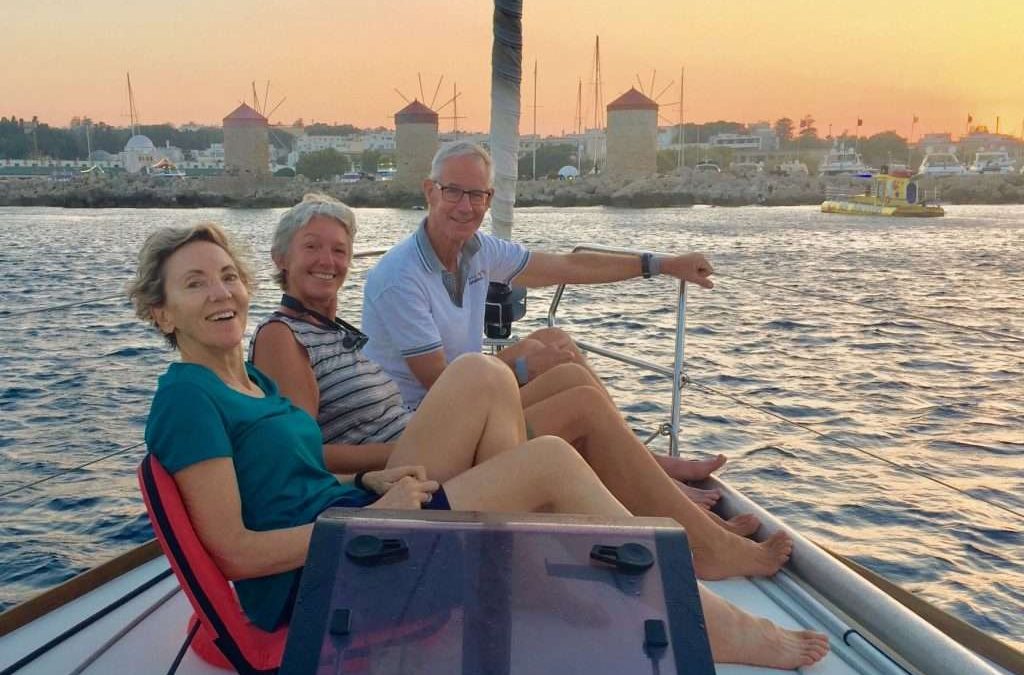
Right – let’s start with sundowners. Mary, Annie & Joe.
One of the gates into the old town.
Annie, Mary & Joe in the old town.
Ladies in conversation.
Narrow alleyways.
The two columns where the Colossus of Rhodes stood, at the entrance to Mandraki harbour.
View out of the old town – Esprit at anchor in the bay.
After two nights next to Mandraki harbour and exploring Rhodes old town, we sailed to Simi where we anchored at Panormitis on the south of the island. This quiet bay is home to a Greek Orthodox monastery.
The monastery in the background.
The sail up to Simi town was quick, but the harbour was chockers, so we anchored round the corner in Pedi. From here it was easy to catch the bus into town. We also had an excellent dinner at a local taverna.
Entering Simi harbour.
Simi town.
We set sail the following day and after a night in Alimia bay, we hopped across to Potamos Bay in Khalki. Pleasant walks into Khalki town followed, with delicacies bought from Dimitri’s bakery. Great swims in crystal clear water.
Schady siblings at Potamos Bay.
Coffees in Khalki.
The motor sail back to Mandraki harbour in Rhodes was uneventful and after a last BBQ, Joe and Mary flew home to New Zealand the following day. We enjoyed their company during their weeklong visit.
The fort at the entrance to Mandraki harbour.
Family update: Karen and Michelle took 2018 as a gap year to have a break from their respective professions – as they did after school, to travel the world, before starting University. Since the beginning of the year they have sailed with us from Thailand to Egypt and travelled in Africa and Europe. Michelle is back in London, not convinced that she wants to go back to the social work coalface, now freelancing in various jobs. She will join us in Greece during September. Karen went back to Australia during August for hospital placement interviews in 2019. She was offered six posts including her first choice, Newcastle, which she accepted. This hospital has the largest and busiest orthopaedic trauma unit in New South Wales. She will continue her apprenticeship in orthopaedic surgery in February 2019. To celebrate, she has bought a round the world ticket to travel for the next six months – starting with her 30th birthday party in London during September.
Karen & Michelle in Cape Town.
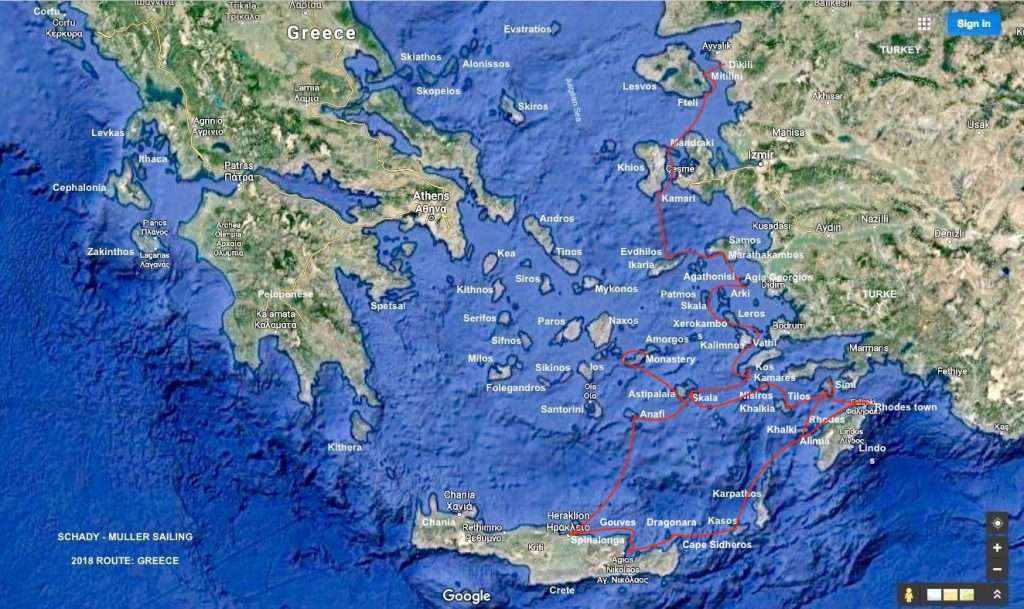
Rhodes to Amorgos.
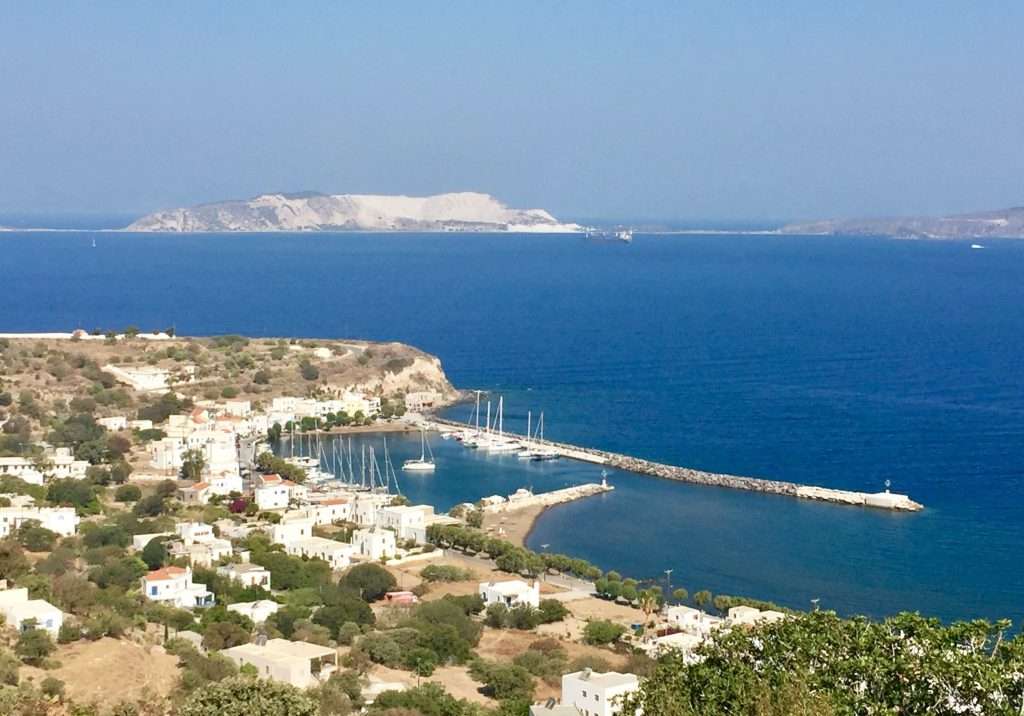
Back to cruising. After three days in Rhodes we set sail for Tilos island in the Dodecanese group. A trip of 49 nm in varying winds. Tilos is off the beaten track and very low key, but we did manage to have a good dinner at a local taverna. The next day we continued to Nisiros island where we tied up in the pretty harbour of Palon. This island is comparatively green and has a crater in the centre, where there are a number of steaming vents releasing sulphurous fumes from deep down in the earth.
Palon town – pubs and tavernas within crawling distance.
Kiwi boat next to us.
Palon harbour.
Saturday afternoon was spent watching the passing parade of locals and tourists, before sundowners with our Kiwi neighbours, Michele Lennan and Christopher Hancock on their Jeanneau “Endless Summer”. Michelle is an Aussie and Topher an ex Saffer, living in Auckland with two sons, about the ages of our two daughters. It turns out Topher and us competed against each other in the 1982 Trans-Atlantic race from Cape Town, to Montevideo in Uruguay – he on Nutcracker and us on 34 degrees South. He met Michele after the race in the Caribbean and they have been sailing together ever since.
Early morning visit to the crater – Annie, Christopher and Michele.
View down into the caldera.
Walking down.
Bubble and squeak.
Breakfast at the Balcony taverna – crater in the background.
Early on Sunday morning, we joined them in their rented car for a trip to the crater, with a walk down into the caldera, before driving up to the village of Emporios, where we had breakfast at the Balcony Taverna. A visit to the Coast Guard in Mandraki town followed, to have our transit logs stamped. The town of Mandraki is quite beautiful with narrow streets and town squares, where we had cold frappes at a taverna overlooking the sea. The afternoon was spent on the beach with a swim to cool down, before dinner.
On the way to Mandraki – view down to Palon harbour.
Starting our walk through Mandraki town.
The streets are getting narrower.
View up a side alley.
Three ex Saffers – Topher, Annie and Dirk.
View to castle above.
And then, a shady square for coffee.
The week started with a boisterous and wet 44 nm sail to Astypalaia island, where we tied up in the harbour overnight, before doing another 44 nm sail to Amorgos the following day in kinder conditions. This sail was made even more pleasurable by keeping a bigger 55ft yacht with Kevlar sails and crew out on the rail, behind us for 30 miles, before reaching Amorgos. Esprit was now entering the central Cyclades island group of the Aegean, having left the Dodecanese group behind on leaving Astipalaia.
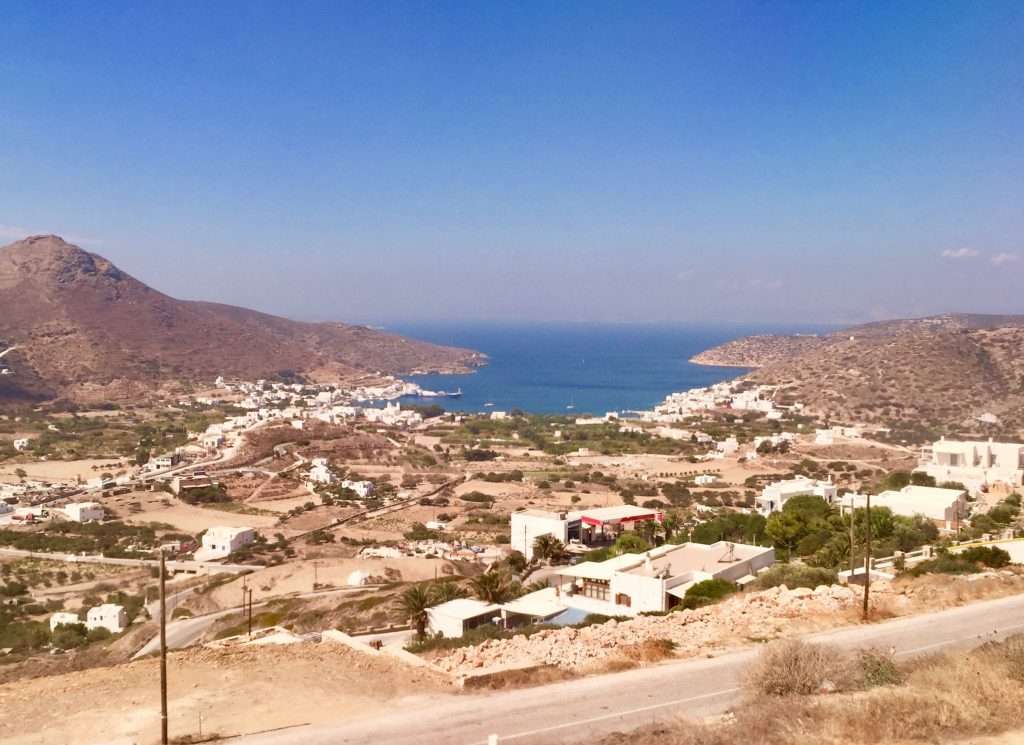
We anchored in an enclosed bay at the SW end of Amorgos in a little fishing harbour called Kalotaritissa. Soon, a 46 ft Prout catamaran anchored next to us and we noticed it flew Australian and South African flags. We invited them over for sundowners, to discover that James was an Aussie and Tam an ex Saffer, who worked and met in London. They have escaped the rat race in London, retired early, bought the cat three months ago in the eastern Sporades and are now setting out to do the ARC rally across the Atlantic to the Caribbean. After a relaxing morning on the paddleboard, we motored the 6 miles to Katapola harbour, doing a quick detour to look at a French yacht which ran aground recently.
Kalotaritissa – crystal clear water.
Annie getting her paddle board exercise.
Mon Dieu!
Architecturally, Katapola is a typical Cycladic town painted in white and blue, with ferries discharging and picking up, hundreds of tourists every day.
Katapola town.
Katapola street.
Katapola beachfront.
The ideal vessel for Annie to go and catch Octopothi.
There’s a ferry coming in!
They should call this one: the Colossus of Mote.
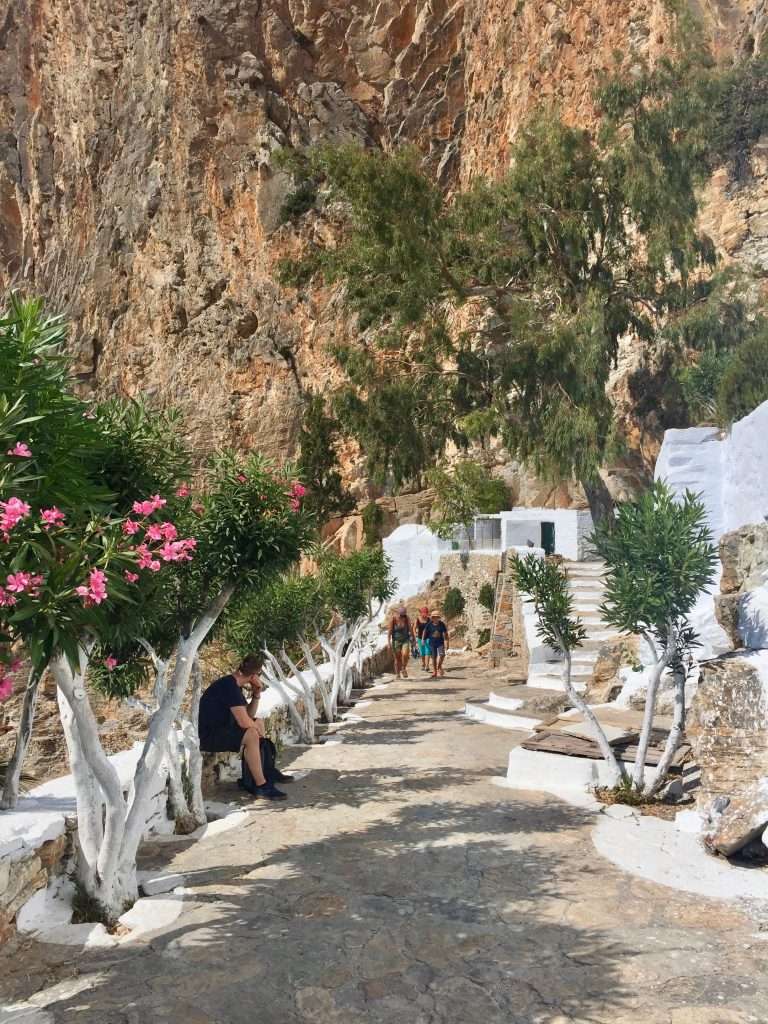
The following day we took a bus across the island to the south coast. On top of the mountain range is the chora (main town) with many old windmills. Halfway down the southern slope, the bus driver dropped us off for the walk up to the monastery of Panagia Hozoviotissa. It is like a latter day pilgrimage to climb the more than 300 steps to this monastery built between 812 – 813 AD. You are rewarded with cold water, a shot of raki and Greek delight sweets (made by the monks). The two-hour round trip with the bus called for a swim and a nanna nap in the afternoon, before sundowners on the German catamaran anchored next to us. We rewarded ourselves with a splendid dinner at a local taverna.
View through the bus window down to Katapola.
Having a rest.
Getting close to the top.
Arriving at the top.
Clothes available to dress to the monks required standard.
Going inside – sorry, after this, no photos allowed.
Going down the 300 steps again.
The following day we had a leisurely cruise through the small islands of Karos, Andikaros, Skhinousa and Iraklia to the south of Naxos, before sailing up the west coast of Naxos to anchor in Naxos town at 4pm. We will continue from here in our next post.
A perfect downwind sail from Anafi island, took us to Gouves Marina, about 8 miles east of Iraklion in Crete.
Lesvos to Crete and on to Rhodes.
Back in 1980, I spent three months in Greece, including a month in Crete. The objective was to have a holiday and walk a bit, to get my legs in shape again. I had stacked my Suzuki 750 motorbike on the way to work, fractured my right femur and tore all the left knee ligaments. I read about the 18 km long Samaria Gorge in western Crete, starting near Chania at an altitude of 1,230m and winding down to Agio Roumeli on the south coast. This hike inspired me to carry on hiking along the Cretan south coast, walking east for about half the length of the south coast of Crete, sleeping on the beach and wherever I could unroll my sleeping bag.
Penny, Frank & Annie at a windmill.
So here we were again, planning to cruise the north coast of Crete with Annie’s sister Penny and husband Frank. They arrived at Gouves the next day from a cycling tour in Croatia and after getting provisions and topping up the water and diesel tanks, we set off east, to go with the building Meltemi. We found shelter in Khersonisos bay with reasonably flat water and only the occasional strong gust to bother our fish barbequing on board. The following day we continued east through a very confused sea and 25 knot winds, until we turned the corner at Cape Fatsi to get into the big bay of Kolpos Merambellou and in the lee of the land.
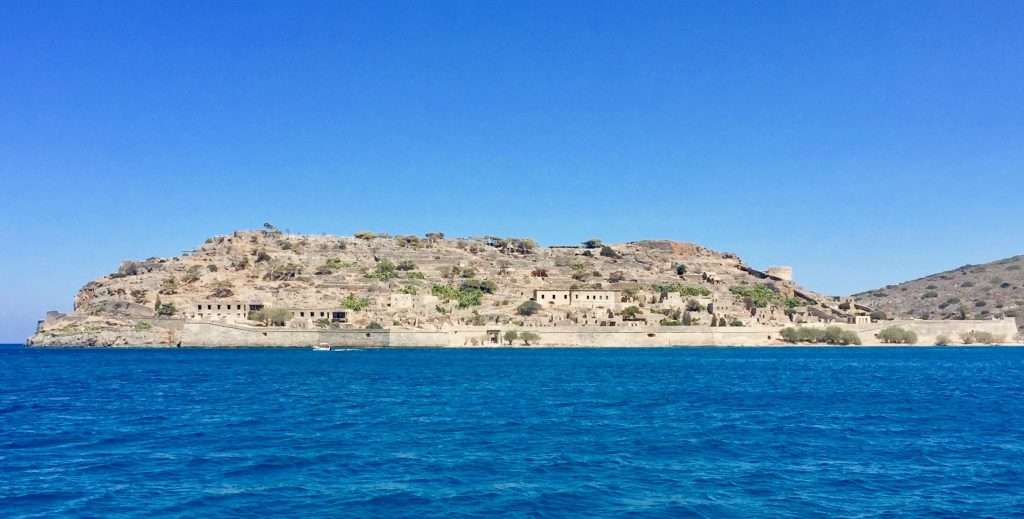
Spinalonga island.
A mile or two to the south, at the entrance to the Spinalonga lagoon, is Spinalonga island with its Venetian fort. There is a small deserted settlement which was a leper colony in the previous century. After 33 nm we anchored at Schisma in the Spinalonga lagoon.
Schisma harbour.
Nice place for a coffee.
View from our table.
Schisma town centre.
This is an attractive town offering walks along the shore as well as numerous tavernas, to have coffees or dinner. The wind increased to a full blown Meltemi gusting up to 30 knots in the two days we spent there. We figured there had to be less wind further south and motored to Ormos Porou where there was some wind shelter, close inshore in front of a holiday resort.
Generic resort – could be anywhere.
By the evening it was gusting 25 knots again, so the next day we motored another 6 miles south to Agio Nikolaos, where we booked into the marina. It wasn’t more sheltered here, but at least we were securely tied to a pontoon in the marina. It gave us the opportunity to do our laundry in the marina laundromat. I bought a Greek gas bottle with a regulator as backup, if we couldn’t refill the Aussie gas bottles by the time they were empty. We also had a pleasant evening in the old town with a superb meal at a taverna.
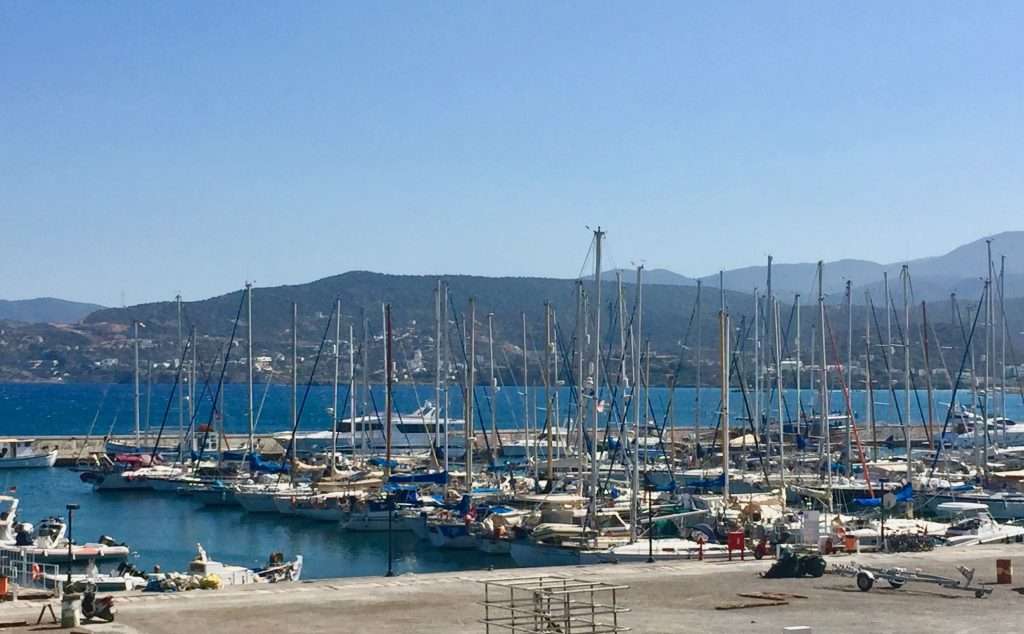
Agio Nikolaos marina.
Agio Nikolaos town – beautifully landscaped street.
The lagoon in Agio Nikolaos.
Dinner time – Dirk, Annie, Penny & Frank.
Penny & Annie in front of a church mosaic.
Photo for an old friend, who loves the word “Octopothi”
On Saturday, after five days on board, Penny and Frank caught the bus back to meet their children at a pre-arranged holiday apartment near Gouves. We spent another night in the marina waiting for the wind to abate and explored the old town. At this stage, we noticed that due to the 30 knot winds, the seagulls and pigeons were walking along the road, because they couldn’t fly. The wind didn’t let up, so we ended staying a third day in the marina until the Monday when we bought more Vodafone data and posted stuff to Karen.
Screenshot of “Windy” on Saturday.
Vasilis, on the boat next to us, gave us some tips on the best route, sailing to Rhodes. By 11 am on Monday, we left the marina and motored back to Ormos Porou where we found a reasonable anchorage with varying levels of wind gusts, interrupted by the continuous drone of speedboats pulling inflatable couches of varying designs, filled with shrieking kids, testing the limits of the flexibility of their spines. The physios and chiropractors in this area must have a field day. We were to wait another two nights before the weather forecasts indicated a temporary drop in wind speed to about 15 knots, by the Wednesday and Thursday.
Ormos Porou, in the split second that there were no speedboats in the frame.
On Wednesday the 15th August, we set off at 7am to do the 23 miles to Cape Sidheros, the eastern tip of Crete. Well, hello! Within 10 minutes, we had to fully reef the main, furl the jib to about 15% of its area. In a big sea and on a broad reach we were bowling along in 25 – 27 knots of wind, hitting 10 – 11 knots going down the waves. We reached Dragonara island, just north of the cape in record time and anchored in a sheltered bay to recover. So much for weather forecasts – Valium or Zoloft please. Hang on, I have Retsina wine for a relaxed arvo.
Waiting for Wednesday at this quiet spot in Kher bay, two miles to the north of Ormos Porou.
At 6am the following day we set off, sail reefs still tucked in, to do the 36 miles across, reputedly, the worst seas, to Kasos island. “Anchor in Fry on the north side, because the south side, which although in the lee, is even worse” Vasilis said. OK, we were going to go around the south side, but let’s listen to local knowledge. The weather the next day was much like the day before and we got to Kasos having averaged 8 knots in a very big sea. Then, a big surprise – we haven’t seen any Aussie boats in Greece up to now, but tied up in the harbour were two boats from Fremantle, Perth. We were quickly welcomed and everyone met on Esprit for sundowners.
Three Aussie boats in Kasos harbour.
Aussie, Aussie, Aussie …
Oi, Oi, Oi!
The small Kasos fishing harbour.
Close up of the church.
Clive and Jenny Willis from Perth on their Beneteau 45, mentioned that George, their impeccable Greek source, had told them the following day would indeed be a low wind day. They were going to leave early to do the 60 miles to Khalki island, west of Rhodes. We decided to accompany them and set off at 6 am, despite a hangover. We had perfect conditions with a flat sea and 14 – 18 knot winds on the beam, zooming past Karpathos to reach Potamos Bay, next to Khalki harbour at 2 pm. Sixty nautical miles in 8 hours, averaging 7.5 knots SOG (speed over ground).
Khalki harbour.
On approaching Potamos Bay, who should arrive from the opposite direction – Mike and Sarah Mason on Soul! After a good night’s sleep, we picked them up with the dinghy the next morning, to go ashore and walk the kilometre across to Khalki village. Here we found Clive and Jenny’s boat tied up to the town jetty and went aboard “Australie” to introduce them to Mike and Sarah. A coffee in the quaint village, with a visit to the bakery and supermarket followed, before we walked back to Potamos bay. We stayed for two days.
Church and cemetery on the way to town.
Lovely old house on the waterfront.
Dimitri’s bakery on the town square doing a roaring trade.
This guy had to go and buy a bread, but bumped into a friend – for a game of backgammon.
Our next stop was the island of Alimia, eight miles to the north, which was used by the Germans as a U-boat submarine base during world war 2. We did a long hike and visited some of the deserted buildings. In one of these, nostalgic German soldiers drew a series of cartoons, depicting what life was like back home and what life might been like on some distant tropical island, if there had been no war.
WW2 quarters on Alimia.
Some of the cartoons.
Dancing with a mermaid on a tropical island.
The following day we had a relaxing 33 nm downwind sail to Rhodes, where we anchored next to the marina. They say you either love or hate Rhodes. We love it, especially the old town. On this our third visit, the number of tourists is overwhelming, as it still is the European summer holidays.
Dolphins outside Rhodes old town.
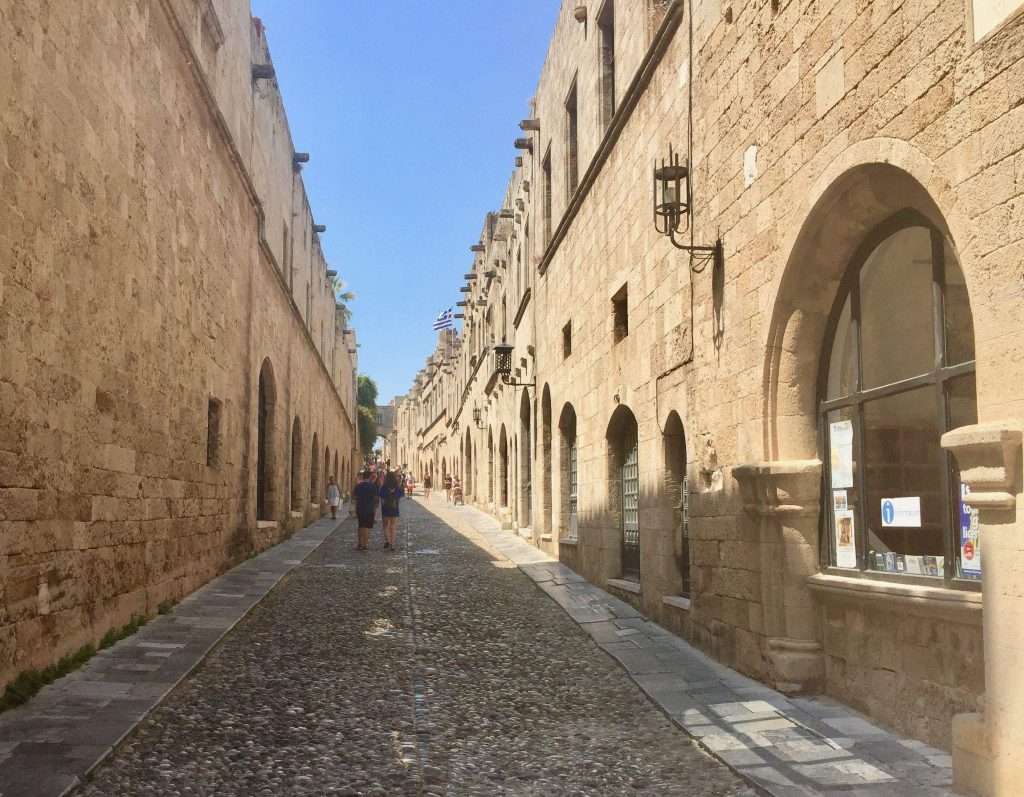
Street with the lodges of the Knights of St. John.
Lots of tourists.
A refreshing beer.
Tomorrow, Joe and Mary arrives to join us for 6 days of cruising. We will report on that in due course.
While checking our current latitude and longitude, I realised that we were further north of the equator than Sydney is to the south of it. Also, we have covered 120 degrees of the 360 degrees of longitude, so were now about a third of the way around the world – and with the other two thirds to go, the best is still to come!
Mitilini harbour – Lesvos.
After a brisk sail of 11 nm from Dikili in Turkey, we arrived in Mitilini harbour on the Greek island of Lesvos just after lunch on Wednesday the 18th July 2018. It took 2 hours to clear in through the passport police, customs and the harbour master and cost EU 45 for a Greek transit log and first stamp of entry. Annie with her UK passport, can stay for a year in the EU Schengen countries, Esprit for 18 months and me with an Aussie passport, only 90 days. Then I have to leave for 90 days to a non-Schengen country, before returning!
Looking for a place to buy phone cards in Mitilini.
Sappho, the Greek poetess was born on Lesvos in 612 BC. Allegations that Sappho was a lover of her own gender, gave the word lesbian to the world. Mitilini is a big town without much character, so we left at 5pm and motored south to Fteli, where we anchored at 7pm. We were alone in this quiet little bay, so we decided to stay for two nights, run the water maker to fill the tanks, clean the boat and do two loads of washing. I also managed to clean the life raft locker and while I had access to the rudder shaft, to lubricate the top bearing as the steering had become sticky.
Route: Lesvos to Crete.
Mandraki harbour on Oinoussa.
The following day we had a downwind sail to Khios, 38 nm to the south and put in to Mandraki harbour on the small island of Oinoussa, a mile off Khios island. A stunning little harbour where we had dinner at Pericles’s restaurant as well as coffees the next morning after walking to the Orthodox church on top of the hill. A 47 ft Dufour yacht arrived to tie up next to us and we helped to secure their stern lines to the quay. On board were three friendly French couples who invited us over for drinks. Annie had a chance to practice her French and we had a great time learning about their lives and children in France – we will stay in touch.
Walking in Oinoussa.
Up to the church.
Mini fishing boat.
Tying up in the harbour cost us EU7.50 – we paid with a smile and left Mandraki at 1 pm the next day, to sail the 23 nm to the southern tip of Khios and anchored at Ormos Kamari in a howling 25 knot north westerly. An hour later, in this strong wind, a 45 ft Lagoon catamaran anchored nearly on top of us, 10 metres away. I took photos and videos of this stupidity, in case it resulted in an insurance claim. Fortunately, the wind died down after two hours and we were able to leave undamaged the next morning to sail to Evdhilos harbour, on the north coast of the island of Ikaria.
Now, you will read the names of a lot of lesser known Greek islands. The reason being: In the seventies we all visited the popular islands – grooving to Pink Floyd on Ios, sleeping on the beach in Paros, smoking Tarzan tobacco in Santorini and sunning in the nude on Paradise and Super Paradise beach in Mykonos. Our less hedonistic lifestyle today, has focussed our minds on the less touristy islands. Did I hear someone say: “Coming back to give something back to the less fortunate”? LOL.
Evdhilos harbour.
Evdhilos is a sleepy little fishing harbour and after exploring the town, we decided to stay for two days and chill. Again, without boring you with photos of our food, we had excellent calamari, baked pork and a Greek salad with a local white wine for about AUD 18. Can’t get any better. The next morning, we took a brisk walk around town and finished off with a Greek coffee on the quay. At this stage, we were still not able to buy Greek SIM cards for our phones, so a coffee or a beer at a taverna with free Wi-Fi is the way to collect emails.
Dinner on the waterfront.
View of the town and harbour from the hill.
Moored next to us was a Beneteau 47.7 from Marmaris with a friendly Turkish couple on board. We had them over for drinks in the evening and it was interesting to hear their views about the incumbent Turkish president, Erdogan, who appears to want to be president for life (The African model). They also worry about his emphasis on Muslim schooling, as a threat to their secular republic. The next day we had a good sail to Marathakambos, a small fishing harbour on the south coast of Samos. Strong katabatic gusts of 30 knots, off the mountains hit us during the night, so we didn’t have a good night’s sleep.
Approaching Marathakambos backed by the high mountains of Samos.
This 230 foot super yacht anchored next to us.
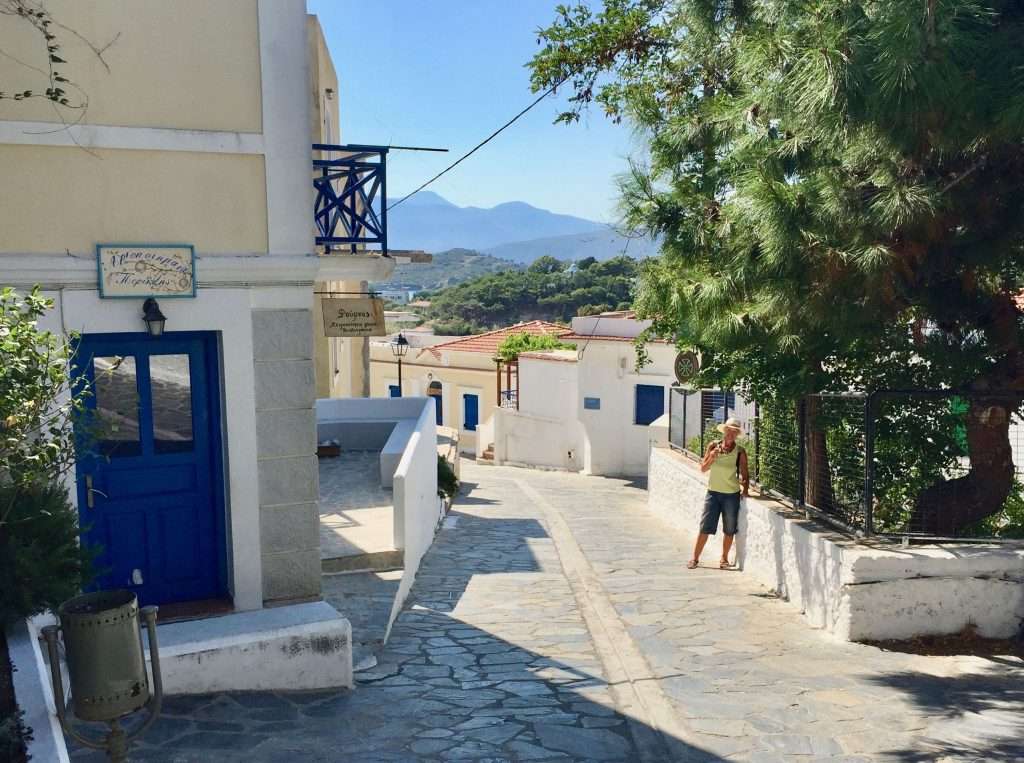
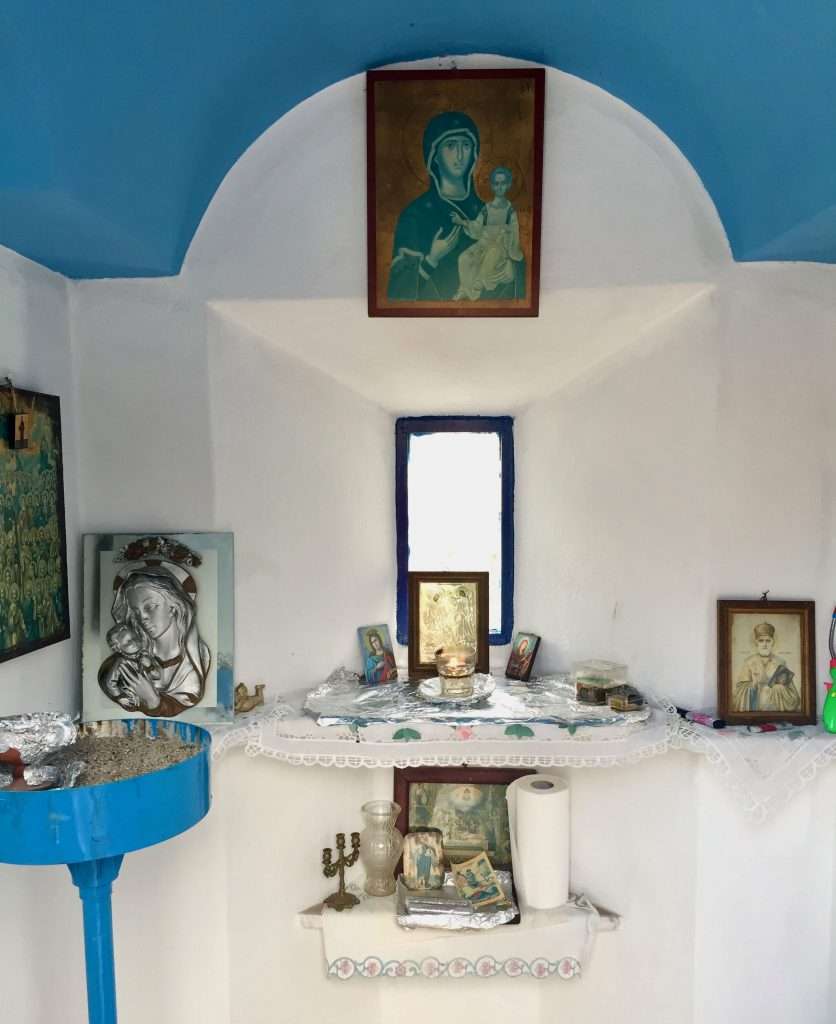
We decided to not brave more wind and sailed the 23 nm to the small island of Agathonisi where we anchored in the small harbour of Agios Georgios. It was worth spending two days here and enjoying meals at George’s taverna and Memento’s café. At this time the fires near Athens had burned and all the Greek flags were flying half-mast. On our walks to the nearby villages of Horio and Mikro Horio, people were offering prayers to those affected, at their small Greek orthodox churches.
View from our anchorage to the village.
Water so clear, you can see your shadow on the sand 3m below.
Walking up to Mikro Horio.
Passing a chapel.
Chapel interior.
View from Mikro Horio.
On leaving Agathonisi for Patmos we were looking forward to a following wind, but this was not to be – we had to motor the 22 nm to Patmos on a mirror like sea, passing Arki island on the way. Skala, the main town of Patmos, is a bustling place with quaint buildings, narrow streets and many tourist shops. At last, we were able to buy Vodafone SIM data cards for our phones as well as decent retsina wine. Annie was brave enough to cycle the steep road up to the monastery and chora, whilst I did the shopping.
Patmos harbour.
Patmos town.
A beautifully restored Fiat 500 Topolino – check the rattan seats.
The wind kicked in the following morning and we had a marvellous broad reach in 12 – 14 knots of wind, to cover the 21 nm to Xerokambos, in the south of the island of Leros. We had an email from Mike and Sarah on Soul informing us that they were anchored in Palionisou on the east coast of Kalymnos, only 9 miles to the south. We hadn’t seen them for about 3 weeks, so the following morning after a walk through the village, we motored through a lumpy sea to pick up a mooring in Palionisou to catch up with Mike and Sarah.
Palionisou.
At sundowners with Mike and Sarah on their boat, they introduced us to a couple from Slovenia, on a boat next to them. These friendly people were principal ballet dancers in various major ballet companies and at 70 and 67 years have physiques only dancers can sport. A liquid dinner with baked goat and Greek salads at a local taverna saw the night out.
Sarah with Mathea and Igor the dancers.
After a recuperating walk through the village the next morning, we sailed the short distance of 9 miles to Vathi on Kalymnos. This is a narrow fjord like anchorage at the foot of the fertile Vathi valley. Tied up at the town jetty, you step off the boat into the street with tables and chairs from the tavernas right there. A bit noisy at night, as we discovered that every male from 15 to 50 who owns a 50cc moped, removes their silencers to give them the make believe roar of a Harley-Davidson motorbike. The next morning, we took our exercise walking up the valley and climbing to some chapels for a view over the valley and the harbour.
Noise on your transom.
Vathi harbour on Kalymnos.
View up the fertile Vathi valley.
On our walk up the valley – a micro chapel.
A lazy 26 nm downwind sail later in the morning took us to Kos island, where we have visited the north coast and main town on two previous cruises. We anchored on the south west coast at Ormos Kamares. This was not a particularly interesting town, so the next day we sailed 32 nm to the west, to the island of Astipalaia. A 13 -15knot north wester had us humming along over a flat sea at 7 – 8 knots. A sailor’s dream conditions. We passed numerous charter yachts motoring without sails and we thought that buying an ex-charter yacht, will give you a boat with as new sails, but maybe a knackered engine. Different strokes for different folks.
Tied up in Skala harbour on Astipalaia.
On Wednesday the 1st August 2018 we tied up in Skala harbour on Astipalaia island where the friendly port policeman told us there are no charges in their harbour – what a welcome change, although so far, the standard port charges for our boat have been EU 7.50, which equates to AUD 11.60 and is very reasonable.
View from the beach – the castle top left.
The following morning, we walked up the hill, where the castle built by the Venetians, dominates the chora. Legend has it that the castle was successfully defended on one occasion, by the defenders throwing beehives onto the attackers (Sort of Asterix and Obelix). From the castle there is a magnificent view to the surrounding islands. It was as usual, good exercise, rewarded with an iced frappe in the chora, some shopping at a bakery and finally, a swim down at the beach.
Halfway up the hill.
Three quarter way – getting tired.
Nearly there.
The entrance, at last.
Not one, but…
..two churches in the castle.
View on the way down.
Windmills in the chora.
Rewarded with an iced frappe.
Colourful alleys on the way down.
After two days we had to start making our way towards Crete to meet Annie’s sister Penny and her family, so we did the 36 nm sail to Nisos Anafi, which is like a barren burnt lump of island in the southern Cyclades. This was a one night stop before doing the 65 nm sail to Iraklion in Crete.
Our next post will cover Crete and then the sail to Rhodes to meet Annie’s brother Joe and his partner, Mary. Cheers for now.
After leaving Port Alacati in Turkey on Monday 16th July 2018, we passed the Greek island of Khios to port, and then saw a NATO warship patrolling the strait between Greece and Turkey. We were now entering the Aeolian coast as we sailed past Cesme. The wind was in our favour and with main and jib up, we averaged 7 – 8 knots to take us to Foca bay for a 52 nm day. Foca is at the mouth of the Bay of Izmir, but we decided not to sail into Izmir as it is now a huge commercial harbour – also my brothers and I travelled overland from Istanbul to Izmir in 1975 and we didn’t find much of interest on the Anatolian plain, or in Izmir.
Dikili – our last Turkish port of call.
Our next stop was Dikili harbour where we planned to clear out of Turkey, before sailing the 11 nm across to the Greek island of Lesvos. The harbour was chockers, so we tied up next to a number of big fishing vessels at the harbour entrance, requiring an interesting climbing/walking trip over 5 vessels to shore. Tuesdays are the big fresh fruit and vegie market day in Dikili, when the farmers bring their produce to town. Annie was in her element buying fresh produce at a smidgen of Sydney prices. A pain getting this all back on board.
Tied up next to the fishing vessels.
Market.
More market.
Overflowing on the streets.
In the afternoon we set off to find the harbourmaster which is your first stop in clearing out. Dikili not being a tourist town, had very few English speakers, resulting in us crisscrossing town before we eventually tracked his office down. He had decided to take the afternoon off, so his secretary called him on his mobile to ask what to do. His English was passable and he told us to call around at 8am the next morning to process our documents. So we spent the afternoon sightseeing and shopping at Migros for food, wine and beer.
Dikili town square.
Next morning at 8am, we were back at the harbourmaster’s office – his secretary serving us tea until he arrived at 9:10am. From here on, things picked up – he only took 45 minutes to complete all the documentation, before giving us instructions of how to get to customs and the harbour police, who processes passports. This was completed in 15 minutes and then we had to return to the harbourmaster to drop off his stamped copies. He then wished us a speedy return and we took our leave without having to pay a Turkish lira.
This then completed our 8-week cruise from Anamur in the east of Turkey, to Dikili in the north west, during which time we covered 768 nm (1,422 km) and enjoyed the hospitality of the friendly Turkish people, saw some amazing historical sites and made many new friends.
Our Turkish coastal route.
As an aside, I had completed Andrew Mango’s definitive biography of Mustafa Kemal Ataturk, which strips away the myth to show the complexities of the man beneath. Ataturk was a man who enjoyed his tipple – when his secretary Hasan Riza Soyak urged him to cut down on his drinking, he replied: “I’ve got to drink, my mind keeps on working hard and fast to the point of suffering. I have to slow down and rest at times. When I don’t drink, I can’t sleep and the distress stupefies me” …… On hearing this, Annie decided to call me Atadurk!
Final chuckle – first the seagull phone, here we have the dolphin phones!
Our next post will start in Lesvos, Greece, from where it will be downwind sailing through the Eastern Sporades and Dodecanese islands – we will catch up in due course.