First up, apologies for our website going down about three weeks ago. Our hosting company in the USA told me, that some plug-in used on the site, malfunctioned. This could only be fixed by paying a developer on their side AUD 112 to trouble shoot and sort it. Evidently, I need to update plug-ins when alerted to do so. After that came the news that we had a random malware attack on the site, which cost another AUD 584 to clean up and be given a clean bill of health for the site – let’s hope all goes well for the next couple of years!
The concrete coast.
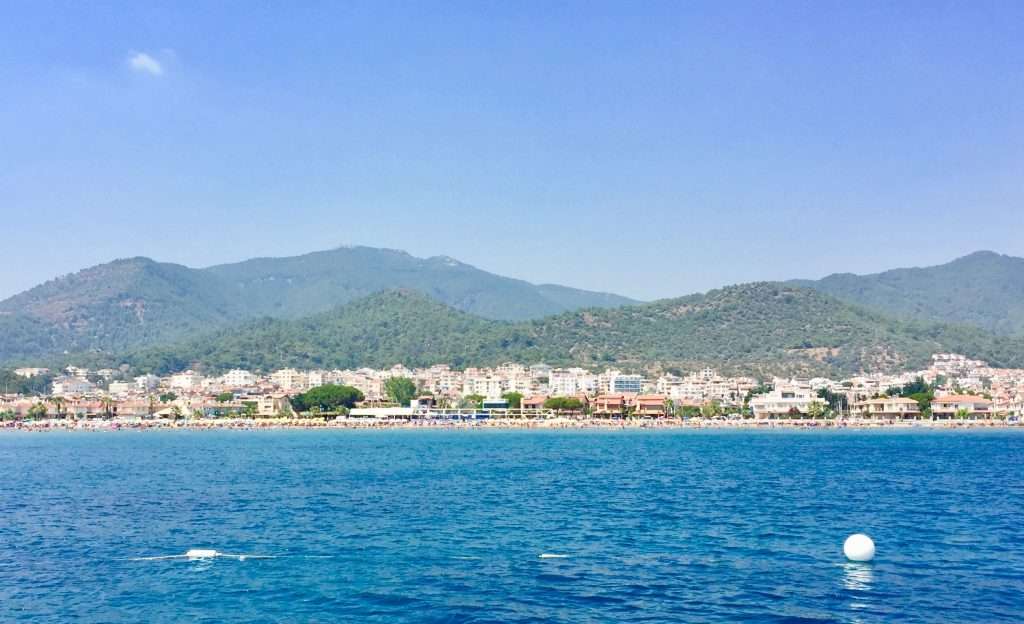
Over the past three months I have spent a lot of time alone in the cockpit while making passages, as Annie spends all her spare hours down below, doing an intensive course in French, to brush up on her school French of many years ago. I would occasionally invite her up on deck to do sail changes or to look at once in a lifetime scenery. There was no need to call her up much, as we left Gumusluk to sail east around the Bodrum peninsula – the reason, as mentioned in our previous post, the “Concrete coast” stretching on for miles.
Entrance to Iassus – the Byzantine tower with the fort on the hill above.
Still, there is a blessing in these developments being limited to about 4-storeys, fragmented into smaller blocks and painted uniformly white. It did get a bit boring though, so we took a shortcut across the Gulf of Korfezi, to anchor in the ancient harbour of Iassus, which is entered though a narrow passage between the ruins of a Byzantine tower and a sunken breakwater. We were welcomed by two German yachts who invited us over for drinks. They had sailed from Germany via the Black Sea to visit this site, their furthest point south.
The harbour entrance tower from the hill.
Iassus was colonised from about 900BC around this harbour and has remains of the Agora, theatre and houses on the hill on the eastern side. The substantial fort on top of the hill was built by the Knights of St John, during the Crusades. We were able to explore this magnificent site the next morning, the only people about, marvelling at intricate floor mosaics, more than 2,000 years old and still in good condition – we wondered which type of tile adhesive they used! Some of the wall murals still intact. The site is enchanting.
The fort built by the knights – note the recycling of materials.
Floor mosaics.
View down to Iassus village and anchorage.
From here we motored through numerous marine (fish) farms, directly to Altinkum on the north side of the gulf, to get into the lee of the land and out of the Meltemi. This proved to be a bad choice, as the locals had decided to challenge Bodrum for supremacy in the doof-doof music stakes – until 4 o’clock in the morning. The mosquitos in town couldn’t handle the noise and decided to fly out to sea and seek refuge on Esprit!
Fish farms.
Bleary eyed, we left Altinkum after an early walk ashore, to tie up at the Didim marina, a mile to the west. We had to make this stop as the Turkish “Mavi” or blue card requires us to have our two black water holding tanks pumped out and logged, once a month – or face a huge fine. Good on them for their effort at minimising waste pump outs in their beautiful anchorages. We can only hope the day tripper boats and gulets with their hundreds of punters on board, does the right thing. We also filled up with water and diesel.
Cheerio Altinkum.
An early night in a secluded bay at Cukurcuk with one other yacht followed – with no music or mozzies.
More fish farms.
Going north from here to the narrow strait between Turkey and the Greek island of Samos, there are dozens of fish farms to navigate, until you reach the small anchorage of St Nikolas, 21 miles to the north. This little anchorage presented us with the worst challenge in anchoring since we left Sydney. After 11 attempts, the anchor eventually bit in a sandy patch between the luxurious seaweed on the bottom. All of this accompanied by loud outdoor voices – thankfully, there were no other yachts in the anchorage. Although only midday, this necessitated a few calming Efes beers, as soon as the GPS confirmed we were stationary.
St. Nikolas anchorage.
The next morning, we motored through the Samos strait, slightly less than a mile at the narrowest part – the closest Turkey and Greece get to each other. We took the shortest route to Setur marina in Kusadasi harbour, as this west facing bay is in the teeth of the prevailing westerly Meltemi and there are no other anchorages between the strait and Kusadasi. We took the bikes out and cycled through Kusadasi, which is a quaint town, focussed on tourism. The old caravansari and the castle in the harbour were really worth the visit.
The Samos strait.
Entering Kusadasi.
Kusadasi town – colourful housing.
Visiting the castle.
It also gave us the chance to take a taxi early the next morning to Ephesus, about 18km inland. Ephesus is home to some of the most impressive ruins in Turkey. Originally occupied by the Lydians, until the Ionians arrived in 1,000BC. Ephesus survived Alexander the Great’s conquest and later as the Roman capital of the province of Asia, entered its greatest period of prosperity. It was sacked and destroyed by the Goths in AD 263. The site today is impressive – you can walk down the marble streets and see the ruins of the theatre, agora, library, odeon, stadium, gymnasium and even the brothel, the bones of the ancient city laid bare. It takes little to visualise what life was like here. After a two-hour walkabout, the taxi took us back to town.
Entrance to Ephesus.
The Great theatre could seat nearly 24,000 people.
Inside the theatre.
The Curetes street.
Temple of Hadrian.
The Celsius library.
Celsius library detail.
Gate of Mazeus to the Agora.
Vicinity of the State Altar.
The Nike of Ephesus.
Inside the hillside houses – marble wall cladding.
Frescoes on the higher walls.
Seeing that it was still mid-morning, Annie decided decided on some retail therapy. She noticed that ladies clothing and swimsuits were very well priced compared to Sydney. Turkish ladies also have fuller figures and therefore she could buy bikinis for gals, with more than a handful. I managed to buy a 665 page English biography on Mustafa Kemal Ataturk, the much revered father of the modern Turkish Republic. Afterwards, we set sail for Cam Limani and had a robust 14-mile sail in a building north easterly, to anchor in a small bay.
Kusadasi marina.
One of the new bikinis.
Mustafa Kemal Ataturk.
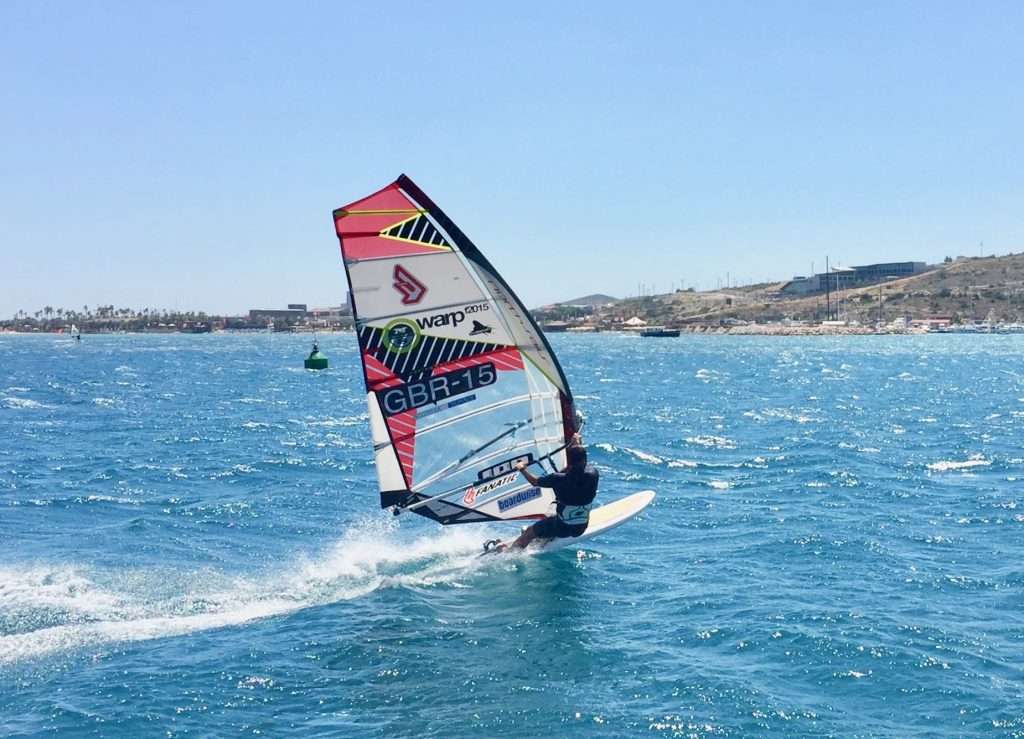
The good sailing continued the next morning until we rounded the Doganbey Cape to set course for Teos Limani, when a 25 knot northerly hit us. After tucking in two reefs in the main and furling the jib to 50%, we were still overpowered. With only the reefed main, we managed to motor sail into an increasing swell to reach Teos anchorage at around midday. The anchor bit well the third time in sandy patch and we enjoyed lunch and a beer watching the board sailors screaming past us in the pumping northerly.
Strong wind sailing.
Fun, fun, fun – longing back to those days at Big Bay in the 80’s.
The plan was to sail around the Teos peninsula to Sigacik to visit the old walled town, but the wind was still gusting 25 knots the following morning. We were confident that the anchor had bitten well in the sandy patch amongst the seagrass, so we went ashore and walked across the peninsula through the remains of ancient Teos. It was a pleasant 3km walk through ancient olive trees and citrus orchards, and it took 40 minutes to reach Sigacik. After walking through the walled town, we had brunch and coffee at a bakery, before walking back along the 3km dirt road. The dinghy and boat were still there. We slept well that night.
Inside Sigacik walled town.
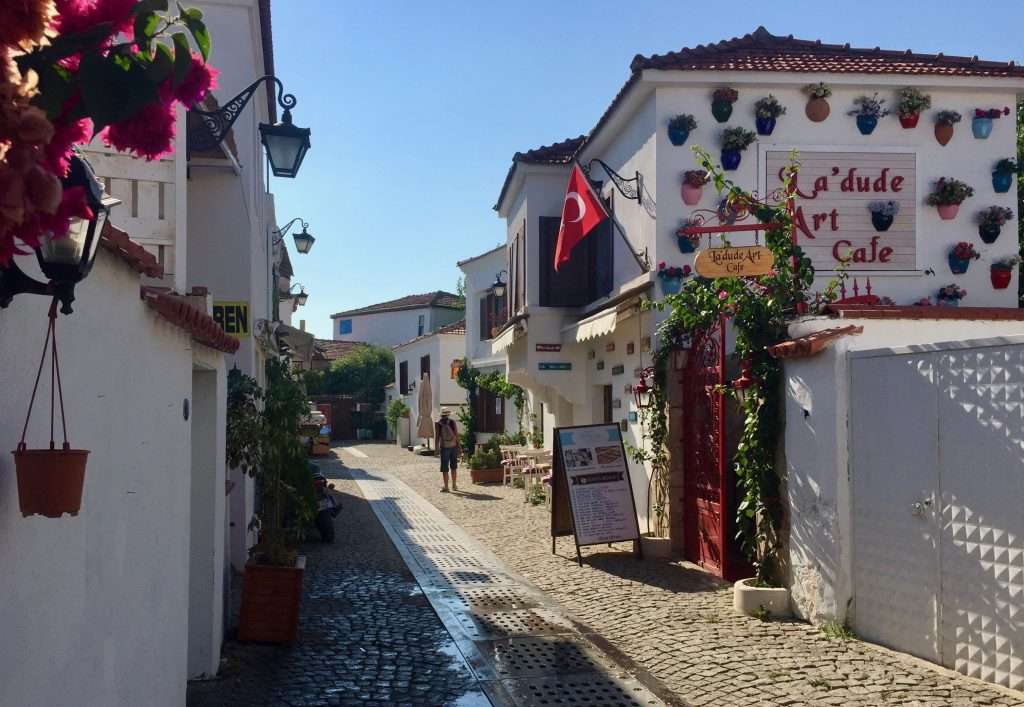
Another pretty street.
The weather forecast indicated two more days of a strong Meltemi, so we upped anchor and had an exhilarating sail in 25 knots of wind on the beam, with only the jib up to reach the lee shore of Kirkdilim bay. Beautiful clear water with not a soul in sight – but unfortunately a swarm of bees came to visit us at sunset. Annie tried some earlier advice and burned ground coffee, which, together with my frantic swatting, drove them away. The following day’s sail to Port Alacati was a replay of the previous day, minus the bees. We sailed out of the Ionian coast area when we passed Cesme the next day to enter the Aeolian coast.
We will report on the Aeolian coast in our next post. Cheers for now!
Having dropped Karen off in Sarsala Bay to catch a taxi to Dalaman airport for her flight to Istanbul, we set sail for Marmaris. Or so we thought – the westerlies had started kicking in, resulting in the wind on the nose, a confused sea and much motoring to make headway. The first night we found shelter at the jetty in Asi Koyu, where we enjoyed dinner at the restaurant, in return for the tie up at their bouncing, floating jetty.
Carian coast.
This time around, we decided not to visit the ruins of ancient Caunos and their rock tombs on the Dalyan river again, because like Machu Picchu in Peru, the tourist numbers have skyrocketed. Across, in the bay of Ekincik we found a beautiful anchorage in Semizce cove, before motoring into Marmaris the following day. We would spend a week in Marmaris, the first four days at the Marmaris Yacht Marina, with its 600 berths and 1,000 dry berths. A well run marina with all the facilities and reasonably priced. We had a lot to do.
Marmaris Yacht marina.
Our original three-year-old anchor chain, had come to the end of its useful life. It had been re-galvanised twice, in Darwin and in India, but was again badly rusted and worn. We purchased 80m of 10mm short link galvanised chain at a very reasonable price (by Sydney standards). Also on the shopping list, was a 6.5l engine oil draining vacuum pump for our periodic engine services and an industrial type pop riveter. After five broken pop riveters in my lifetime, it seemed the sensible thing to buy. The other items required were two stern reels with 50m webbing for the med style mooring here – no more tying halyards and lines together!
The name is Blond – James Blond, correction – James Grey.
Stern webbing reel.
Webbing reel in action.
Lucky for us, we could refill the gas bottles, but we will probably have to dump them when we get to the EU countries, as they don’t refill the Aussie bottles. We also found a sailmaker to sew new Sunbrella edging fabric to leech and foot of the jib sail– he also reinforced the spray dodger which showed signs of wear. I rust treated the anchor and painted it with cold galvanising, as the nearest galvanisers were in Istanbul. Then there was the usual replenishing of water, diesel, petrol, wine, beer and food. In between, we spent time at the pool, at the bar and walking around Marmaris old town, still recognisable, but much modernised.
Marmaris harbour – the castle and old town on the hill.
The old town mostly unchanged.
The bazaar area now paved with sculptures.
New paving and landscaping.
Social media has a lot to answer for – Sunday the 24th June 2018 was election day for 56 million eligible voters in Turkey, for a new government and president. As a result of misinformation, many sailors left for Cyprus and Greece to be away from this perceived catastrophe. Everything went without drama and we spent the day at the library and later, having a few drinks with friends. The Turks were mostly non plussed.
Byzantine church ruins above Gerbekse Cove.
From Marmaris sailing west, we will be on the Carian coast. We anchored at Gerbekse Cove, Bozuk Buku and Bozburun over the following three days, as we wanted to re-visit these anchorages to climb some hills for exercise and visit their Byzantine ruins. Bozburun is the heart of the timber boat building industry where most of their traditional gulets are built. Five years ago, while sailing with Dave Bruce, we visited a huge shed here where some Russian oligarch was having a 100m long timber gulet built. We didn’t call again, as security was tight – maybe the oligarch was now spending time in Siberia as one of Vlad Putin’s guests.
The massive uncompleted fortification at the entrance to Bozuk Buku.
The view down from the fortification.
Huge stone blocks, perfectly hewn and placed.
A refreshing beer after the climb up and down.
Anchored off Bozburun town.
Anchoring in Selimiye, we caught up with Soul again and had a great dinner with them on Esprit. Selimiye is a pretty town offering walks along the shore with waterside cafes and shops. The next day we anchored in Keci Buku where the dedicated rock-hounds on Soul and Esprit climbed up to the fort on the island for sundowners – leaving the climb down not too late, as the climb down was as difficult as the one going up.
Selimiye beachfront.
Cozy cafes along the beachfront.
Colourful bougainvillea on the streets.
For the Vespa enthusiasts.
Keci Buku – the fort on the island.
Sundowners with the Mason’s at the top.
View of Keci Buku from the top – note the people walking out on the sandbar.
Our next stop was Datcha which has retained much of its charm despite the substantial growth of this beautiful town. Annie had to buy more data for her SIM card in town and I did shopping for fresh vegies and other provisions at the Migros supermarket. The sail from Datcha to Knidos was quite lively in a strong westerly. The anchorage in the ancient harbour of Knidos was crowded but we found a spot and explored this ancient city early the next morning. Knidos was one of the six cities of the Dorian Confederacy.
Anchored in Datcha.
Fish statue in Datcha – hard to resist for our fishing enthusiast.
The town was famous for the statue of Aphrodite by Praxiteles one of the great Greek sculptors. In the 4th century BC, the statue was one of the first of a naked woman, only male statues having been naked until this time. The sexy Aphrodite was believed to bring good fortune to seafarers. Although the ruins of the city are overgrown, it is easy to pick out the skeleton of the city in this grand setting. We set sail after our hour walk around the site and had a fast sail past the Greek island of Kos to Aspat Koyu, 5 miles west of Bodrum.
View over part of Knidos to the harbour.
The theatre.
Clay amphora for grain storage.
Amazing detail on these lintels.
Even more amazing.
Although Bodrum is quite a lovely but very busy town, the reason we gave Bodrum a miss was the memory of 5 years ago when we sailed out of there with Dave Bruce. To quote Rod Heikell from his Turkish Pilot: “Several discos assail the night air with the latest dance music to keep the novice sailors happy into the late evening. In the height of summer, bars and clubs around the harbour compete for ascendancy in decibels and the incessant beats, reminiscent of a cardiac monitor in overdrive, can go on into the small hours.”
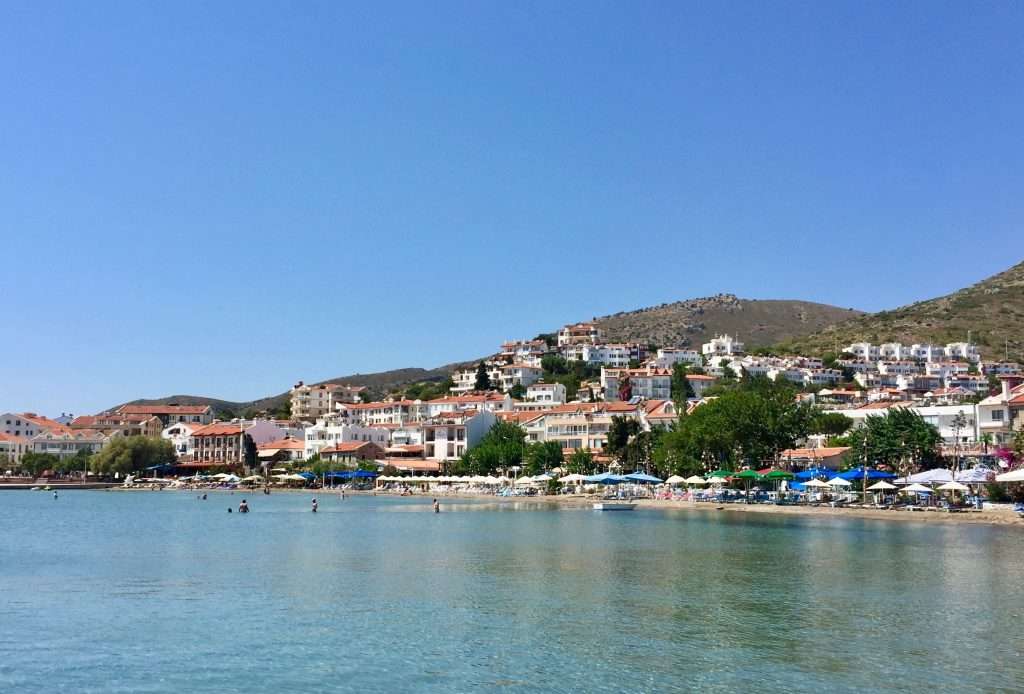
The start of the Meltemi season appeared earlier this year and we had a night of 20-25 knot winds in Aspat Koyu, requiring constant checks of the anchor during the night. An early start the next morning in lighter winds got us to Gumusluk, which is a more sheltered bay and very quaint with its village on the shore. Thanks to strict planning laws, little has changed here for 20 years. Despite the intense housing developments to the north and south, which had earned itself the moniker of the “Concrete coast”. Lots of opportunities for exercising here, with walks up to the ancient ruins of Myndus and the lookout at the top of the hill.
View of Gumusluk bay from the hill.
Gumusluk waterfront restaurants.
Gumusluk village.
Lively restaurants at night.
Here you can keep your feet cool.
The wines of Myndus were said by Athenaeus to be salty in taste because they were mixed with salt water, a practice believed to eliminate hangovers and aid digestion. Others have said it was mixed with salt water because the wine was so bad. The local wines we had at the restaurants here, were in fact most palatable. Gumusluk also has an excellent bakery where we bought delicious spinach and feta pies, baklavas and rice puddings after our walks. After waiting for two days for the winds to subside, we set forth to round the Bodrum peninsula, leave the Carian coast behind and enter the Ionian coast. Our aim was to explore the coast going north to Kusadasi harbour and then visit Ephesus, site of the most impressive ruins in Turkey.
Next to us in Gumusluk: “Young men who sail” – who said 22ft is to small to sail from Australia? Half the length of Esprit.
We will report on the Ionian coast in our next post, around the end of July. Cheers for now!
Our stop in Kemer was very brief, as this was holiday central for Russians. Friendly, robust and loud people enjoying their new found freedom on jet skis and pirate boats with very loud doof music. We anchored a few miles further west at Phaselis, a picturesque site which was founded in 690BC by colonists from Rhodes. It quickly grew into a prosperous trading city under Roman jurisdiction with many structures remaining. Phaselis is thankfully a preserved site, in contrast with the lack of grace and balance of the walls of reinforced concrete hotels along the rest of the coast. The next morning, we explored the ruins in the town.
Phaselis – aqueduct.
Phaselis – theatre.
Phaselis – main street, all quiet now.
Finike harbour 42 miles to the west was our next stop, where we anchored outside the marina. We had a midnight visit from the Coast Guard who wanted to inspect our documentation – all very courteous. The girls went shopping for provisions in Finike the next morning, while I topped up our diesel tank with 80l of diesel from our jerry cans. Late morning, we motored west to enter the Kekova Roads, a lovely sheltered and indented coastal area behind Kekova Adasi, a four-mile-long island. We anchored at Kale Koy, where a magnificent castle is situated on a steep ridge behind the hamlet below. A fabulous place to explore.
Approaching Kale Koy.
Climbing to the top of the castle – a small theatre inside the walls.
View of the village through the castle wall.
View from the flagstaff at the top.
Lycian sarcophagus near the castle – the hills are littered with these sarcophagi where the dead were interned.
Esprit tied up at the Likya cafe down in the village.
The village.
We then motor sailed to Bayindir Limani, a bay opposite the town of Kas, where we had dinner at the La Moda restaurant. The owner, a friendly and soft spoken retired investment banker from Zurich. We detoured past the harbour of Kastellorizon, a Greek island barely 2 miles off the coast of Turkey. We planned to enter Kas harbour the following morning, but found it packed with tourist tripper boats and gulets. The girls wanted to visit Kas town, so we motored around a peninsula which took us to Kas marina, where there is an anchorage close to town. The girls went sightseeing and shopping, while I started this post on board.
La Moda restaurant.
Kastellorizon harbour.
Kastellorizon town.
Our journey continued west to overnight in Kalkan, have lunch the following day at Butterfly Bay and med mooring at Olu Deniz the night after. Olu Deniz is at the foot of the high Taurus mountains, providing an ideal high altitude launching pad for paragliding enthusiasts, with dozens of parachutes floating down to the beach from early morning to sunset. At night the beach throbs to the moronic beat of popular dance music from the numerous discos and bars – not really the yachties’ scene.
Butterfly Bay.
Julia enjoying the water.
The island of Gemiler Adasi was our last stop before Fethiye. On the slopes of Gemiler Adasi are the extensive ruins of what must have been a sizable Byzantine community and it is interesting to wander around the remains. Part of the island connecting it to the mainland, sank 20m below the sea after an earthquake. There are the remains of no less than four Byzantine churches. Evidently St Nicholas (Santa Claus) visited or stayed on the island.
Background information.
Partially collapsed tunnel connecting two of the churches.
Small theatre at the top.
The girls with the mainland behind.
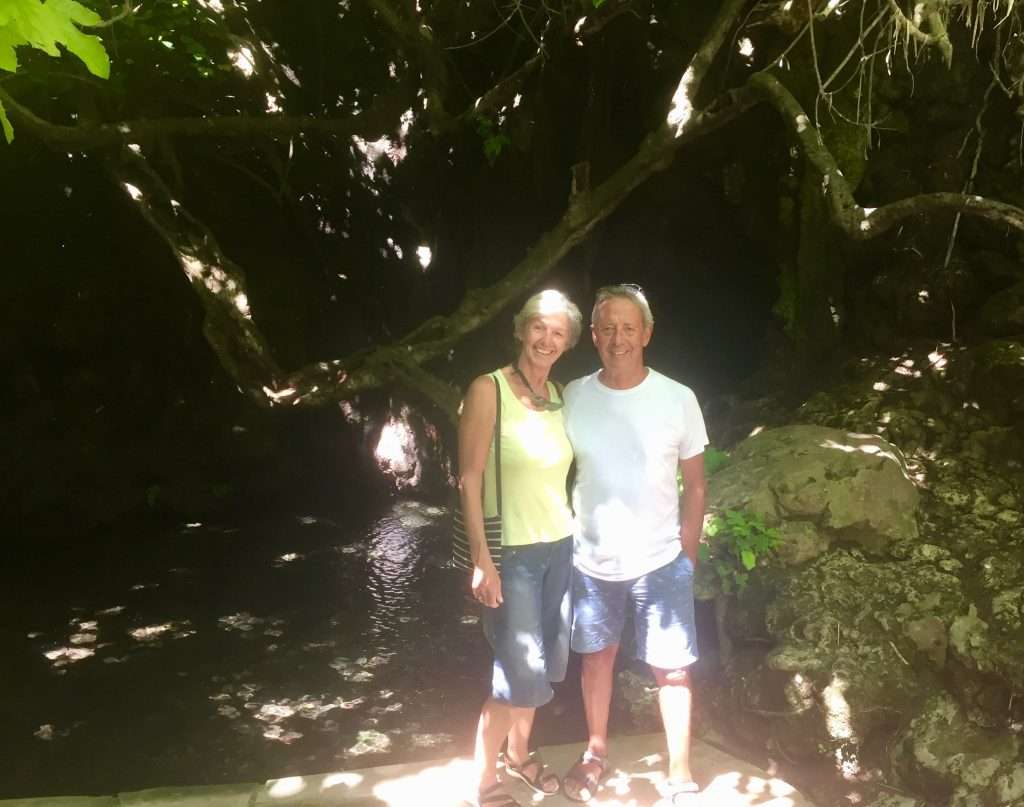
Darby & Joan at the top.
In Fethiye, we tied up at the Classic Yacht Hotel marina, so that Michelle and Julia could catch their respective flights to Istanbul and London. In Istanbul Michelle would catch a train to Bulgaria, where she would meet up with Karen at the “Meadows in the Mountains” festival. We enjoyed dinner at the hotel with live music provided by a chap on guitar, playing Spanish and Brazilian music faultlessly.
Dinner at the marina.
Annie and I then had a leisurely exploration of the large bay north-west of Fethiye, anchoring in five different bays over five nights, before tying up at the Skopea Marina in Gocek. Gocek is still as pretty as always, but the growth in the number of tourist boats and yachts, have resulted in no less than six packed marinas in this relatively small bay. This has resulted in strict pollution controls on boats, to preserve water quality.
Skopea marina in Gocek.
Gocek town.
Before tourism, Gocek’s mainstay was chromium mining and agriculture – Ataturk in the centre.
32 years ago, in 1986, we chartered a yacht in Rhodes with six friends, to explore the Turkish coast and sailed west to Kusadasi and then east as far as Fethiye. In subsequent sailings, we haven’t sailed further than Gocek, six miles west of Fethiye. This time, we were pleased to have explored the coast further to the east. The changes in this area over time have been remarkable – sometimes not for the better, but generally resulting in better infrastructure and employment for the locals in their vast tourist industry.
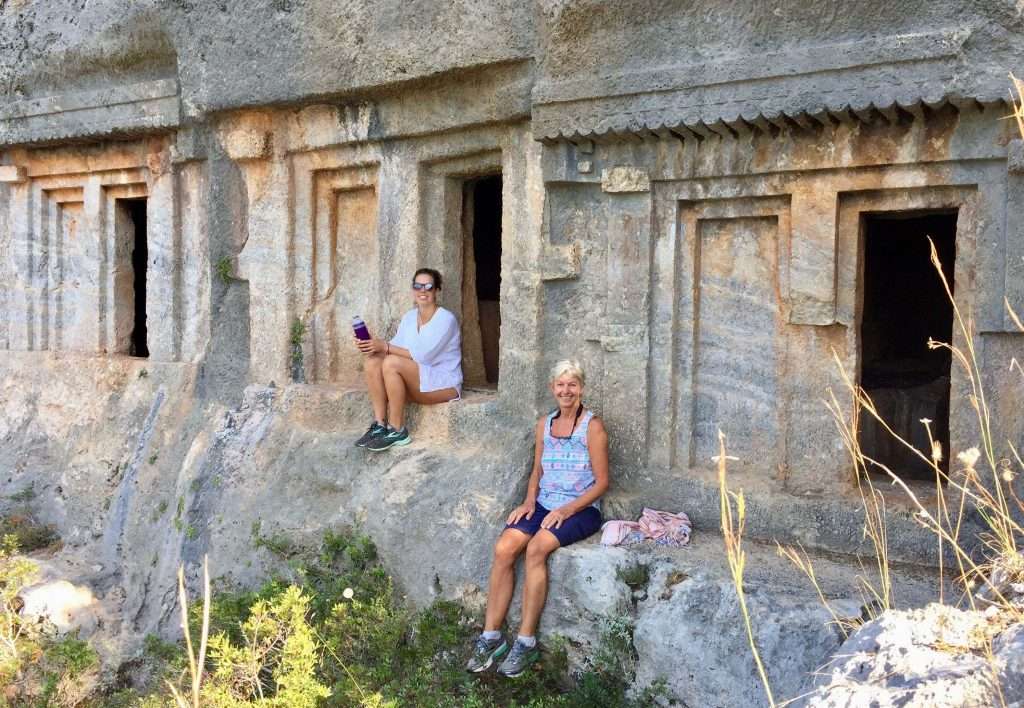
Annie & Karen hiking up a mountain.
Destination: Some Lycian rock tombs.
Karen arrived from Bulgaria on the 12th June to spend a week with us on Esprit, while we cruise to Marmaris. Having the girls join us from time to time has been most rewarding, as we have been able to learn of their pursuits in more detail than we ever did in Sydney. For the week she spent with us, we visited numerous bays in the Gulf of Gocek, before she caught a taxi to Dalaman airport to fly to Istanbul for w few days and from there to the Greek island of Corfu.
Esprit anchored med style to the shore.
Another beautiful bay where we tied up at a restaurant jetty.
The friendly restaurant owner who couldn’t do enough for Karen.
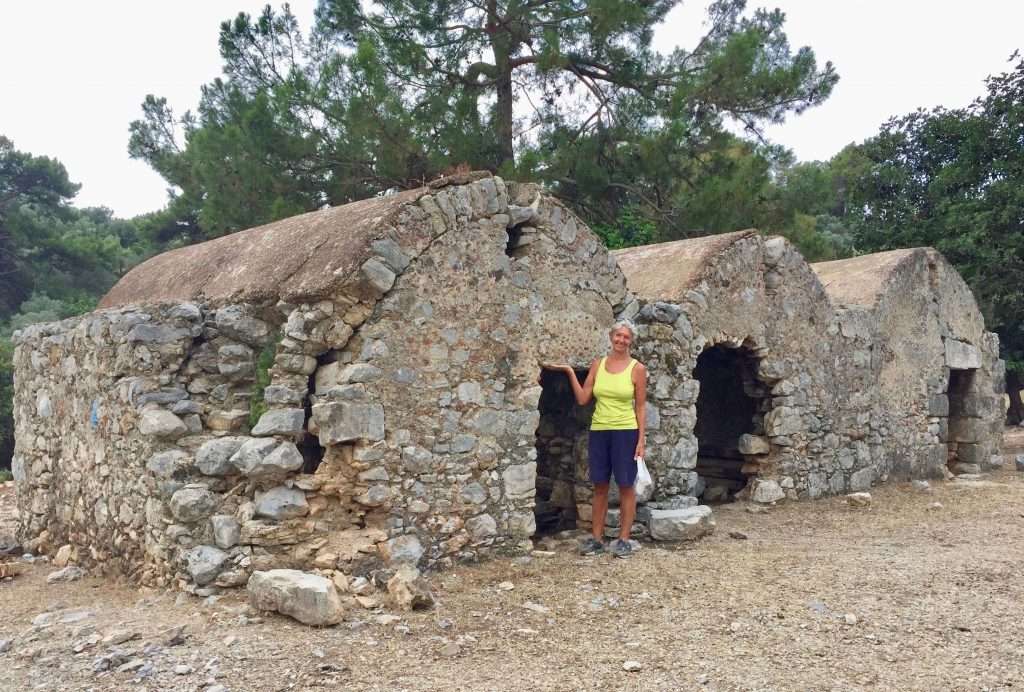
An old farmhouse – the people must have been small.
Migros and Carrefour have supermarket boats visiting the anchorages!
More exercise – another bay.
The last stop before Marmaris.
On reaching Marmaris, we came to the end of the Lycian coast. We will spend a few days at the Marmaris Yacht Marina, to do some work on the boat, stock up with food and wine and catch up with Darryl, Mike and Sarah who are also in the marina. Our next post will take you from Marmaris, further west. Cheers for now!
Note: The Turkish Waters Pilot uses the ancient titles for the Turkish Aegean and Mediterranean coasts, rather than the modern ones such as the Blue, Turquoise, Emerald coasts etc. We will use the ancient.
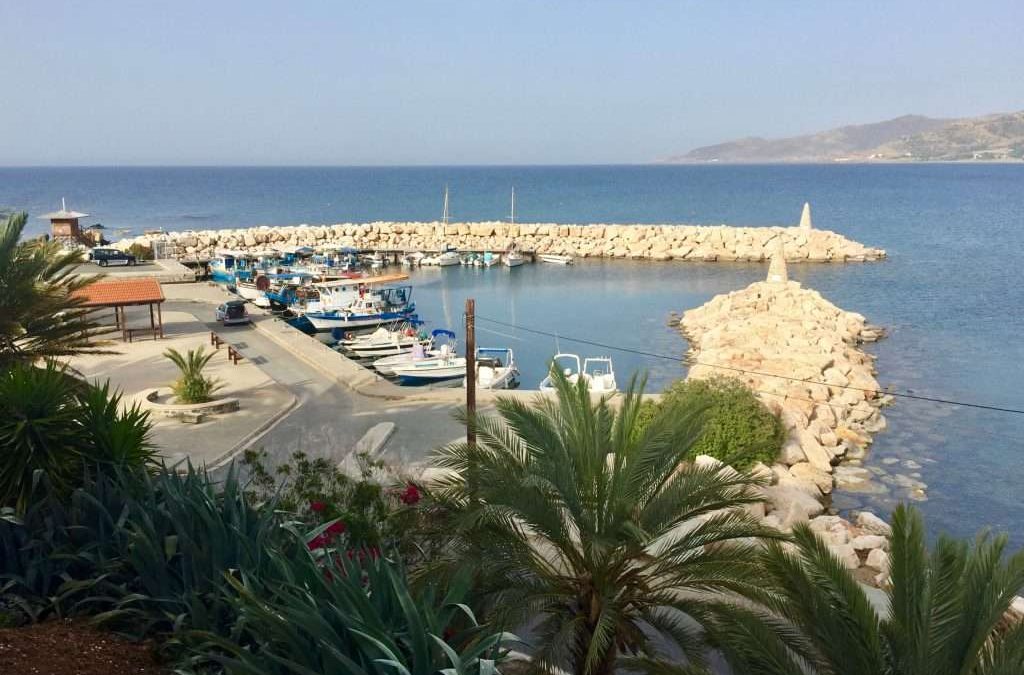
After checking out at Latchi harbour in Cyprus, we did a short 10-mile sail to Pomos fishing harbour in north-western Cyprus, to reduce the next day’s sailing distance to Turkey to 53 miles. We had a pleasant dinner at a restaurant overlooking Pomos harbour.
Pomos harbour.
Pamphylia and Cilicia.
The conditions for the crossing to Turkey were perfect, with a flat sea and starting with an easterly wind, which by midday had swung 180 degrees to a westerly – both on beam reaches. We anchored off Cape Anamur in Turkey at 4:30 pm and had a swim in crystal clear water before sundowners. At 7 am the next morning, we motored 6 nm to the east to anchor at Anamur Kalesi, to visit the castle of Mamure Kalesi. It was built in the 12th century and is one of the best preserved castles on Turkey’s Mediterranean coast.
Sailing to Turkey.
Old castle on the left, the main section was restored by the Ottomans.
The landward side has a moat and drawbridge.
View inside the restored castle, from the old castle.
Old castle and old man, both falling apart.
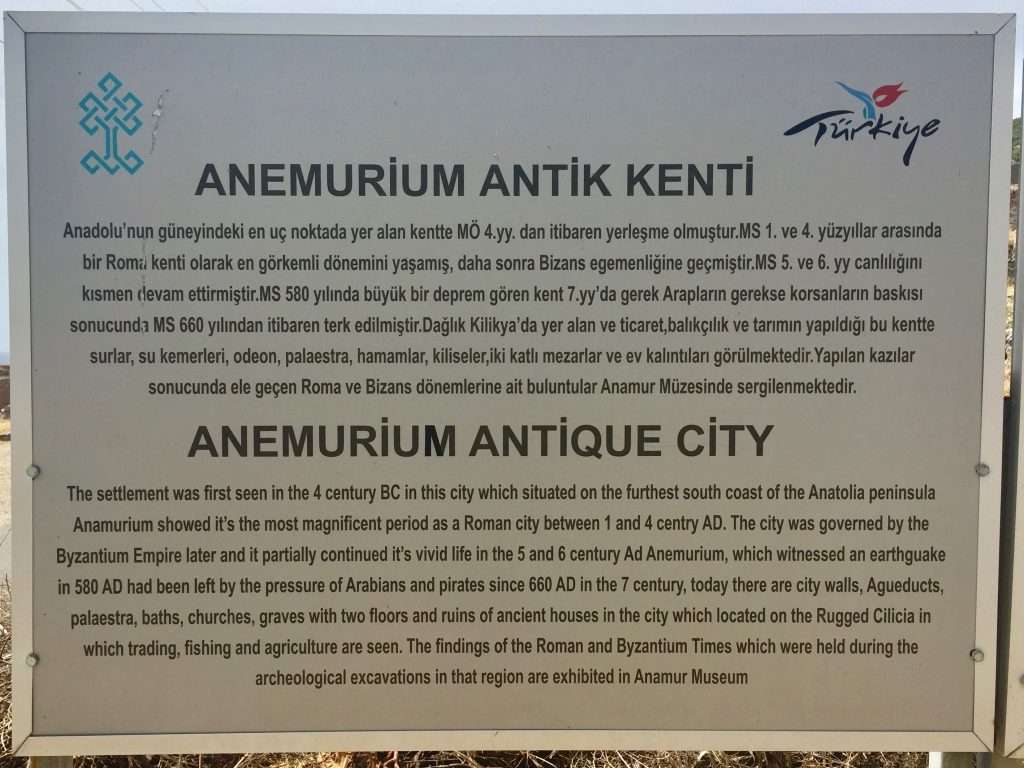
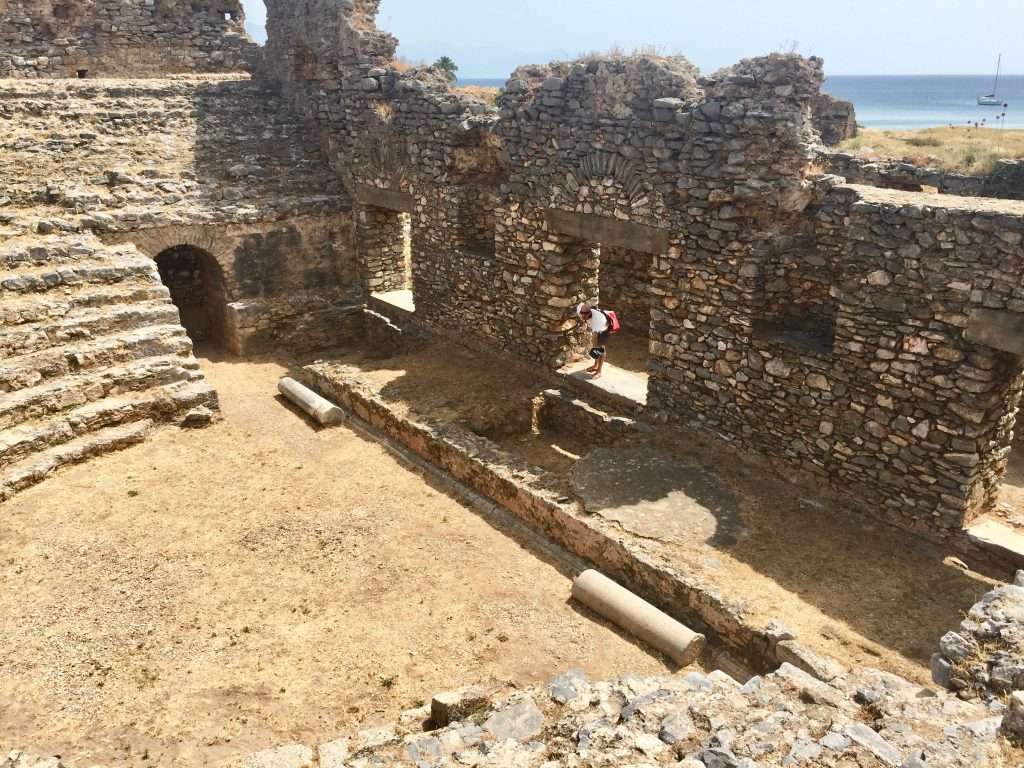
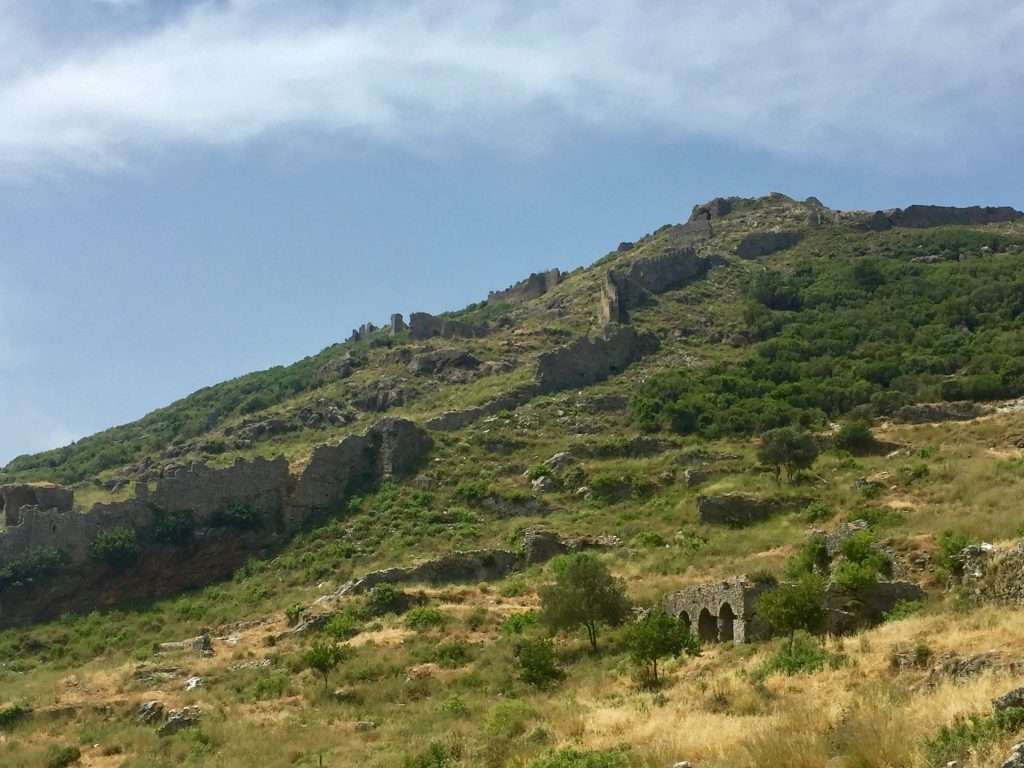
An hour was enough to explore the castle, before we motored back to Cape Anamur to visit the ruins of ancient Anemurium, founded by the Phoenicians in the 4th century BC. It reached its heyday in the 1st to 4th century AD during Roman times. In 580AD an earthquake damaged the aqueduct and many buildings. Still, it is amazing to walk around the baths, the theatre, the remaining houses and a large necropolis for the inhabitants.
Soul motoring to Cape Anamur.
Anemurium information.
Sarah, Mike and Annie ready to start the long hike.
The theatre – Mike taking a bow after addressing his friends and fellow Romans.
Audience of one.
Sarah and Annie in the tunnels below the theatre.
The aqueduct.
The baths.
Inside the baths.
Fortifications on the hill.
A lot of the buildings were clad in limestone – some of the remnants.
Finally, the cemetery – a grand affair.
We set sail in the afternoon and anchored at Yakacik (ancient Charadus), about 20 miles to the west before motor sailing to Alanya to tie up in Alanya marina the following day. The checking into Turkey through an agent went smoothly, albeit expensively. Turkish transit log cost AUD 155, visa for Australian passport AUD 75, visa for UK passport AUD 25. It gave us the opportunity to wash the boat down, after a dust storm from Syria hit us on the way. We bought local SIM cards and Annie went to have a filling repaired at a local dentist. The marina chandler had passerelles (gangplanks), so we invested in a 2m folding model for local use.
The new gangplank.
Alanya – these guys take their pirate history to the limit.
After two nights we headed west and anchored off Side in a bay between the old town and the modern tourist strip. An early morning walk through this charming old town showed its various stages of settlement, from the early days when this strip of coast to Alanya was a pirate stronghold, until the Romans drove them out and settled here. There are remains of the Temple of Apollo, Roman baths, Theatre, Aqueduct and Agora. Also Byzantine structures like churches etc. All in all, a town worth visiting – can’t get enough of old stones.
Plan of Side.
Temple of Apollo.
The Agora with the theatre in the background.
A house in the old town.
Traffic free street in the old town.
Very sensible – new shopping development with glass paving to show the history below foot.
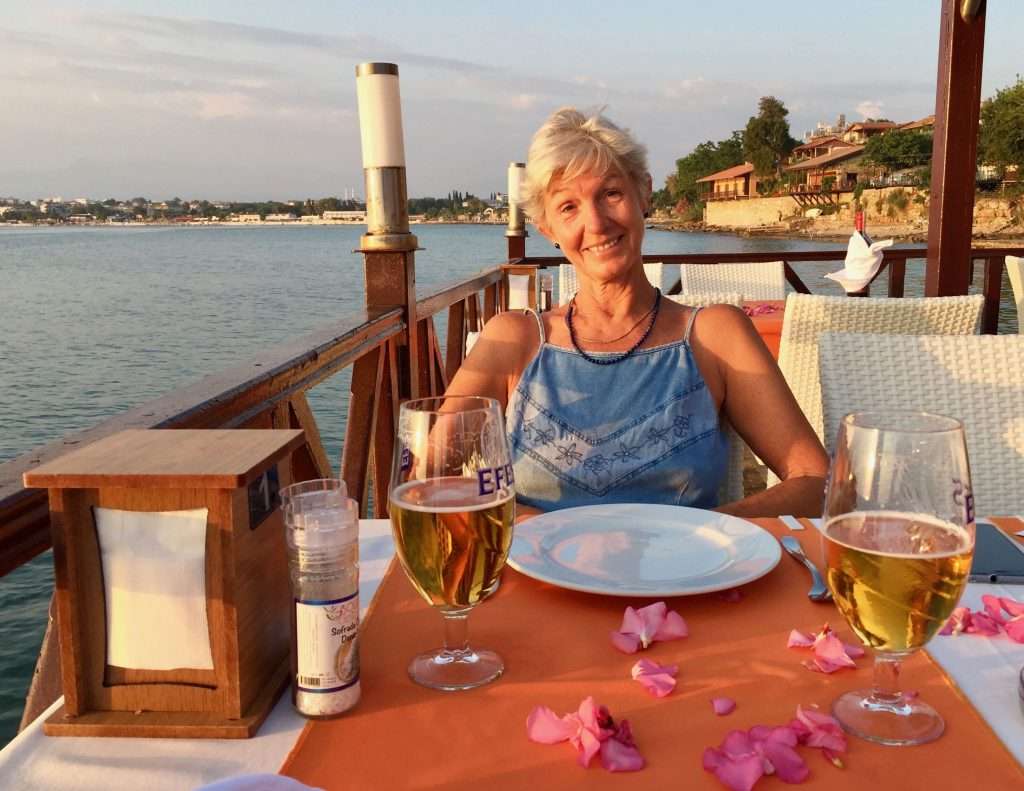
Dinner at the Cuba bar.
Mehmet the owner married a Cuban lady – we promised we will visit them in Havana.
Our next stop was Antalya, where we tied up in the fishing harbour on Monday the 28th May – just in time for Michelle and her Kiwi cousin Julia, to fly in and hop on board to join us for 10 days of cruising. Or so we thought – they only arrived the following day! We got the date wrong, but it gave us the chance to explore the beautiful old town of Antalya and watch the tourists coming down to visit the quaint little harbour.
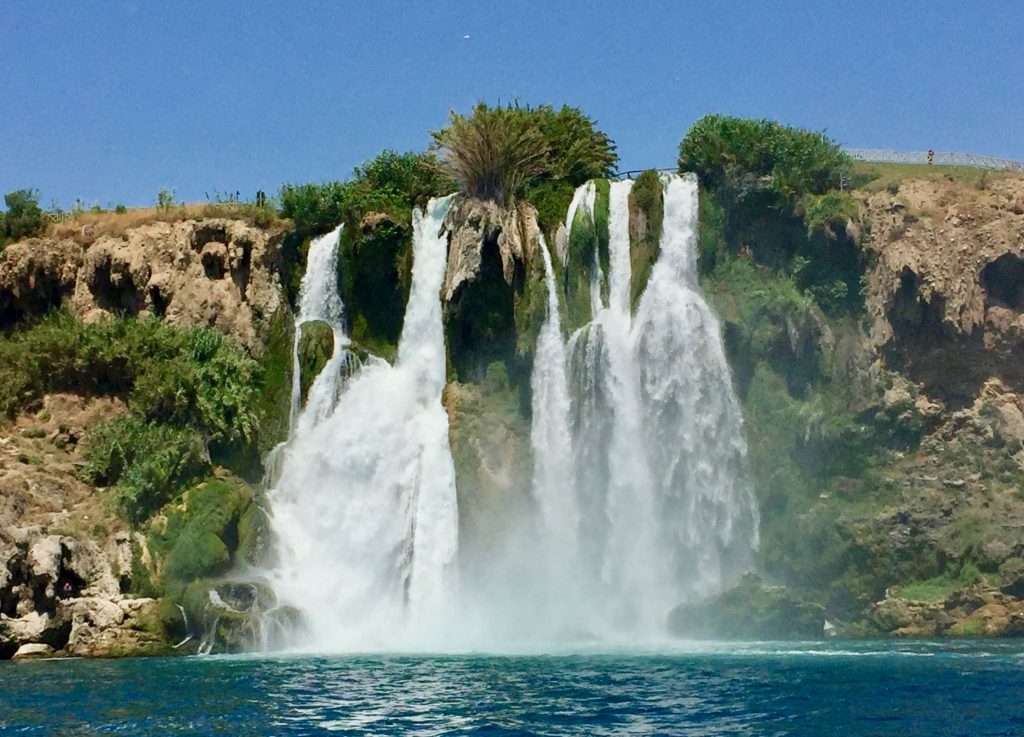
40 m high waterfall of the Demer river, just before Antalya.
Approaching Antalya harbour.
View of the harbour from the old town.
View of the harbour from Esprit
The old town.
We are not through with the pirates yet!
Hello, is this the Society for the preservation of Seagulls’ dignity?
Once the girls were on board, we set sail the following day for the Lycian Coast to anchor in the bay south of Kemer Marina.
More in the next post, until then, cheers for now!
Before we realised it, twelve days had passed in Larnaca marina – at the very reasonable cost of 13m x E0.60 = Euro 7.80/day, which equates to AUD 12.48/day. Having done all the sightseeing inland, jobs on the boat and cleaning, we set off again on Monday the 7th May, motor sailing to Limassol, 38nm to the west. We anchored outside the marina, which is very modern and expensive and out of the wind. The next day was spent exploring the marina and the surrounding city area, before motoring 4 miles to Ladies’ Mile Beach.
Limassol, approaching the marina.
Limassol marina houses.
Limassol marina boats – check the scale of the guy washing the decks.
Black boat: “You may be bigger than me, but I have bigger Mickey Mouse ears!”
Sign in a Limassol supermarket – fortunately, I found a youngster to buy me some Retsina.
Let’s dance!
Next day, sailing around the aptly named, Cape Aspro.
The following day we sailed around the Akrotiri Peninsula to anchor in Pissouri Bay, taking shelter from the strong westerly wind. It should be noted that the prevailing wind on the south coast of Cyprus, is a westerly wind, which starts at about 10am and builds up to 25 knots in the afternoon, before dying down again in the evening – leaving an uncomfortable swell in unsheltered anchorages. The coastline is dotted with windfarms of dozens of wind turbines, providing clean energy. Our next stop was to be Coral Bay, but one look at all the Jet skis and tourist boats with blaring music, had us hot footing it to Lara Bay – quiet and undeveloped.
Pissouri Bay
The reason we left Coral Bay.
Esprit anchored in Lara Bay north.
Lara Bay north – turtles come here to lay their eggs to hatch.
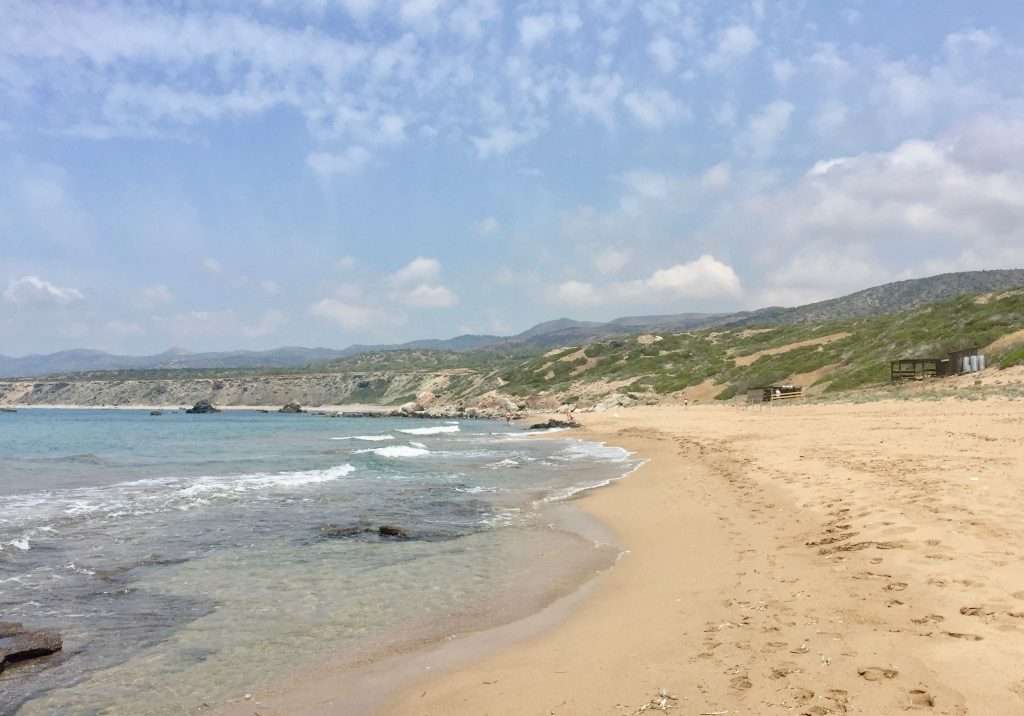
Lara Bay south – Van Gogh could have painted this scene.
We motored the 8 miles from Lara Bay to Cape Arnauti, the the north western tip of Cyprus, before anchoring 3 miles down the east coast of the peninsula, at Aphrodite’s Beach (According to legend, Aphrodite comes from this area). Our anchorage opposite Ttakkas’ restaurant was in crystal clear water, on sand, 1.5m under the keel. The fold up bikes were taken ashore and we cycled into Latchi town, about 5 km away, over an undulating landscape of olive trees and wheat fields. Latchi is quite a pretty town, built around the harbour.
Aphrodite Beach – Ttakkas’ restaurant.
The beach in front of Ttakkas.
On the Sunday, we cycled to the 300-year-old village of Neo Chorio, pushing the bikes up the steep hills for the last kilometre, before enjoying fresh pomegranate juice and baklava at an elderly lady’s small taverna. The ride down was quick, so we pushed on to Aphrodite’s pool to look at where the goddess reputedly bathed. Arriving back at Ttakkas’ restaurant we sank a few refreshing Keo beers, before going for a swim.
Stopping for a welcome drink, going up the mountain.
300 year old Neo Chorio mountain village.
Annie inspecting the menu at the Taverna where we stopped for refreshments.
View from Neo Chorio down to Latchi town and harbour.
Arriving at Aphrodite’s bath.
Me and my Aphrodisiac at Aphrodite’s Bath.
Ttakkas’ Sunday special lunch of lamb Kleftiko, which he starts at 6am with lamb cuts and potatoes on top of green Carob branches, bakes in a sealed clay oven for six hours. At 12:30 the Kleftiko oven was opened and we sat down for lunch with Mike and Sarah, who arrived on Soul that morning. The food, wine and company was excellent. After the very smooth house red wine, we had a Nanna nap in the afternoon.
Ttakkas’ uncle plastering the oven closed.
Ttakkas opening the oven 6.5 hours later.
Inside the oven -yum!
Lamb Kleftiko with Mike and Sarah.
View from our lunch table to Esprit and Soul.
Tuesday the 15th of May was a milestone for us – it marked two years since we set sail from Sydney and when I threw away my $7.95 Aldi Limited Edition watch. During this time, we have covered 16,739 nm (31,000 km) by sea, via Papua New Guinea, Indonesia, Singapore, Malaysia, Thailand, India, Eritrea, Sudan, Egypt and Cyprus. It has been a wonderful experience for us, meeting the local people in the countries we have visited, as well as sailors from all corners of the world. Health providing and with no grandchildren on the horizon, we estimate our circumnavigation of the world, will keep us busy for the next five years, maybe more. A great transition from work, to eventually chillaxing in retirement.
Latchi harbour approach.
Latchi on the north-west coast was our next stop. Panos, the harbourmaster at Latchi harbour, allocated us a berth at 9 Euro/day, including water and electricity, for 5 days – an absolute bargain, in a lovely harbour/marina. A coastal cycle/walkway leads to Polis town, a couple of kilometres away, where we shopped at the local Papantoniou supermarket. We cycled back with the bikes laden with wine, vegies and believe it or not, some excellent “boerewors” from the butcher, who once worked in South Africa.
Our marina berth with Mario’s furniture to relax on.
Dramatic cloud build up over Latchi every afternoon.
Our neighbours on the marina, Malcolm and Ann from Oxford, came around for drinks and we made a good impact on our white wine collection. Mario the other neighbour, lives on board and has an outdoor patio setting and an excellent collection of 60’s and 70’s hard rock music. The next morning after her morning walk, Annie cycled to Polis again for a haircut, while I dismantled Esprit’s winches to clean the gears in diesel, from the dust from the Red Sea and lubricate them. Quite a messy job and tricky to re-assemble.
Cycling to Polis – old farm buildings next to the road.
Cycling to Polis – prickly pears next to the road.
Sampling the prickly pears.
Polis church.
The winch stripped bare.
Right, all clean, now let’s put this together again – repeat this 4 times!
We have now almost spent a month in Cyprus and would be happy to spend another month here. But Turkey beckons – so on Monday the 21st May we will set sail for the Turkish coast – only 55 nm away.