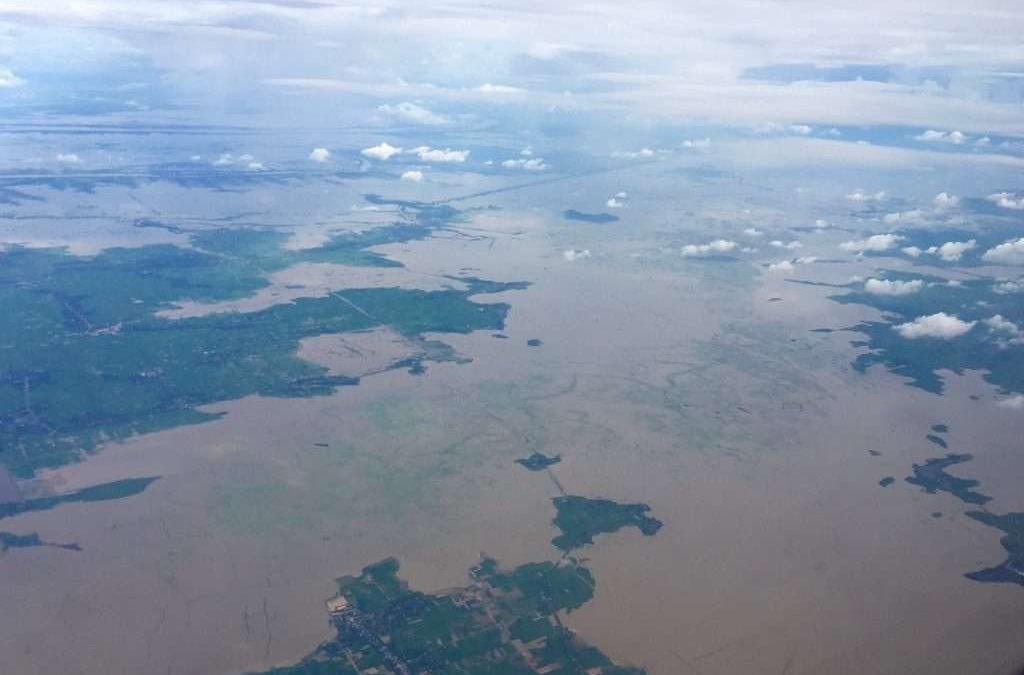
From the air, flying into Phnom Penh in Cambodia, the Mekong river outline was barely visible as the river had broken its banks and flooded the countryside as far as the eye could see. We arrived 10 days after the deluge of 10 – 12th October, the worst floods in 25 years. See:
With the world’s attention focussed on that curmudgeon, Donald Trump’s hairstyle and Hillary Clinton’s seizures, this barely rated a mention in the news or the press. Phnom Penh however, had dried out by the time we arrived, with dust everywhere as the mud dried and vegetation floated down the Mekong river.
Kim, our first of many Tuk-Tuk drivers.
Kim, a Tuk-Tuk driver delivered us to the Double Leaf Hotel and after the hair raising 40-minute trip, we were covered in grit and badly in need of a drink. Traffic in this city is chaotic and the only rule of the road appears to be: “I can turn into oncoming traffic at will, change lanes, make U-turns etc. as long as I don’t make eye contact with other drivers. I don’t have eyes at the back of my head, so those behind me need to take avoiding action, because they can see me” Also, the continuous use of the hooter is mandatory. Still, we didn’t see a single accident – I can only presume Cambodians are born with a 7th (traffic) sense.
Busy streets.
Construction material moped.
Chicken delivery moped.
How to turn into oncoming traffic.
Cambodia is very affordable: Two nights in a good hotel with a pool and exceptional service, including breakfast: $75 – 100. Excellent happy hour cocktails from 5 to 7pm – two for the price of one: $4; bottled Angkor beer: $1; Dinners of fish, beef or chicken with rice & curries: $6-7. We asked Kim to take us around Phnom Penh the following day, showing us all the sights. He patiently waited or snoozed in his Tuk-Tuk while we took our time through the Cambodian national museum, markets and Buddhist temples. All this for the princely sum of $20 for the day. We decided to give the macabre “Killing fields museum” a miss, as we are familiar with the tragic consequences of the Pol Pot and Khmer Rouge period. Instead we decided to look for the “Daughters of Cambodia” shelter for girls rescued from prostitution, where the girls are taught new skills.
Cambodian National Museum.
Buddhist temple – this is not a wet T-shirt competition – the humidity is 98%.
Smoked fish varieties at the market.
The bus trip to Siem Reap took 5 hours and set my cracked coccyx back at least a week. This was however worth the effort as we could now visit the amazing World Heritage Angkor temple complexes near the town. Our daughters, who visited these temples on bicycles, wisely suggested to us, to use a guided minibus tour, as the temple complexes are huge. The guides also impart concise information, with the tour starting at 8:30am and finishing at 6pm.
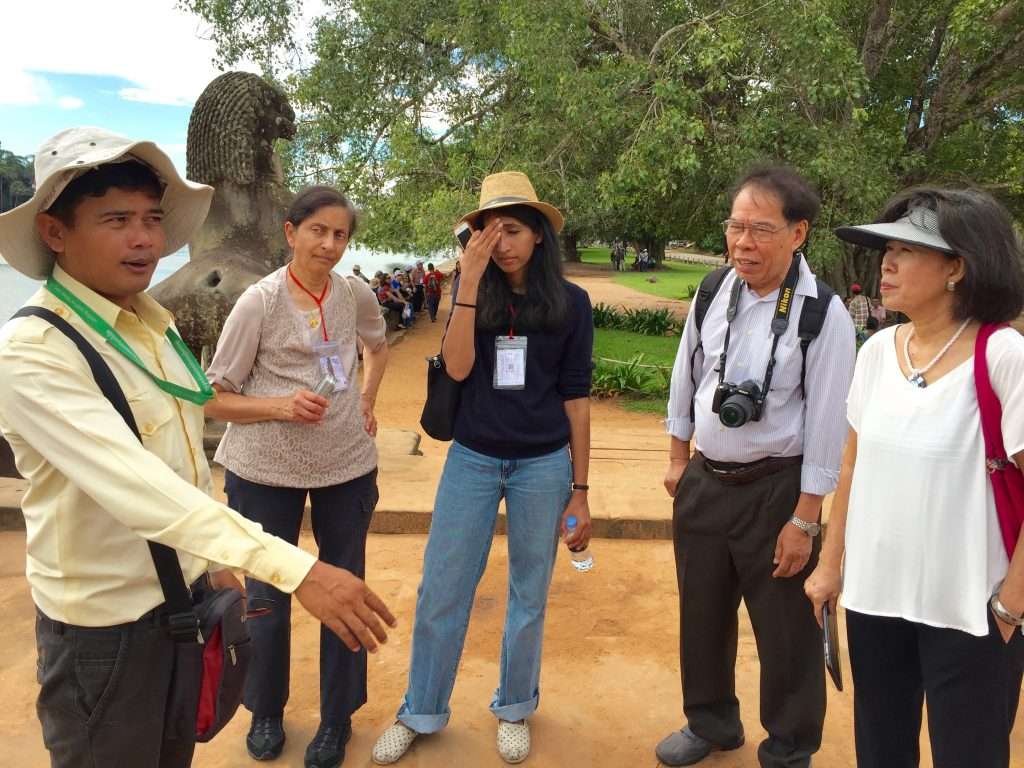
Our guide.
The 12th century Angkor Wat temple is the best preserved complex, surrounded by a moat and exterior wall measuring 1.3km x 1.5km. The temple was dedicated to the Hindu god, Vishnu. Depending on the belief of the King of the time, the temples were dedicated to either Hindu gods, or to Buddha. In the end, Buddhism became more popular and today, 95% of the Cambodian population are Buddhists.
Picture postcard shot of Angkor Wat.
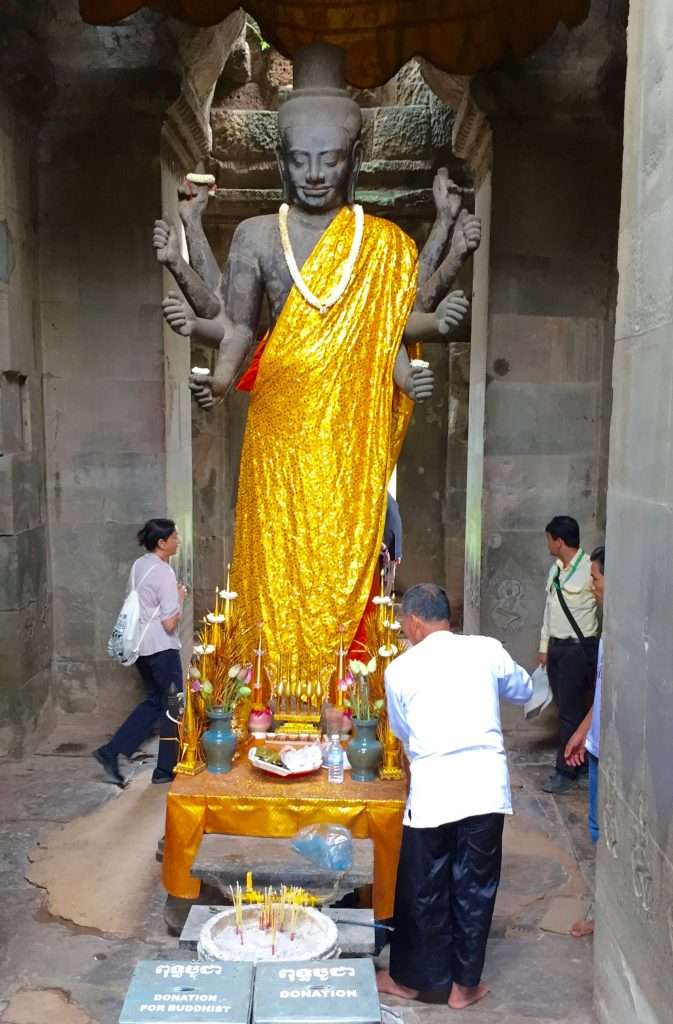
Buddha statue inside Angkor Wat.
Detail of one of many thousands of stone carvings.
Buddhist monk dispensing holy water blessings.
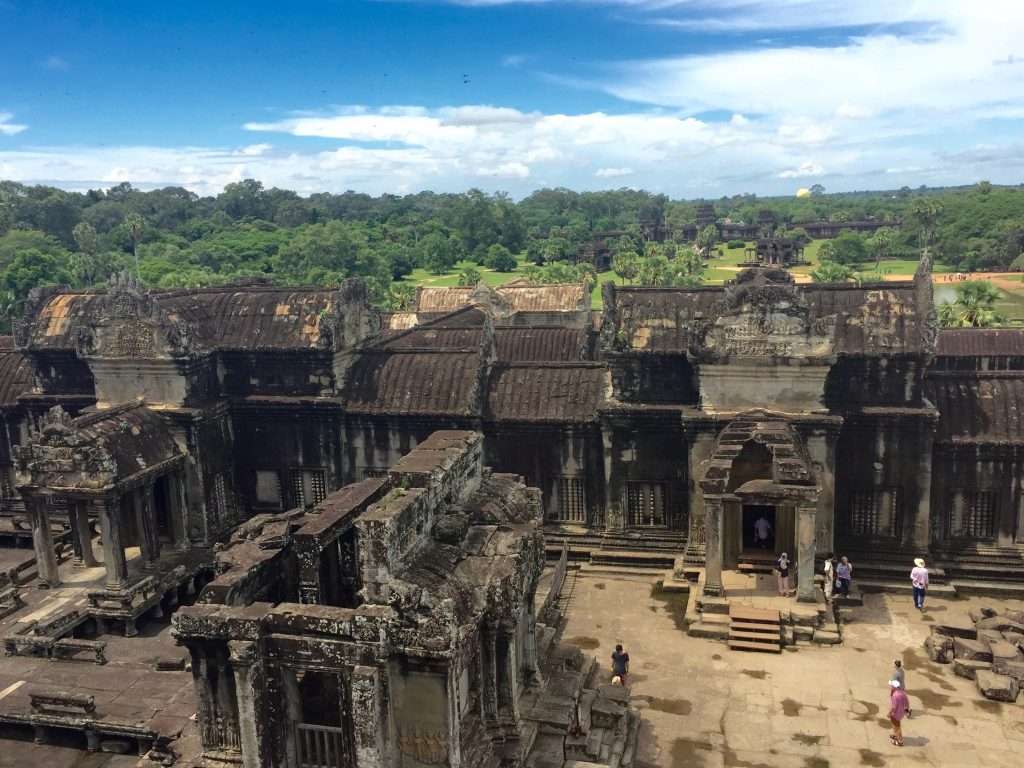
View from the top of the temple.
The Angkor Thom complex of 9 square km’s, is nearly 5 times as big as Angkor Wat. It houses the largest Buddhist temple, Bayon, which was constructed in the 12th & 13th centuries. The Bayon’s most distinctive feature is the multitude of massive serene stone faces that grace its many towers.
Kids catching snails in the moat around Bayon.
Serene faces – many of these.
Annie at the foot of the towers.
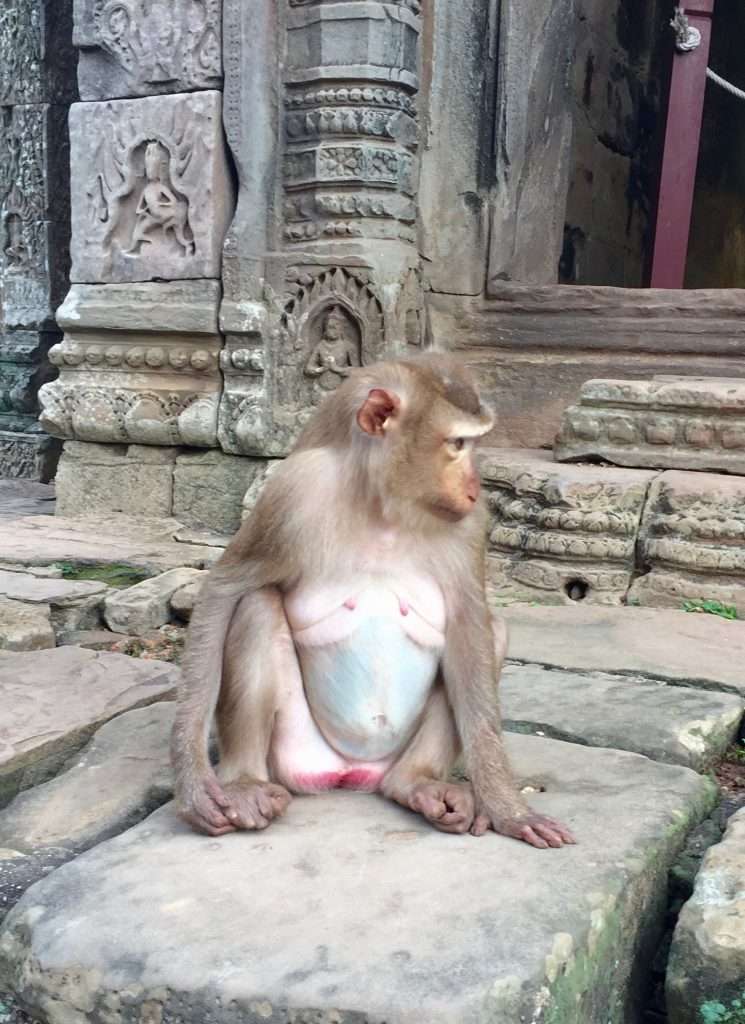
One of the monkeys living in the temple.
The Ta Prohm temple commissioned in 1186 AD, was dedicated to the goddess of wisdom in Mahayana Buddhism. This temple is fascinating, because it was literally eaten up by the jungle after this area was abandoned by a subsequent king, two hundred years later, to move the capital to Phnom Penh. It was re-discovered 500 years later at the end of the 19th century, totally overgrown by trees.
More trees!
We flew from Siem Reap to Sihanouk Ville on the south coast to spend two days at Ochheuteal Beach to relax.
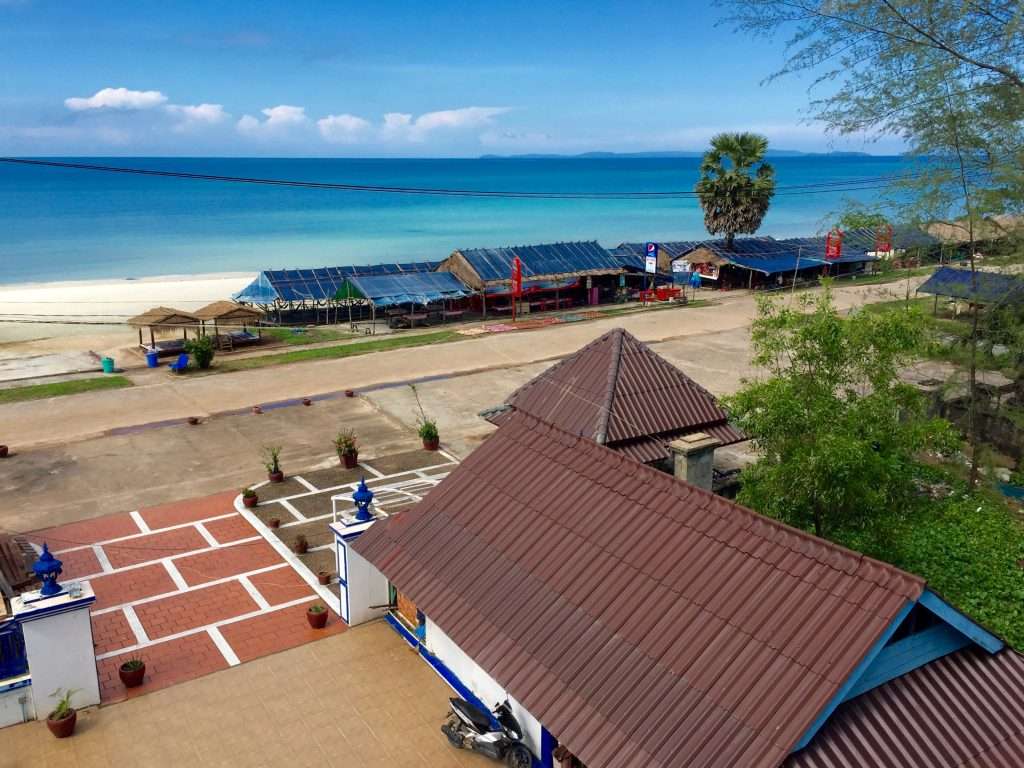
Ochheuteal Beach view from our room.
$10 manicure & pedicure.
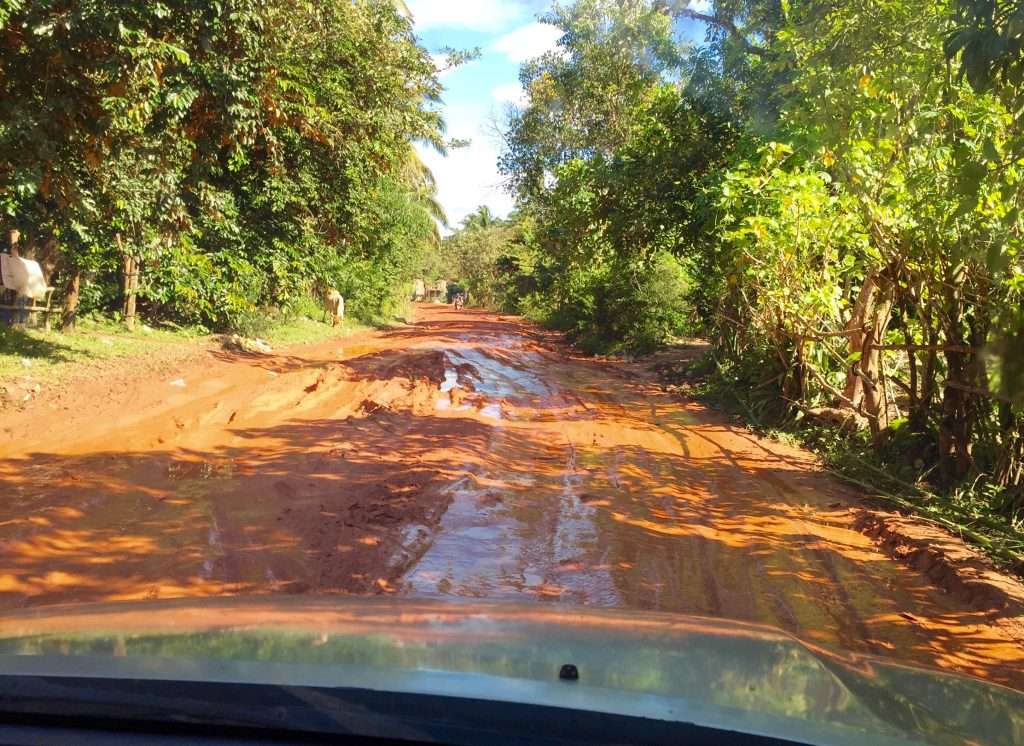
Then followed a hair raising trip over the worst roads I have seen, to a fishing village, to catch a boat to Koh Thmei island. Michael and Kavita Scholz, a German couple, has built an eco-resort on the south side of the island with 7 bungalows and a restaurant. This is a jungle experience, not suitable for city-slickers, but we thoroughly enjoyed the total isolation for two days before we returned to Phnom Penh for our flight back to Singapore.
After the rain.
Mopeds have their time cut out.
Leaving the fishing village.
Riverside living – check out the waterborne dunny!
Cruising to the island – two vintage Cortina 1500cc engines (one for back up).
Waterside bungalows.
Our no.7 bungalow, 10m from the water and next to a creek.
Bungalow interior.
Michael and Kavita with one of their six kids – two birds and four dogs.
Having taken the time to speak to locals, particularly the younger ones who are becoming better at English, as opposed to the Khmer language and sometimes, French their parents speak, some problems become apparent. Cambodia was once the heart of the Khmer empire, but after the Vietnam war (actually, the Indochina war of Vietnam, Laos and Cambodia), Vietnam has become the strongest country in this region. As a consequence, Vietnam has redrawn its border with Cambodia a number of times, annexing parts of Cambodia. Through marriage, Vietnam influences the King of Cambodia and the government, whilst syphoning off a large part of the aid from China to Cambodia. As a result, Vietnam’s economy is growing, whilst Cambodia’s remains poor and its economy stagnant. Cambodia’s debt to China is huge.
Although a democracy, the government has been controlled by one party, for the last 25 years. Evidently, nepotism and corruption is endemic and very little is spent on education, because it keeps the population under control through ignorance. Our driver back to Phnom Penh airport, said teachers were paid so little, they insist on extra payments from parents, should the parents wish them to give attention to their children. The military, media, money and health care is tightly controlled by the government. The younger generation is getting more savvy through the internet, but there is also censorship in this field. This younger generation is working towards change, but see it as a long term ambition, which may take 20 to 25 years.
A taxi drove us the 230km from the fishing village back to Phnom Penh airport. A final observation on traffic rules: The open road is white knuckle country – a broken yellow centre line means the road is yours; a solid yellow centre line means overtake when you please; a double solid yellow centre line means overtaking only allowed if you simultaneously smoke and talk on a mobile phone.
Roadside petrol stop – I felt exposed at the outdoor urinals – right opposite the ladies WC!
In the meantime, if you want to enjoy a rough and ready, cheap holiday, Cambodia is the place.
The instructions of Gijs, Annie’s second cousin, were good and after landing at Schiphol airport we caught the train to Bussum, 20 minutes East of Amsterdam, where Gijs & Florence Lamsvelt live.
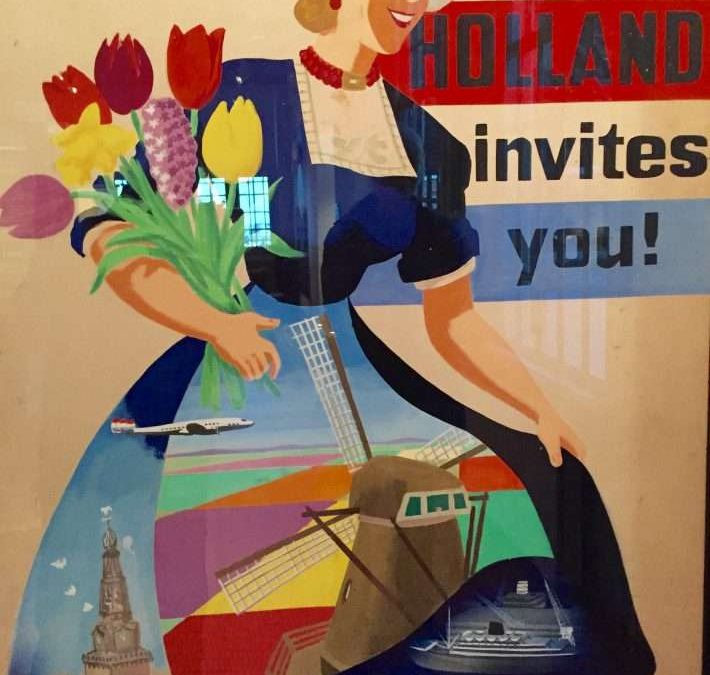
Vintage poster.
They visited us in Sydney two years ago, just before Gijs retired as a judge on his 70th birthday. He has since missed the bench and is now doing pro bono work for victims of crime, sparring with his ex-colleagues in court. Florence is still involved with volunteering and has received the Queen’s medal for her work.
Gijs and Florence Lamsvelt’s house in Bussum.
Florence’s excellent Nasi Goreng dinner.
On our first day, Gijs took us to his yacht club, The Royal Dutch Sailing and Rowing Club, founded in 1847, a 100 years before I was born.
The Royal Dutch sailing and rowing club.
A traditional sailing boat coming in to tie up.
Muiderslot (fort) opposite the yacht club.
Gijs recently sold his yacht Cordelia with which he has sailed the North Sea and crossed the English Channel many times. He and Florence also did a canal trip with Cordelia, from Holland to the South of France for 3 months in 2012. With the mast down, they travelled 2,200km and went through 524 locks on the canals!
Gijs’s book cover.
After the visit to his club, he showed us through Muiden, the old town next to the club and a suburb not far from Bussum. These parts used to get flooded before the Afsluitdijk (Cut off dyke) was built in the 1930’s. It is amazing to think that half of the Netherlands is reclaimed land (Polders), below sea level. For example, Schiphol airport, built on a reclaimed lake, is 4 metres below sea level.
Muiden street scene.
Monday was a relaxing day with Gijs showing us Naarden Vesting, (a fort built to protect Amsterdam) with a quaint town built inside the fort, after the military moved out. This is a beautiful town, where evidently, wealthy divorcees tend to buy their boutique townhouses.
Naarden Vesting street scene.
The following two days were devoted to exploring Amsterdam. There is so much to see in this city, so we walked a lot, to visit the Rijksmuseum where the Dutch masters like Rembrandt, Vermeer and others are on display. The red light district near the centre of Amsterdam offered some amazing scenery, not least the ladies on show in windows, next to a church!
Amsterdam Central Station – our arrival point each day.
The Rijksmuseum.
“Walletjies” the red light district.
Typical Amsterdam canal.
Amsterdam street scene.
The highlight for us, was the Van Gogh Museum. I was overcome by similar emotions in Liverpool when I visited the Cavern Club. Vincent has been my favourite artist, since high school. We spent the whole morning to explore this vast museum of Van Gogh’s work, before visiting the “Concertgebouw” Amsterdam Concert Building.
The original Gerrit Rietveld designed Van Gogh museum of the 70’s on the right with the turn of the century additions of Kisho Kurokawa on the left.
Interior of the Kurokawa designed entrance lobby.
Me and Van.
A walk to Rembrandt’s house brought us to the Ship’s museum on the harbour. There were many other sights, but enough of that.
Rembrandt’s house.
Number 7, the house with the narrowest street frontage in Amsterdam: 1 metre wide!
On our second last day Gijs and Florence drove us across the Oostvaardersdijk (dyke) to Lelystad for lunch and across the Houtribdijk (dyke) to Enkhuizen to visit the Zuiderzee Museum. It is very interesting to drive across a dyke with the sea on one side, about 3 metres higher that the cattle grazing on the polders, (reclaimed land) on the other side. We finished the day on a liquid note at a lovely “Brown café” in Naarden Vesting.
Zuiderzee museum: Dirk, Annie, Florence & Gijs.
Enkhuizen.
And look: Uncle Dirk’s cafe!
Dinner at Naarden Vesting.
We got word that Michelle our daughter, arrived in Amsterdam with some friends for a music concert. We met with her for breakfast at a café in Amsterdam Central station with Gijs, who hadn’t seen her in 26 years. Then we took the train to Schiphol for our flight to London on Easyjet and our connecting flight to Singapore.
Gijs and Michelle.
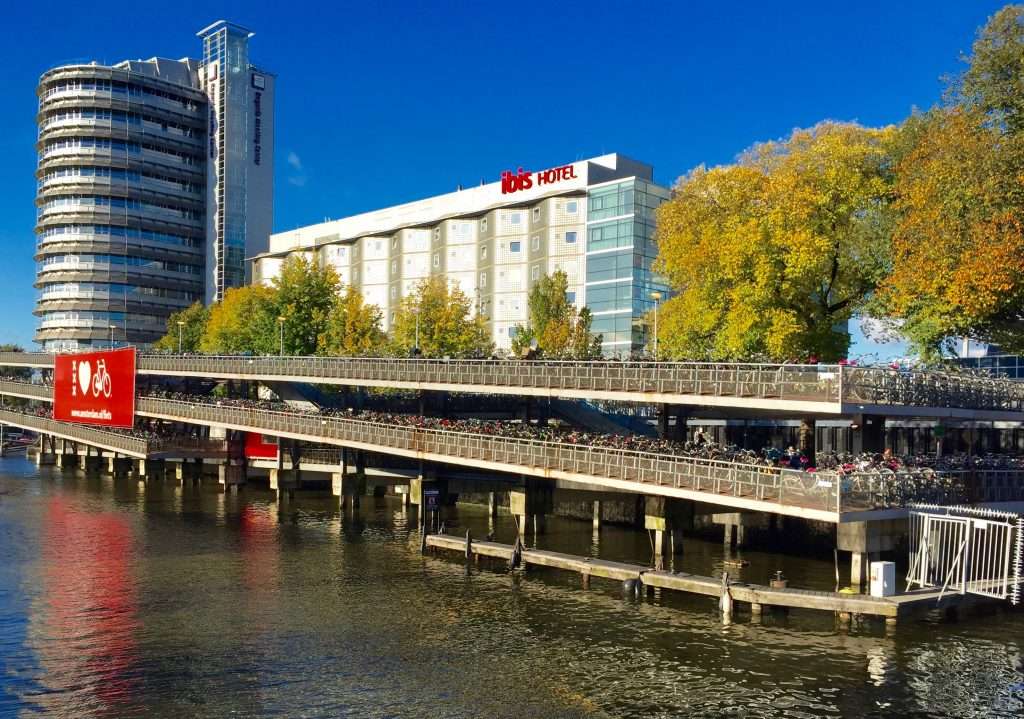
And finally, for those weekend 4-wheel drive warriors around the world: A parking garage for fairly average bicycles. Lycra and helmets optional.
Michelle warned us to book a flight to Heathrow, but no, us cheapskates had to fly to Luton. This meant catching a bus to Heathrow with about three hours to spare. Problem was, the bus from Cambridge was about an hour late because of Friday afternoon traffic. We arrived at Heathrow terminal 5, an hour before our scheduled departure on British Airways flight BA11 to Singapore. The flight was overbooked, but Annie with her usual charm and a very helpful BA staff member, saw us upgraded from departure lounge/runway, to cattle class.
Full marks to BA, who showered us with wine all the way to Singapore, to drown out the 3 wailing babies in bassinets, 6 rows in front of us. No complaints, we remember those days, travelling with babies!
Next instalment: Getting to know Changi airport – Again!
With the Tour de France behind us, we explored Bordeaux the next day, before collecting a rental car for the following week. Bordeaux was deservedly voted the best city in Europe in 2015. We enjoyed walking through the city and visiting its landmarks.
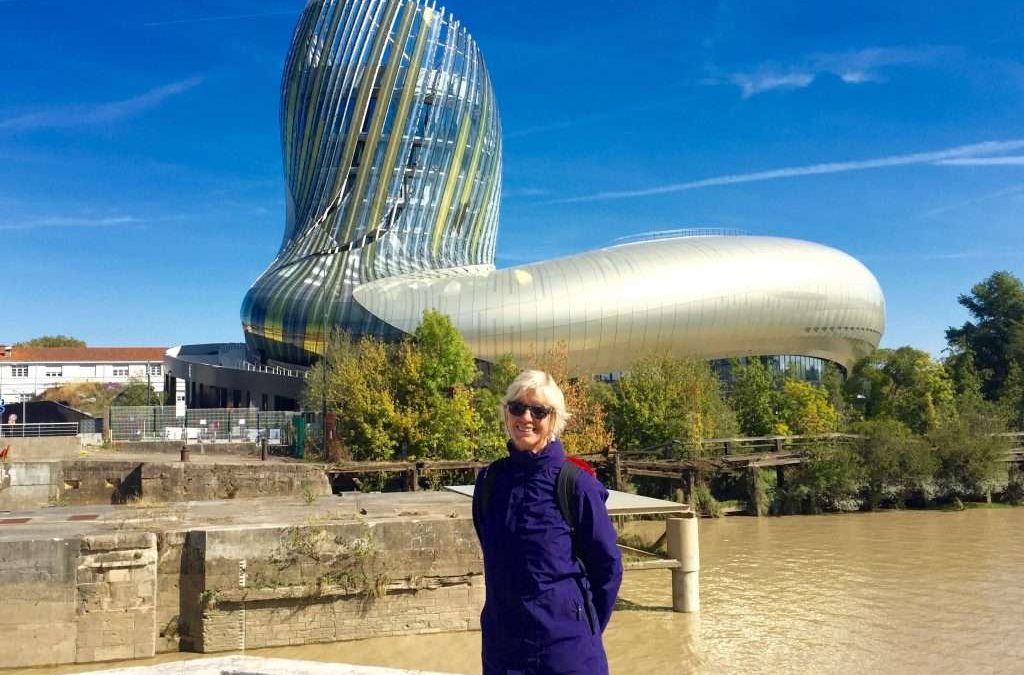
La cite du Vin
Pont Chaban-Delmas.
Rue Notre Dame
The Toyota Yaris is a hybrid vehicle and getting used to it was hilarious. After leaving it in the hotel’s parking garage for the night, I couldn’t get it started the next morning. After 10 minutes on my mobile to Toyota, I discovered that the engine does not need to start – it quietly pulls away on battery power, only starting the engine when required. Now that we have learned the ropes, I can recommend this car – it has all the features you find on the luxury BMW’s and Merc’s. The difference? It’s exceptionally economical and easy to drive and park – particularly on these narrow roads.
Following: Saint-Jean-de-Luz street scenes.
Due to a painful sternum and coccyx, after my Lance Armstrong impersonation, I asked Annie if she could drive down to Spain and back, while I shifted from cheek to cheek and enjoyed the scenery. The drive down to Saint-Jean-de-Luz took less than two hours, with Annie “Fritterpaldi” hurtling down the freeway at 130km/h cheek by jowl, with all the big trucks. Talk about scenic – it will be difficult to beat Saint-Jean-de-Luz on the Bay of Biscay. Even Louis the 14th had a weekender down here!
Louis, lead lute player for the heavy medieval rock band, King. (Apologies to Brian May of Queen)
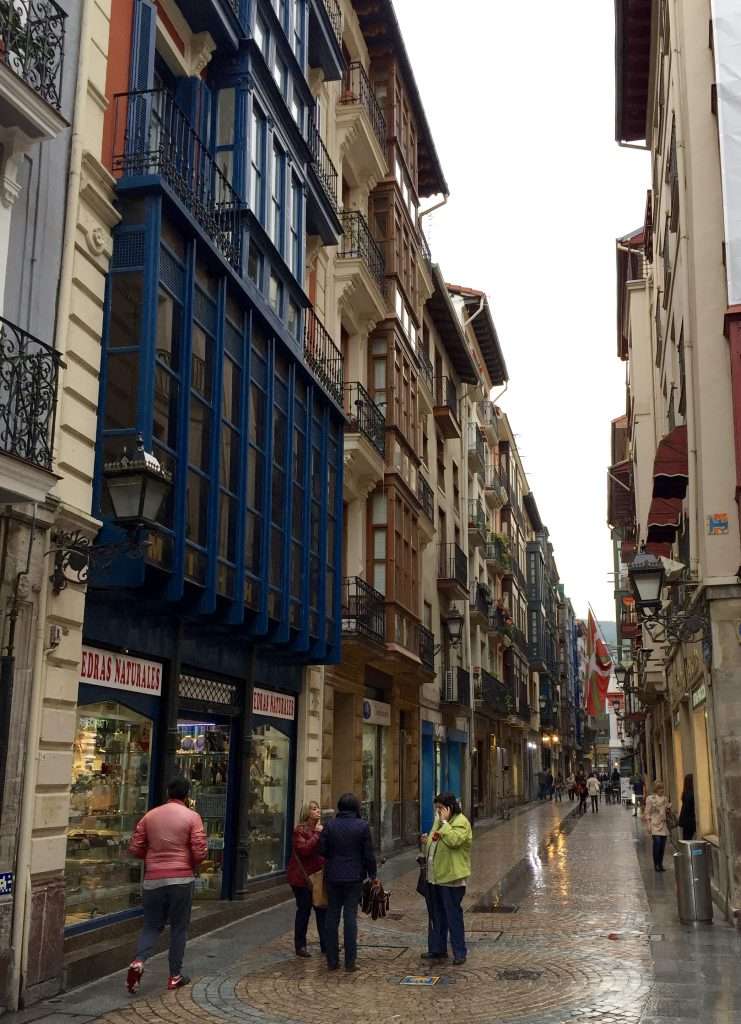
Street scene Saint Jean
And another one.
At Daan and Gretel’s recommendation we drove to the vintage rack railway dating from 1924, to take the 35-minute ride to La Rhune’s summit at 905m. The first summit of the Pyrenees mountain range, it overlooks the Basque coastline from Biarritz to Saint Sebastian and the seven provinces of the Basque country.
Le Petit train de la Rhune.
Mountain sheep on the tracks.
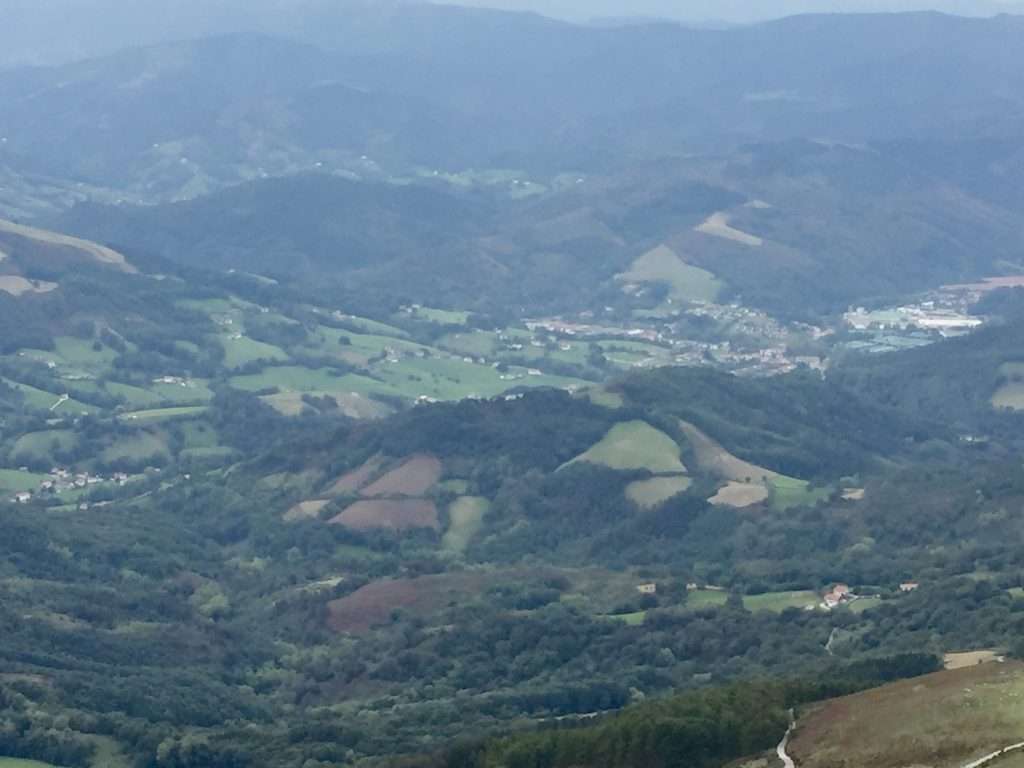
View from the top.
Crazy mountain bikers.
After two days in this area, we drove into Spain to follow the coastline to San Sebastian and Bilbao in Northern Spain. I relived a similar journey along this coast to Oviedo, with four friends in a camper van back in 1975. Much has changed since that time, notably the new motorways and the Frank Gehry designed Guggenheim Museum in Bilbao. But first San Sebastian: Marketing itself as the new cultural capital of Europe.
Bridge design: Baroque, LSD?
Old city streets.
The Basque pub where we were feted with tripe and bacalao.
Every city needs and icon: Sydney has its Opera House, Coffs Harbour has its Big Banana, Bilbao has the Guggenheim Museum.
More sculpture than architecture – this building left us breathless.
On the river bridge, with a busker playing classical clarinet – can it get any better?
So relieved I didn’t have to do the working drawings.
Jeff Koons’ Tulips outside.
Richard Serra’s enormous corten steel sculptures inside.
Jeff Koons’ “Puppy” at the Guggenheim entrance: 12.4 m high planted with 38,000 plants. Being re-vegetated when we visited.
Regular Bilbao architecture.
Statue of a comedian named Tonetti.
After two delightful days in Bilbao, we headed back to France, stopping in Biarritz for a day to enjoy the fine weather, beaches and restaurants.
Surf’s up, straight off the Atlantic.
The Biarritz harbour.
Annie drove us back to Bordeaux for our last night before flying out to Amsterdam. The little Toyota Yaris hybrid went like a dream and she drove like Emerson Fittipaldi.
Three things about this region of France which I really enjoyed: 1. There are more wine varieties in the supermarkets than food; 2. The women have great dress sense – not a pair of torn jeans in sight; 3. People are courteous and patient, both on the road and when you are trying to explain yourself. A final bonus for those interested: The property prices are extremely affordable – AU$250,000 will buy you a lovely place like Daan and Gretel’s in Cognac.
Gretel dropped us off at our hotel in Bordeaux. We then walked through the old city, along the river to orientate ourselves. On the way back, we stopped for a beer at a pub to discover that the owner was a rugby tragic. Couldn’t wait to tell us that Adam Ashley-Cooper of the Wallabies, is now playing for Bordeaux. He also has autographed photos of Wallaby, All Black and Springbok players.
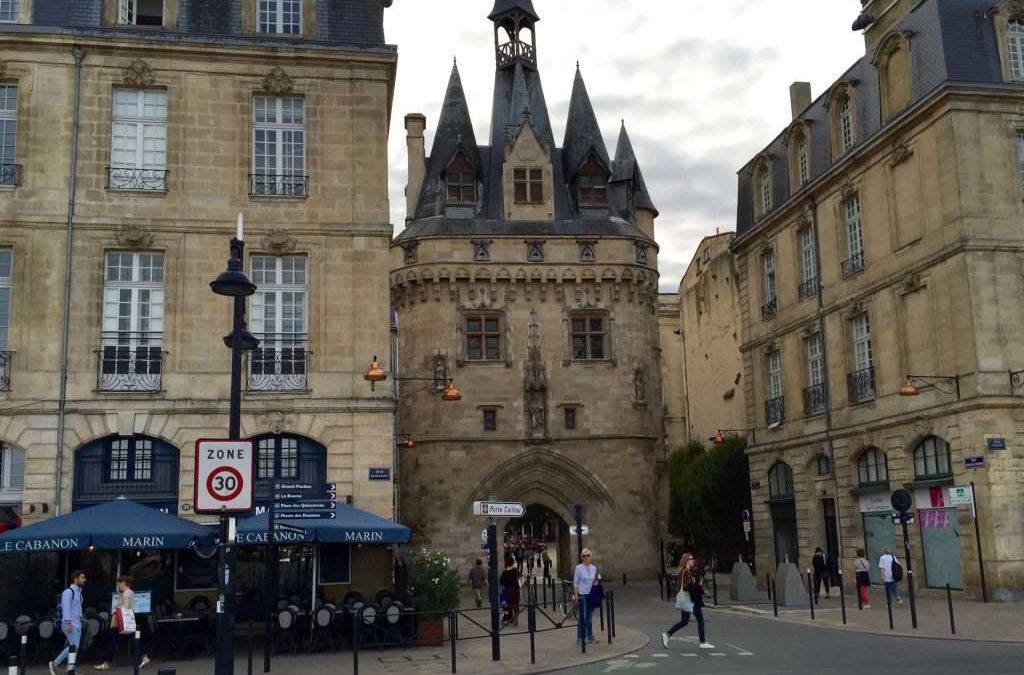
One of a number of gates into Bordeaux’s old city.
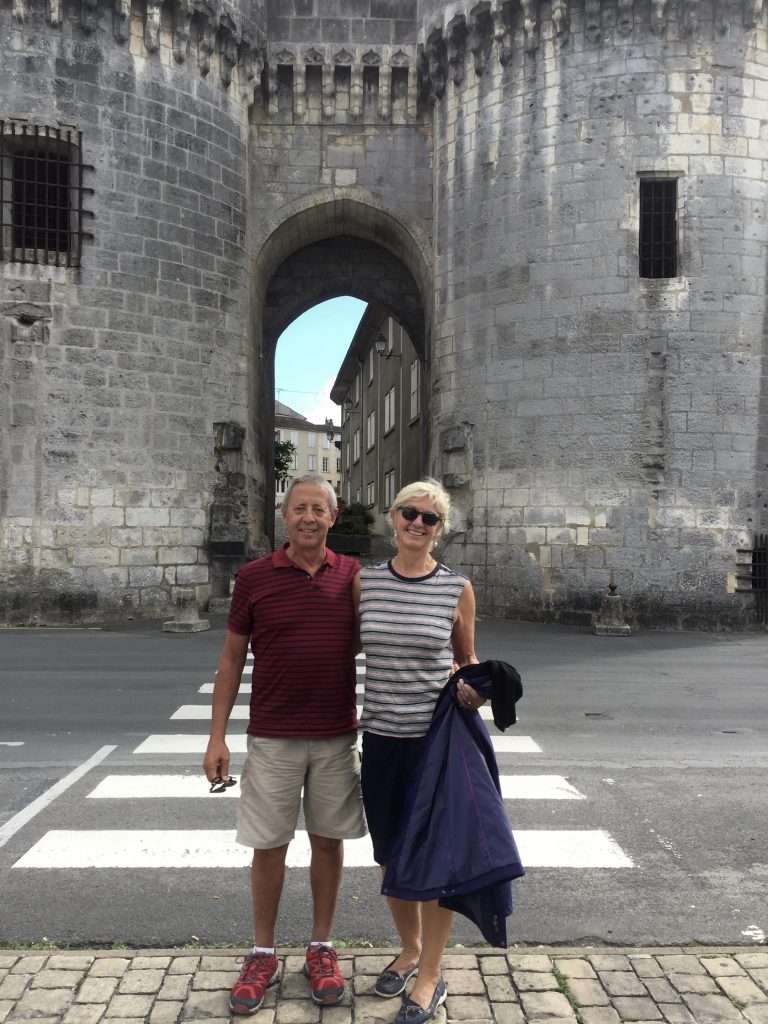
Another Bordeaux gate.
Electric cars everywhere!
The following morning our bikes were delivered to the hotel and our luggage picked up for the 50km journey to Cadillac (for us, 62km due to wrong turns!). We settled in on these touring bikes with Bosch electric motors in the crank housing, powered by a Lithium battery behind the saddle. This is the answer to the up and down terrain of the Bordeaux region – it doesn’t allow you to free wheel, but assists you when you go uphill. (4 settings: Eco, Tour, Sport and Turbo)
Annie and her bike in front of the hotel.
A stop along the river path.
Annie unfortunately, picked up a puncture in the front tyre, which we repaired. The next puncture on the rear tyre, happened downhill at 45km/h, which managed to cause multiple leaks in the tube. After 6 patches, I gave up and replaced the tube. Fortunately, the bike company provided a range of tools and spares!
Puncture no. 2.
We arrived in Cadillac which is a beautiful town at 4:30pm. After a shower we explored the town and had a dinner of duck, salads and frites, washed down with a bottle of local wine. Then, early to bed.
Cadillac town.
Cadillac street.
The next day, we set off to St Emilion over much hillier terrain, giving the Bosch systems a good workout. Again what was supposed to be a 54km journey, stretched to 68km because the route directions included in our pack, was in English for the first day, with the following 3 days in French! Annie gallantly navigated using her patchy school French, with me trying the new English-French app on my phone. I was hoping Google and GPS will get us there, while softly humming the Bonnie Tyler song of 1977.
On the road to St Emilion.
Chateaux along the way.
Getting quite hilly!
The landscape is really beautiful with old Chateaux and rustic buildings dotting the landscape. It is also grape harvest time and we looked in amazement at the mechanised harvesting. We arrived in St Emilion at 5pm, with an aching bum in my case – Annie being ever chipper. Our route included dinners and breakfasts at the 3 star hotels we stayed at, and the food was exceptional. The French know how to prepare fantastic 3-course meals in small portions. How they stay so slim, we can’t figure out!
Riding into St Emilion.
The town from our hotel.
Street scene.
After a walk around St Emilion the following morning, we headed off to Blaye for the 64km trip, which we did in 73km! At this point my derriere was really aching, but the historic hotel in the Citadelle, (Fortification guarding the Garonne river entrance to Bordeaux) plus a fantastic dinner washed down with a Bordeaux sauvblanc, eased the pain.
Searching for Panadol and anti-inflammatories in my saddle bag.
Entrance to the Citadelle.
View from outside the hotel across the Garonne river.
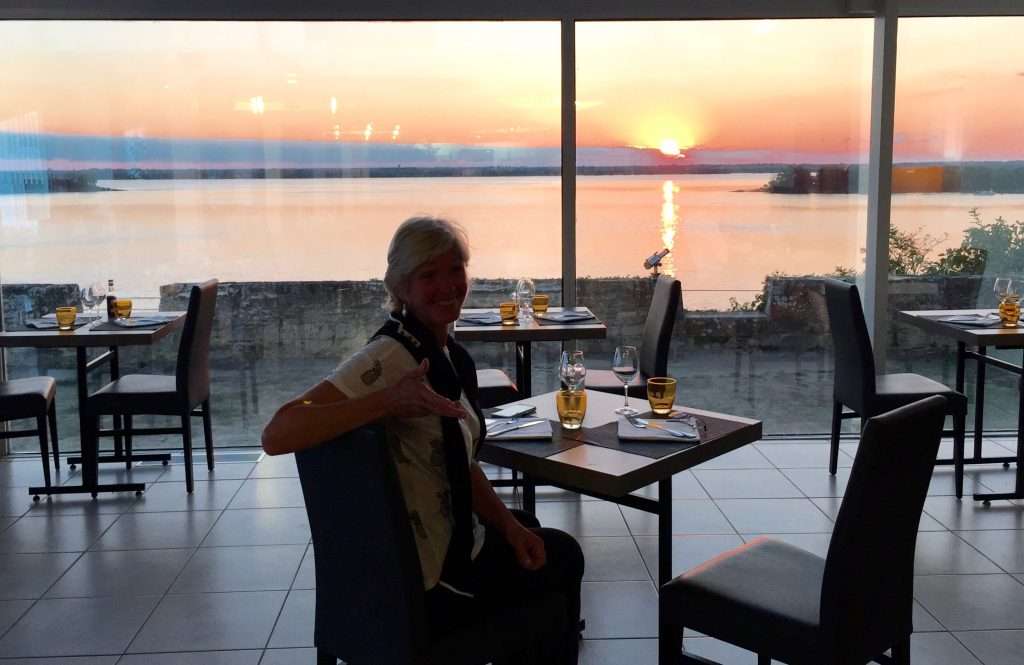
View from the dining room at sunset.
A ferry took us across the river to Lamarque the next morning, to cycle the last 62km back to Bordeaux. After 15km, we crossed a railway line and I spotted a railway station next to the road crossing. After feigning an impending heart attack, Annie gave me money to catch the train back to the city, while she set off doggedly to complete the trip – clocking up 82km!
Ferry approaching the Lamarque shore of the river.
Vines pruned so that all the fruit hangs at the bottom for mechanical harvesting.
After a pleasant train trip, I arrived at our hotel at 2:30pm, the same time as our luggage and after a shower and two calming Cognacs, had a relaxing recovery on the bed.
There are so many beautiful photos of this area in our photo collection – if there was more time and internet bandwidth, we would have uploaded them all.
The TGV train from Paris to Angouleme near Cognac took two hours, reaching speeds of up to 320km/h. Daan Prins, an old friend from University days, met us at the station and drove us to his place in La Maurie on the Charente river, about 15 minutes from Cognac.
Train spotting: The TGV beast.
Daan and Gretel his wife, bought this house a couple of years ago and renovated it beautifully. Gretel certainly has an artistic touch and has collected an eclectic mix of furniture at the local flea markets.
Gretel & Daan’s front gate. Note the date: 1825.
Inside the gate.
The lounge room.
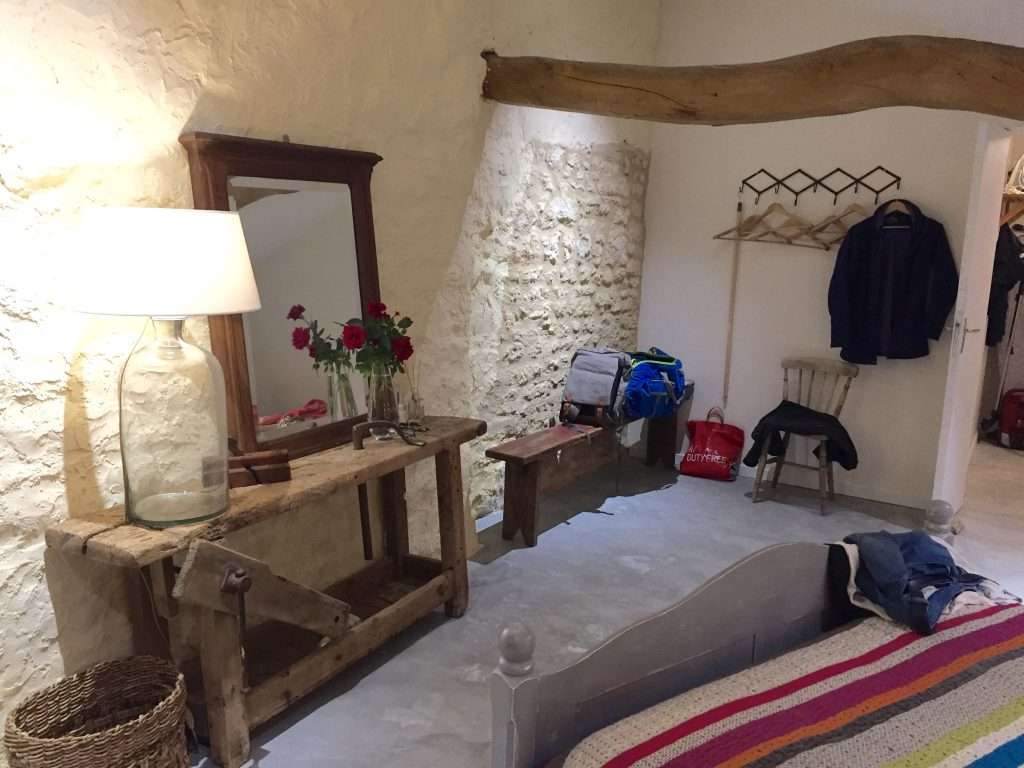
Our room – check out the timber beams.
Our room 2.
They showed us around their village and the adjoining village of St. Brise, on our drive into Cognac on the Sunday. This is of course the heart of Cognac production where all the well-known Cognac brands are distilled. Late Sunday afternoon, we packed a few bottles of wine and snacks for a scenic river cruise in their dinghy to Cognac. Eye wateringly beautiful!
Entrance into Cognac’s old town.
The oldest house in town – now a Cognac tasting centre.
Lovely park in the centre of town with the Municipal offices.
Beers after all the walking: Daan & Gretel.
River, boat and jetty at the bottom of the garden.
Sundowner cruise.
River reflections.
The following day, we drove to La Rochelle on the coast, about 90 minutes from La Maurie.
La Rochelle old town.
Covered colonnades.
This popular coastal resort has a historic town centre and an enormous marina, giving access to the Bay of Biscay. As luck would have it, there was a Boat Show on in the marina, which we explored at length. With the Jeanneau and Beneteau yacht factories a short distance to the North of La Rochelle, there was a comprehensive display of all their sailing and power vessels. Conservatively speaking, this show is about 3 times the size of the Sydney International Boat Show!
La Rochelle boat show.
Jeanneau exhibition – please, don’t tempt us!
La Rochelle harbour – persecuted French Protestants departed from here to the rest of the world.
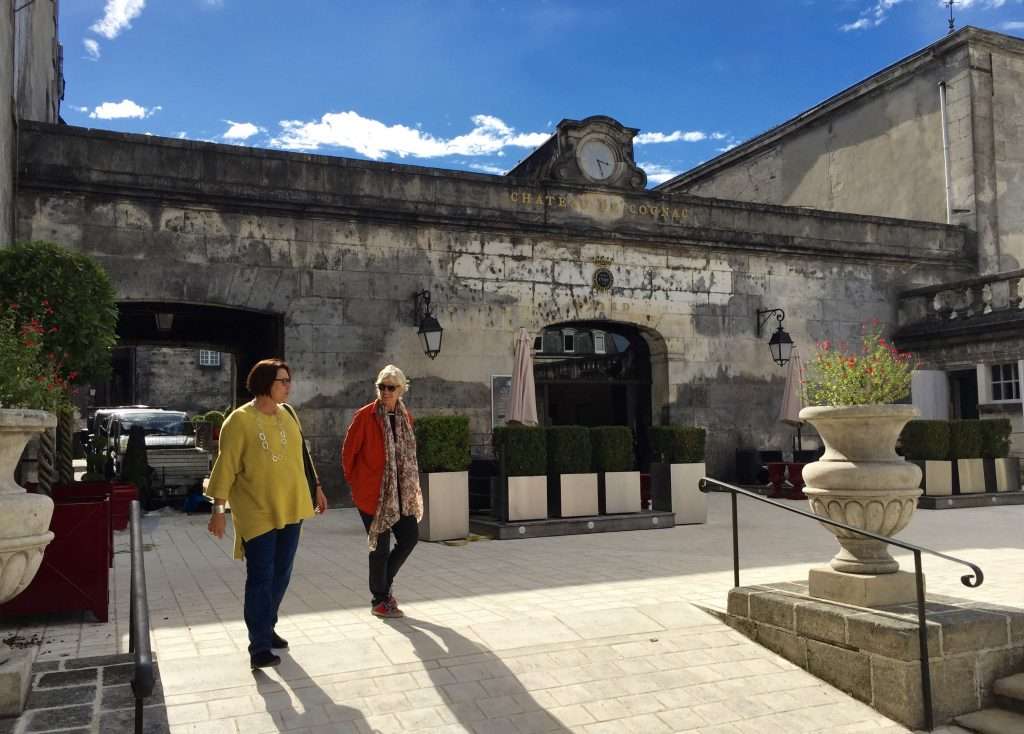
On Tuesday we did a long walk through the surrounding vineyards and saw first-hand how everything from pruning to harvesting is done mechanically. After lunch we visited Baron Otard, one of the oldest Cognac Chateaux’s, for a tour of their cellars and a Cognac tasting. Annie, a brandy lover, was in her element and we had to purchase some VSOP Cognac.
A walk in the vineyards.
Early morning jetstream trails over Cognac.
Entrance to Chateau Baron Otard.
Barrels of Cognac ageing for up to 50 years.
And now, for the tasting.
On Wednesday after another sumptuous breakfast, we said our goodbyes to Daan, and Gretel kindly drove us to Bordeaux, where she had some other business to attend to. This was a truly wonderful four days in the company of good friends.
Dining room at Chez Prins.
These croissants are much too nice!
Next: Madness? A five-day cycle tour through the Bordeaux region.