The warm welcome we received on entering Malaysia at Puteri Harbour Marina was a harbinger for the friendliness and excellent facilities which awaited us, as we sailed north.
Puteri Marina harbour.
Approaching the bridge linking Singapore with Malaysia.
Esprit sailing north – from catamaran “Por Dos”
Malaysia is a modern country with good infrastructure, a varied manufacturing base and a country that seems to have pollution under control. After crossing the South China Sea which was busy in terms of marine traffic, the Strait of Singapore was an eye opener in respect of serious marine traffic, as reported in our previous post. Sailing and motoring north through the Strait of Malacca, between Sumatra and western Malaysia, traffic intensified even more, due in local fishing and cargo vessels.
Approaching Malacca.
Our first anchorage after leaving Puteri was at Pisang Island (Banana island). A further two days of motor sailing got us to Malacca. The Portuguese, later the Dutch and then the British, settled and administered Malacca as their trading outpost in this region. Lots of the original buildings are still standing and the old part of town has been declared a UNESCO world heritage area. The oldest church in Southeast Asia sits on the hill in the centre of Malacca and has an interesting history.
St Paul’s church exterior.
The history of the church.
Church interior.
On the floor: A surprising South African connection.
Malacca bicycle taxis.
Dutch fort on the river.
Old town centre.
Historical Malaccan houses.
Malacca’s famous son.
Malacca has however expanded incrementally and now is a modern city surrounding the old town. After three days of exploring the town and city, a two-day sail to Port Dickson followed, where we tied up at the Admiral Marina. Three days of stocking up, filling with diesel and trying to repair our dinghy, which suddenly started falling apart at the seams followed. Getting around was cheap and easy, as Uber and Grab operates in this part of the world.
Admiral Marina
Ex Saffer’s on the rally.
Chili’s at the supermarket – an ingredient in most dishes.
There followed a 2.5-day sail via Port Klang the huge harbour for Kuala Lumpur, to Pangkor Marina Island. We managed to get a berth in the marina on our second day anchored outside. James Khoo, the manager is an exceptionally friendly and capable man, who arranges any spares, services etc. you may require. Apart from that, he also organises seriously good parties with free beer, which is a winner with the yachties.
Welcome dinner and party.
Excellent duo.
One of James’s contacts Alan Quek from ATT Marine, came to inspect our over the hill lead acid batteries, wiring and charger controls. He quoted us to replace the four 110Ah service batteries with a 200Ah Lithium Iron Phosphate (LiFePo4) battery with BMS system, charger and control. His price, including installation, programming and commissioning was 50% of Sydney prices.
The Buddhist temple with Kim & Tom from Canada.
View from the shrine on the hill.
The little Great wall of China.
The tiger shrine.
The fishing harbour at Pangkor island.
Yachtie kids swinging on the beach.
Lunch on the beach – 5 nationalities at one table.
Sundowners at Pangkor Marina.
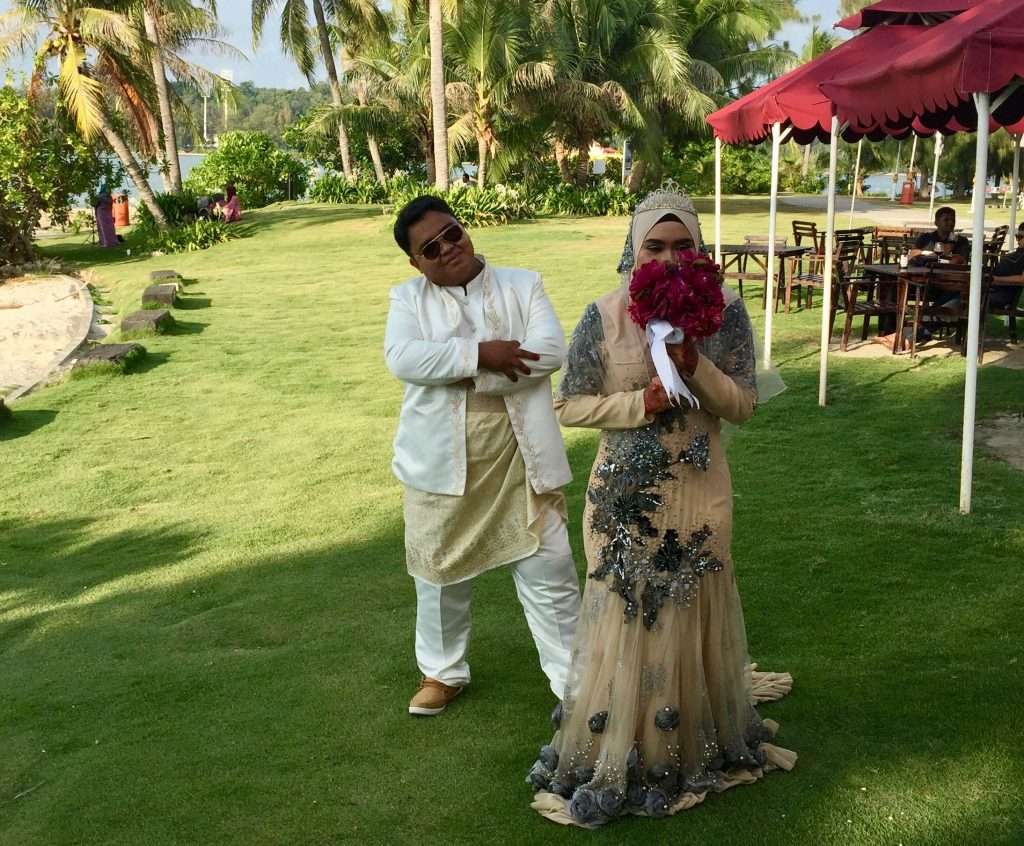
A wedding party in front of us.
Sundowners take two – Eric, Booker, Dave and Sieg.
We had a wonderful time in Pangkor, with tours, parties and meeting new friends. After 12 days, we set sail for the Straits Quay Marina in Penang. We passed under Penang’s second and first bridges on the way to the marina. The second bridge which opened in 2014, is 24 km long and is the longest bridge crossing in Southeast Asia. It is also the longest rubber damped bridge in the world, designed to withstand a 7.5 scale earthquake.
Approaching bridge no. 2.
Penang bridge no. 2 curving away in the distance.
Penang bridge no.1.
Massive yacht anchored off the city shore.
George Town on Penang island, is also a UNESCO world heritage area and the centre of Malaysia’s first world medical services. I availed myself of the competitive rates, and had my bi-annual colonoscopy performed by Dr Chin Loong (G’day mate! He lived in Melbourne for 10 years, studied medicine at Melbourne University and did his specialisation at Melbourne hospitals). We also applied for our Thailand visas at the Thai consulate in George Town.
The Swettenham Pier cruising terminal at George Town.
Our berth at Straits Quay Marina. Nice spot!
Entrance to Straits Quay Marina Mall – Christmas decorations are up.
We have to confess, we love Malaysia. It is a sensible destination for any retiree. It has first world facilities, excellent medical and dental services and it is very affordable to live here. The government promotes their MM2H programme (My Malaysian Second Home) which encourages foreign ownership of houses, apartments and condominiums at a fraction of Sydney prices. A 2 bedroom, 2 bathroom apartment in the Straits Marina complex (the low rise behind Esprit) for AUD 350,000! No taxes on offshore income and pensions. Also, Penang has island wide free internet broadband, provided by the local government! Maybe we come back here after our planned circumnavigation.
Alan Quek installed the new LiFePo4 service battery, additional battery charger and battery monitor on Esprit, the Saturday before we set sail north. We can wholeheartedly recommend his meticulous service .
Alan with the 200A/h LiFePo4 battery (2,560W/h) that replaced the 4 Exide lead acid batteries (2,200W/h)
We spent a day walking and exploring the World Heritage listed George Town. The old buildings, shops and restaurants in Little India and Chinatown are fascinating.
George Town has some outstanding public art.
Better than Banksy?
Street musicians in little India, raising money for a charity.
Temple in Chinatown.
Colonial architecture: Penang city hall.
After Penang, we had a robust 20 knot one day sail to Langkawi island, in the north of Malaysia. Langkawi is a duty free port and requires checking in and out with Customs. The farewell party for the Sail Malaysia Rally participants at Rebak Marina was a huge success with around 100 sailors, fantastic catering, drinks and live music, worth more than the $120/boat entry fee for the rally! Langkawi with its 105 islands is beautiful and laid back. We will report in more detail on this area when we sail to Phuket and Krabi.
Sailing into Langkawi – typical sea eroded rocky islands.
After leaving fabulous Belitung, we did a two day sail to Ketawai, a small island off the mainland. Robby the local organiser did a fantastic job of organising parties, food and music on the island, as well as tours onshore.
Robby, the organiser, with his twin daughters.
During a visit to a local school, I realised I had run out of money. No problem – our tourist police escort ran me to the nearest ATM with their blue lights flashing. I felt like a politician in South Africa!
Two friendly policemen who took me to an ATM.
More friendly students at the hotel and tourism school.
An interesting item on our itinerary, was a boat ride to a secluded and unspoilt mangrove forest. A long walk on walkways to protect the mangroves followed, culminating with lunch at an eco-friendly cafe.
Mangrove walk.
Lunch at the mangrove cafe.
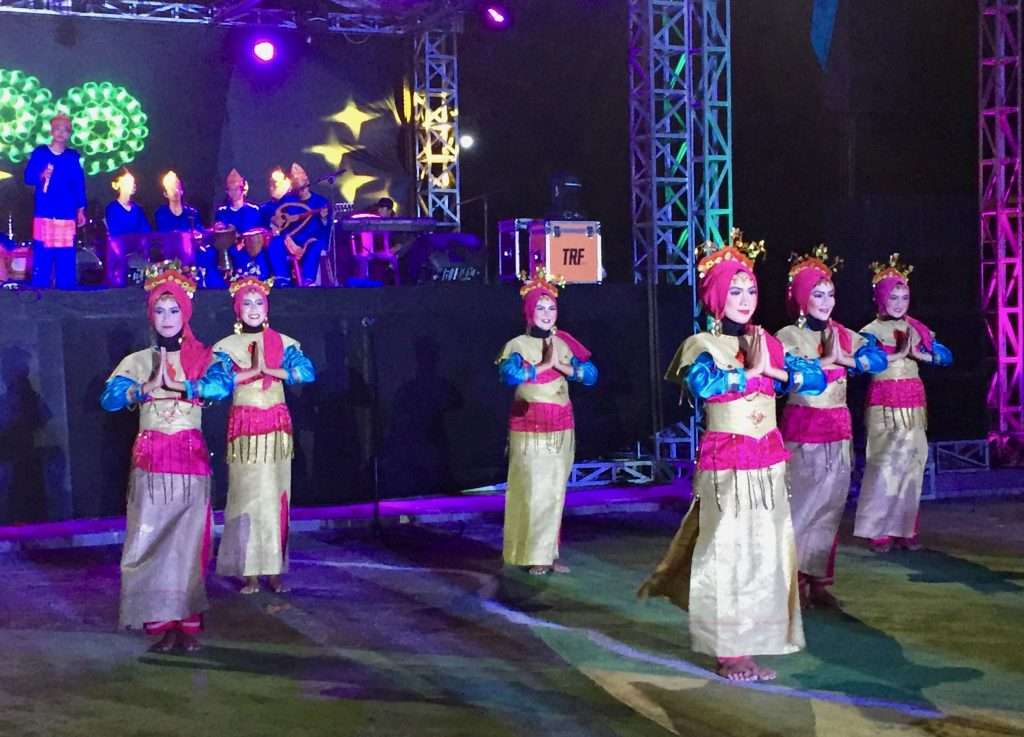
Back at Ketawai, a farewell party with live music provided by a very talented young band and their vocalist.
The very good band on Ketawai island.
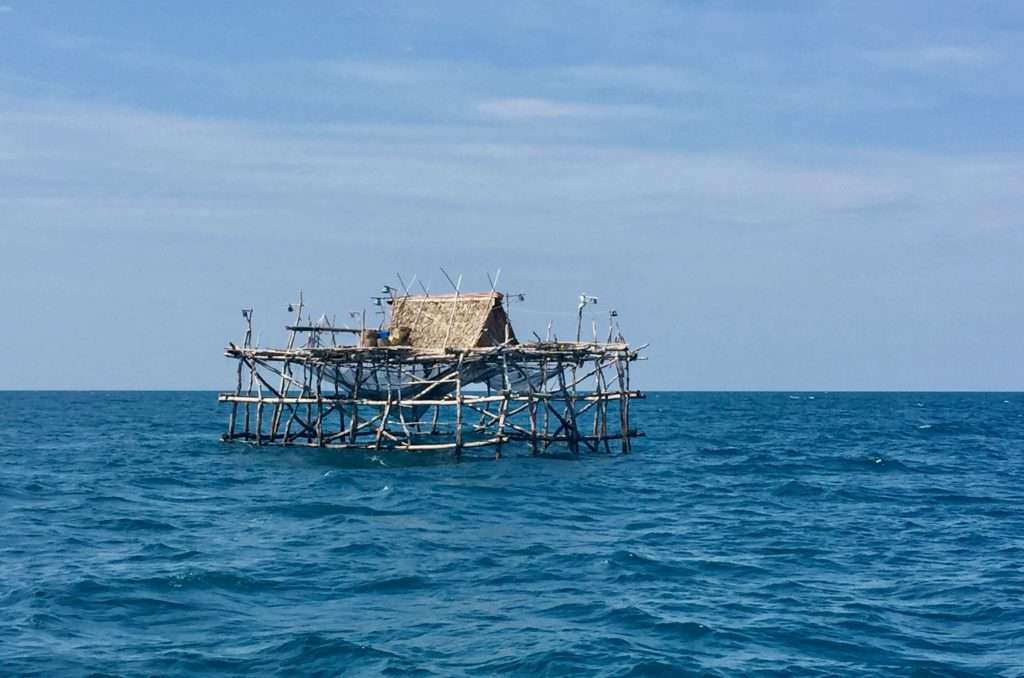
The sail north from Ketawai was best done during the day, as the sea was littered by fishing structures made of bamboo, complete with huts on top. Literally hundreds of them, unlit at night!
Fishing structures out at sea.
Number two of hundreds – why we don’t sail at night in this region.
Two day sails brought us to Lingga island with it’s smaller surrounding islands – absolutely beautiful and unspoilt by tourism. On Tuesday the 17th October 2017, we crossed the equator just south of Kentar island. This was followed that evening with a party on Esprit with the other three boats at the anchorage.
Crossing the equator as shown on our chart plotter.
A toast to King Neptune.
And another G&T for us!
Our second last stop in Indonesia was at Sembulang island where Thant Zhin from Burmese Breeze helped me repair four leaks which had suddenly sprung on our dinghy.
Thant Zhin fixing our dinghy.
Our last Indonesian anchorage was at Bintan Lagoy where the Sail Indonesia Rally organisers and the Bintan Tourist Ministry pulled out all the stops. Trips to various sights, like a beautiful Buddhist temple with 500 soldiers, a music festival and the final night gala dinner with a band and a beach party.
The representatives from Sabang island in attendance to market their island to us for Sail Sabang week, after Sail Malaysia.
Buddhist temple – completed two months ago.
Our guide and an army of 500.
Annie and an angry fellow.
These senior ladies know their moves at the Bintan festival.
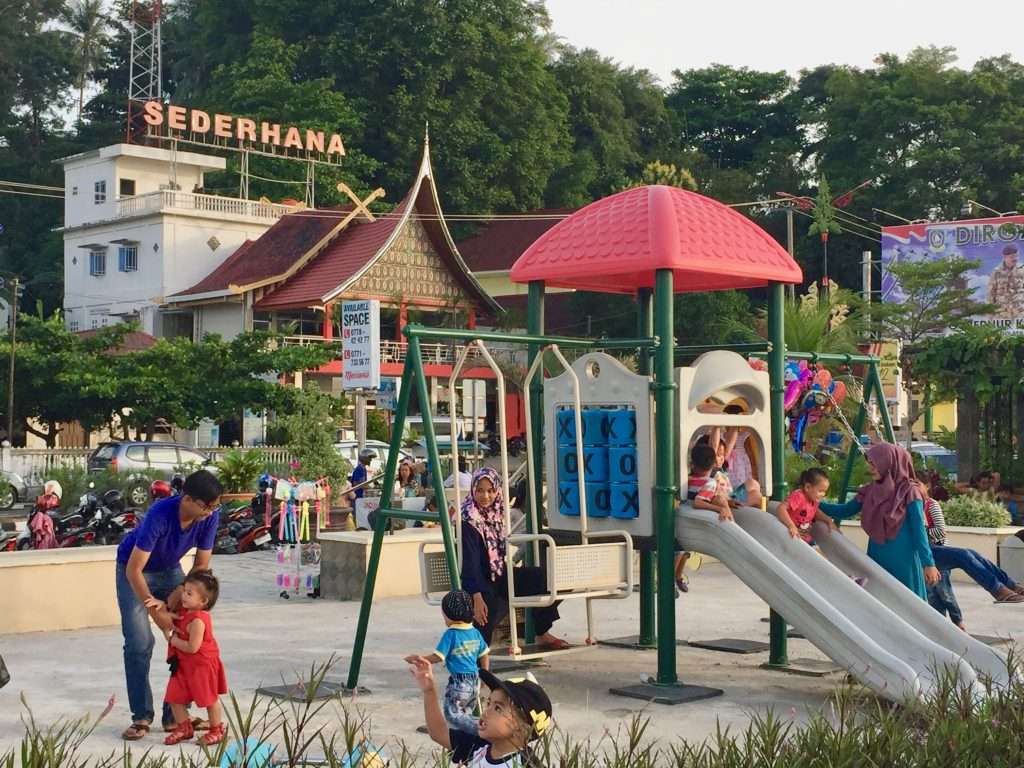
Kids play area – just like in Sydney.
Join the Indonesian Army, Navy or Airforce!
Beach structure resmbling a snail or hermit crab?.
Seriously good rock group for the beach party.
The yachties doing their moves.
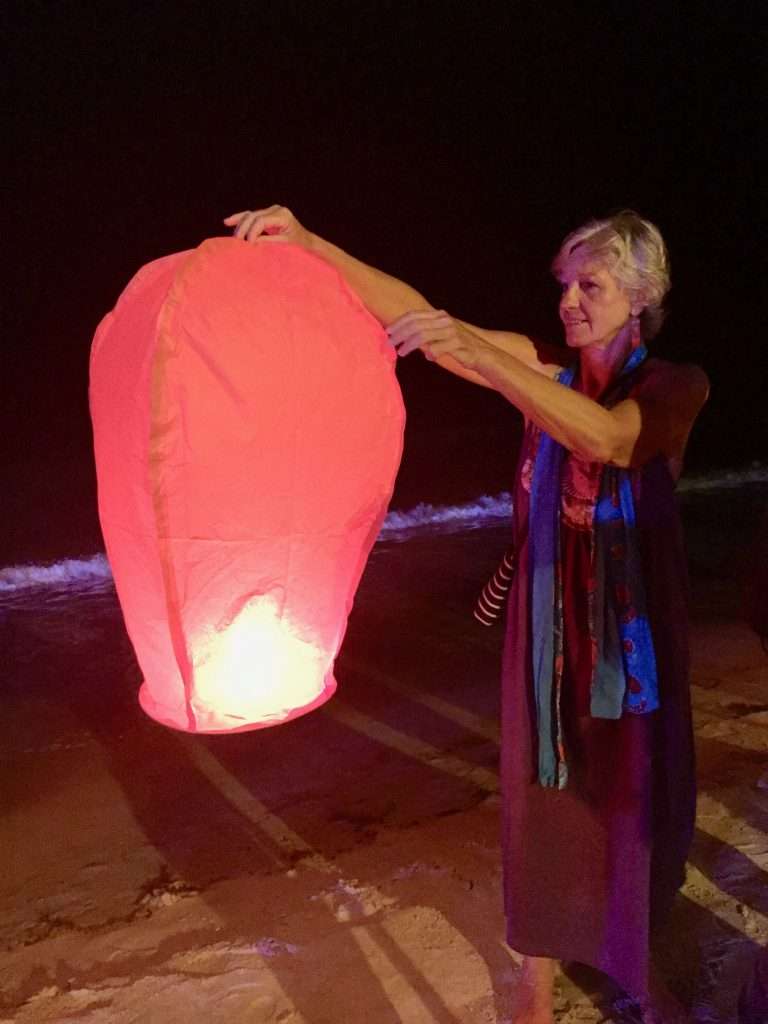
Midnight – setting off the mini hot air balloons.
Annie waiting for her balloon to lift off.
Up, up and away!
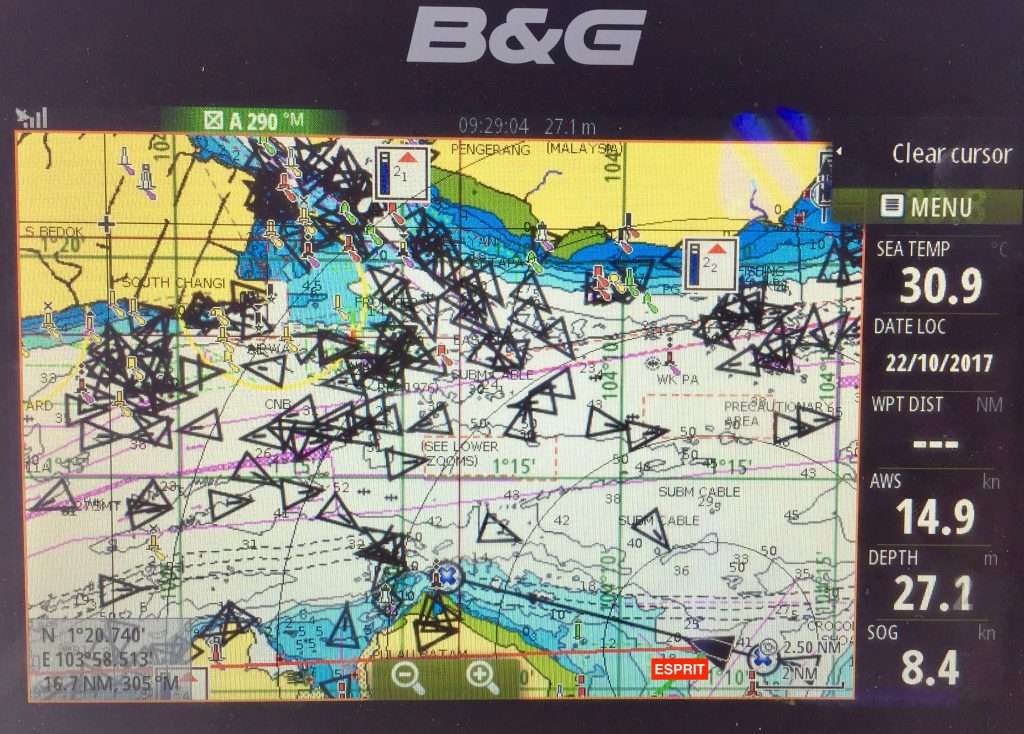
After the farewell and checking out of Indonesia at Bintan, we had to cross the Strait of Singapore – quite intimidating when you have to cross two shipping lanes, with more vessels than you can count on your AIS.
Most of the large vessels are travelling at around 20 knots, with the numerous ferries going at 30 knots. A rain squall hit us just before the first lane so we waited for it to clear and was lucky to get a reasonable gap in the east flowing lane. The west flowing lane required gunning it at maximum revs to pass just ahead of a 200 metre long tanker doing 18 knots.
Esprit approaching the Strait of Singapore.
Shipping highway.
Massive crane.
We checked into Malaysia at Puteri Harbour Marina where the organisers made the customs procedures part of their service, requiring only our electronic fingerprints. Absolutely painless and a 3 month visa at no charge! They laid on a gala welcome dinner for us at the 5-star hotel on the waterfront. A total of 68 vessels have signed up for the 5 week sail to Langkawi. We depart from here to Malacca on the first leg.
Puteri marina reception.
Sail Malaysia 2017 entrants.
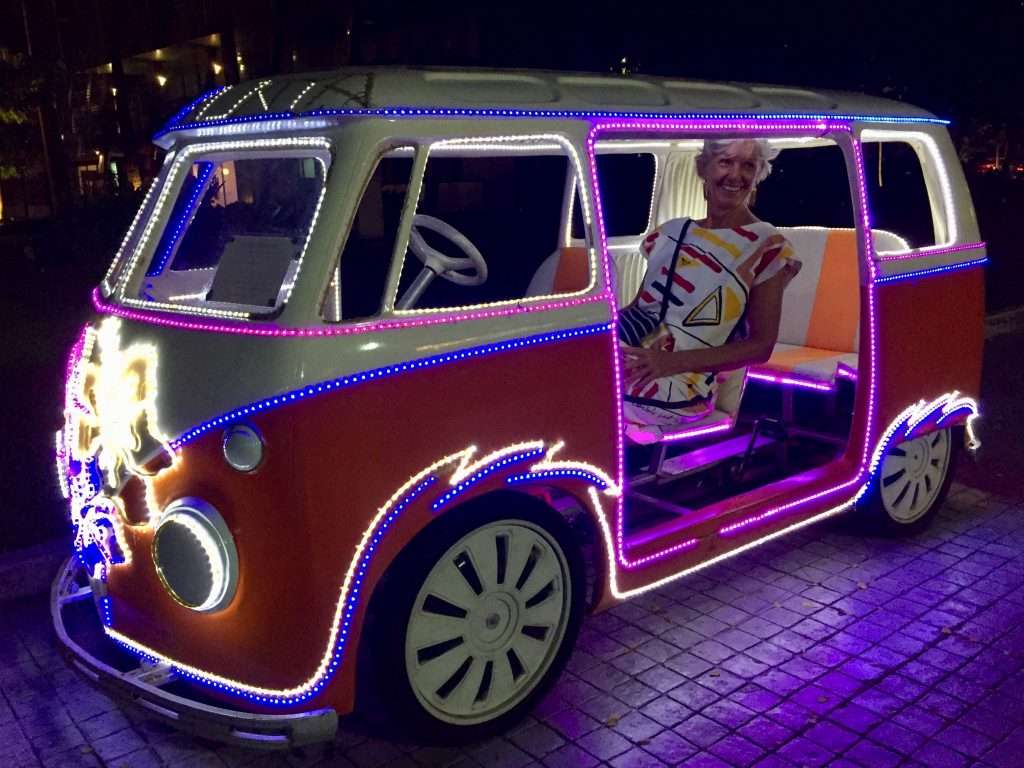
Annie in her pedal VW Kombi.
We will catch up again in Langkawi, before we sail into Thailand. Cheers for now!
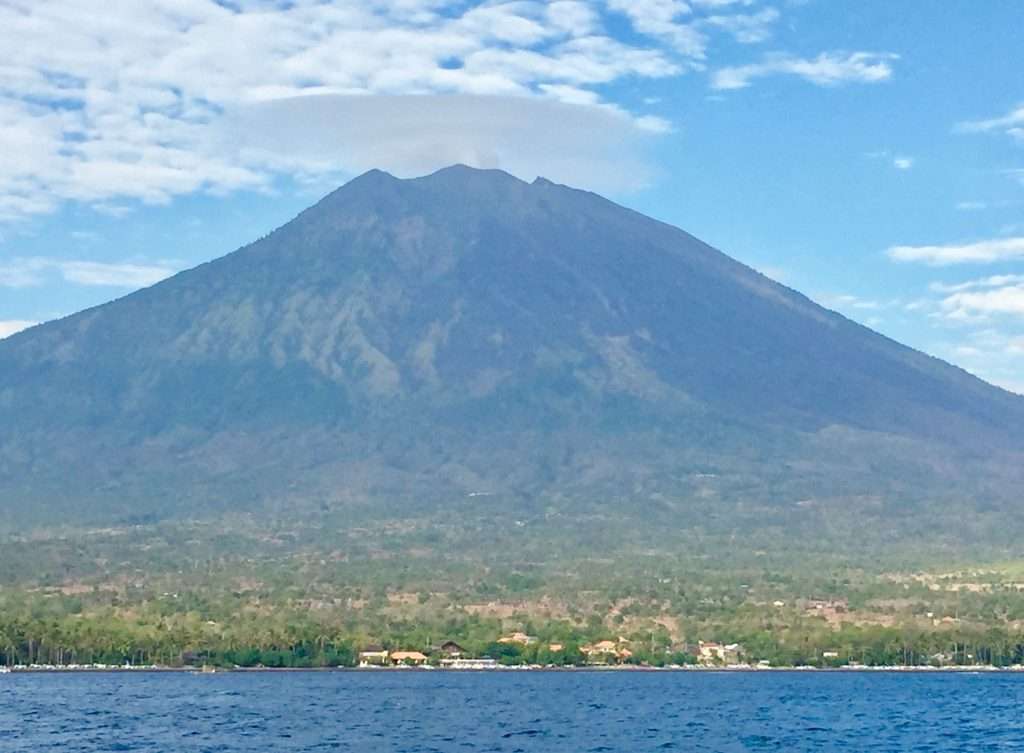
The Watson’s took a ferry from Gili Air to Bali on the 22nd September and we cast off the following morning to have a brisk sail to Ambat on the north-east coast of Bali. Ambat is at the foot of the active volcano, Ugang. The Watson’s who keep abreast of the news, told us that volcanic activity was imminent and that people have been evacuated around the volcano.
Mount Ugang
When we set sail the next morning, Ugang emitted a light cloud of steam, barely 10km away, so we hotfooted it to Lovina Bay for an overnight stay.
She’s smoking!
The rest of our rally group was now in Kumai, Borneo to see the orangutans, so we day hopped from Bali along the coasts of Java and Madura, before we did an overnight sail to Karimunjawa. With a population of about 140 million people, Java is the world’s most populous island and is home to about 60% of the Indonesian peoples. Around Surabaya, the second largest city after Jakarta, there are extensive gas and oil fields with very heavy shipping traffic and thousands of fishing boats.
Huge clouds forming over Java.
Approaching the strait between Madura and Java, I counted 73 large vessels on our AIS system. Mostly tankers waiting to take on oil and gas, but also ferries, tugs with longline tows of barges laden with mountains of coal and of course, the ubiquitous fishing vessels. It is best to only sail during the day because of the traffic intensity, but we had to do a 170-mile overnight sail to Karimunjawa, which was nerve racking. Most of these vessels don’t have AIS, and being timber built, not visible on radar.
One of the many unique Javanese fishing boats.
Internationally, vessels at sea show three lights, red (port), green (starboard) and white (stern). In these parts, strobe type LED disco lights in blue, pink, purple etc. are popular, making it impossible to determine the vessel’s course. The larger fishing boats have very bright arc lights to attract fish. So, sailing at night is a real challenge, particularly when you factor in the fish traps and fish nets. After anchoring in Karimunjawa, Annie had to dive to get some fish nets off Esprit’s propeller.
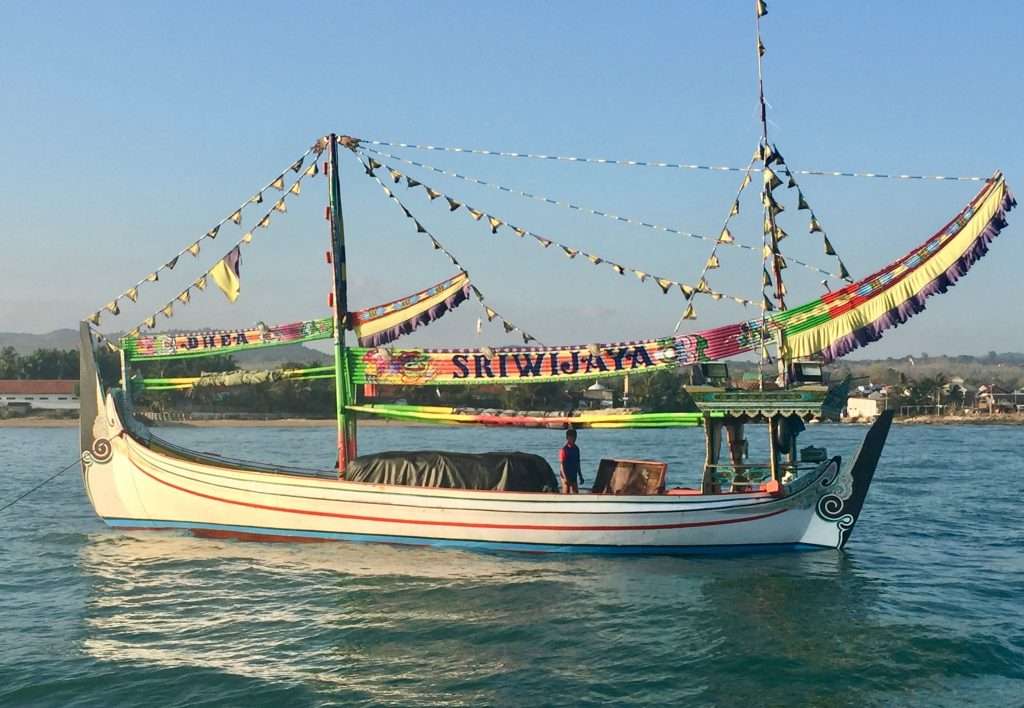
Even the smaller boats are decorated.
Karimunjawa is a pretty place where we stocked up with fruit and vegetables at the market and had dinner at a local café. The two plates of Nasi Goreng cost us AUD2.40, all up. The beers were slightly dearer at AUD3.00 for 500ml of Bintang beer (Bintang meaning “Star” in Bahasa). We left the following day to do the long haul to Belitung island. The 274 nm crossing of the Java sea took us 52 hours. Very little wind, meant we motored for 49 hours, burning about 90 litres of diesel.
Karimunjawa fisherman’s house.
And another quaint house.
A big and strange looking fishing boat.
We arrived in Belitung in a heavy rain squall at about 3pm in the afternoon. A lot of familiar faces from the rally awaited us and we joined Burmese Breeze for a fish BBQ in the evening. Annie discovered a lesion on her calve which she thought should be checked in case it was a melanoma.
The beach resort at our anchorage.
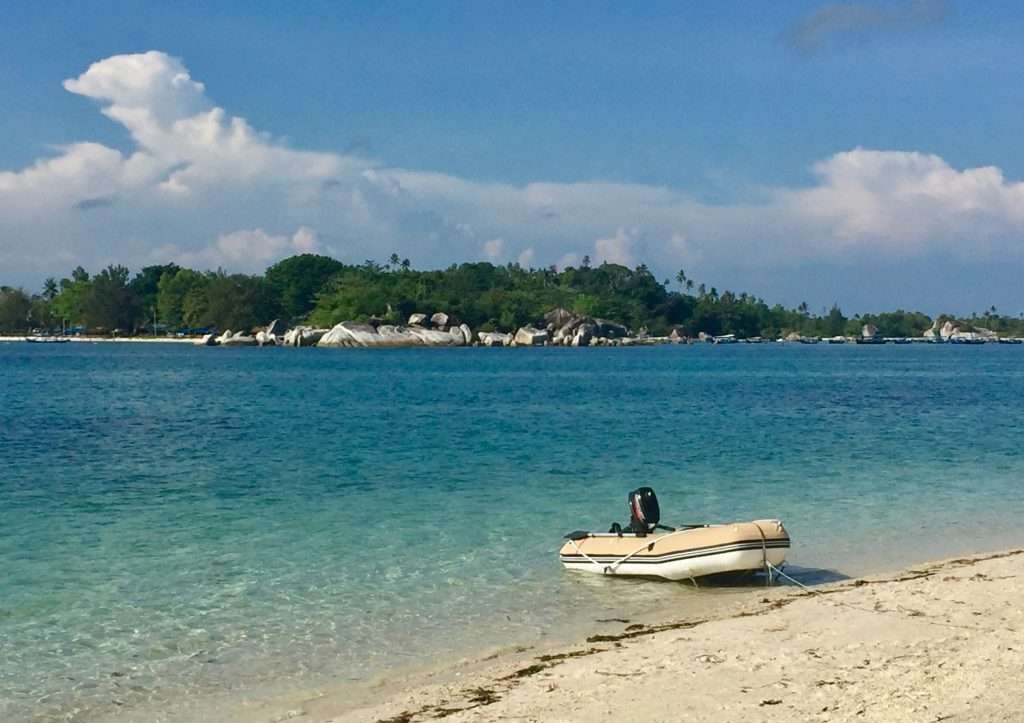
Kelayang beach on Belitung reminds a lot of our previous home in Bakoven, Cape Town, where we surrounded by these huge granite boulders and white sandy beaches.
View towards the Kelayang village from a small island offshore.
A small island near our anchorage.
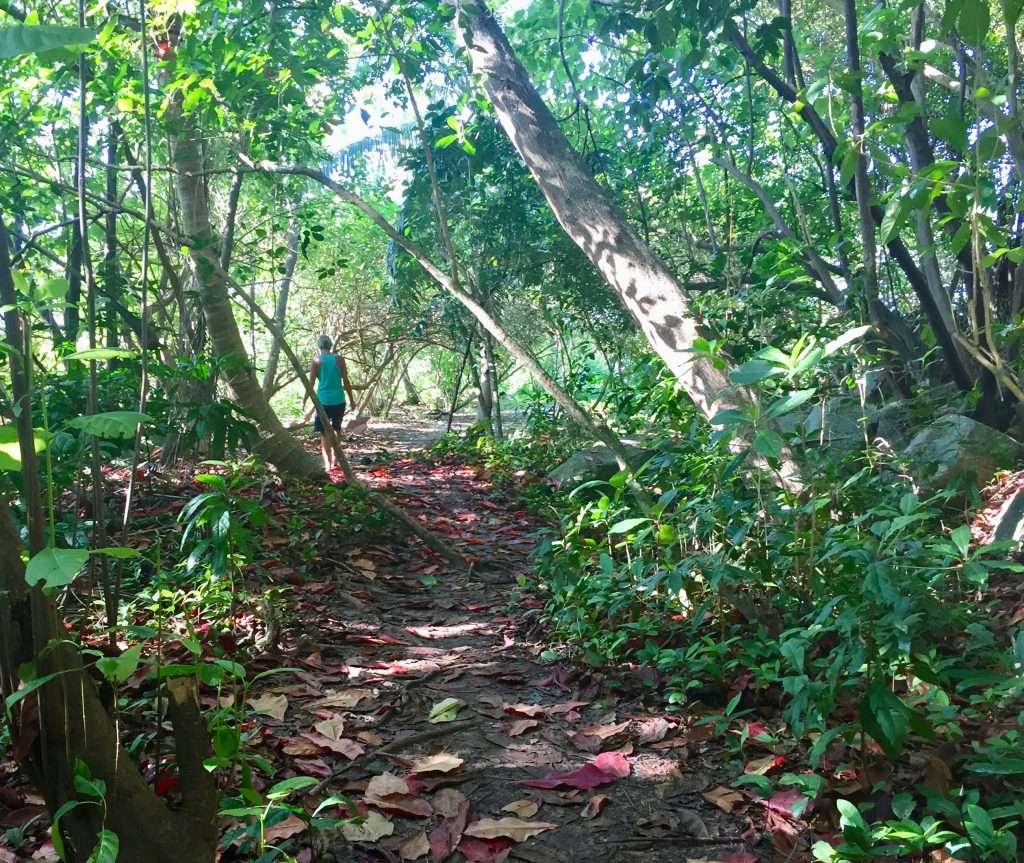
Walking trail on this island.
This island is a sea turtle sanctuary.
The view from turtle island.
A huge granite boulder.
The following morning a helpful local gent took her on the back of his scooter to the local hospital, where he announced her as an emergency. She saw a doctor who confirmed it was a beetle bite, picked up in Karimunjawa. There seems to be poisonous rogue beetles on that island. The doctor gave her cortisone cream and antihistamine tablets – total charge was AUD0.60.
The doctor and Annie.
We visited a local senior high school where the students and staff laid on breakfast, singing, acting and dancing of a very high standard.
The teacher’s welcoming us at the gate.
Entry ceremony.
Male students doing their thing.
Female students welcoming dance.
Revlon has a big market in Indonesia.
First, a vegetarian breakfast.
Some of the 700 friendly students.
Welcoming song where Annie was asked to join in.
One of the student’s acts.
Dancing to wrap up the ceremonies and our visit.
The teachers also want to join in.
This was followed by lunch at a traditional timber house, with more dancing and music. Again the entry ceremony is a quaint and funny ritual where our host had to convince the owner of the house to let us in. In this case the owner was offered and accepted a fake A4 size, 100,000 Rupiah note (about AUD10).
Convince me why these people should enter.
Welcoming gifts.
Lunch at the traditional house.
Our traditional lunch.
Lunchtime music.
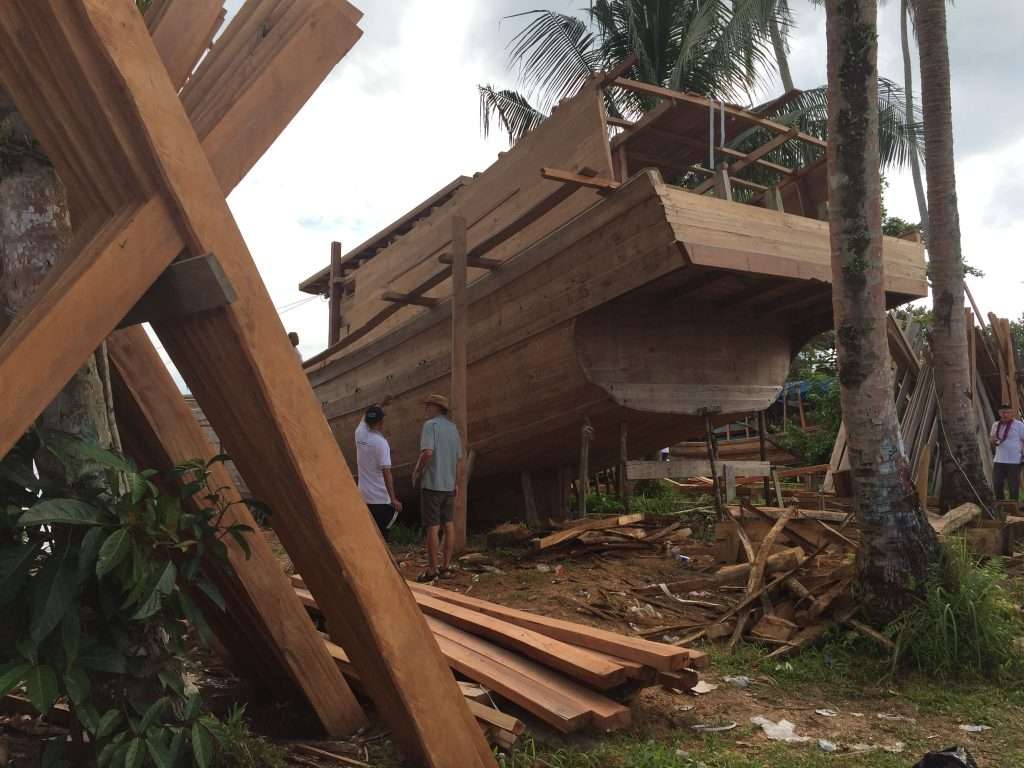
On the way back to our anchorage we visited a timber boat building yard where fishing boats are built in the traditional style.
Planked timber hulls.
Boat interior.
The evening was devoted to our welcoming dinner with various musical acts, excellent food and even the minister of tourism singing for us!
Opening act.
Childrens group creating environmental awareness.
Another environmental act aimed at unlawful hunting.
Leslie Rigney, one of our yachties, singing for the locals.
The minister doing his thing.
We had to do a closing act, so we sang Rod Stewart’s “We are sailing” to the max.
Part of our group.
Full blast.
The local tourism authority laid on an extensive programme of tours, cultural events and music performances for us. We also spent time talking to the local high school student’s “English Club” to give them the opportunity to practice their English and learn about our countries and cruising agendas. The students are bright and eager to learn, knowing that the future of their island is in tourism.
My group of English Club students.
The East Belitung Tourist Authority took us on a bus day tour to the capital Manggar and on the way we visited an open pit tin mine, a Buddhist temple with dragon dances and the local fighting between young men who try to cane their opponents on the back.
At the mine with Khadafi the tourist police chief.
Dragon dancing.
The dragons and us.
Beating the bejesus out of one another.
We were treated to lunch at a restaurant on the water’s edge before visiting the tourist authority offices and finishing at a coffee bar (Manggar has approximately 1,100 coffee bars) where a local music group performed for us. The two 17-year old local vocalists were very good.
Our last report was from the Medana Bay marina on Lombok. We called in at Gili Air on the way to Lovina Bay in the north of Bali. Michelle our daughter, has spent some time surfing in the Gili’s and highly recommended a visit to these islands. Ironically, she and Karen her sister, was in the heat and dust of the Burning Man festival in the USA, during our visit to these islands.
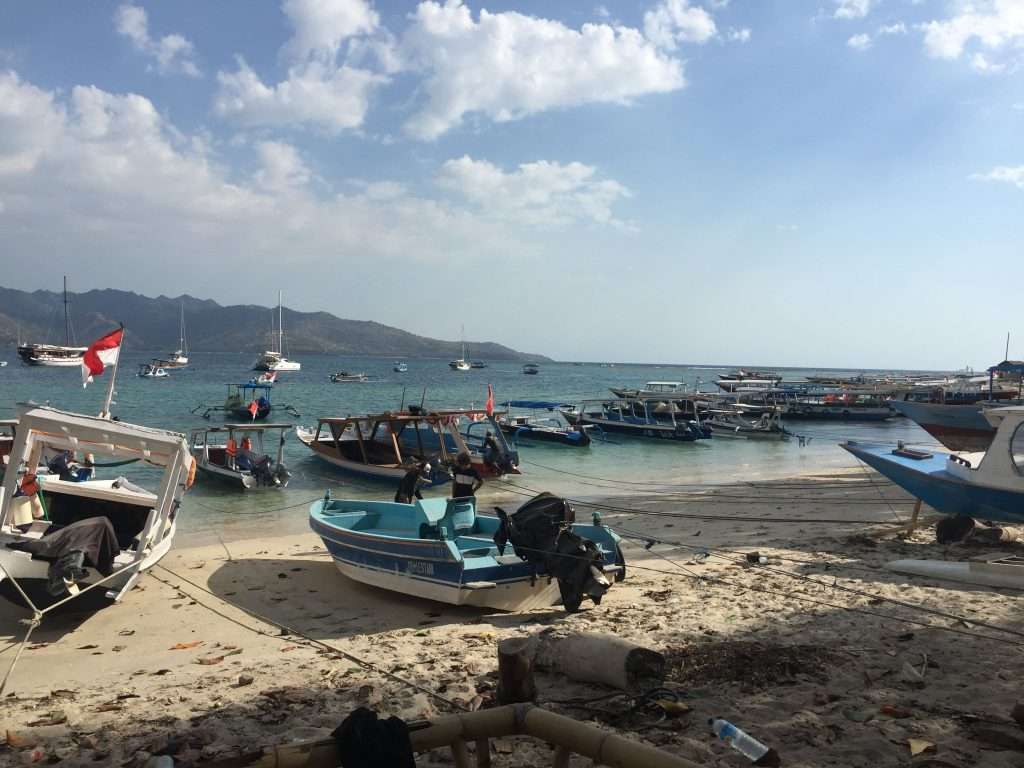
Gili Air – no motorised transport!
Gili Air anchorage.
Esprit enroute to Bali.
We arrived in Lovina Bay to renew our 3 month visas for Indonesia. Our Sydney friends, Ron and Michelle Watson, arrived the next day to join us for some sailing and R&R. The visas took five days to process, but the welcoming parties for the Lovina Bay Festival kept us fully occupied.
Annie and Michelle.
Ron, our new six pack barman.
Mr & Miss Lovina Bay Festival 2017.
Ladies, all dressed up.
Gents, also in their best.
Yachties, in their best.
Eric from Seattle, looking like a local.
Lovina Bay locals welcoming us with a dance on the beach.
Beautiful ladies on parade.
Very good kids band.
These girls were excellent twirling their flags.
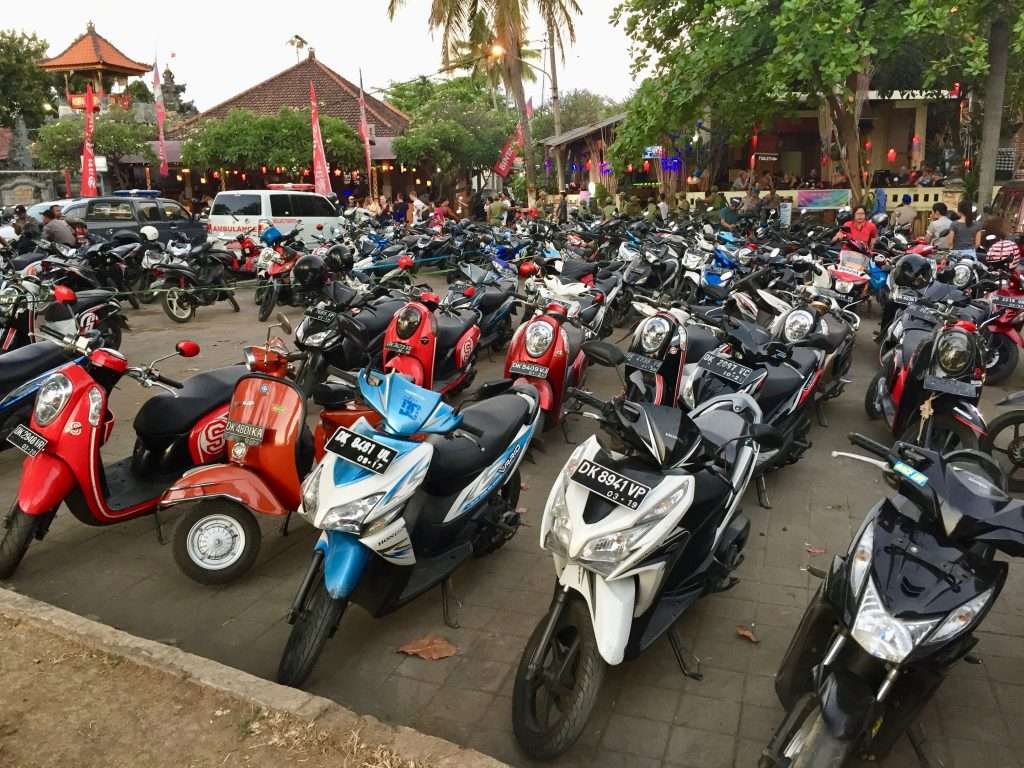
Traffic jam.
Mick, Annie & Dirk at the selfie seat.
Fashionable teenagers strutting their stuff.
While these kids are making mud cakes.
Creating awareness for recycling!
Lovina Beach wall sculpture.
Buddhist/Hindu prayer posts everywhere.
After receiving our visas, we backtracked to Lombok island to show them the southern Gilis (Gede and Asahan) and northern Gili islands and visit Medana Bay.
Gili Gede.
First customers at a pub on Gili Gede.
View from the pub.
Hoola Hoop resort on Gili Asahan.
Drinks at Gili Air.
The young lovers in front of us.
To remind us of our age – the Stones mural at a music venue.
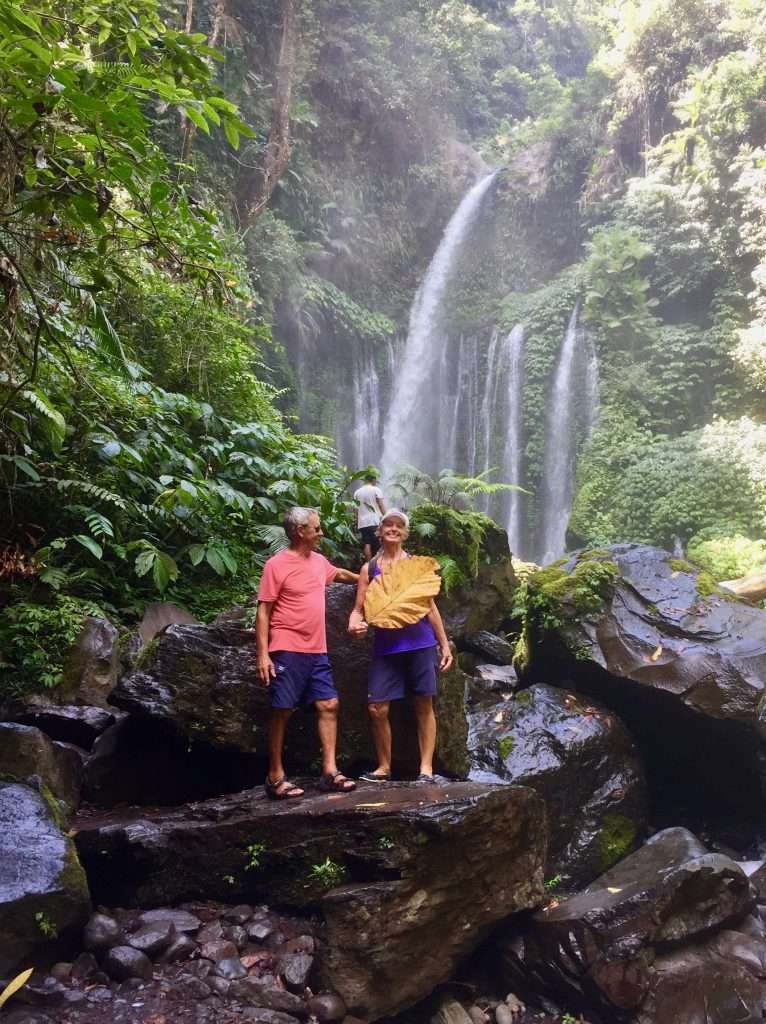
Aji the driver took us to some spectacular waterfalls near Medana Bay and also to an Elephant and wildlife park. After this we visited Gili Air where we enjoyed some good food and music. Unfortunately, the Watson’s had to catch a ferry back to Bali after 10 days on board, but hopefully they will join us again in Thailand.
On our way to the waterfalls.
Adam and Eve.
Ron and Annie had to swim.
Walking back through the Dutch built irrigation tunnel.
Park entrance.
Annie and some birds.
Ron, the snake handler.
Less dangerous feeding an elephant.
Agile monkeys.
You call that a day bed? Annie calls this a day bed.
We are now working our way across Java up to Karimunjawa to re-join the rally. There will be a number of overnight sail legs and we will report on these in our next post.
After day hopping along the north coast of Flores island, we arrived at Labuan Bajo on the western end of the island. This is a popular destination for those visiting the Komodo and Rinca National Parks. After re-stocking with beer, fruit and vegetables we did the short hop to Rinca island where we anchored late afternoon. At 7am the next morning, we started the long trek with a guide through the hills and valleys of the park. We saw quite a large number of male dragons of up to 3 metres in length. There are also numerous monkeys, buffalo and deer in the park. After hiking for 3 hours, we got back to Esprit and lifted the anchor.
A 30 year old male dragon.
A wary Annie with a 15 year old young lad.
Buffalo.
Deer – one heavily disguised with vegetation!
Walking with our guide.
Female dragon digging a hole for laying her eggs.
It was a short sail to Komodo island, where we sailed past the popular pink beach, before anchoring off the eastern reefs to snorkel the next day. The ladies were lucky to be entertained by the huge Manta Rays doing their graceful ballet in about 4 metres of water. The reefs had good coral with numerous tropical fish.
Manta Rays, 3-way dance.
Red soft coral.
Reef finger coral.
It was a short hop to the top end of Komodo where we anchored in a sheltered bay called Loh Gebah. This gave us the opportunity to do a 3-hour climb and walk up a hill affording us beautiful views across the surrounding islands. We spent three days at this anchorage, snorkelling, paddle boarding and doing general maintenance on the boat.
Looking down to Loh Gebah.
View looking north.
Sailing from Komodo island to Wera on the eastern side of Lombok island, we passed an active volcano.
Smoking gun near Wera.
On the way to Wera, Annie caught a juvenile barracuda of about 800mm long. The following day, sailing to Kawienda, she caught a 1 metre long Spanish Mackerel, which will provide fish portions for about 10 meals.
Spanish Mackerel.
After Kawienda, we anchored off Pulau Satonda to visit an extinct volcano, the caldera now filled with water, more saline than the sea.
Caldera of Pulau Satonda.
School girls at the volcano asking for a photo with pale people.
Cool dudes asking for the same.
From we did three day sails to Medana marina on the western tip of Lombok island. This marina was a lovely stop with excellent meals and cold beers, efficiently run by Peter from Australia.
View from Medana Bay marina restaurant.
Our next post will be from Bali where our Sydney friends Ron & Michelle Watson will join us for a sail. Cheers until then.
After the welcoming dinner and tours of Wini, midway up the north coast of West Timor and close to the border with the Timor Leste enclave, we set sail for Alor island, 69 nm to the North. There was a good breeze at 6:30am when we set sail, but this only lasted for two hours, when the wind dropped. The spinnaker was deployed to make the most of the 6-7 knot wind, but had to be taken down after 30 minutes when the wind veered north. The Yanmar cranked to life and we motored the rest of the way, to the south of Alor and dropped our anchor in a sheltered bay after covering 44 nm.
Drinks on Ocelot.
There were three other yachts anchored there, who decided to overnight, rather than arrive at our destination at around midnight. Jon and Sue from Seattle, invited everyone around for drinks on their catamaran, Ocelot. A pleasant time was had with the yachties, before heading back to Esprit for dinner and an early night. We set off again at 6:30 am the following morning to do the last 25 nm leg, but on activating the autopilot, the GPS reported “Rudder response failure”.
Not a bad spot to wait for the tide to turn.
We called the other yachts on VHF to let them know we were going to anchor in the next bay, to reconnect the rudder response unit arm. This requires unpacking the life raft, fenders and mooring lines in the lazarette locker, to get to the hatch, giving access to the steering quadrant. It turned out to be a good move, as we could hear the chatter on our VHF radio, reporting a strong 5 knot current slowing down the three boats already on their way up the channel between the islands of Alor and Pantar. We checked the tide tables for the channel and found that the tide would turn from low to high tide at about 10:45 am and assumed this might reverse the current.
Fish traps on the way to Kalabahi.
This bay was quite a pleasant spot, so we had breakfast, fixed the RRU and Annie went snorkelling in the crystal clear water, while I settled down with a book. We set off again at 10:30 am and had a 2 knot current in our favour, going up the channel to Kalabahi town on Alor island. We anchored at 3pm. Kalabahi was a smaller and dirtier (if that’s possible) version of Kupang. The harbour was particularly trashy as it’s at the end of a fjord and doesn’t flush as well as Kupang. The locals throw everything into the water and most of the trash these days is non degradable.
Trashville.
The harbour master of Kalabahi (and 4 assistants) checking our paperwork.
Children rehearsing for the Indonesia day celebrations.
Indonesia is a country consisting of 15,677 islands, including the western half of New Guinea. It has a population of over 260 million with the largest population of Muslims in the world, although it is not an Islamic state. The island archipelago stretches for over 3,200 miles from north- west to south-east, straddling the equator. Indonesia is located on the Pacific “Rim of Fire” and leads the world in many volcanic statistics. It has the largest number of historically active volcanoes (76), and has a total of 1,171 dated eruptions since European arrival.
Two of the most devastating volcanic eruptions during historical times, took place in Indonesia: the enormous eruption of Tambora in 1815 – the largest known eruption in the world, had such far-reaching effects on the climate, that for instance Europe was to experience 1816 as the year without summer. In 1883, the disastrous eruption of Krakatau was followed by severe tsunamis that killed about 30-40,000 people. The first volcano we sailed past after leaving Alor island, was Lewotolo on the island of Kawula, where we anchored overnight at the town of Balurin.
Lewotolo volcano on Kawula island.
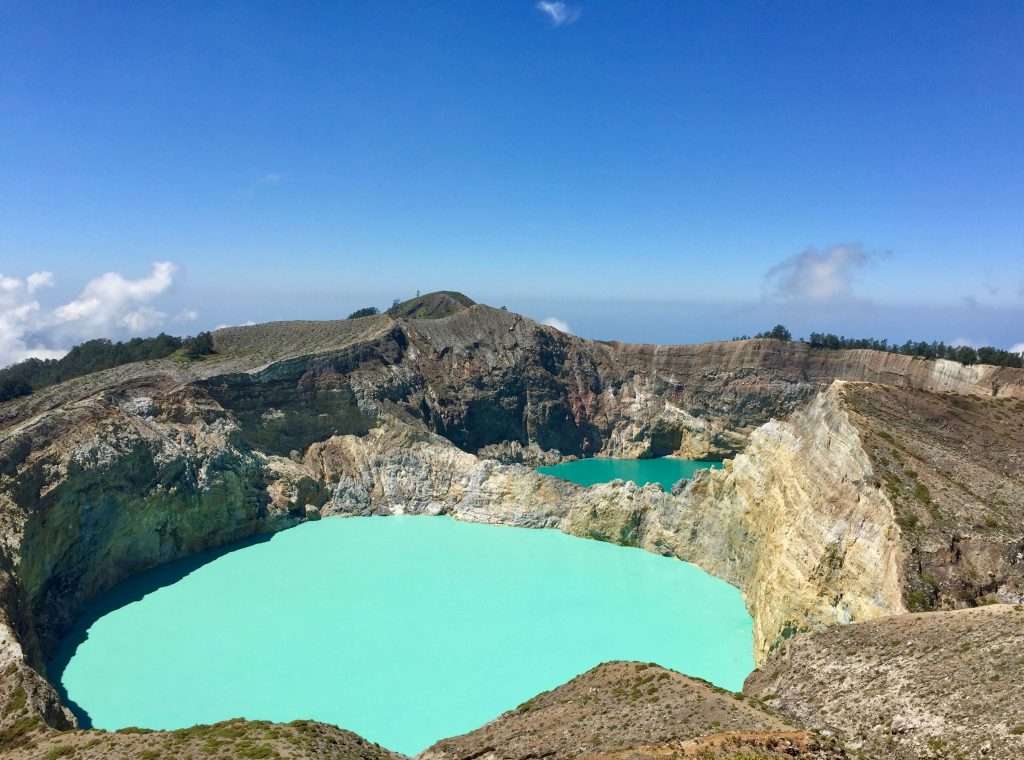
When we reached Wodong on the island of Flores, we were able to travel overland to see the Kelimutu volcano, now dormant. It has a caldera of three lakes with different colours due to minerals such as copper and tin. Flores island stretches more than 300 nm from east to west, so we day hopped from Wodong to the west coast over four days in the company of 4 to 7 other yachts. There wasn’t much wind, so we had to motor quite a lot. Another reason for only travelling during the day, are the great number of floating fishing platforms off the coast, which are unlit during the night.
Annie admiring the caldera.
The lakes from the highest point. We are above the clouds.
Two old guys at the top lookout.
Lunch on the way back.
Our next stop will be the Komodo island National Park where the famous Komodo dragons and two other species of giant lizards live. We will report more in our next post.