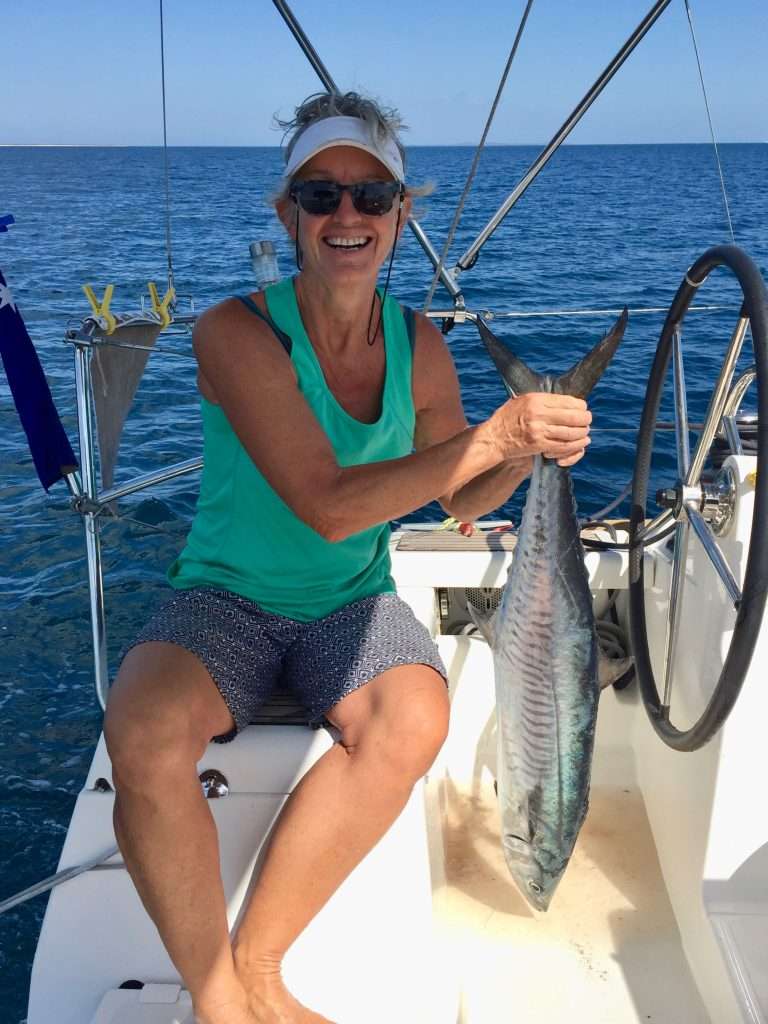
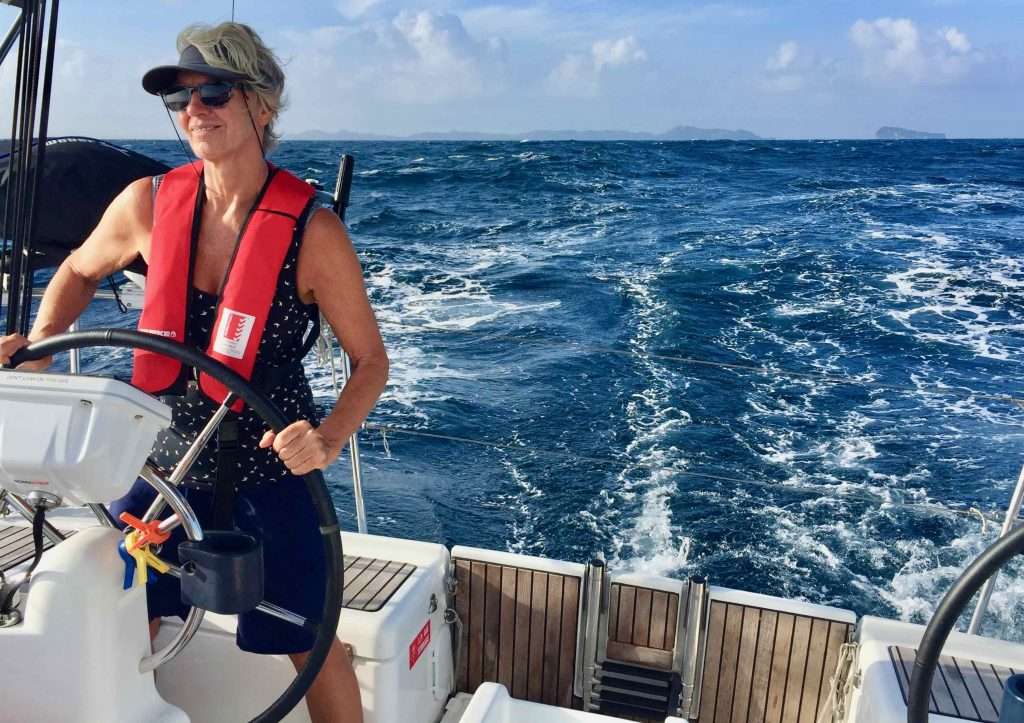
The Sail Indonesia Rally started at 10am off Fannie Bay in Darwin on the 29th July 2017. There was a good 13-18 knot S-E sending us off on a cracking reach. Barely an hour out and Annie caught a 1.2m shark which put up quite a fight before she landed it and then released it.
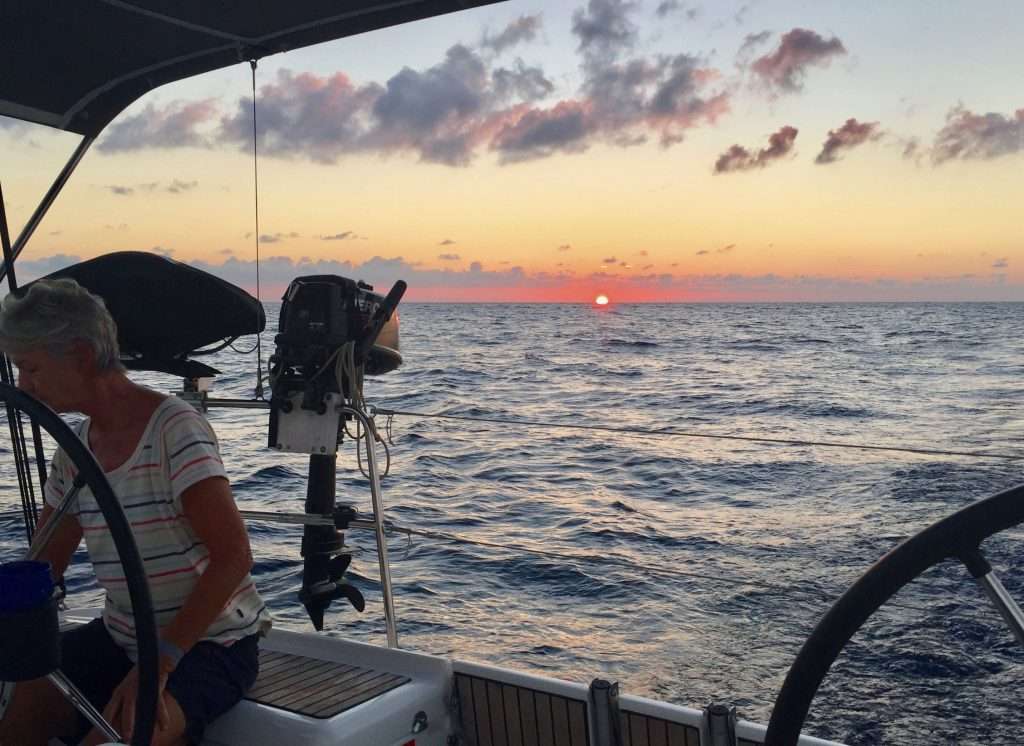
Sunset day 1.
After sunset the wind died down and we had to motor through the night. Sunday morning dawned clear and a light wind kicked in, allowing us to hoist the asymmetric spinnaker for a lovely downwind sail on a flat sea. The Timor sea was a vast improvement on the Torres Strait. Annie was gobsmacked when she landed a 1.8m marlin about midday. This fellow also put up a good fight, but we released it as the fridge and freezer were filled to capacity. No photos were taken as both the shark and the marlin required all our hands, to land and release them.
Spinnaker run.
A light wind night followed as we sailed poled out past the West Timor gas wells and platforms. The third day continued as a poled out run, which lasted until 9pm when we entered the passage between West Timor and Semau islands. It was quite unnerving to motor through numerous fish traps and fishing boats at night, before anchoring off Teddy’s Bar at Kupang beach at midnight. The 488 nm passage took us a slow 3 days and 14 hours.
Poled out downwind.
Customs and Quarantine boarded Esprit at 9 am for their inspection. They were a friendly mob and took photos and swabs of everything. We were then able to launch the dinghy and go ashore where the CIQP registration was done in a special venue to deal with the number of yachts and crew. All very efficient, with reams of paperwork, many stamps and signatures. We were asked where our ships stamp was. Not having one, a local assisted in having one made for us within 24 hours.
Indonesian customs officers.
Lunch of Nasi Goreng and Bintang beer at Resto 999 followed, in the company of other yachties. A yacht rally provides the opportunity to meet very interesting people from the four corners of the world. On this rally there are sailors from Norway, France, Canada, Japan, USA, Malaysia, Poland, Burma and the UK, amongst others. We are able to learn a wealth of sailing information with these people. Best part is, they are mostly of our vintage, some with kids, and they are very relaxed and friendly.
The Rigney family from Los Angeles with their yacht Kandu at sunset.
Thursday was a busy day with the welcome ceremony at 10 am with traditional dancing and music and the start of the Koepan festival in the evening. We went to the fish market for dinner afterwards with some of the yachties on Burmese Breeze and Vadana.
Welcome by the mayor and his interpreter.
Traditional dancing by the children.
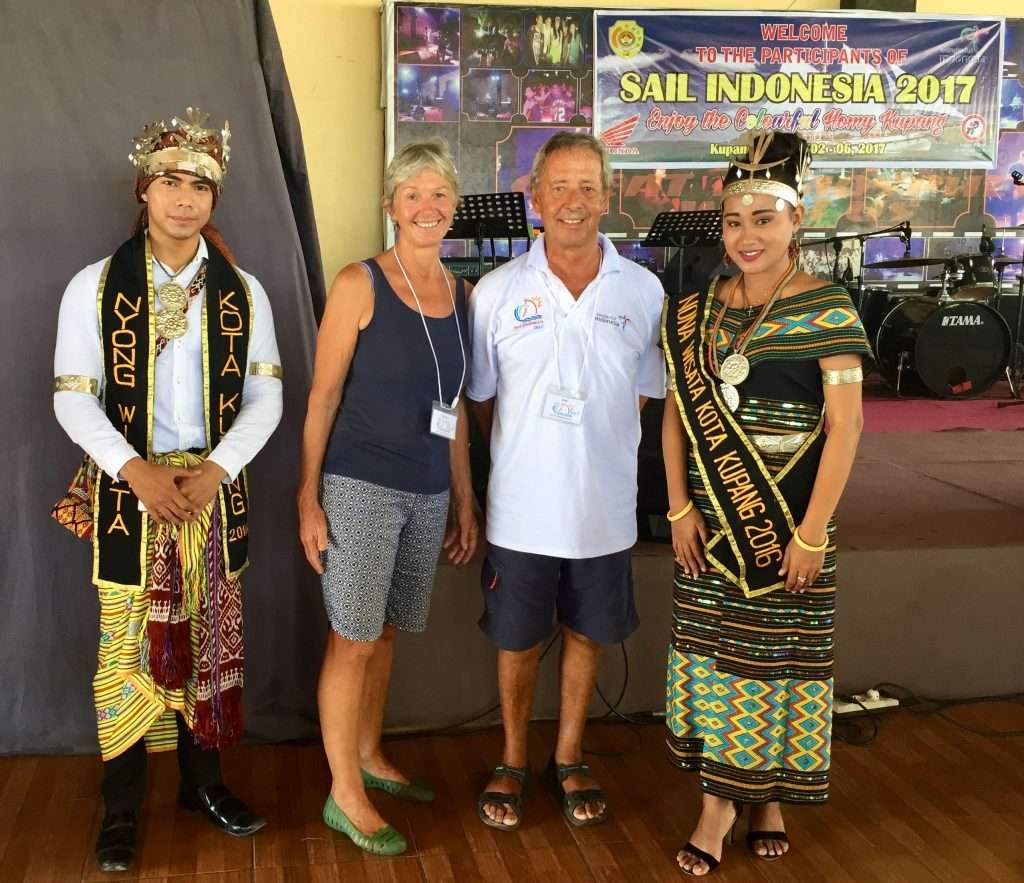
With the outgoing Mr and Miss Koepan Festival 2016. Beautiful people.
Thant Zin from Burmese Breeze selecting dinner for our Japanese, Australian and French sailors.
A city tour with visits to the museum and traditional weaving centre was arranged for us the following day, with the welcome dinner in the evening. More speeches by dignitaries, followed by traditional music and dancing. Saturday was spent recovering after the splendid meal and lots of drinks the previous night.
The yachties at the museum with their English speaking guides.
Traditional weaver.
Traditional music group.
Kupang street scene.
With all those antennae, the passengers should have great mobile phone reception.
At 7:30 am on Sunday we lifted the anchor and had a relaxed 69 nm spinnaker run to Nemberala on the west coast of Roti island, where we anchored at sunset. This is a lovely spot, famous for the huge waves the south current generates and visited by countless surfers. We met up with Steve Friedman from Darwin who has been relaxing here for the past 3 months. He has since lost his razor and is sporting a handsome beard. We also met Marco, Julie and their two young kids from Cape Town sailing on their catamaran. Burmese Breeze and Kandu on the rally, were also anchored here.
Steve and Annie at Nemberala beach. Steve originally from Durban and my vintage, has been sailing for the past 25 years.
View from the cafe where we had breakfast.
Nemberala fresh food market.
Innovative palm tree frond fence.
Main street shop with resident pig.
After 3 days we lifted the anchor again and had a wet and windy beat upwind to Semau island where we anchored in a beautiful bay in the lee of the island. Annie replenished our freezer with a big Spanish mackerel she caught on the way. Then followed two day hops, first to Naikliu and then to Wini, over a total distance of a 100 nm to our next festivities. At Naikliu there was a soccer match just off the beach with a very vociferous crowd in attendance. Here we were again reminded that even the smallest of villages, have dozens of 50 to 100cc mopeds roaring around without silencers – presumably to give the impression that they are actually 1,300cc Harley-Davidsons.
Ten meals from this beauty.
Our next stop will be Alor island 68nm to the north of Wini on Timor – we will keep you posted.
Drew the diver, did Esprit’s bio-security check on the Friday afternoon we arrived in Darwin. He squirted some pink mussel poison into all the sea water intakes of Esprit, in case there were some killer mussels hiding there. This we had to pump through the toilets and run through the engine and then wait for 10 hours overnight at the fuel wharf for this stuff to do its job. Saturday morning the 15th July, we entered the Tipperary Waters Marina through their lock and tied up in our allocated berth. Comfort at last! In the afternoon we washed down the salt encrusted Esprit with fresh water and filled the water tanks. We had our neighbours on “Nauti Buoy”, Barry and Wayne from the UK, over for sundowners, which carried on until 1:30am – quite a welcome to Darwin.
In the Tipperary lock.
Welcome to the Tipperary Marina.
The foldup bikes were put back into service on Sunday, when we cycled into the city to stock up at Woolworths. This is Barramundi country and we bought some lovely fresh fish at the fish market. John, from the rally organisers visited us on Monday morning to welcome us and supply us with the latest rally information, name tags and T-shirts for the rally. Annie visited the Indonesian consulate to submit our visa applications, while Jack Warren our friendly American neighbour, ran me out to Darwin Galvanisers with our anchor chain to have it re-galvanised. Jack and his partner Janice Holmes have twice crossed the Pacific. We enjoyed their company over sundowners.
Back in the saddle again.
Annie, Jack & Jan.
As an aside, the Coral Sea and the islands in it, have lots of coral heads (bommies) which snare your anchor chain and literally strip the galvanising off it, allowing the rust to set in. The advice we were given by Yogi our lockmaster, was to spray the anchor chain with lanolin after re-galvanising, to inhibit rusting. We bought 5 litres of lanolin for this and other rust prevention. Lanolin is a by-product from sheep wool and has many uses other than an aftershave lotion and deodorant for Kiwi blokes. We also had to visit the doctor for medication scripts for the next six months, Bunnings for tools, bolts and gas and Annie had her hair cut, plus had the usual manicure and pedicure done.
The following Saturday we attended a welcoming BBQ at the Darwin Yacht Club for the 22 yachts in the rally, to meet the Indonesian consul, his staff and the other yachties. The crowd was treated to a graceful Balinese welcome dance performed by three ladies. The evening was a huge success with fantastic food and unlimited booze sponsored by the consul – yachty heaven!
Balinese welcome.
The reception.
Serious yachty discussions.
I was reduced to reading the weekend papers on the Sunday, while Annie polished all the stainless steel work. On Monday we ran into Northern Territory grog laws when we tried to order 120 litres of cask wine for the next three months sailing in a Muslim country. The aboriginals are a thirsty lot, so you are limited to 1 x 2 litre cask of wine per person per day – after 4pm! We were allowed to order unlimited bottled wine, so we settled on 120 litres of Hardy’s Stamp varieties – though not ideal with so much glass weight.
Sunset at the Darwin Yacht Club.
Darwin was on our itinerary 25 years ago, when we first visited Australia. It was a much smaller town then, but has grown to a modern city with tower blocks and all modern amenities. The presence of the Australian and US armed forces bases around the outskirts, must have stimulated this growth. The Northern Territory is also making a pitch for building a new rocket and satellite launching facility outside Gove to attract NASA, SpaceX and Ariane to launch their vehicles only 12 degrees south of the equator, with the potential to reduce launching fuel costs by 50%. Gove can certainly do with this plan, after the closure three years ago of the aluminium smelter, we sailed past just recently.
Darwin skyline.
Darwin walking street.
Darwin has two seasons: the wet and the dry. The current dry season at around 30 deg C and humidity at 40% is quite pleasant. We hear that the wet season with higher temperatures, constant rain and 90 – 95% humidity can be very challenging to acclimatise to. The rally technical briefing was held at the Darwin Yacht Club on the Tuesday arvo, with presentations by Customs, Border Force and Indonesian officials. On the way back, we detoured and cycled to an engineering shop about 10 km out of town. A 15-minute wait and Nick the owner cut and machined a new 8mm solid stainless steel rod for the rudder feedback arm to replace the original 5mm threaded rod – for only $25!
The new improved 8mm rod.
I took the opportunity to strip and service the four winches and the anchor winch the following day. Two joker valves for the toilets arrived from Brisbane on the same day, so I installed these in the toilet pumps to stop the back syphoning of the old valves. Wednesday evening saw us at the Dinah Bay Cruising Yacht Club with Jack and Jan to listen to some blues and have dinner. Lovely food,music and company.
Really cool blues at the Dinah Bay club.
Paul from the galvanisers called to say our anchor chain was ready on the Thursday, so Jack and Jan kindly ran us out to collect this and then took Annie and I to Coles to buy our food supplies for the trip.
Annie and the re-galvanised anchor chain.
Friday, before the start of the rally, Customs did a mass clearing of all the yachts and their crews at the Darwin Yacht Club. Our duty free whisky, gin and wine arrived just in time on Friday arvo, so these were carefully stored as everything was in glass bottles – not ideal on a yacht. Saturday the 29th July at 10:00 the Sail Indonesia Rally started off Fannie Bay in Darwin.
The Thursday Island Customs and Quarantine personnel came to clear us in on Monday morning, the 3rd of July, after which we went ashore on Horn island to have lunch, visit the museum and collect water for our tanks. In the afternoon, Annie caught the ferry across to Thursday Island a mile away, to buy fresh salads, veggies and meats for the trip ahead, to cross the Gulf of Carpentaria, south of the Arafura Sea. We set sail the following morning.
Thursday Island.
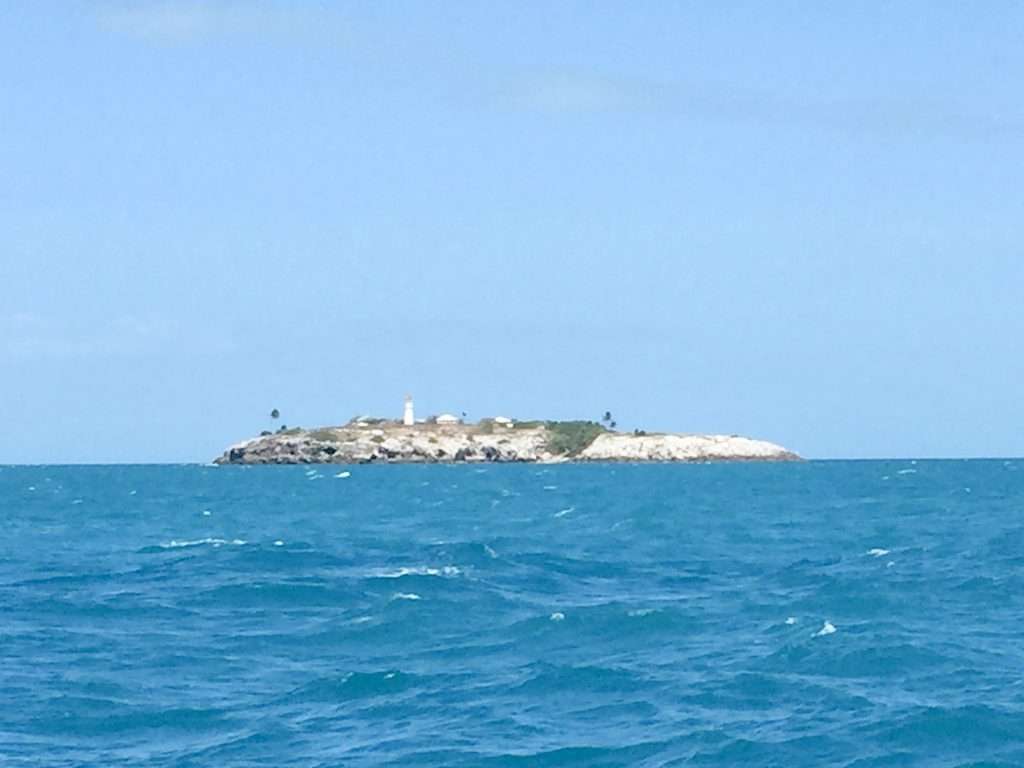
Booby Island -the last waypoint to Gove.
The water was flat and the winds light for the first 12 hours, but after sunset the wind increased and the sea built up. A very uncomfortable night followed, but the following morning we were able to pole out the jib, for a better sailing angle. We arrived at Gove after two days and six hours of sailing. Gove, on the north-western side of the Gulf of Carpentaria, is like Weipa on the north-eastern side, a mining town for bauxite, the feedstock for aluminium smelting.
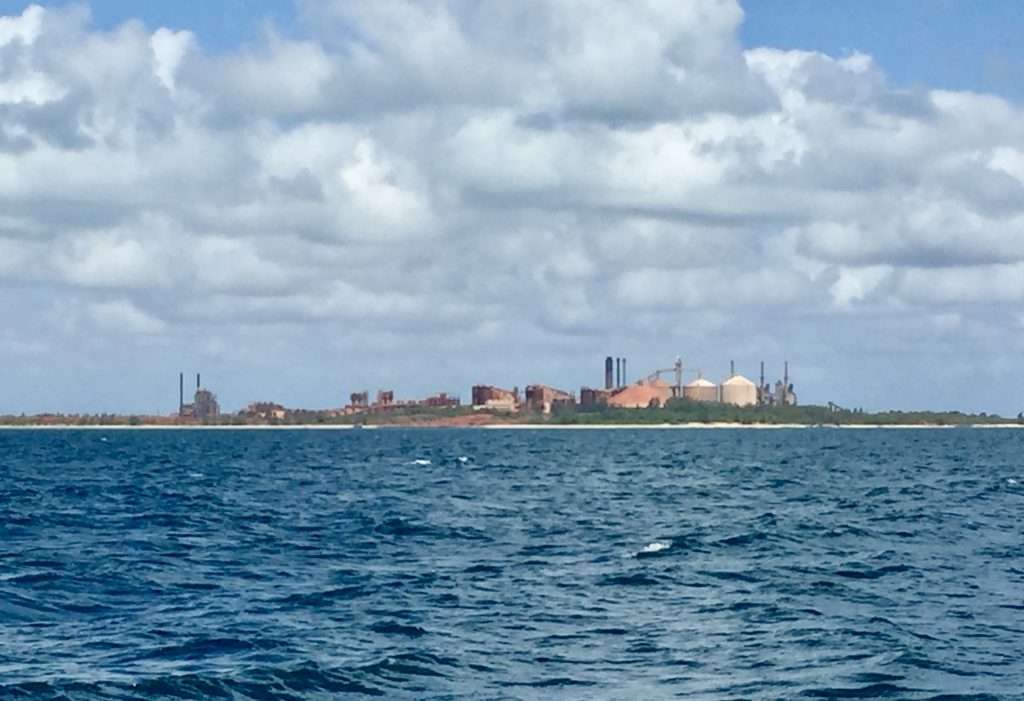
The Gove smelter – like a set for a Star Wars movie.
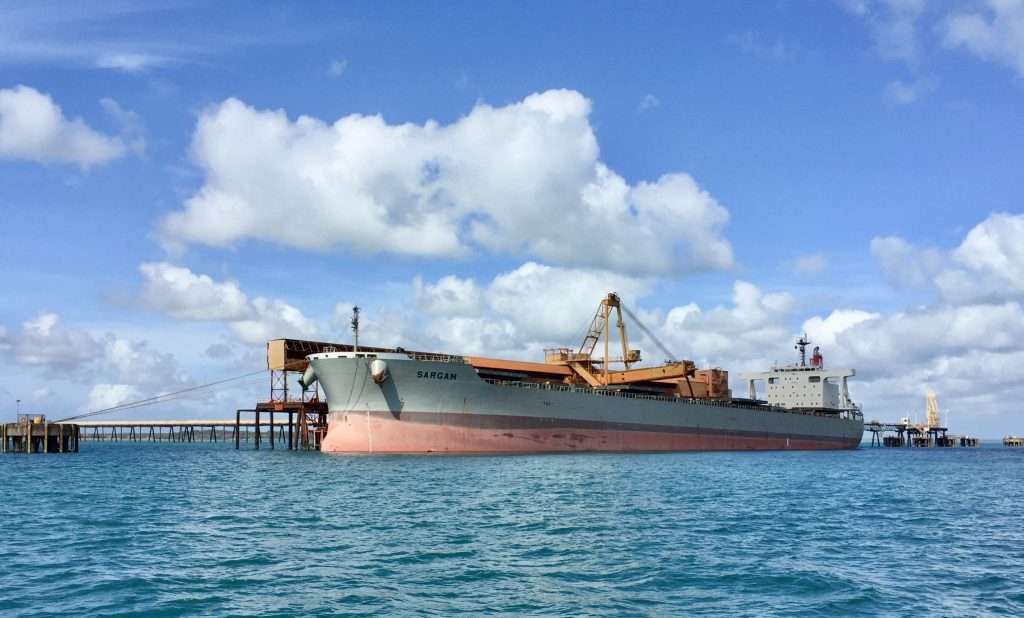
The bauxite loader.
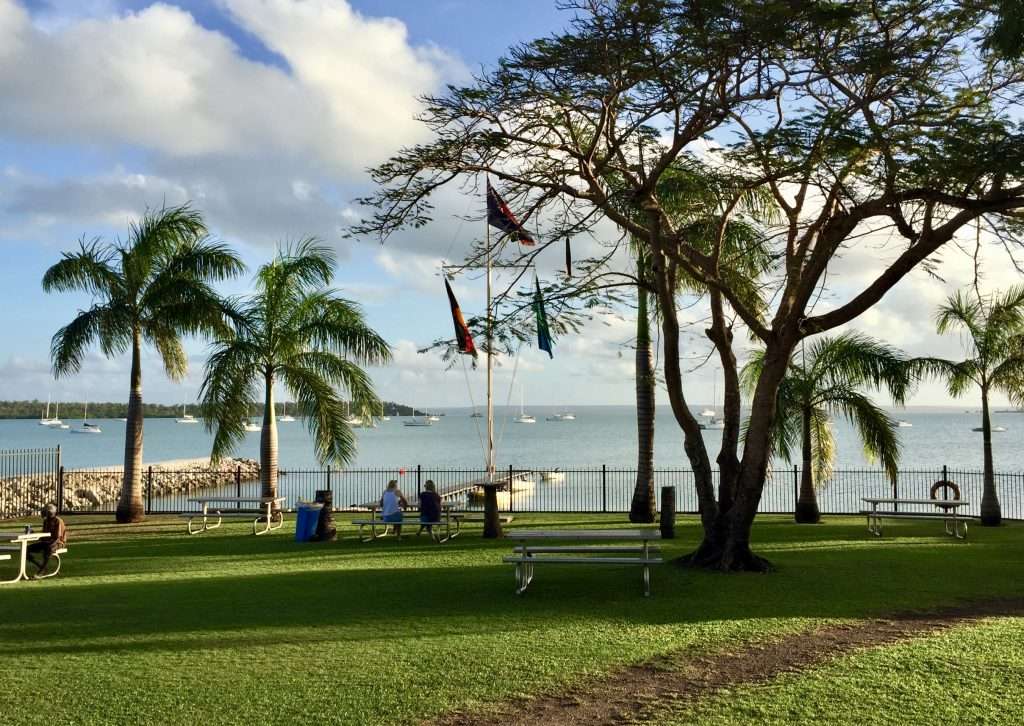
The red dust from the bauxite is everywhere, but the Gove Boat Club is an oasis in this arid region, with green lawns and trees.
Gove Yacht Club
The club is the social hub for the locals and serves great meals. We ate there on both nights in Gove and met some interesting people, like Harold, who at 81, recently completed a solo circumnavigation of the world. He is due to set sail for South America again shortly, on the 38 footer he built of steel. Annie managed to get to Woollies to stock up with fresh food and we again topped up the water.
View from the Yacht Club.
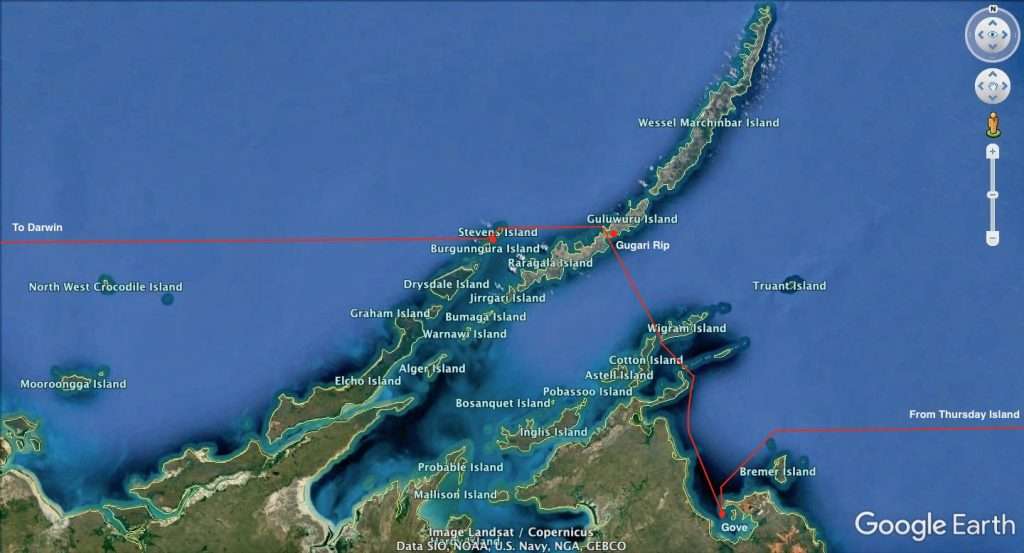
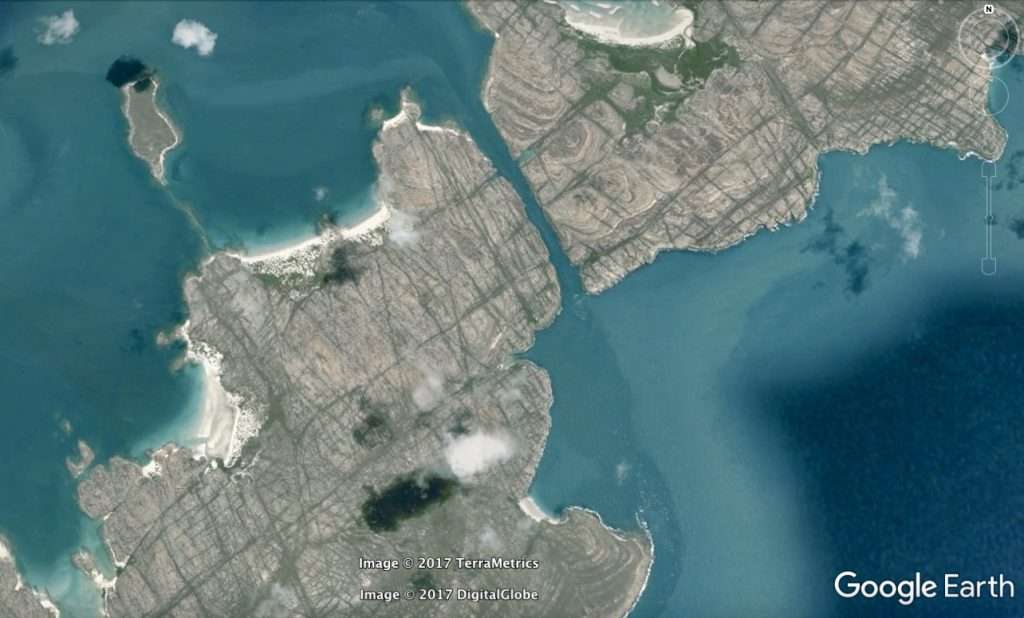
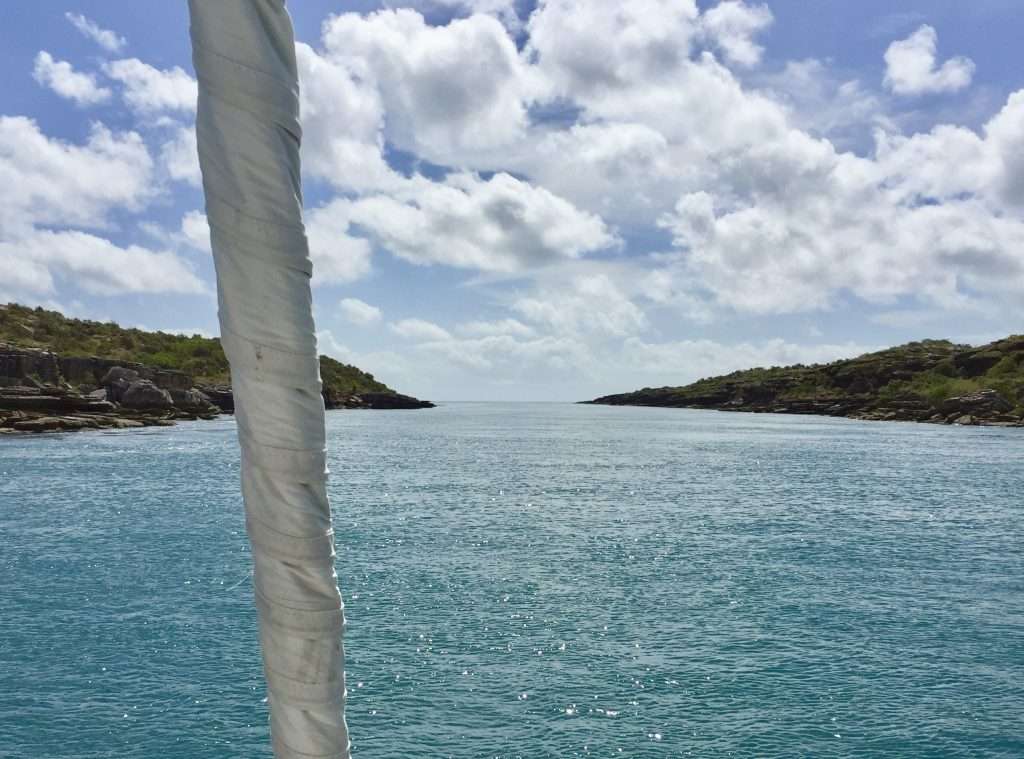
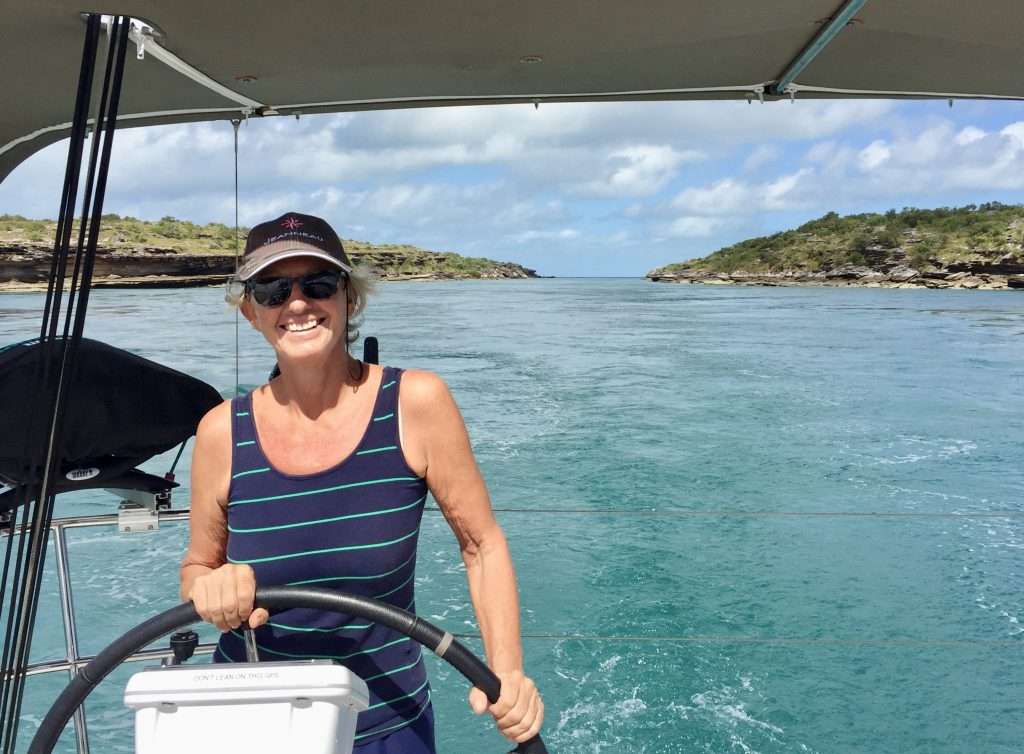
The trip from Gove to cross the Wessel island chain was interesting. You have to get to the Gugari Rip, also called the Hole in the Wall at the right time, to cross at the start or end of an ebb tide. The Gugari Rip has been the foundation of many a yacht club “best yarn” and can be disastrous if you attempt to do it against a flood tide or at full ebb tide, and would probably require a change of underpants afterwards. We left Gove at 6 am to do the 45 nm and arrive there in the last half hour of ebb tide. The nearly slack tide still pushed us through at 10 knots, before it spat us out on the western exit. We anchored for lunch at a lovely beach just south of the exit.
Wessel island chain.
The Gugari Rip as seen from Google Earth.
Entering the Rip.
Slocum Schady shooting through the rip.
Lunch stop.
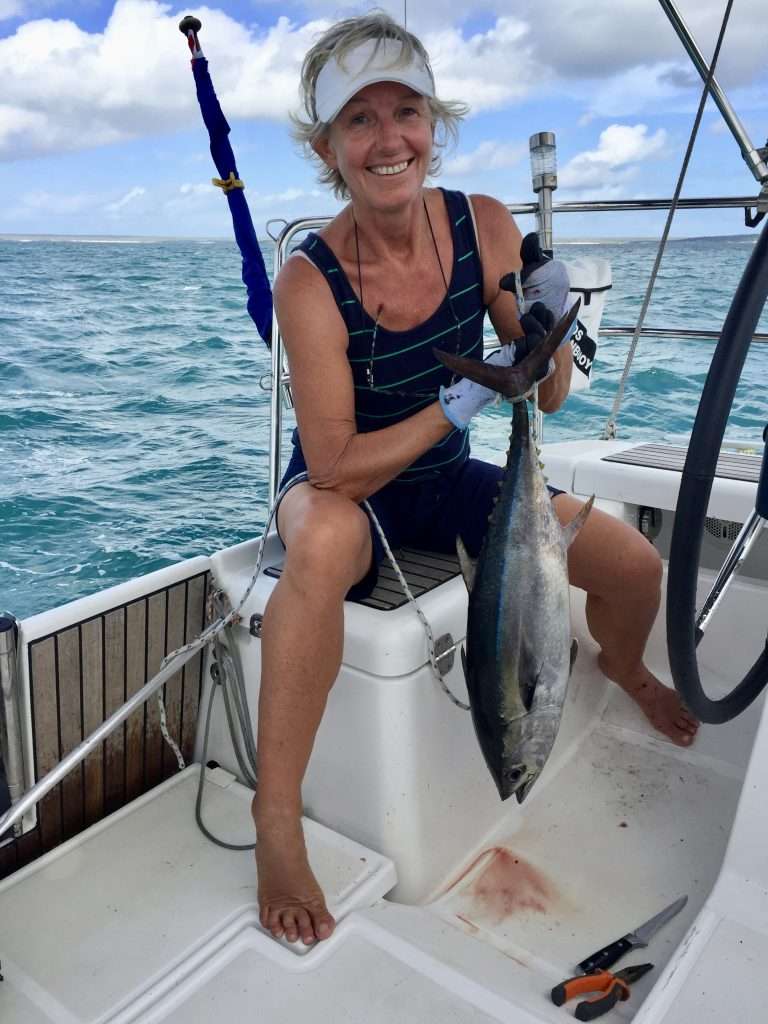
After lunch we sailed 15 miles to Stevens island and on the way Annie caught a northern Bluefin tuna. We had some sashimi and cryovacked the rest for later BBQ’s.
She is getting good at this!
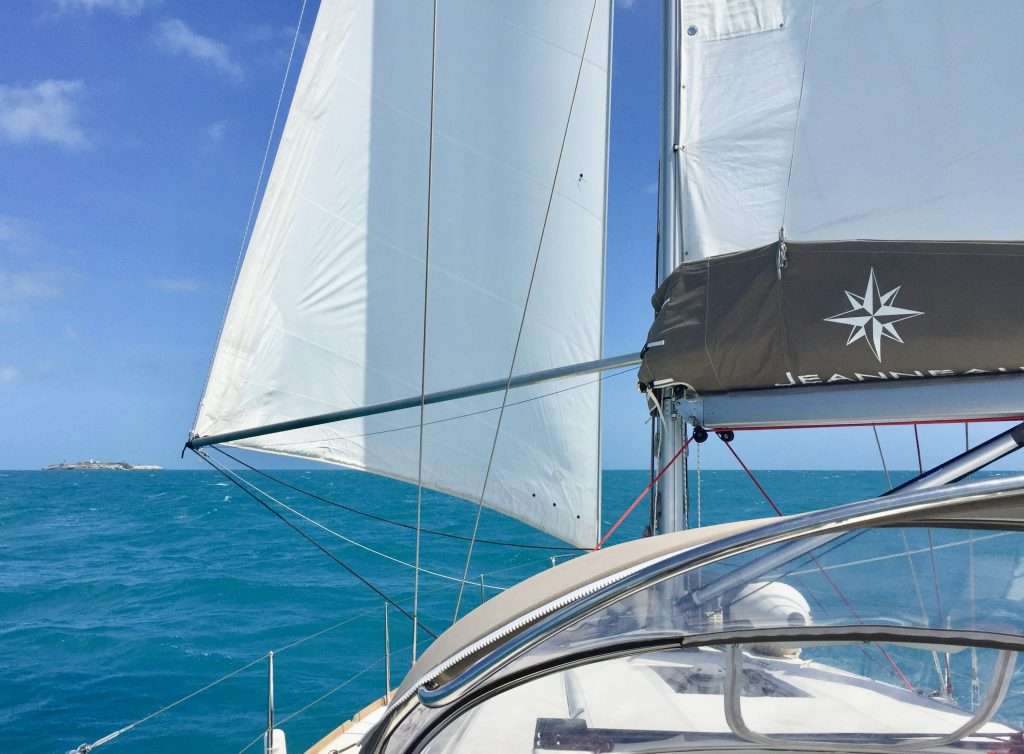
We anchored in the lee of the island, for a very bumpy night. We couldn’t wait to set sail at 7am the next morning, to cover as much Westing as possible, before a strong S-E wind system across the Arafura sea was due to start blowing. The first day was a pleasant poled out downwind sail with 12-14 knots of wind and a moderate sea, averaging 6-7 knots Speed Over Ground. We also had an Australian Border Force ship shadowing us for a while, until our credentials were established. I hoisted our big Aussie flag!
Poled out.
But wait, it was getting better. After a beautiful sunset, a full moon came up in the east and we continued sailing with a full main and the jib poled out, in 14-16 knot winds throughout the night. We only lowered the pole after 32 hours of beautiful sailing, when we rounded Cape Croker at 3pm the next day. An hour later we anchored after sailing 193 nm, in Somerville Bay in the lee of a flat a featureless landscape. Checking Predictwind on the sat phone that night, the forecast was for the strong S-E winds to track south to Darwin, which was still 170 nm away. Rather than try and cover it in another long-haul, we decided to do small hops and anchor in the lee of the landmasses at night.
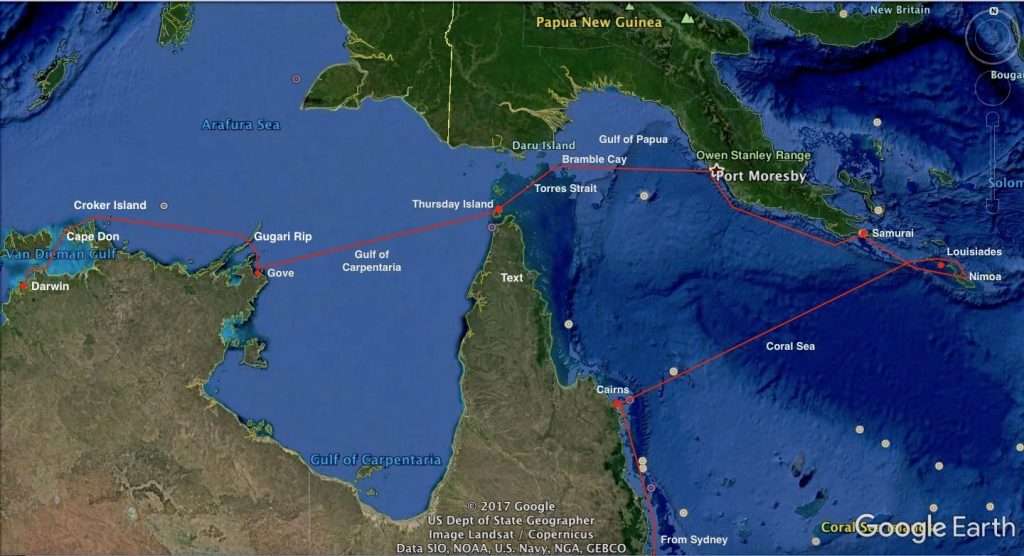
Our trip so far to Darwin.
The first night was at Port Essington, then Cape Don and after that, Cape Hotham, before reaching Darwin on Friday afternoon. Darwin has a huge tidal range of between 6.5 and 7.5m, so anchoring will leave you miles out on the mudflats. Or, you rent a berth in one of the marinas which you have to enter through locks. If your boat has been in foreign waters, the biosecurity diver has to check the boat’s hull before you can go through a lock. The reason for this free check, paid for by the Northern Territory government, is an exotic and aggressive type of mussel that was brought in by a yacht some years ago, destroying the local marine environment before it was brought under control and eradicated.
The biosecurity dive check and injection of a mussel eradication liquid into all the boat’s sea water intakes by Drew Pearce of Darwin Dive Company took an hour, followed a 10 hour quarantine period. We entered the Tipperary Waters marina though their lock the next morning and tied up in our allocated berth. Comfort at last!
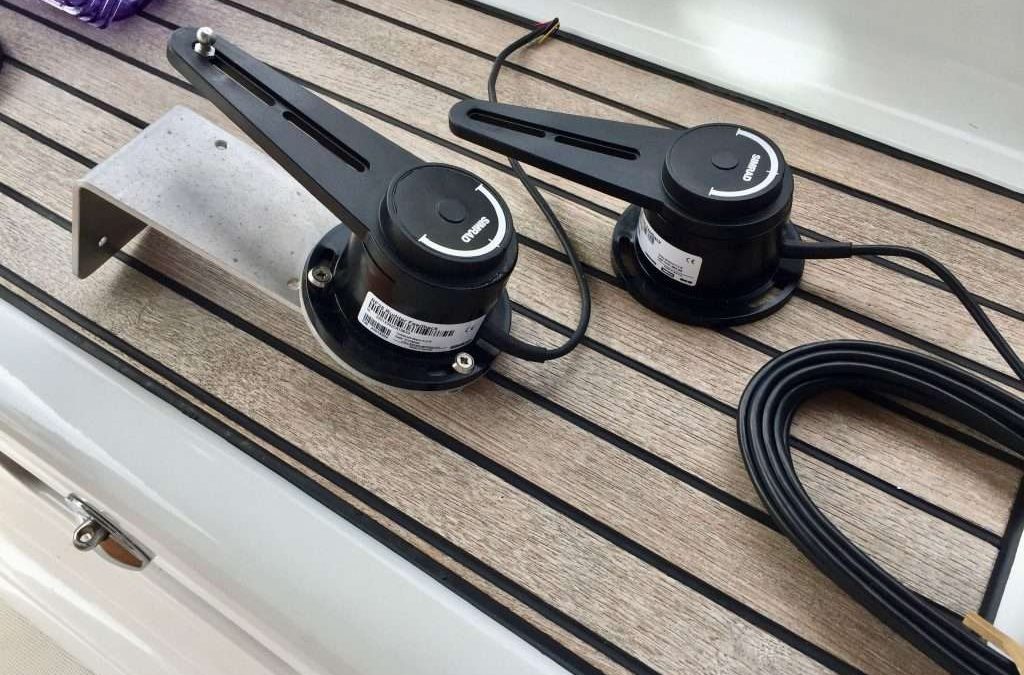
The autopilot rudder feedback unit eventually arrived late morning on Monday 26th June, after waiting 5 days for the DHL express delivery from Sydney. After installing the new unit ($439 plus $100 shipping fee), we tested the autopilot and found that it was still not working!
The old and the new rudder feedback units.
Crawling around below decks, I found pink hydraulic fluid running down a rear bulkhead. Andrew Olsen, hydraulics expert, now takes over. He discovers that the Jeanneau factory in France, didn’t tighten the outer cylinder of the hydraulic ram sufficiently at installation, thereby allowing the hydraulic fluid to slowly leak past the O-ring at its junction with the body, until the system was empty.
The steering quadrant and hydraulic ram.
The defect.
After he topped up the hydraulic pump reservoir with half a litre of ATF, bled the lines and ram, plus a few hundred dollars later, the autopilot came to life. Jeanneau SO 439 owners please note: check the hydraulic steering system on your boats for leakages and check that the threaded connecting rod between the quadrant and the rudder feedback unit doesn’t push into the bulkhead next to the mounting, thus bending the rod! We are not impressed by this installation at the Jeanneau factory in France.
The other defect.
Say no more.
One thing is clear: Carry spares for all the components on your boat which are subject to constant use. This includes winches, furlers, autopilot and the anchor winch. Whilst waiting for our spare part in Port Moresby, there were a number of other yachts waiting for spares to fix broken components, before sailing again. Among them, a French Canadian couple whose fridge had packed up in the Louisiades, on “Grace” their Beneteau. They are Robert and Lucie from Beaumont in Quebec.
Robert Ruel & Lucie Dumas.
Over dinner and subsequent sundowners with another French Canadian couple, Claude and Louise, we learned that Robert and Lucie’s first Beneteau sank off Ibiza in Spain after sailing from Canada to the Mediterranean. They wouldn’t let this get in the way of their long term plans and after their insurance company eventually paid out, they bought another Beneteau in Mexico, on which they have crossed the Pacific, visiting many Pacific islands, New Zealand and Australia over the last three years. They and Claude and Louise fly back to Canada from time to time to visit their kids and grandchildren. These are all people of our vintage, sailing two up.
Louise Lafontaine & Claude Jolette.
On Tuesday, after Andrew finished his work, we cleared out with Customs, paid our RPYC account and set off at 2pm for the 200 nm crossing of the Gulf of Papua, to Bramble Cay at the Bligh entrance to the Great North East Channel. At 6pm we started the autopilot, which worked well through the night until we switched it off at 6am.
Shitty conditions.
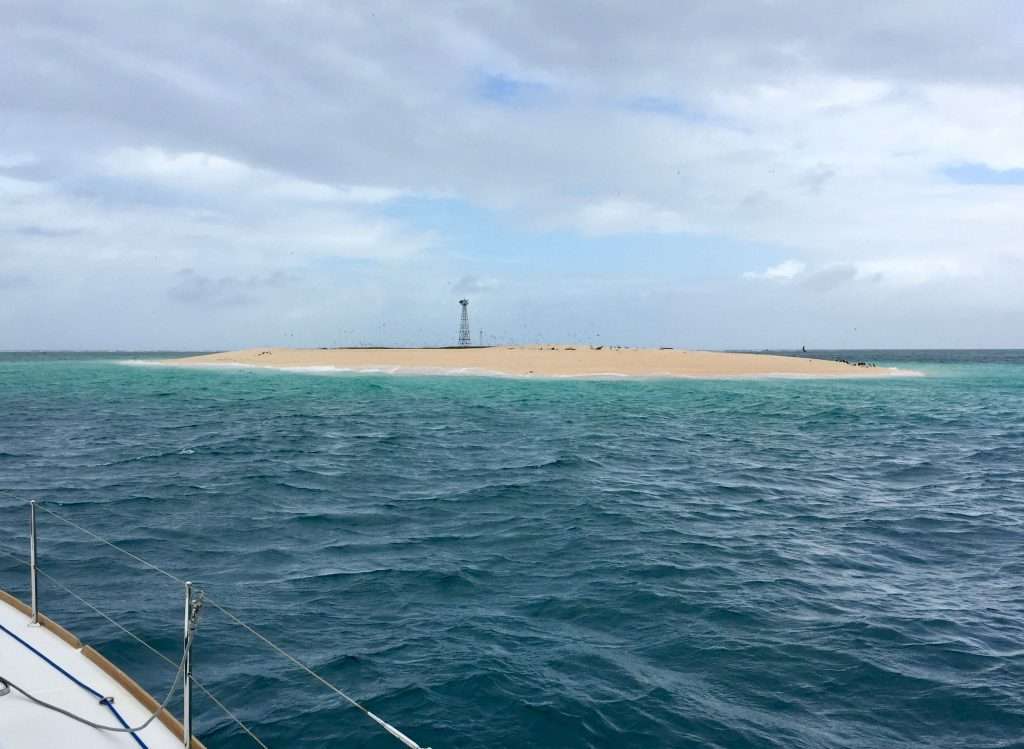
We then started steering manually because the sea was getting lumpy and the wind increased to 25 knots as we approached the Torres strait. We arrived at Bramble Cay after 30 hours at 9pm and at our third attempt at anchoring, the anchor eventually bit. We had a bumpy but good night’s sleep, to wake up the next morning and see how minute this cay is. The rain was pouring down, so we waited until 12:30 before setting sail through the North East Channel.
Bramble Cay.
The autopilot was turned on and did its job until 7pm, when it decided to kark it again. At 10:30pm we anchored behind Dalrymple island, only 55 nm down the 125 nm channel to Thursday Island. Early the next morning an Australian Border Force plane buzzed us and a friendly female officer called us on VHF 16, to identify ourselves and read us the quarantine regulations about what not to bring into Australia. The reason is hundreds of exotic pests that may prove impossible to control, should they reach mainland Australia from across the Torres Strait. Another reason we were told later, is to intercept drugs from Irian Jaya (Indonesian annexed west New Guinea) to Australia.
Dalrymple Island.
Back to below decks to find out what was wrong with the autopilot and to top it all, find out why our chart plotter was no longer working! I discovered to my dismay that the rudder feedback unit’s threaded connecting rod was again bent, probably having suffered metal fatigue after being straightened a few times. There was however a new replacement rod that came with the new rudder feedback unit, which I suppose I should have installed. So cursing, I replaced the bent rod with the new one. Suddenly, the chart plotter decided it liked this and came alive again. This was fantastic as you can only re-programme the autopilot parameters on the chart plotter, which I then did.
Remember me? I will haunt you!
So happily, we set off at 2 pm with the autopilot working again and anchored behind Dove islet at 5:30pm. Annie didn’t want to challenge fate and sail at night with a dodgy autopilot, in case things went pear shaped again. The next day we did a short hop to Poll island where we anchored for our last night before sailing to Thursday Island to anchor in the lee of Horn island.
Horn island jetty.
Now to quote Alan Lucas in his “Cruising the Coral coast”: The Torres Strait is in the centre of the windiest trade wind area in the world. Accelerating this wind is the funnelling effect of the two great land masses, Australia and Papua New Guinea converging on each other in the strait whose warmer waters exacerbate the situation. This is not an understatement – we have sailed from Port Moresby to Thursday island with two reefs in the main and a half furled jib. Annie decided to call it the Torrid Strait! Cruisers should avoid the Torres Strait and also the Gulf of Papua, if they can.
The Torres Strait’s myriads of islands – Cruising the Coral Coast by Alan Lucas.
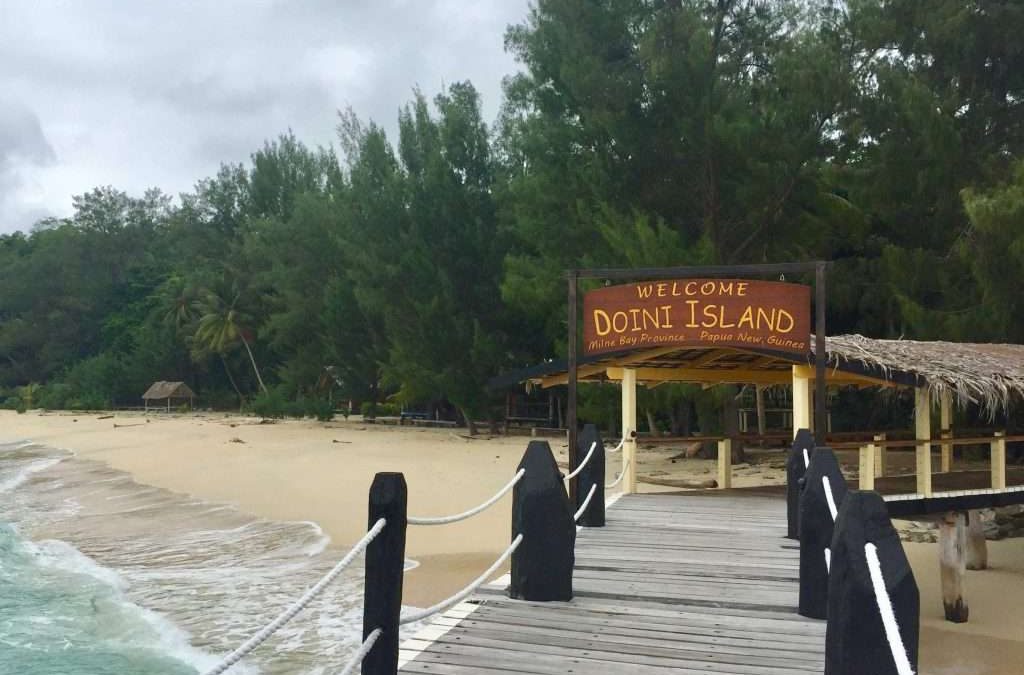
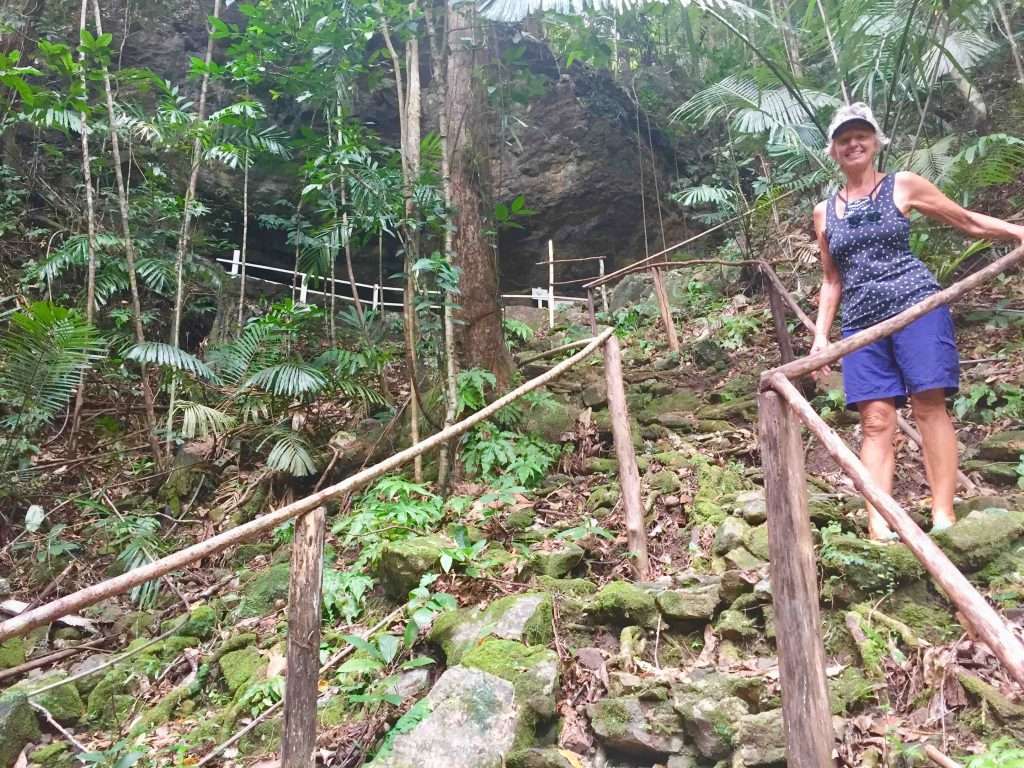
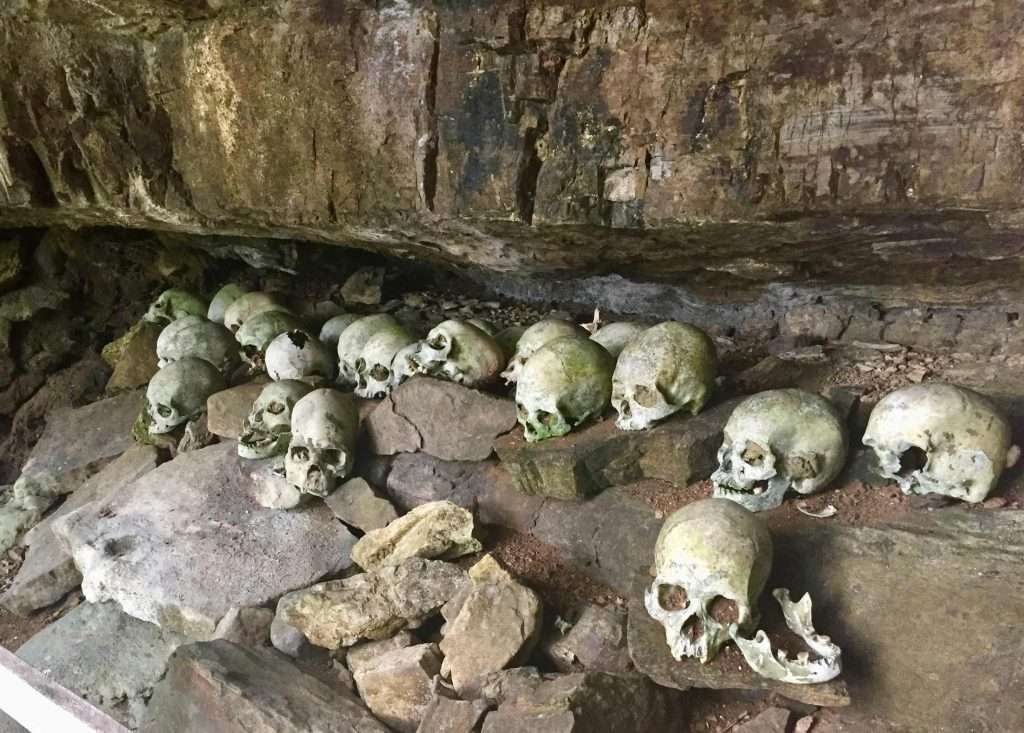
The plan was to take shelter and rest behind Doini island for 2-3 days before we set sail for Port Moresby. This was not to be, as the Predictwind Offshore forecast for the next 10 days indicated very strong winds for the next 7 days, only moderating by Sunday the 11th June. It indicated a window of 3 days of 14-15 knot winds along the South PNG coast, which would allow us a two-day sail to Port Moresby. We went ashore, meeting the friendly staff at Peter Neville’s resort and tackled a walk to the airstrip to stretch our sea legs. Did we stretch the legs – it turned into a 3,5h walk around the island, visiting the skull cave and Love Beach and then back to the resort. We slept well!
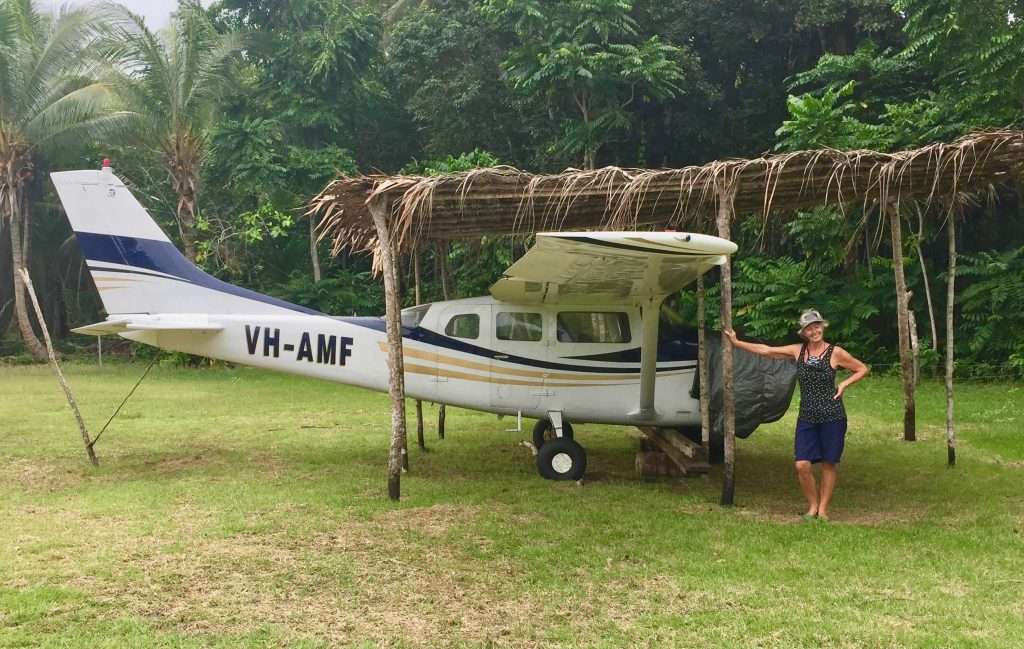
Peter Neville’s plane hit a pothole recently, bending the nose wheel and propellor – now in Brisbane for repair.
Up and down hills.
Steep climb to the skull cave.
Old burial custom – body in the ground, skull in the cave.
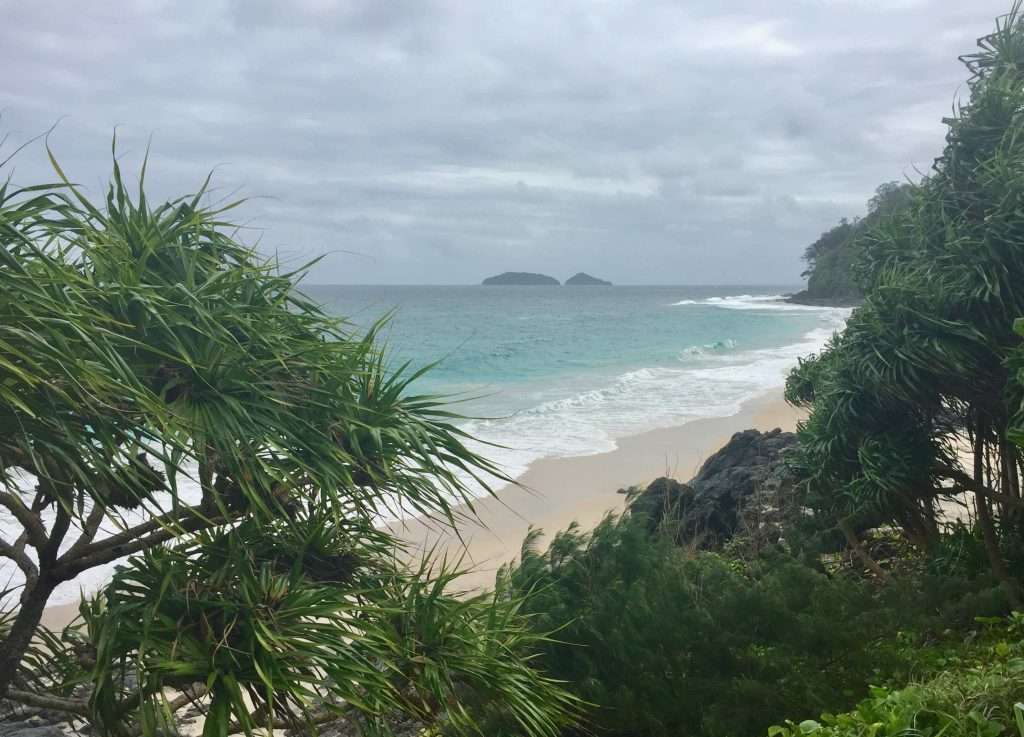
Love beach on a windy day.
Our nights were interrupted by strong gusts coming across the island, swinging the boat wildly from side to side, seriously testing the ground tackle and anchor chain. Michael, one of the staff invited us to bring our washing to the land. As they had to turn on their power generator to pump water to their tanks, they could also run the washing machines in their laundry. We fetched water from a rainwater tank at Cecilia and Margaret’s house. We were most grateful for this and donated all our remaining trading clothing, fishing line, hooks, etc. to them.
On the Thursday we tackled the walk up to the lookout, which afforded good views over part of the island. Friday and Saturday was spent packing up to sail North.
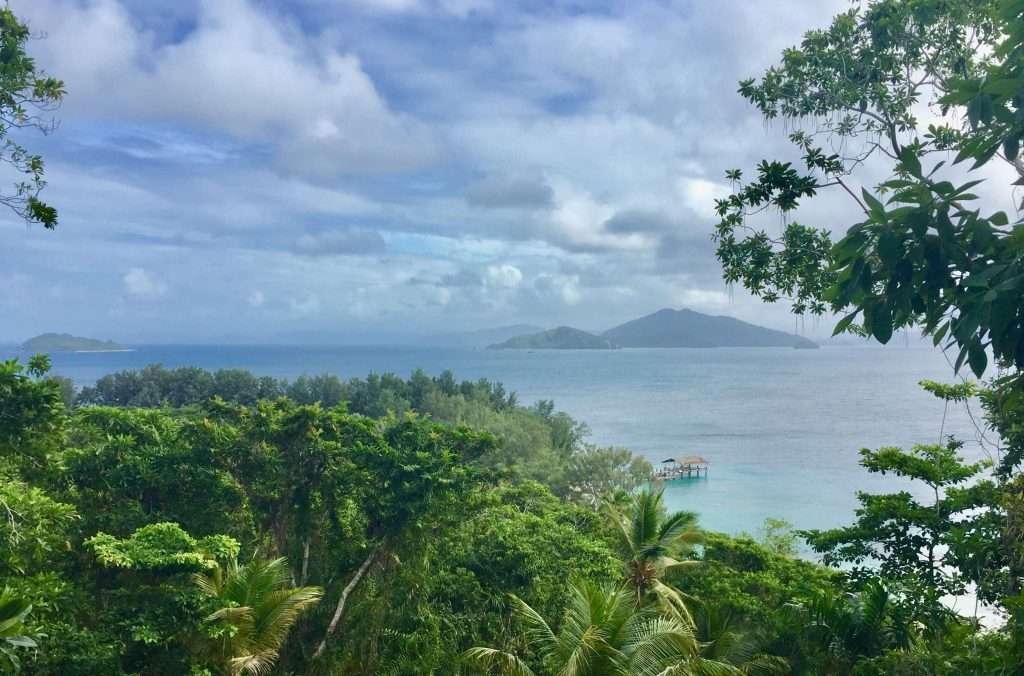
View North from the lookout.
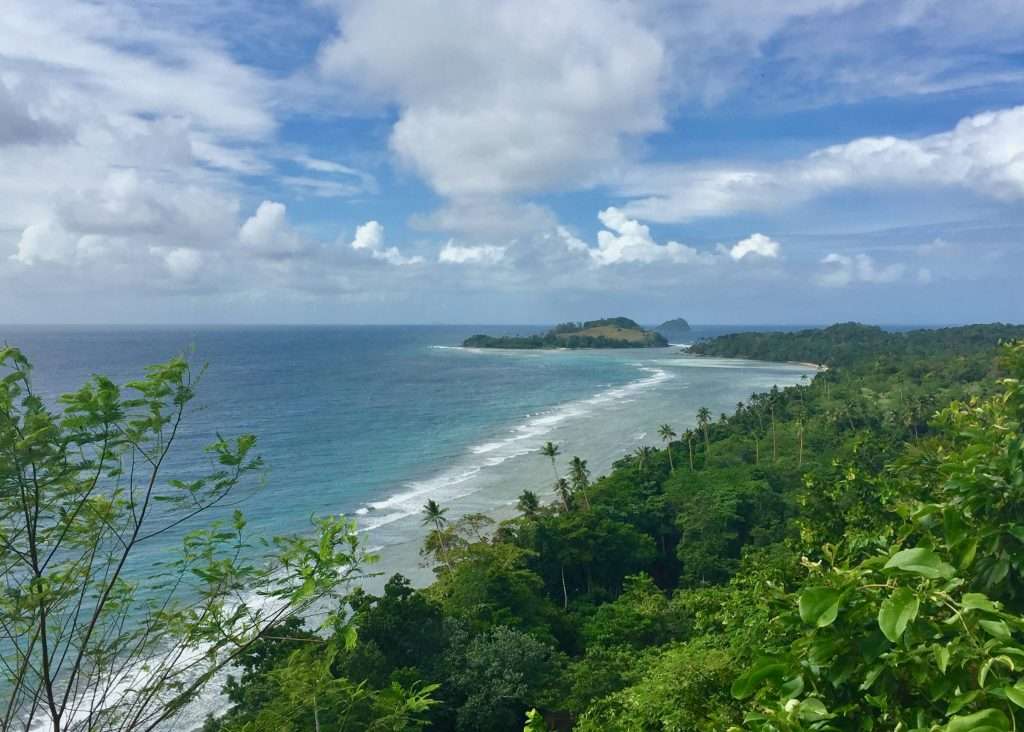
View South towards the airport.
Our weather routing programme indicated a break in the strong S-E winds, so on Sunday the 12th June we lifted anchor at 7am, or rather thought we would be lifting the anchor. The anchor and chain was wrapped around a coral head and after motoring in all directions to try and unwrap it, I dived down to try and dislodge it. It was beyond my 70-year-old depth limit at about 8 metres, so more forwards and backwards with the motor, until an hour later, we got the anchor up.
The first four hours was spent motoring until we passed Brumer island, when the wind picked up. Not only did it pick up, but we sailed into increasingly confused seas, eventually resembling a washing machine with 3-5 metre swells and breaking waves – the remnants of the week long strong winds. The wind increased overnight, forcing us to reef the main first one and then two reefs, before furling the jib. The wind increased to 35 knots, until the autopilot decided it had enough and shut down, forcing us to steer the boat for the next 14 hours.
We expected to reach Port Moresby by 2pm, but no such luck – the sector on the Navionics GPS chart for the approach to Port Moresby was blank and showed no depths or reefs. Fortunately, it was still light, so we had to visually navigate around some seriously treacherous reefs, lining up the final 30 mile run into the harbour by an occasional full moon – due to cloud cover.
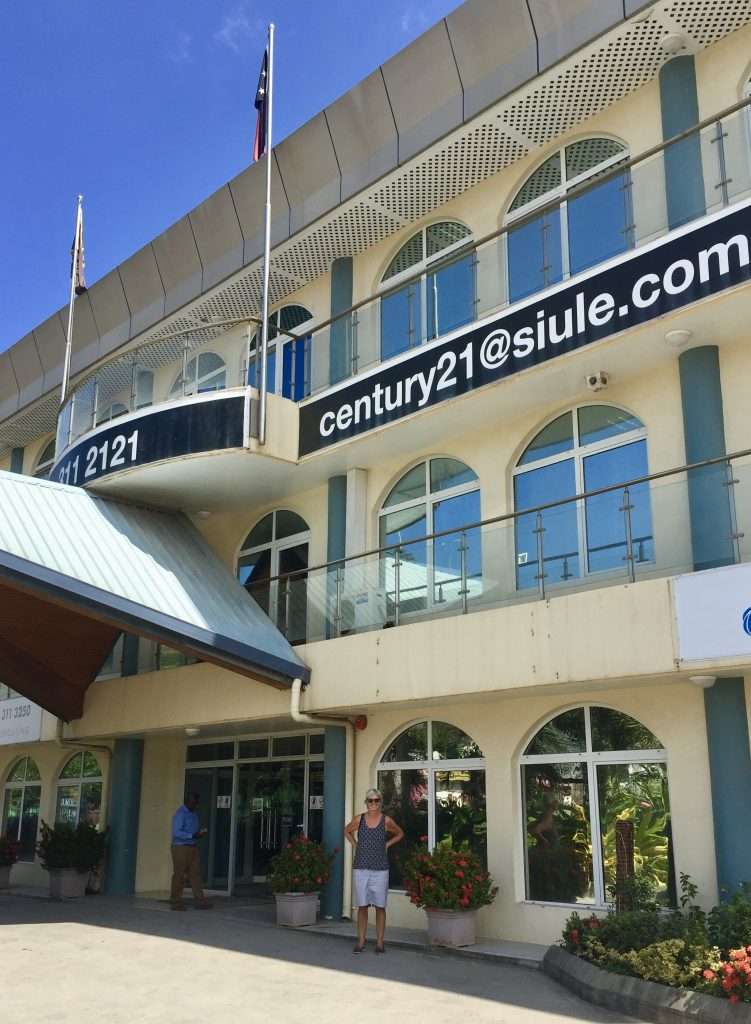
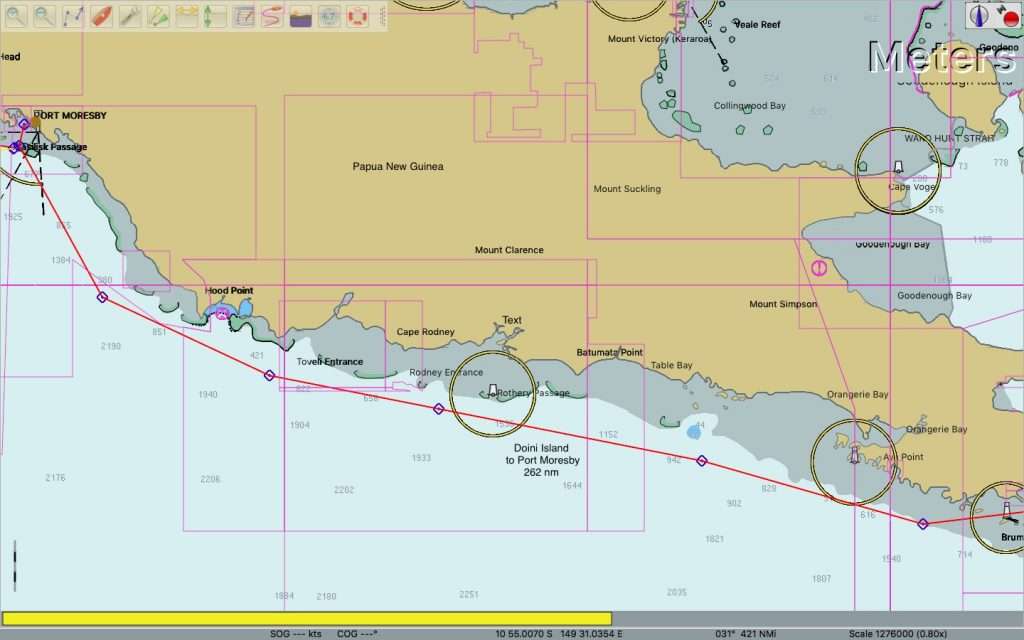
After 262nm, we anchored in the yacht club basin at 1:30 am, downed a beer, had a shower and hit the sack – dead tired. At 7:30am the next morning, we were called from the shore, by a gentleman named Brian Hull, inviting us to sundowners at 6:30pm! He is the chairman of Century 21, a property sales/management company employing about 50 people and at 79 years, still running his business! He came to PNG from Australia at age 19, sixty years ago and at independence, became a PNG citizen.
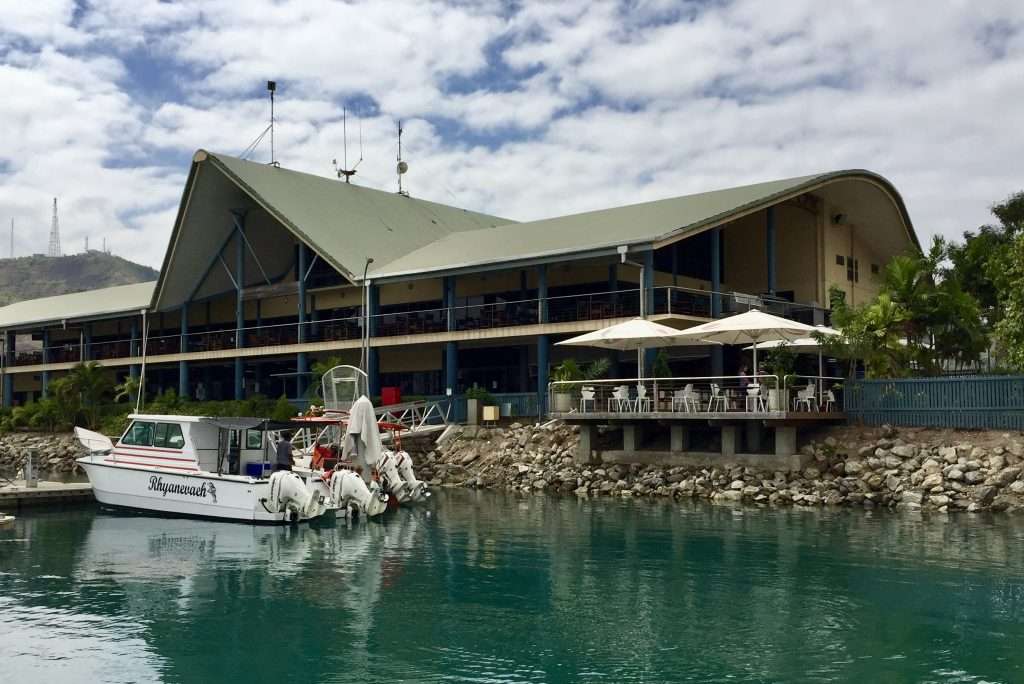
But first we had to welcome Andy from Customs aboard to check us into PNG (having already been there for six weeks!) and then Jimmy from Quarantine Services, who charged us 55 kina (about $22) to go through the boat, remove our three bags of rubbish and take it ashore. Royal Papua Yacht Club (RPYC) allocated us a berth and by 11am, we were enjoying a great cup of coffee on the deck. The club is comparable to RMYC, our home club, with a 256 berth modern marina. The club has a large restaurant, café, bar, boat shed, gymnasium as well as shower and laundry facilities.
RPYC clubhouse and marina.
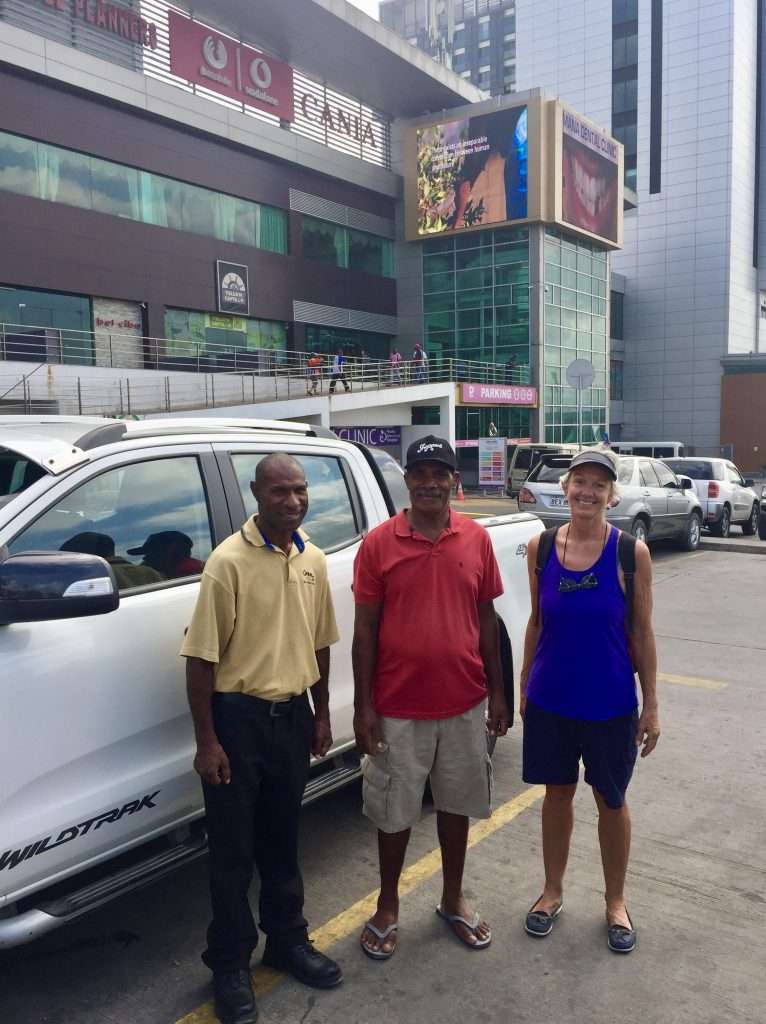
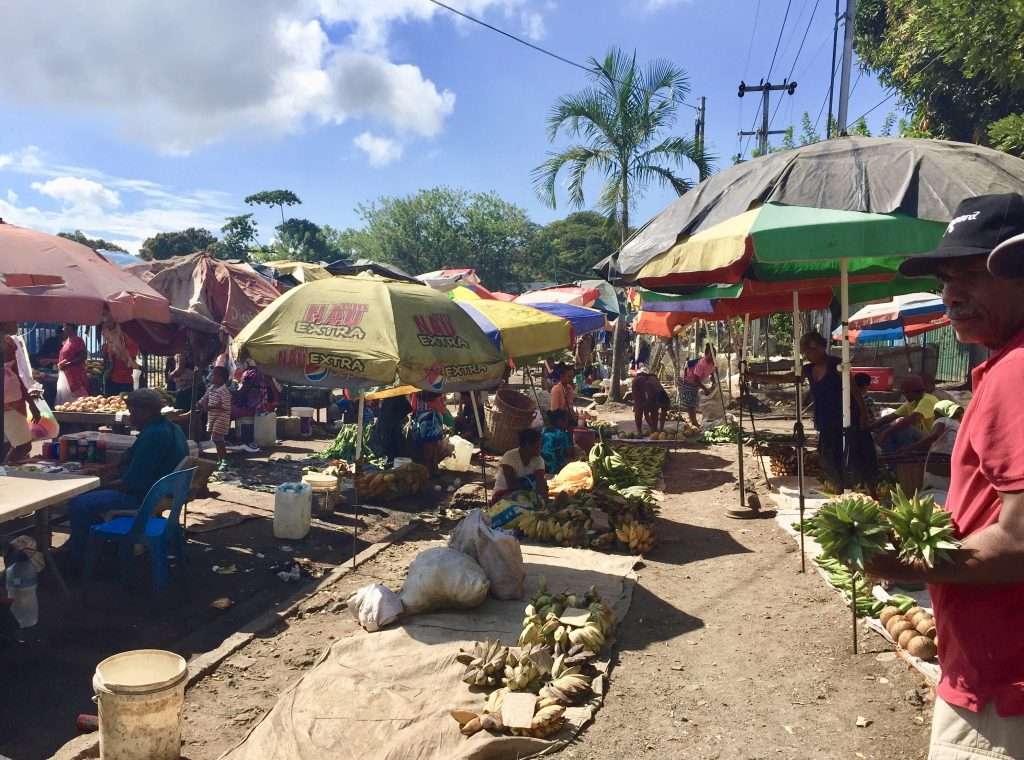
RPYC has approximately 3,200 members and is very secure with 24-hour security. They have approximately 130 members living on boats in the marina. We relaxed the rest of the day and went for sundowners as requested. Brian arranged for Stephen, his offsider on his two boats and Paul, his driver, to take us around Port Moresby the next day to show us around and to do our shopping at a modern supermarket and at the fresh product street market. We had to join him and his lawyers for lunch at a Japanese fusion restaurant. Very generous indeed – hopefully our company was OK.
Century 21 offices.
Paul the driver, Stephen and Annie.
Stephen at the street market.
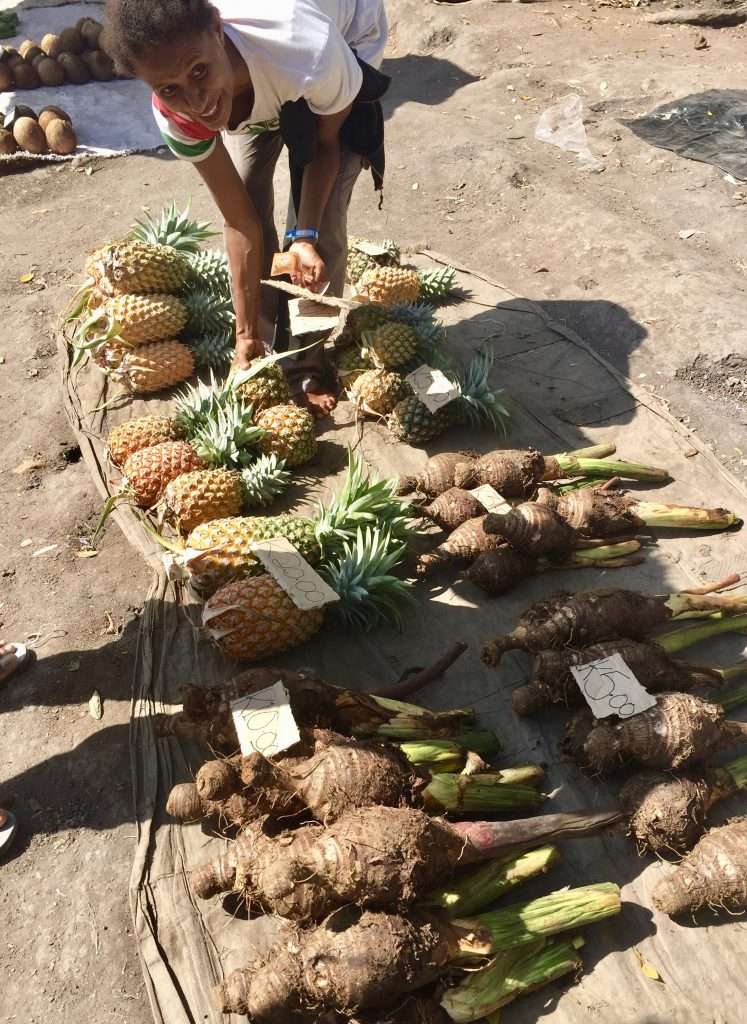
Pineapples & Yams.
We had a busy day next, doing four loads of washing at the laundry. Stephen, Bill’s offsider, found us lock washers which we fitted to the anchor roller bolts, as these worked loose every time we used the anchor winch. The club’s free Wi-Fi also came in handy to catch up with emails.
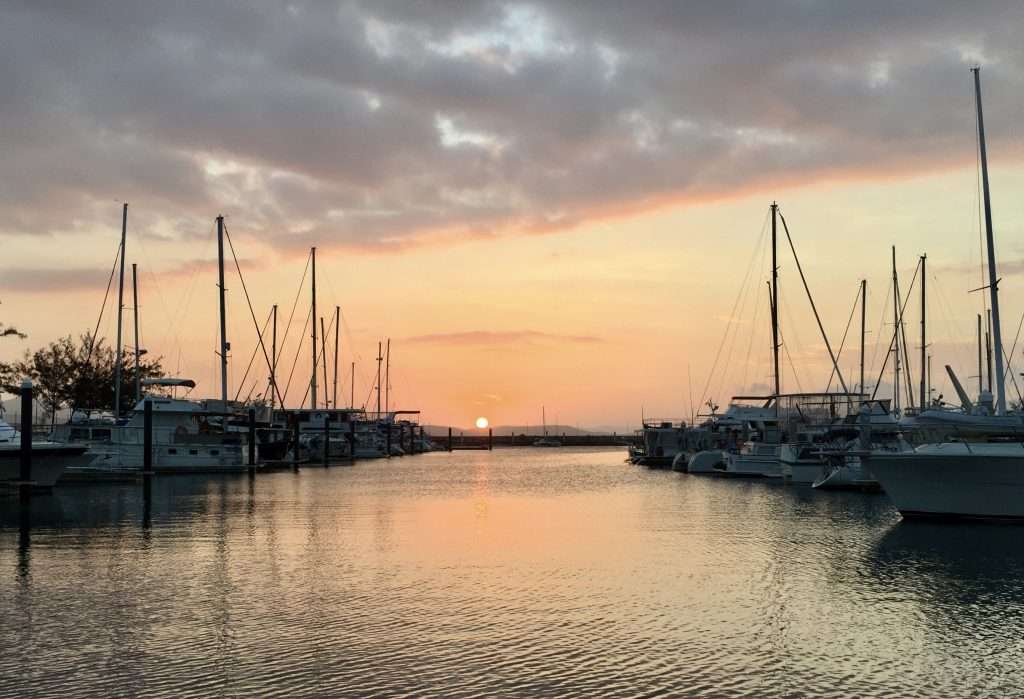
Sunset from the RPYC balcony.
Emails were going to and fro to Sydney, to find out how to sort out the autopilot. I spent a couple of hours crawling around inside the guts of the boat to locate the rudder response unit and follow the cable back to the bus to check the connections. Then re-programming the Chartplotter to get the system going again. Friday night we had Brian Hull and Ernie Lohberger for dinner. Ernie at 80 years is sprightly and slim and still running his company Lohberger Engineering.
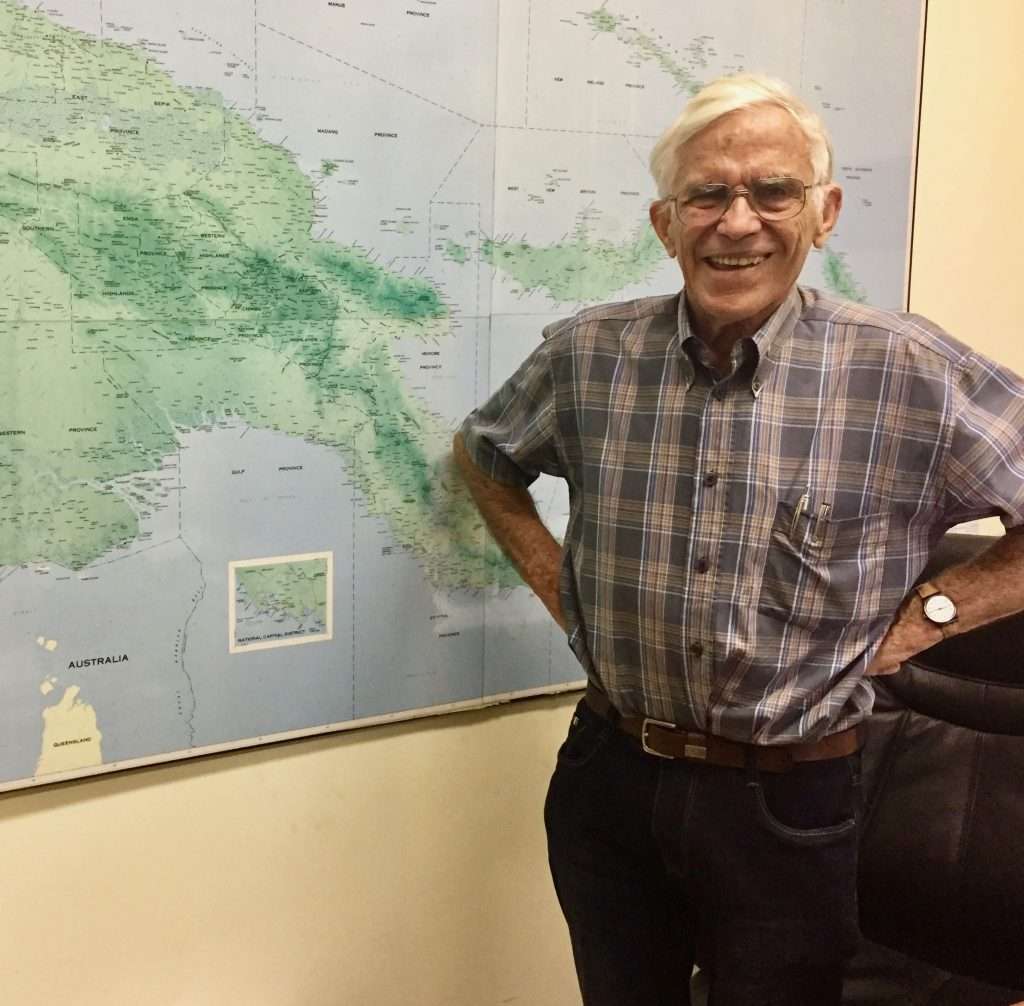
Ernie at his engineering business at 80.
Having tried all week to phone the kids on Skype, the RPYC Wi-Fi allowed us to connect by WhatsApp to Michelle in London and Karen in Tweed Heads – for the first time in two months! They were relieved and stopped short of calling us irresponsible parents. Both are well, with Michelle’s manager requesting her to apply for a new position at her NGO and Karen having decided to do a Master’s degree in Surgery through Melbourne University.
On the Sunday we took Esprit out for a test drive to see if the re-connection of the cables to the bus bars activated the autopilot. However, there was still no steering from the autopilot. Back to crawling into the lazarette locker to get to the steering quadrant and the rudder response unit to check for a mechanical reason for the malfunction. It turned out the Rudder Feedback unit packed up and needs replacing. Our fantastic marine electrician in Sydney, Adam Russell of Ocean Phase Marine Electrical dispatched a replacement unit to us by DHL courier – we hope it will get here by Friday, so that I can install it.
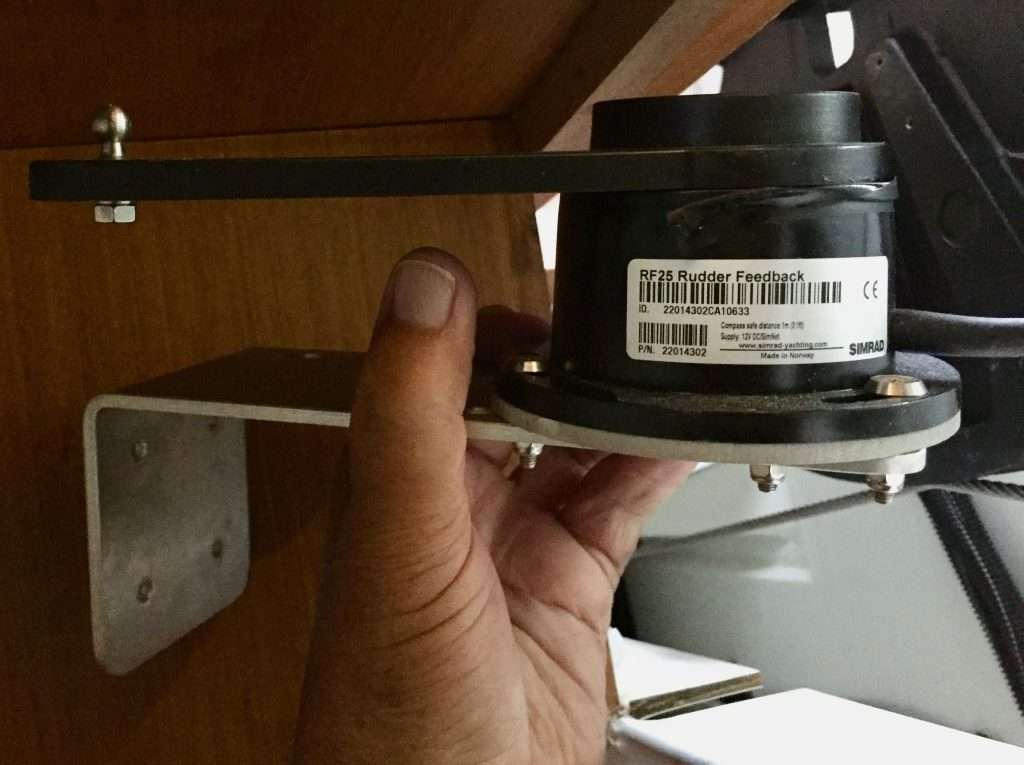
The problem Rudder Feedback unit.
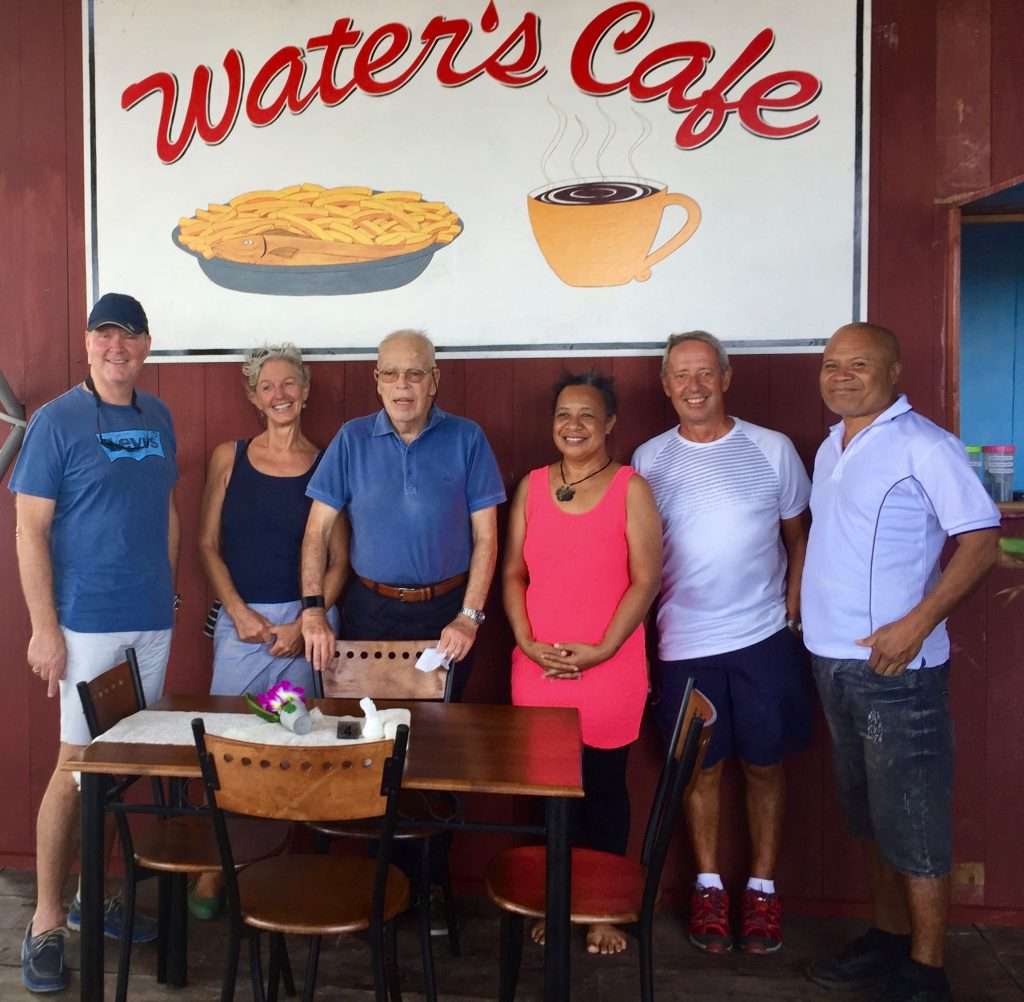
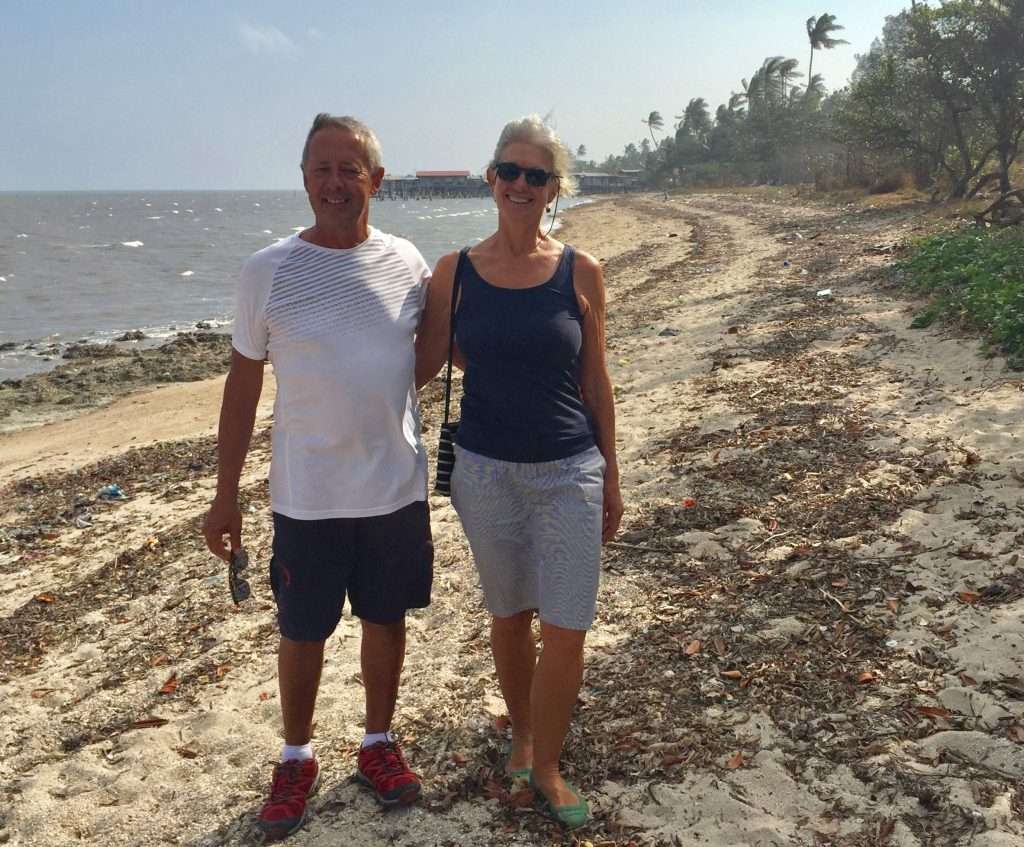
Brian had invited us to lunch on Sunday at a nearby village, so we set off with him and Peter Goodwin (past commodore of RPYC) to a quaint restaurant on the coast where Bill and Ranu Seneka run their Water’s Cafe. Ranu means water and the cafe is on the beach. We enjoyed a fantastic meal of prawns, salad and chips.
Peter, Annie, Brian, Ranu Dirk & Bill.
The beach outside Water’s Cafe on a windy day.
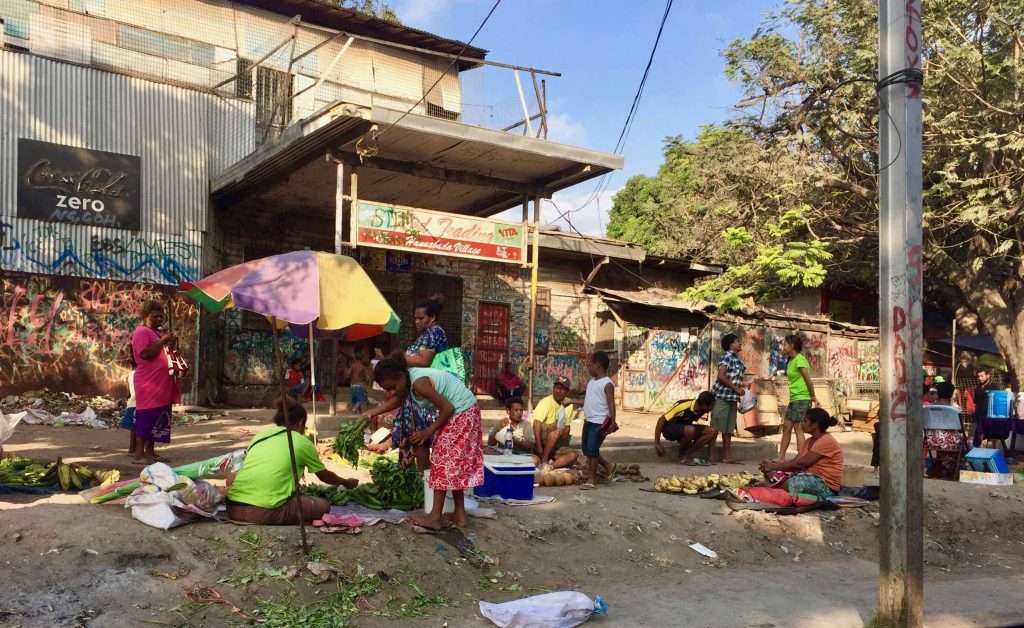
Brian drove us back to Port Moresby through some of the villages, very few of the expats ever visit. Third world, with graffiti and rubbish – far removed from RPYC.
Local village scene.
On the Monday Brian’s driver took us to Lohberger Engineering and Steel Industries, where we bought stainless steel threaded rod, tube, lock washers and nuts to reinforce the anchor and mooring bow rollers. The installation took us the better part of a day, but the anchor roller fixings are now secure.
The next good weather window will come around on Saturday the 24th June. So Andy from Customs will check us out on Friday arvo, we will settle our account with the club and set sail early on Saturday. We will cross the Gulf of Papua, before chucking a left at Bramble Cay to follow the Great North Eastern Passage to Thursday Island for re-entry into Australia. Then, westwards to Darwin.
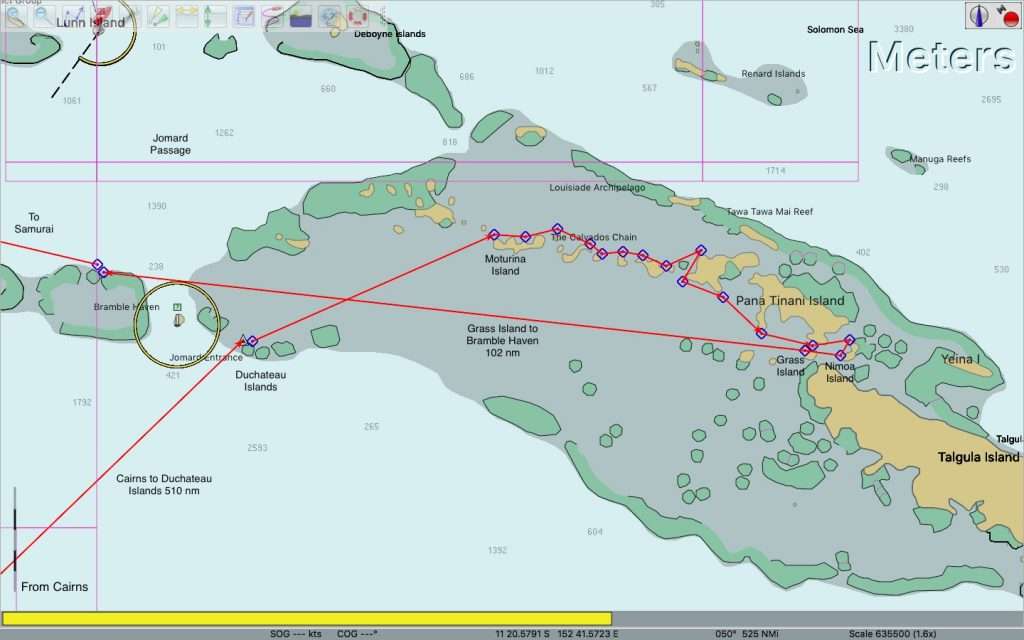
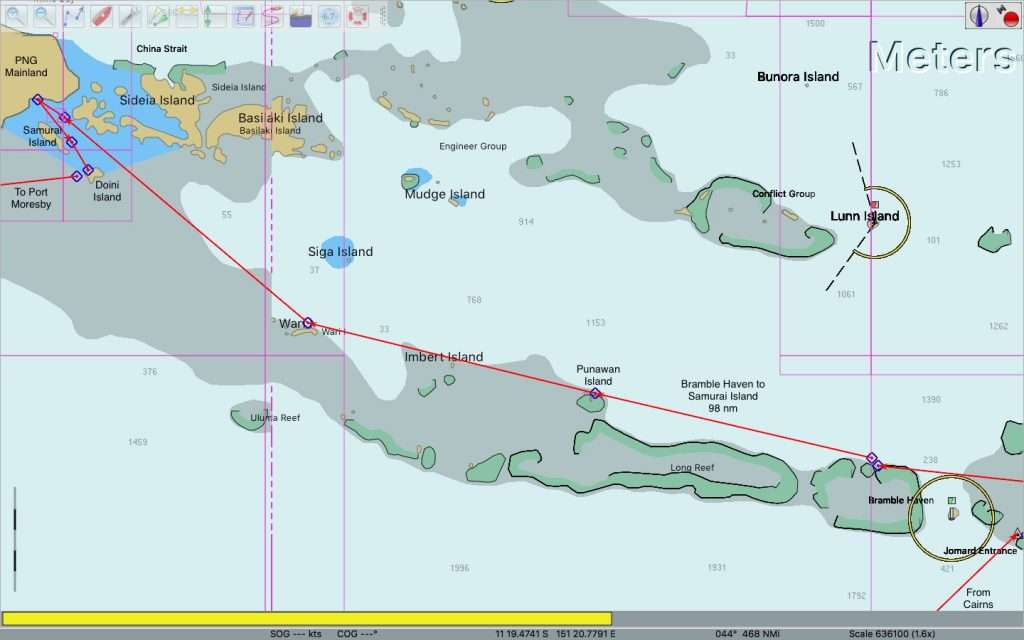
Some friends asked where these places and islands are, so I attach a few screenshots of the Open CPN charts on my MacBook. These charts are not as detailed as the Navionics charts on Esprit’s chart plotter, so we only use them for route planning. Here they are:
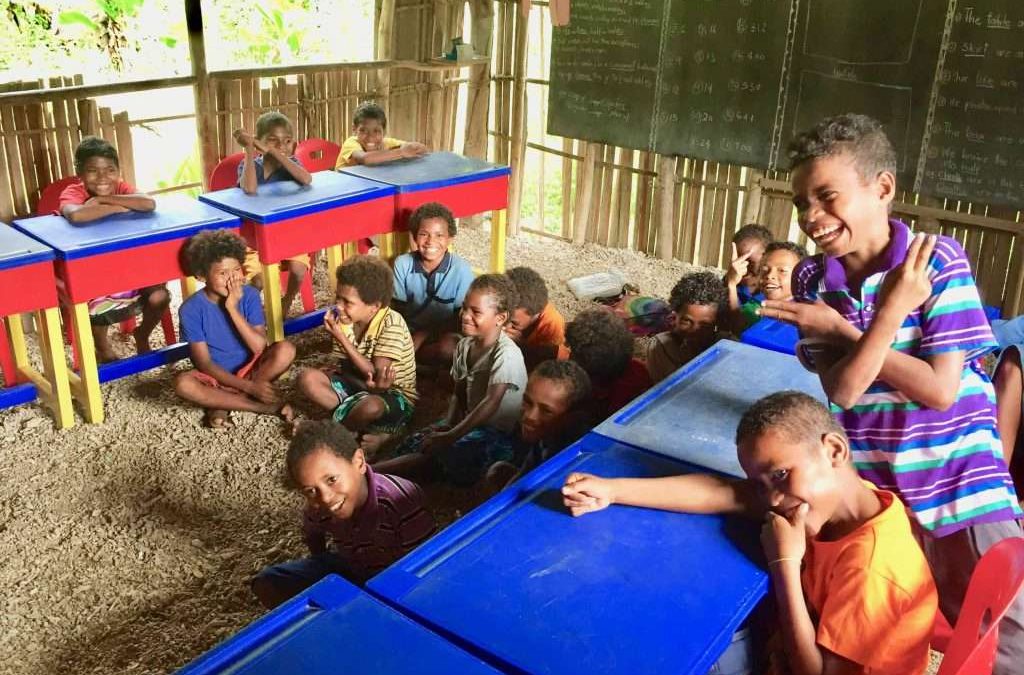
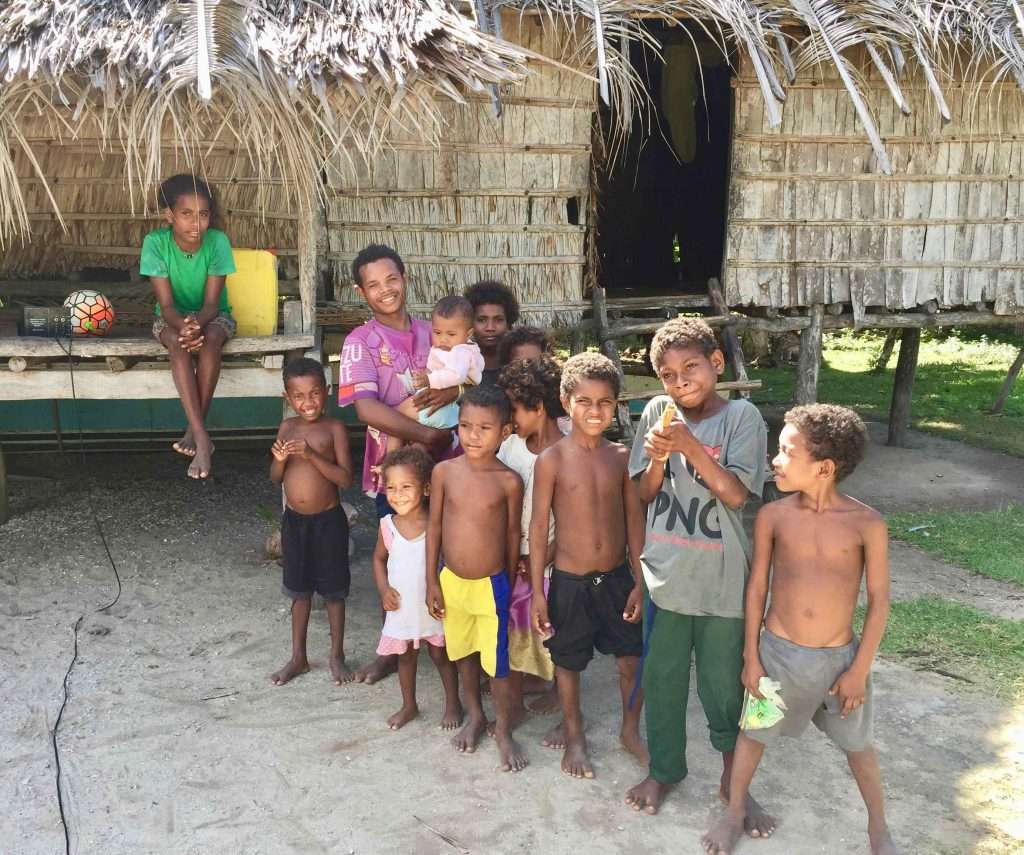
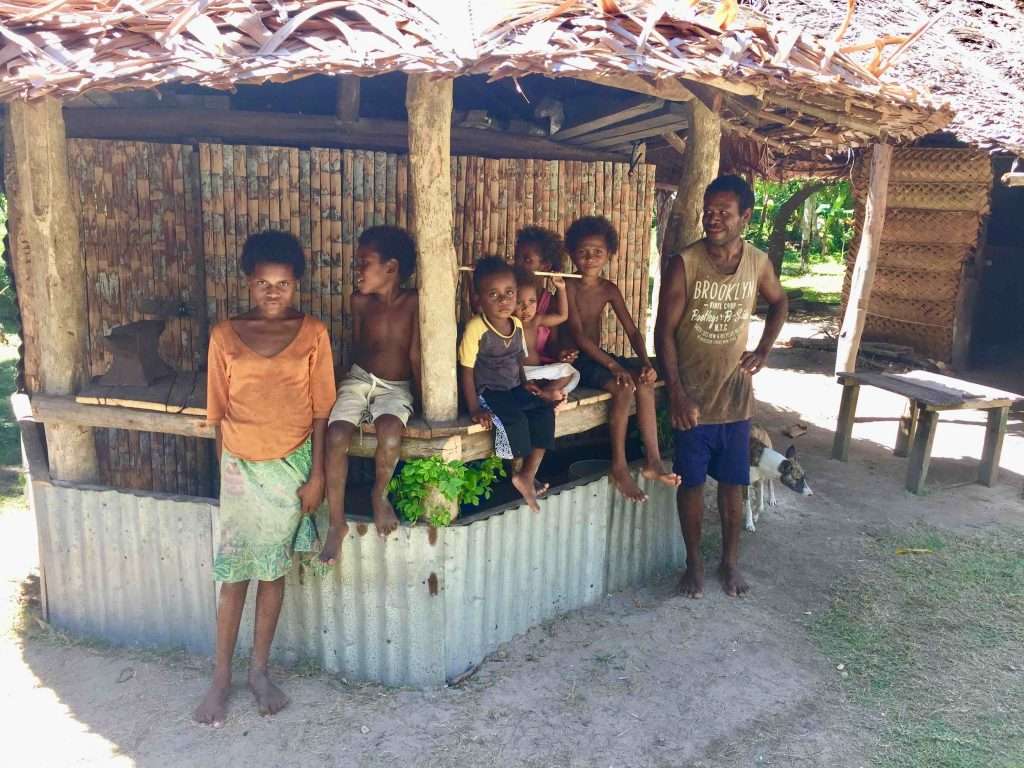
The people of these islands are the friendliest people we have come across thus far. Although poor and with very basic living conditions, they are positive and accepting of their circumstances. We often hear the term “living a minimalist lifestyle” in the city – compared to what – a materialistic, wasteful lifestyle? Man oh man, you haven’t seen a minimalist lifestyle, until you have seen this island lifestyle. The islanders have the benefit of the ubiquitous betel nut which most adults chew as a relaxant, mixed with mustard leaves and lime, resulting in their alarming red smiles and teeth – the Zoloft of the third world.
Moturina primary school kids – nice classroom floor!
Moturina primary school kids not at school – their teacher decided to take the week off!
Joseph, pastor of the Christian Outreach Church, with coral trout to trade.
During our stay in Moturina we anchored in the lee of Ninan island, about two miles offshore. This quiet uninhabited island didn’t deter the kids from the main island, rowing their canoes over to trade fruit and vegetables for school books, pens and pencils. Amongst the teenagers, the girls always wanted tampons, while the boys were asking for condoms.
Lads on a traditional sailing canoe, setting sail
Once they got going, Esprit was hard pressed to keep up with them!
We sailed from Ninan island in a fresh S-E of about 18knots, tacking a few times while passing Bagaman island and a few more in the Calvados chain, before anchoring in a beautiful bay at Pana Numara. The next day, Hans wanted a rest, so we motored over to a neighbouring island famous for its blue lagoon and to do some snorkelling.
Pana Numara Bay – good snorkelling.
Neighbouring Blue Lagoon island.
The school guest house at Pana Numara.
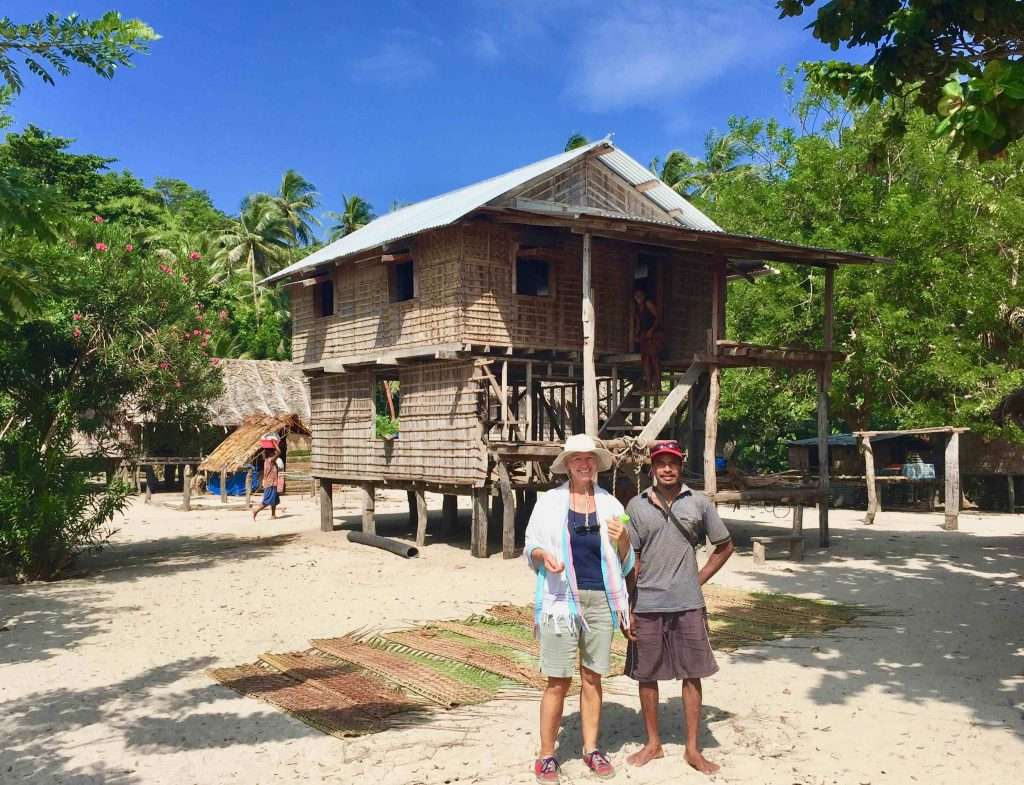
Double storey house a la Madison Way.
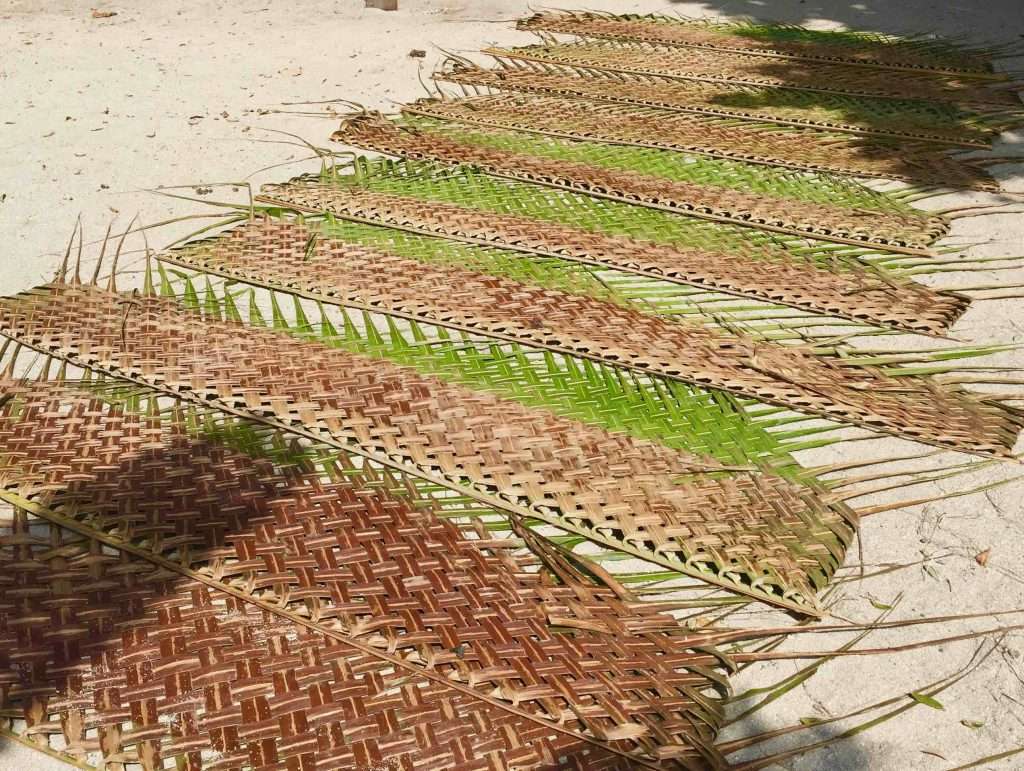
Palm leaves woven and dried, to be used as wall cladding or partitioning.
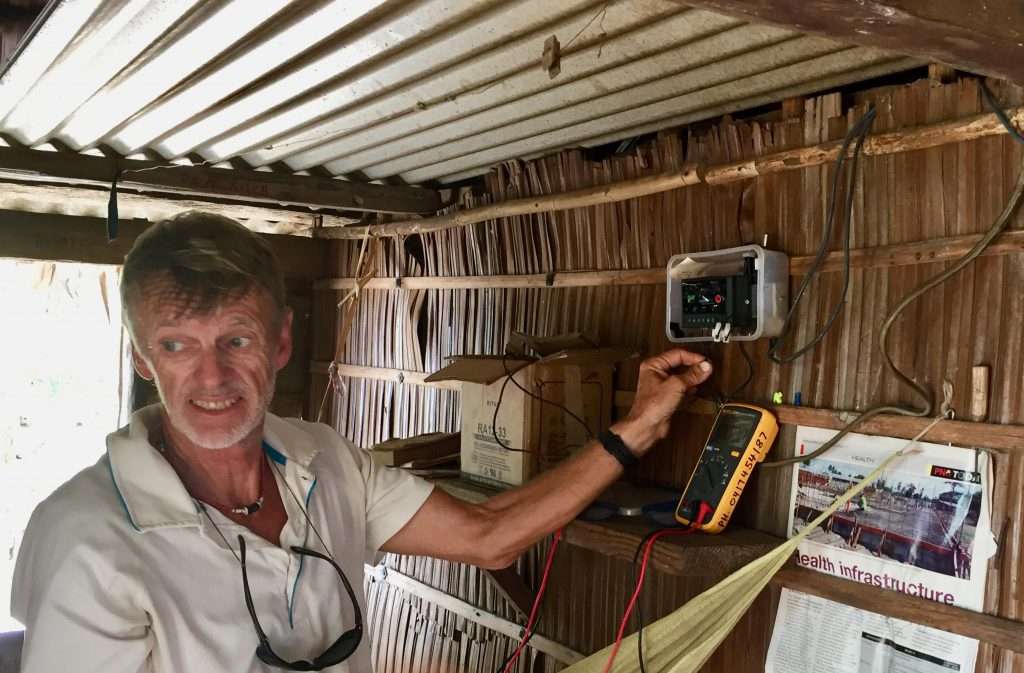
The three previous solar installations that Hans had done the previous three years, were all playing up due to user interference. However, life had come to a standstill as there was a big political rally taking place under a big tree in the village centre, where a parliamentary candidate, Henry Larry was holding forth on a megaphone. Hans would later negotiate with Bernard, the village chief on what had to be done to effect repairs and prevent future problems.
Hans: “Who buggerup dis ting?”
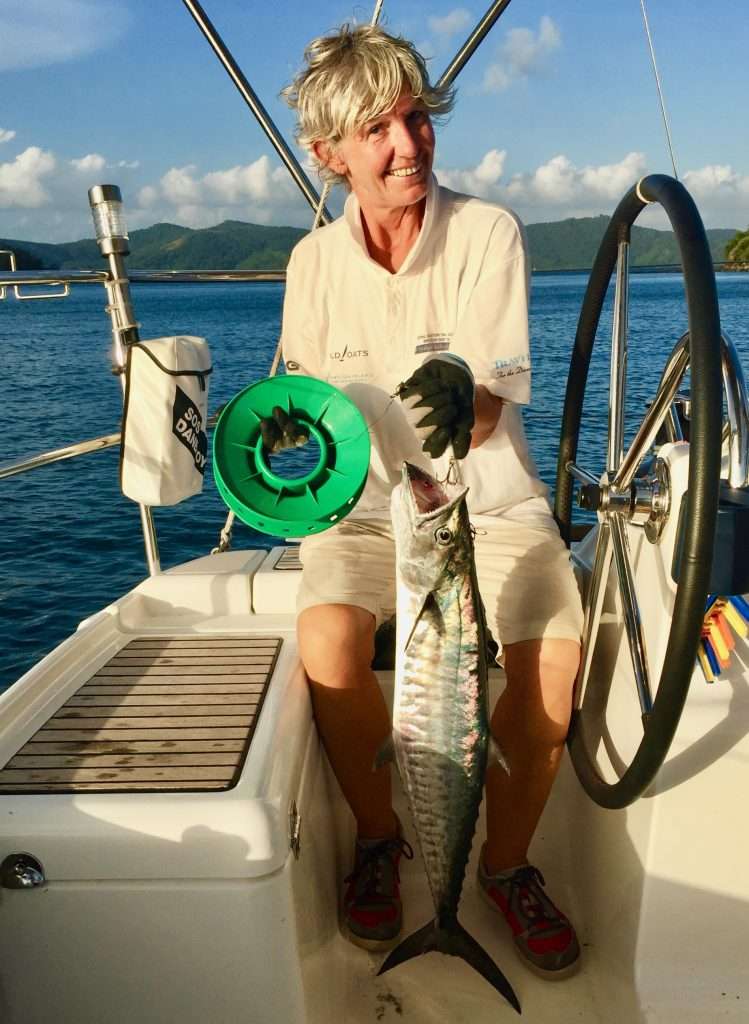
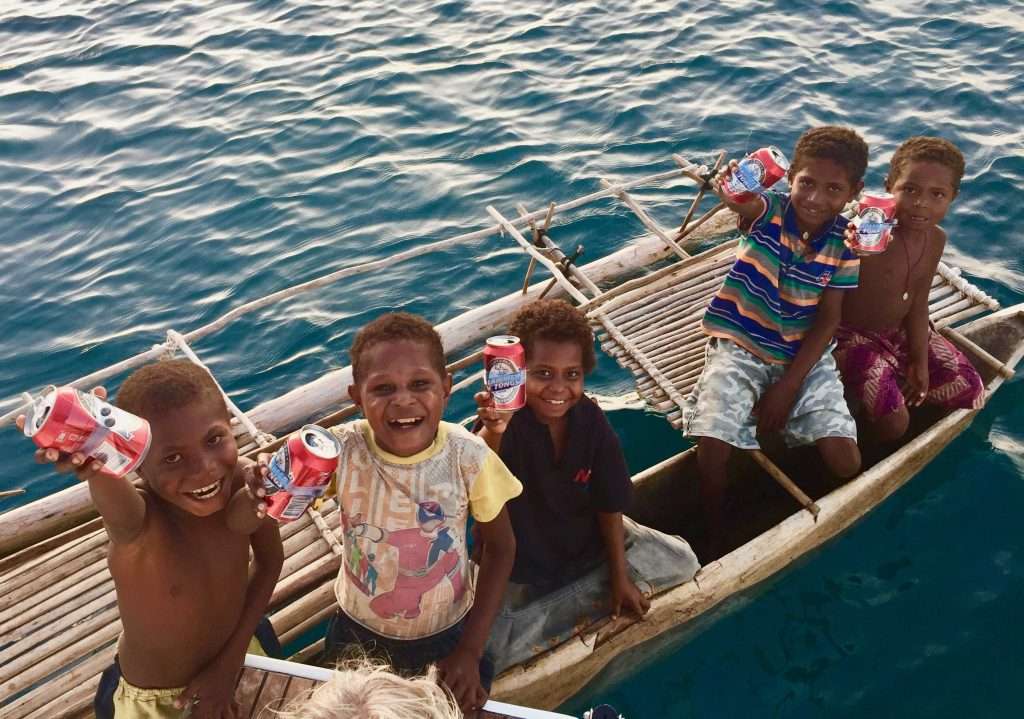
We were running low on water as our water maker was playing up, so we opted to sail West to Nimoa island, one of the few islands with water. We made it as far as Wanim island, also known as Grass island, where we anchored for the night after catching a Spanish Mackerel. Annie was delighted, as she has been hunting one for months. We traded some paw-paws and lemons for fishing line. Annie used our empty beer cans and rolled off 20m of fishing line on each, fitted it with a sinker and a hook, making dozens of these kits for kids.
You beaut! – at last.
Five happy boys with our empty beer cans, 20m of fishing line, sinker and a hook.
The following day was an easy sail to Nimoa island, where we anchored off Coleman and Juliana’s house to drop off four solar panels for later installation. In return we were able to collect 100l of fresh water from their spring.
Coleman with his and his sister’s kids at his workbench next to his ‘shed”
The pretty split level house that Coleman built – he should have been an architect.
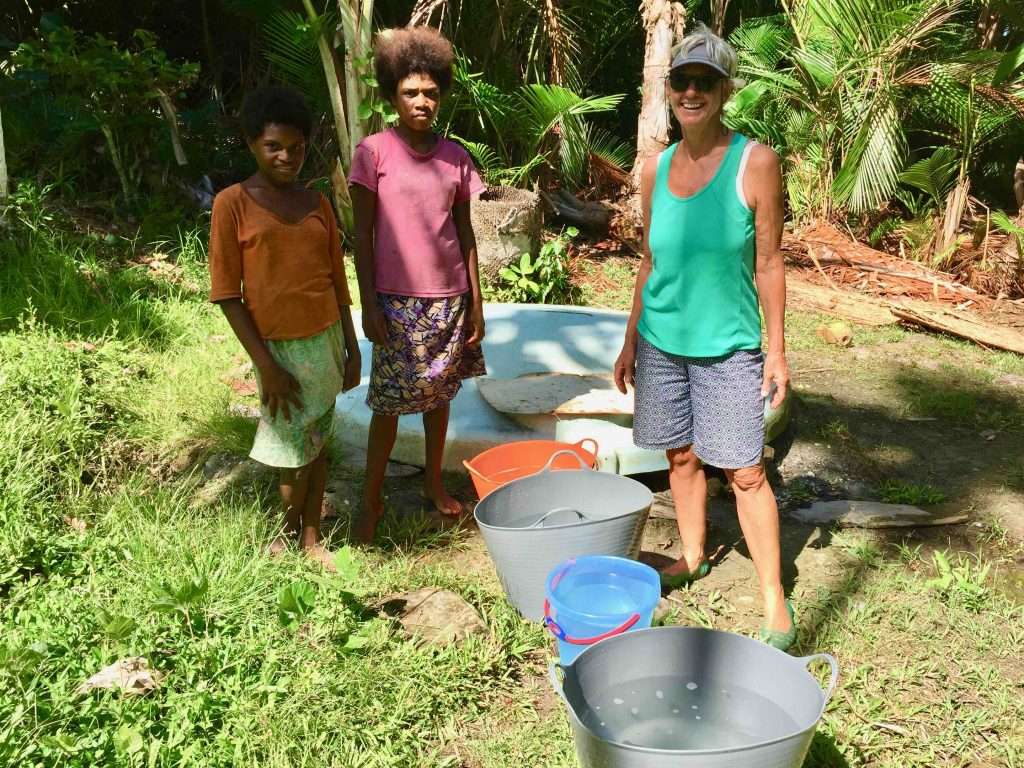
Fetching water from Coleman’s spring.
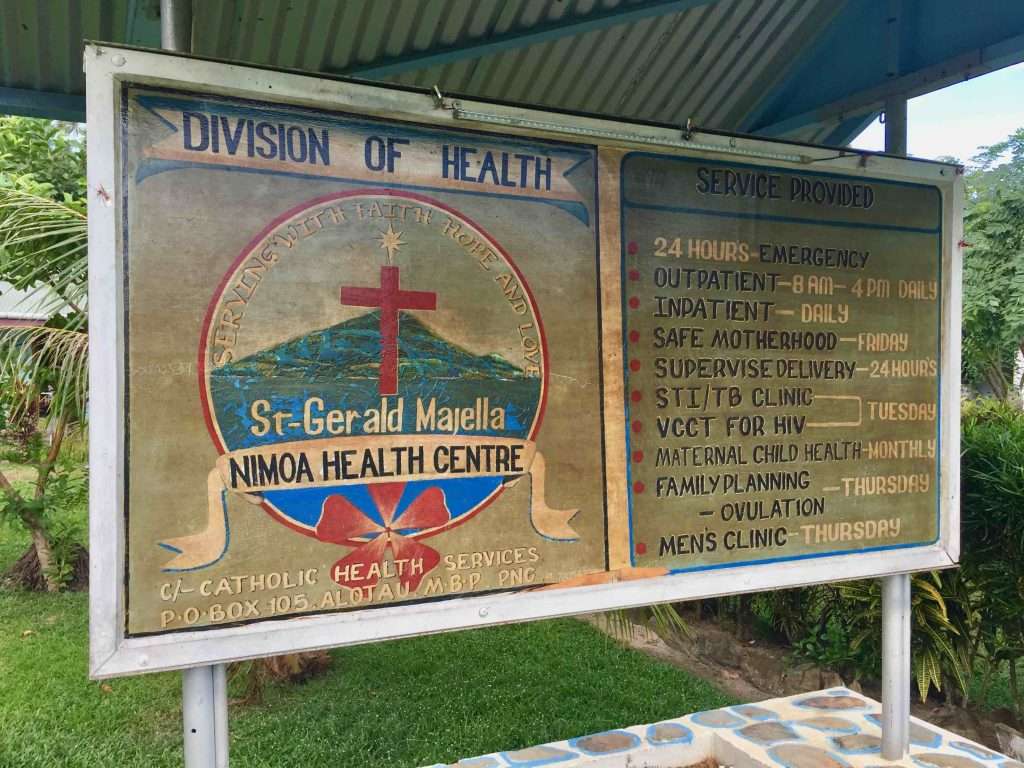
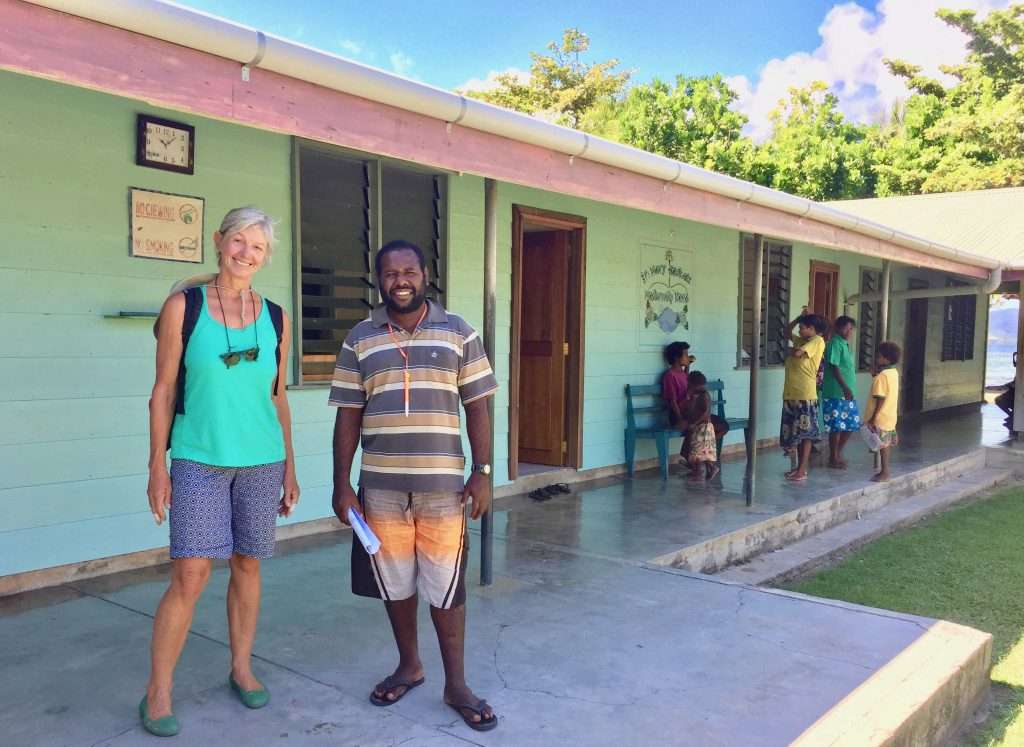
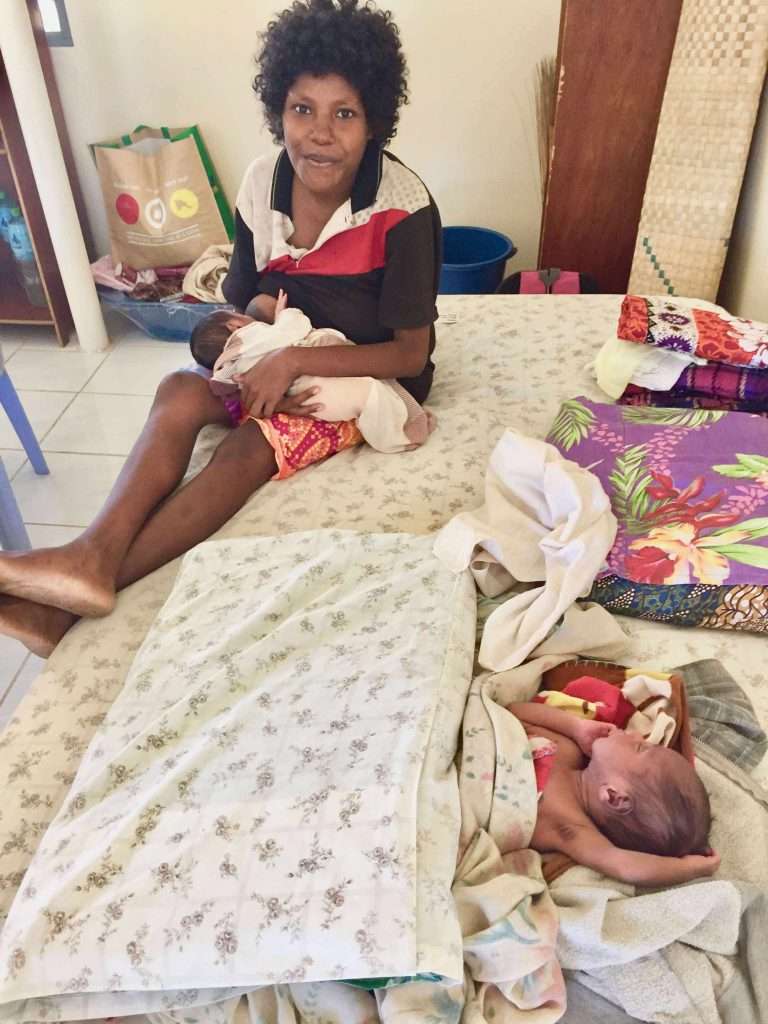
Then a short trip to the South of the island where the hospital and Hope Academy high school are located. We brought a lot of baby clothes and nappies for donation to the hospital which the manager, Pius Wiseman gratefully accepted. He has done an amazing job of rebuilding the hospital after the 2014 cyclone. They handled more than 200 births in 2016 without a single fatality.
Health Centre services and hours.
Annie and Pius Wiseman.
Young lady with her twins.
We also met Barry Kirby, an Australian flying doctor who is quite an inspiration. He came to PNG as a carpenter years ago, but his wife did not settle down and left him. With no kids and having fallen in love with the islands and their people, he went back to Oz to finish high school and study medicine at age 40 and get a pilot’s licence. He qualified at age 52 and came back to serve the people of PNG. See: http://www.sbs.com.au/news/article/2015/05/06/builder-obstetrician-giving-life-mothers-png
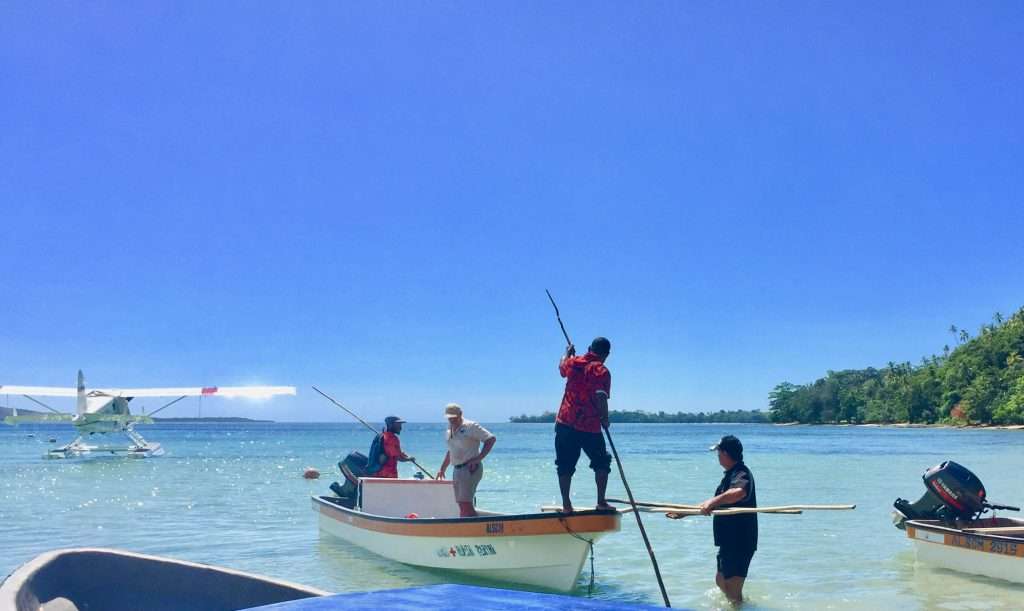
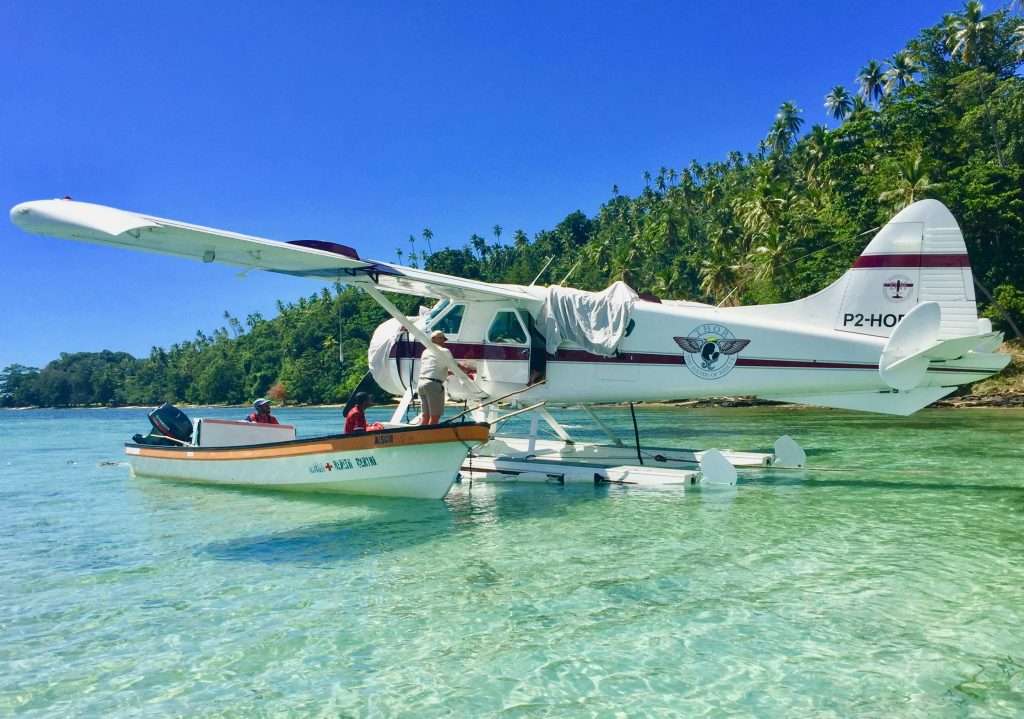
Barry Kirby in the dinghy and Peter Neville ashore, getting fuel out to his plane.
Barry filling his fuel tanks for another mercy flight to Alotau hospital.
His friend, Peter Neville a PNG born, Australian educated businessman was also on the island to fix the broken down generator in the village and campaign for the upcoming parliamentary elections in July. He is one of the two white candidates in the election. A big, jovial character, we had him over for dinner on Friday night while Dr Barry as the locals call him, did an emergency flight to Alotau to operate on a lady who was haemorrhaging badly after a delivery. Mission accomplished, he flew back to Nimoa the next morning.
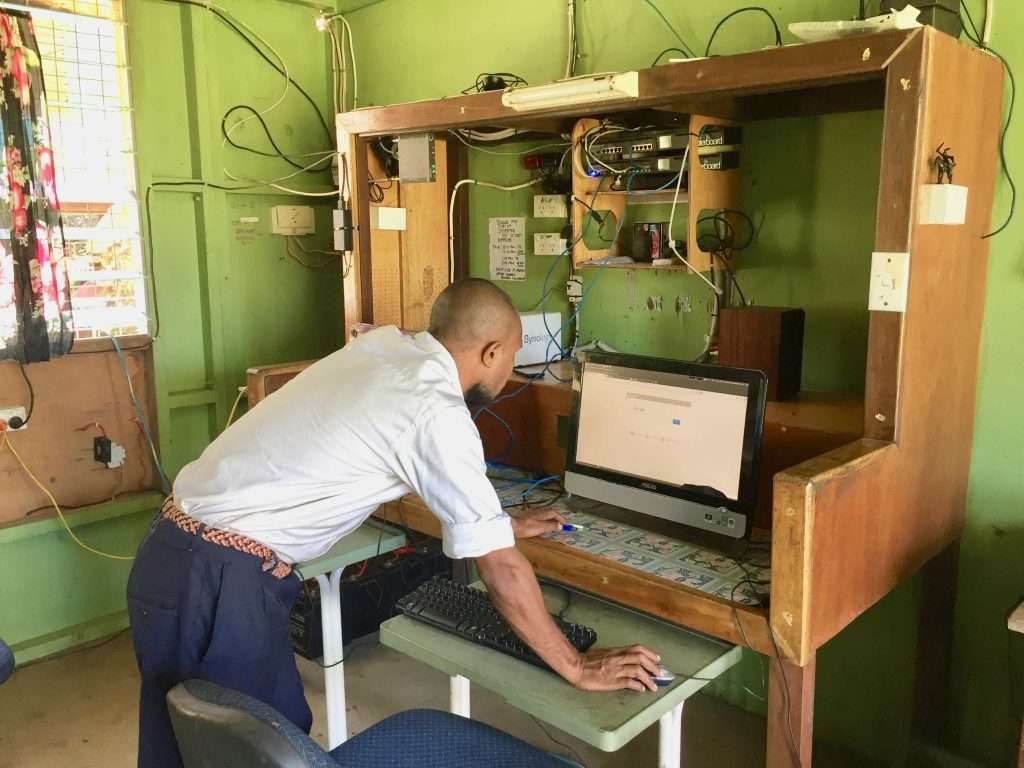
Noel, the headmaster, sets up one of their ancient desktops in their “computer room” for me to work on.
A further complication arose: Our satellite phone decided to go into a loop while searching for satellites, finding them (there are 66 in the Iridium constellation) and then, not connect to them. So, no Emails or SMS’s. This posed a problem, as we had to contact the suppliers of our water maker in Oz to get guidance on getting the unit going again. Fortunately, the Hope Academy has a satellite dish with intranet for their school. Noel, the headmaster and Mary-Ellen his deputy, were taken by our donations to the hospital and offered access to one of their computers to use Gmail. We fired off Emails to H2Go and Iridium who responded by the next morning, with further questions. We replied to these by Friday lunchtime, but then had to call it a day as the school was closing for the weekend. They offered us another 100l of fresh water which we gladly accepted.
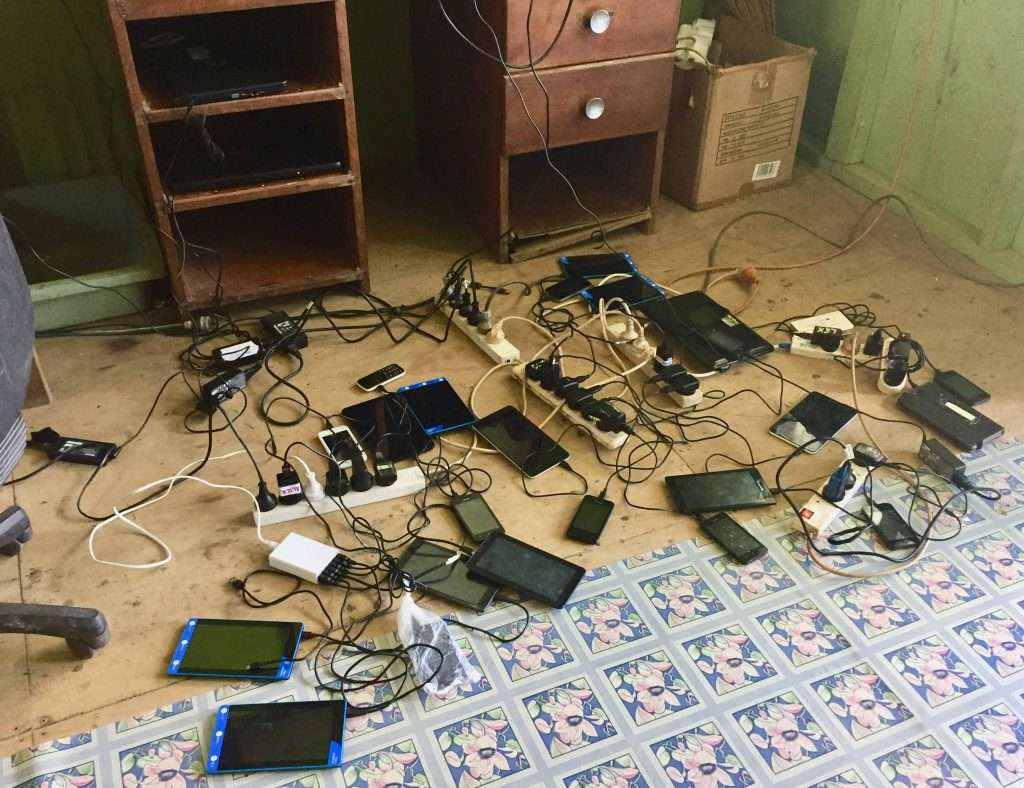
A sign of the times – student’s tablets and mobiles charging in the computer room.
On Saturday morning we motored back to Coleman’s abode and arrived with gifts, to secure another 100l of water from his spring. He also gave us water to do our washing which had piled up. Having shown us through his well-built compound, he visited us by canoe in the afternoon to inspect our floating house and chew the fat. Back at the school on Monday morning, their server had carked it, so we decided to sail back in a 15knot following wind to Gigila island to assist Hans. He had finished on Gigila, so after spending the night in the lee of the island, we sailed to Pana Wina island where we found him installing solar in a very poor community.
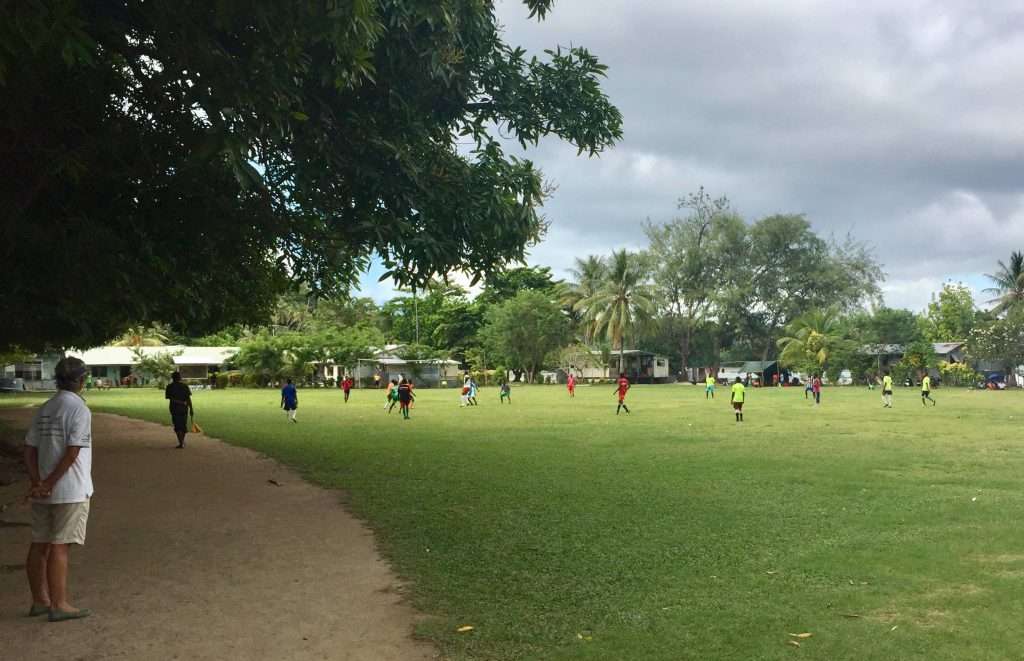
Saturday morning soccer on Nimoa.
Because of the muddy bay and mangroves, mud crabs flourish here and we were able to trade two huge mud crabs for clothes – most of the kids were naked. Hans showed us how to wrangle these aggressive crabs into a pot of boiling water and after cooking, how to crack open their huge claws and bodies for their amazingly tasty meat – much better than the crayfish, or lobster, of which we were getting a bit tired by now.
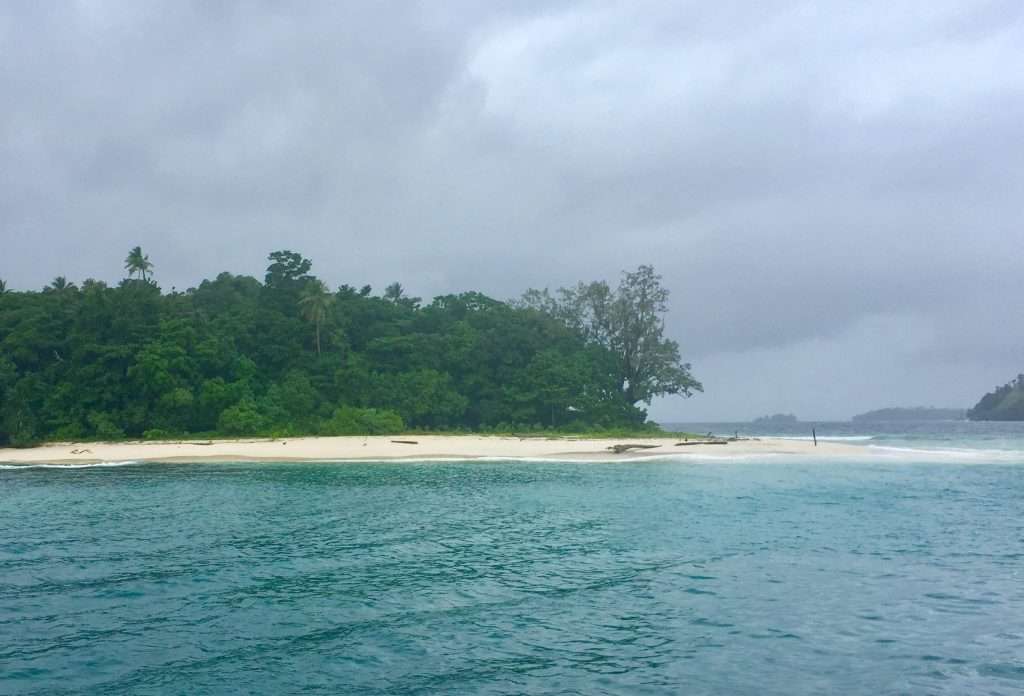
Predictwind offshore indicated a good weather window of moderate S-E winds to sail the nearly 200nm West, back to the mainland. In order to get back to a place where we could get the desalinator fixed, we transferred the balance of the solar gear and hospital/clinic donations to Seagoon and bid Hans farewell when we set sail at 7am the next morning. We enjoyed a broad reach and sometimes, a poled out run in 15 – 20 knots of wind and anchored in the lee of Punawan island in the Bramble Haven lagoon at about 5pm. More trading!
A beautiful downwind sail to the PNG mainland over 3 days.
The following day we covered a similar distance to Wari island, poled out in 14-18 knots where we anchored at 4:30pm for a rolly night in the lee. The third day saw us reach Samarai island in the China Strait, off the mainland at about lunchtime. After 6 attempts, we finally anchored in the strong current running through the China Strait, launched the dinghy and went ashore to check in with Customs. Felix Dosi the Customs officer, was however in Alotau for the week, so his wife said we may as well check in and out at Port Moresby, our next port of call on the mainland. All very relaxed!
Neville, the well-spoken school principal, took us under his wing and motored with us across the strait to his school, where their rainwater tanks were full. He quickly rounded up 8 students to fetch and fill our water containers with about 100l of water. He would accept nothing in return, but was happy for us to give the students packets of biscuits. We set off ironically, in a heavy downpour and strong headwinds, motoring as far as small Deka Deka island, to anchor in the lee for a rolly night.
Anchored behind minute Deka Deka island.
Overnight, the wind increased to 20 knots so we decided to take shelter behind the much bigger Doini island. Our recently met friend, Peter Neville built a resort on this island and insisted we should not pass it by. We are now sitting out a weeklong S-E buster in the lee of this lovely island, before we sail to Port Moresby. More about this in our next post.